God’s Order for Living Beings, Human Beings and His Grand Design

“Then God said, ‘Let the earth bring forth living creatures after their kind….'”


I am starting a new Bible reading plan for the year, beginning in the beginning: in Genesis. Reading through the rich text of Genesis again I am seeing some things I hadn’t noticed before. Consider the following (with my emphasis added):

“Then God said, ‘Let the earth sprout vegetation, plants yielding seed, and fruit trees on the earth bearing fruit after their kind with seed in them‘; and it was so. The earth brought forth vegetation, plants yielding seed after their kind, and trees bearing fruit with seed in them, after their kind; and God saw that it was good.

Genesis 1:11-12

“God created the great sea monsters and every living creature that moves, with which the waters swarmed after their kind, and every winged bird after its kind; and God saw that it was good. And God blessed them, saying, “Be fruitful and multiply and fill the waters in the seas, and let birds multiply on the earth.’

Genesis 1:21-22

“Then God said, ‘Let the earth bring forth living creatures after their kind: cattle and creeping things and beasts of the earth after their kind‘; and it was so. God made the beasts of the earth after their kind, and the cattle after their kind, and everything that creeps on the ground after its kind; and God saw that it was good.”

Genesis 1:24-25

Then God said, ‘Let us make man in our image, after our likeness. And let them have dominion over the fish of the sea and over the birds of the heavens and over the livestock and over all the earth and over every creeping thing that creeps on the earth.’ So God created man in his own image, in the image of God he created him; male and female he created them. And God blessed them. And God said to them, ‘Be fruitful and multiply and fill the earth and subdue it….'”

I color-coded the various provisions that form the pattern that informs my thinking today. The provisions in each color correspond with the other provisions of the same color.

Now, let me see if I can put all my thoughts together in a coherent whole.

First of all, God ordered (in the sense of designed) all living beings to multiply after they own kind. We see this everywhere in nature: apple trees produce seeds that grow into new apple trees; asparagus plants produce seeds that grow into new asparagus plants; lions beget lions; polar bears beget polar bears; yellow polka dotted salamanders beget yellow polka dotted salamanders; bluefin tuna beget bluefin tuna; and purple finches beget purple finches.

This is the order of living things. Not only that, but we now know that something (call it evolution or something else) works powerfully within living beings to reproduce and even to adapt with changes over time.

Every living thing bears seed or otherwise reproduces more of its kind. Human beings included, but only humans are made in the image of God. (Hold that thought.)

God “blessed” the living things He created, saying, “Be fruitful and multiply” and fill the earth. (Gen. 1:22) He also blessed man who God made in His own image, and gave similar blessing/order: “Be fruitful and multiply and fill the earth and subdue it….” (Gen. 1:28)

Note that God “ordered” (as in designed) the living things He created to reproduce after their kinds and to be fruitful and multiply, but God ordered – as in not only designed, but commanded – man to do the same. The difference is an important key to understanding what God is doing.

Unlike the other living creatures that are designed to reproduce and multiply after their kinds, humans have some agency in the matter. God designed them for the same purpose, but He also commanded them to do it – and gave them agency in doing it – because humans are created in the image of God who has agency – the ability to exercise will and to do (or not do) things.

Humans, of course, had no choice in their creation, but they do have choice in whether to “participate in God’s design” and how they would participate in God’s design. This choice was demonstrated in the one tree in the garden that was forbidden to them.

It was a real choice, and it had real consequences. It had to have real consequences or it wouldn’t have been a real choice. That choice was part of what it meant to be made in the image of God. Without the ability to choose, humans would have been just like the other living things God created. The ability to choose set humans apart.


As the story goes, humans ate the fruit of the one tree that was forbidden.

They exercised the choice God gave them. In eating the fruit of the tree of the knowledge of good and evil, humans opened up their world to all the ways they might choose to go against the order of creation.


Throughout Genesis 1, we read over and over again that what God did “was good” (Gen. 1:4, 10, 12, 18, 21, 25, 31). If what God designed was good, choosing to operate counter to that design would be evil (the opposite of good).

None of this is very revelatory so far, but I am getting there.

Genesis 1 reminds me of 1 Corinthians 15 where Paul says:

God gives [all living things] a body as he has chosen, and to each kind of seed its own body. For not all flesh is the same, but there is one kind for humans, another for animals, another for birds, and another for fish.

1 Corinthians 15:38-39

The order/design of life – of reality – is immutable. Life is ordered the way God created it, though humans have some choice (within limits) of whether to align with God’s design or to buck against it. Indeed, the story of the fall is the story of humans exercising that choice, God built into His design an adaptation (if you will) to accomplish His ultimate plan.

Continue reading “God’s Order for Living Beings, Human Beings and His Grand Design”

Ten Reflections on 2020 and Three Things to do in 2021

If God isn’t our first love, we are putting other things first.

The writer of Ecclesiastes asserted boldly many thousands of years ago that “there is nothing new under the sun”. The ancient date of that statement has always been a poignant reminder to me that we aren’t as wise as we think we are for all our modern sensibilities. We struggle with the same basic issues that are common to humanity, despite our scientific and technological advances.

God stands enthroned over all of His creation. From His vantage point outside of space/time, He watches as His purposes unfold, including the groaning of creation as some of His crowning creation “seek Him, feel their way toward Him and find him”. (Acts 17:27)

We fit into His purposes by doing just that – to know God and to grow in the knowledge of God is the ultimate fulfillment of God’s purpose for us.

We easily get mired in the mundane concerns of daily life. Our future planning is often limited to the benefits we can obtain in our years in these jars of clay we call our bodies. We often fail to give full room for the eternity God set in our hearts. (Ecc. 3:11) We fail to allow the Holy spirit to have full sway in our hearts and our lives.

We are easily distracted and easily preoccupied by lesser things than our relationship with God the Father and His purposes.

I am forever grateful for the grace He has shown to us in the sacrifice He made for us that He has made a way for us to come to Him despite our frailties and sinful tendencies, and to continue coming to Him who receives us in Christ. I am more indebted to His mercy and grace now than ever before. His lovingkindness is truly new every morning.

As we watch the time closing out on 2020, looking backward, and straining forward, I am borrowing from another writer for my own ten reflections on 2020:

Continue reading “Ten Reflections on 2020 and Three Things to do in 2021”

There Is Now No Condemnation, but Go and Sin No More.

When Jesus said, “Neither do I condemn you,” it isn’t the end of the story.

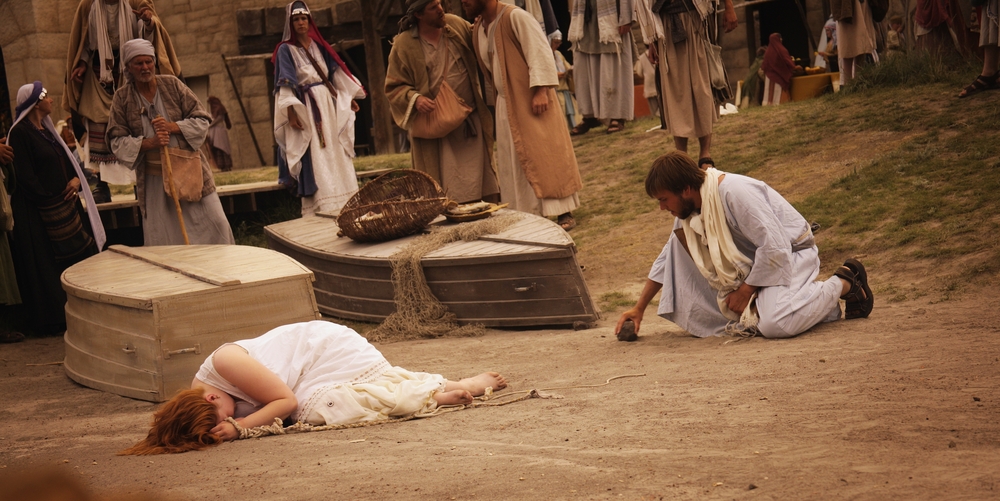
I have been thinking lately about the phrase, “Do not go on sinning.” These were the words Jesus spoke to the woman caught in adultery after he rescued her from her accusers. We forget about them, perhaps, because of the force of the rest of the story.

The Pharisees brought her to Jesus one day and challenged him: “’Teacher,’ they said to Jesus [with a hint of affected deference, I imagine], ‘this woman was caught in the act of adultery. The law of Moses says to stone her. What do you say?’”

They were trying to trap Jesus into saying something they could use against him, but Jesus was not shaken or disturbed by the dilemma they posed him. He stooped to write in the dust with his finger.

The awkward silence was broken finally by a demand for an answer. Jesus obliged,

“Alright, but let the one who has never sinned throw the first stone!”

John 8:7

Significantly, Jesus didn’t deny what the Law says. His answer implied agreement with the judgment of the Law, but his answer turned the table on the accusers and focused attention on them.

His answer is reminiscent of apportion of the prayer that Jesus taught his followers to pray and of a segment of the Sermon on the Mount:

“And forgive us as we forgive those who trespass against us.”

Matt. 6:12

“[I]n the same way you judge others, you will be judged….”

Matt. 7:2

The pregnant silence continued again, as Jesus returned to writing in the dust with this finger. This time, the demands for an answer slipped away with the accusers, one by one, leaving alone with the accused woman.

The focus of the encounter had shifted dramatically from the adulterous woman to her accusers. Their self-righteous smugness turned to bitter disappointment and shame as Jesus put them in their place.

Now alone with the woman, Jesus asked her, “Where are your accusers? Didn’t even one of them condemn you?”; “No, Lord,” she replied. “Then, “Neither do I,” Jesus said.

This seems to be the perfect way for Jesus to end the story. The accusers of the adulterous woman were sinners too. When Jesus said, “Let the one who is without sin cast the first stone”, none of them could do it. They knew they would be condemning themselves. What Jesus wrote in the sand must have hit home with them.

The story would be perfect if it ended there, right? Jesus, the Lord and Savior of the world, says he doesn’t condemn the adulteress woman either!

But that isn’t the end of the story. The story ends with Jesus adding, “Go and sin no more.” (John 8:11)

Those words hang there now for me, as I imagine they did for the woman.

What wisdom and command of the situation Jesus had shown! The pompous self-righteousness of the religious leaders who used this poor woman as a ploy to back Jesus into a corner was deflated. The public humiliation and shame she must have felt was heaped back on her accusers in divine vindication. The gentleness with which he treated her and affirmed her value is beautiful.

But, when the men had left, and she was alone with Jesus, he left her with the instruction, “Go and sin no more.”

Jesus didn’t condemn her, but Jesus didn’t release her to go back to the lifestyle and choices she had made to that point. Why not?

The words, “go and sin no more”, haunt me as I think about myself and how easily I fall into sinful attitudes and stumble. It would so much easier if Jesus hadn’t tagged those five words on to the end of this story!

Continue reading “There Is Now No Condemnation, but Go and Sin No More.”

Jesus Wept with Mary, Though He Knew the Joy to Come

We live in a world in which Jesus wept at the tomb of Lazarus, knowing that he was going to raise him from the dead.


NT Wright commented to Justin Brierley in the 39th episode of Ask NT Wright Anything, “We live in a world in which Jesus wept at the tomb of Lazarus, knowing that he was going to raise him from the dead.”

Jesus was able to identify with and feel the crushing sorrow and the intense grief that the family and friends of Lazarus felt. When Jesus saw Mary, the sister of Lazarus weeping, he wept too. (John 11:32-33) Jesus felt her grief, and it moved him to tears.

Jesus weeping at the tomb of his friend, Lazarus, of course, reveals his humanity, his empathy and the fact that he felt the range of human emotions that we feel in our own lives. Imagine God taking on our form and experiencing what we experience!

The most remarkable aspect of this story, for me, is that Jesus felt the grief of the loss of a loved one and was moved to tears even though he knew he was going to raise him from the dead. He wept with grief though he know that joy would follow the raising of Lazarus from the dead.

In this way, we see that God doesn’t minimize our grief and suffering. He is able to identify with it because he felt the crush of it as we feel it.

He felt the crush of human grief even though he knew the miracle he was about to perform.

Perhaps, Jesus was weeping for all the people who feel grief without assurance or confidence or hope. Surely, Jesus had more than merely hope. He knew that he was about to raise Lazarus from the dead, but he also realized that his friends, the friends and family of Lazarus, didn’t know or appreciate what he was about to do.

Even though Jesus told the friends of Lazarus that he was doing “to wake him up” (John 11:11), and he told Martha, “Your brother will rise again,” they didn’t fully understand or appreciate what Jesus was saying. (John 11:23) They didn’t feel the assurance or confidence or hope that Jesus had.

I imagine Jesus also thought in those moments of all the people in the world who mourn without assurance, confidence or hope in the face of death. This is the human condition, and Jesus fully embraced it. He fully felt the weight of it, and it caused him to weep with them.

Continue reading “Jesus Wept with Mary, Though He Knew the Joy to Come”

At the Curve of a Waterfall: Matter Flowing Through Us

Harrison Wright Falls at Ricketts Glen State Park by Chris A. Fraley

A person posed this question to N.T Wright: “If my body decays, and goes on to become reconstituted into plants and animals and things, what remains? What is essentially me?” NT Wright responded by noting, first, that Tertullian and Origen discussed this question in the 2nd and 3rd centuries, and CS Lewis picked up the same theme in the 20th century in his book, Miracles.

CS Lewis observed that fingernails, hair, skin and the entire the human body are in a constant condition of flux. “Bodies change their entire molecular kit once about every seven (7) years”, Wright noted.

I am not the same person physically that I was when I was born, or graduated from college at age 22, or graduated from law school at age 31 or when my last child was born when I was 39. I am not the same person, physically, at 60, as I was when I was 39.

All of the molecules in my body have switched out many times over those years, yet I am still recognizably me. Maybe a bit larger, with gray hair and visibly aged from my mid-twenties, but I am still me even though none of the same molecules exist in my 60-year body.

NT Wright re-phrased the question in different ways: If a ship goes into a port and one year later, after all parts of it have been replaced, it goes into port again, is it the same ship? If my grandfather has a spade, and replaces the blade and handle several times, is it the still the same spade?

I don’t know about a ship or a spade, but as for me, I know that I am still me even though I don’t have a single molecule left over from my 22-year old self. I have more experiences; I have gained more memories. People can see in my body and mind some resemblance of the “me” they might remember.

Though memories aren’t physical things I can show anyone, I can describe them, and people who share those experiences with me can recognize them. Those nonphysical memories are undeniably “part” of “me” – things I have picked up along the way in addition to the extra weight in my physical body.

CS Lewis says that people are like the curve in a waterfall. They have continuity of form but discontinuity of matter. Matter pours through us. The “us” matter pours through is the real thing – not the matter.

On this day six (6) years ago, Facebook informs me that I posted this quotation from CS Lewis:

“You don’t have a soul. You are a Soul. You have a body.”

I don’t know if CS Lewis is exactly right, but he is getting at the same idea – that we are something more than our physical selves. We aren’t reducible to our physical selves. Our physical selves aren’t even made up of the same molecules that once existed in us. Not one molecule remains from my 22-year old self – yet my self remains.

This mystery is extended in the death and resurrection of Jesus. Through Jesus, God promises to give us new bodies. Our bodies will be changed, Scripture says, but each one of us will remain the same person and be recognizable. Biblical scholars say we will be more fully us then we were before.

In a sense, it’ will be the opposite of the saying about a sick person who is “just a shadow of himself.” Except, the perspective will be reversed. We will see that our bodies were just a shadow of what we will become. Wright says there is a “real you” that is much more like you, vividly more like you, then you are now.

Getting around to attempt an answer to the question posed, NT Wright says, “Nowhere in the New Testament does it describe a soul leaving a body and going to heaven.” What does he mean?

Continue reading “At the Curve of a Waterfall: Matter Flowing Through Us”