Focus on Love to Remain on the Narrow Path

The narrow road is where the innocent and the wise travel in the maturity of love.


When the church reaches “unity in the faith and in the knowledge of the Son of God and become mature, attaining to the whole measure of the fullness of Christ…. [t[hen we will no longer be infants, tossed back and forth by the waves, and blown here and there….” Ephesians 4:13-14

This a verse that ended a sermon in a series on the love chapter – 1 Corinthians 13, given by Jeff Frazier at Chapelstreet Church, The Greatest of These, May 24, 2020.

The sermon began with the observation that 1 Corinthians 13 is not really the “ode to love” that we often think it is. The First Century Corinthians probably didn’t embroider 1 Corinthians 13 and hang it on their walls. Paul was chiding them for all the things they were not doing and doing wrong.

The Corinthians were a worldly, wealthy, educated and diverse people. If Corinth had magazines, they would have been candidate for the list of 10 best towns in which to live in the First Century Roman Empire. They were sophisticated in all the ways of the world.

But they fell short when it came to love.

Love, of course, is the greatest attribute of a Christian. That’s the point of 1 Corinthians 13. (1 Cor. 13:13) Though the Corinthians were rich in many things like eloquent speaking, even prophecies and faith, Paul says even those things mean nothing without love. (1 Cor. 13:1-2) A person could even give all his wealth away and offer his body to hardship, but without love, nothing is gained, says Paul. (1 Cor. 13:3)

The Corinthians thought they were pretty hot stuff. They had much in this world and much in the way of talents and resources, and because of that they were boastful and proud.

The beautiful list of what is love is a list of what the Corinthians lacked.

We could read it this way: the Corinthians are not patient or kind. They are envious, boastful and proud. They dishonor others and are self-seeking, easily angered and keep records of all the wrongs done to them. They delight in evil and do not rejoice in truth. They aren’t protective, trusting or hopeful, and they don’t persevere. (1 Corinthians 13:4-7)

The Corinthians were full of jealousy and pride about their own spirituality, and they didn’t appreciate each other. (1 Cor. 12:16 -22) They were puffed up with their own knowledge. (1 Cor. 8:1) They were given to argument, strife and disunity over which leaders to follow. (1 Cor. 1:10-12) At the same time, they tolerated sexual sin, greed, idolatry cheating, slander and drunkenness in their members. (1 Cor. 5:1-5, 9-11)

The Corinthian church was rich in the way of worldly wealth and talents. They were even full of the gifts of the Holy Spirit, but they were poor in the fruit of the Holy Spirit (love, joy, peace, forbearance, kindness, goodness, faithfulness, gentleness and self-control (Gal. 5:22-23)).

Paul goes on to say that love is the greatest fruit of the Holy Spirit. Love is the ultimate goal of the Christian, because God is love (1 John 1:9), and He desires us to be transformed into His image. (Rom 8:29) We don’t need wealth, resources, talents, knowledge or even the gifts of the Holy Spirit if we have love.

Love, including all the fruits of the Holy Spirit, is the sign of mature Christianity.

Jeff Frazier said that Paul could have written the love chapter to much of the American church, and I think he is right.

Continue reading “Focus on Love to Remain on the Narrow Path”

My Answers to Questions about Christianity

Good questions are maybe more important than answers


A recent blogger posted the following challenge: Questions about Christianity, do you have answers? I am not sure I have all the right answers, but I feel compelled to respond, nevertheless. Good questions are maybe more important than answers. This blogger asks some good ones, so I will attempt some answers.

Question 1: The Christian religion portends God knows past, present, and future, and only a select group of people will go to heaven. The rest, whom he gave their own ability to think for themselves are condemned to hell for eternity. If God allows people to be born he ultimately already knows [sic] will reject Christianity and are destined for hell [sic] would this not preclude God’s love and benevolence?

I don’t like the word, religion. Growing up Catholic, I never felt good about religion. I didn’t feel comfortable in church, and I recoiled from dogmatism. I became a believer in college after reckless alcohol and drug use, becoming a seeker and exploring philosophy, literature, poetry and world religions. I still don’t feel comfortable with religion.

Religion is what people do and how people appear on the outside. Reality is on the inside. God sees the reality of people’s hearts; we don’t.

Religion, I believe, is too much of a man made construct. Not that there is no truth in religion; it’s just that religion is an effort at boxing in metaphysical reality that more or less defies the effort. The box (religion) often isn’t as flexible and resilient as it needs to be.

I think that God knowing past, present and future (from our perspective) flows out of who/what God must be. This gets into cosmological and other “arguments”. Simply, if the universe had a beginning, it had a cause. They cause of the universe could not possibly be the universe. The cause had to be something other than the universe.

The universe that came into being at the point of singularity (the so-called Big Bang) includes all of space/time and matter as we know it. Thus, the cause must be something other than space/time and matter. This basically means a cause that exists “outside” of space/time matter.

At this point, we don’t have the right words or perspective to flesh it out much further. Our perspective is subject to space/time and matter, so we naturally struggle describing something beyond it. The best conception we have is that God knows the past, present and future.

From our perspective, God did set the universe in motion “knowing” how it would play out. It sounds like you grew up in the Reformed tradition. I don’t understand that either. I don’t think God resigns some people to heaven and some people to hell, but what do I know?

I do think that will to choose is a necessity of love. If a man says he loves a woman but rapes her when she rebuffs his advances, no one would think that he loved her. Just the opposite. Love requires two freely willing entities. (Or it isn’t love.)

Did God know that some people would (or might) reject Him and go their own way? Yeah, I think we have to say He did. If He created a universe in which real love is possible, though, it has to be a universe in which there is real choice.

As for hell, I think it is a construct. It’s an attempt to define a particular reality that isn’t good. (Not all Christians believe in eternal flames.) It is the reality of not choosing or choosing not to love and embrace God. If God is love, rejecting or failing to choose God leaves a person without love (at a minimum).

I have come to conceive it kind of like gravity and other laws of physics. It’s just the way it is. I don’t know what hell really is. Some people say that people who reject or fail to choose God just cease to exist, and they have strong arguments from Scripture for that view. I really don’t know, and I am not willing to claim that I do.

CS Lewis, in the book, The Great Divorce, explores the idea of hell being an extension of our existence on earth (as is heaven) in which people are forever moving away from each other and fading into a shadowy existence. We choose the direction we go; and though we are free to choose otherwise, at some point, the inertia of our movement carries us along in the direction we have chosen. It’s not so much a single choice, but an untold number of small ones that can become reflexive over time.

CS Lewis also paints a picture in the last book of the Chronicles of Narnia that gets at the idea that we don’t know what is in the heart of a person, but God does. For want of time and space, the whole world is lined up in front of the Lion (the Christ figure) and most walk past Him. As each person approaches, they are either drawn or repelled.

At that point, they have no more choice left. People have made their choices (the sum of all the choices they made during life). The surprising thing is that some of the people who are drawn and some of the people who are repelled are not what you would expect.

One last thought: the conversation between Jesus and the thief on the cross suggests that a person can make the choice at the very last minute. Despite all the choices or failing to choose during life, if a person turns to God, even at the last minute, God will accept them. This makes sense if God is, indeed, love as Scripture says.

There is so much more to explore here, but time and energy suggest that I more on. Continue reading “My Answers to Questions about Christianity”

The Story of the Napalm Girl and the Healing Power of Jesus

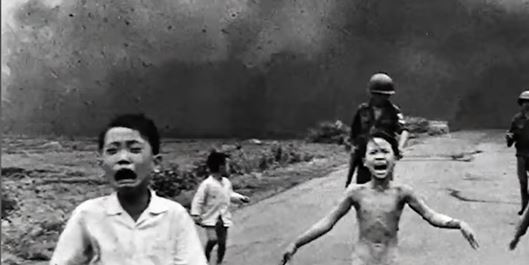
Kim Phuc saw another plane coming in low, fast and loud. She saw the bombs drop, and she froze….


Kim Phuc is “the girl in the picture”, maybe the most iconic picture of the Vietnam War. It’s one of the most memorable wartime photos ever taken. She is the girl in the picture running from a napalm bomb that dropped on her village.

Kim grew up in a happy family that was well off and lived far from the war, or so they thought. Then, the war came to them. The villagers had taken refuge in the local temple, and the South Vietnamese Army had taken up guard to protect them.

One day, however, planes flew overhead. The first plane dropped a marker at the temple. The soldiers, knowing what that meant, screamed for everyone to run. As Kim reached the exit of the temple, she saw another plane coming in low, fast and loud. She saw the bombs drop, and she froze.

Before she knew what was happening, she was surrounded by flames. When she saw her arm on fire, she ran in panic and fear until she couldn’t run anymore.

When she stopped running, a soldier gave her water. She remembers crying, “Too hot! Too hot!” The soldier poured water on her, thinking it would ease her pain, but the water reacted with the napalm, intensifying the pain, and she passed out.

Kim suffered 3rd degree burns over a third of her body. The photographer who took the photo dropped his camera and took her to the hospital.

The hospital didn’t have enough room for her because of the number of injured from the raid on her village. She was in such bad condition they moved her to a morgue. They left her for dead to tend to the living.

Her mother and brother searched for her, found her, and carried her back to the hospital. When her father arrived, she was transferred to a burn clinic in Saigon. She was saved by her family’s determination to help her, but she would have a long, painful road ahead.

Every morning when the nurse took her to the “burn bath” to soften her dead skin to be removed, she cried through the excruciating pain until she passed out. She had a dozen laser treatments. She had eighteen surgeries. She spent years in physical and emotional pain.

Her father spent all his waking hours tending to her with a broken heart. She was in so much pain, he prayed she would die to end her misery. Her parents feared something would happen to them that would leave her alone in her pain.

She lived of course, but she was ashamed of her scars. Friends stopped wanting to be with her. Her family loved her, but she became lonely. She was no longer the beautiful, young girl she once was. She saw nothing but ugliness when she looked in the mirror.

She also lived with trauma and nightmares from her experience. She was filled with bitterness, hatred and anger. She kept asking, “Why me?!” She despaired of life. She felt like only death would give her an end to the suffering and pain.

Continue reading “The Story of the Napalm Girl and the Healing Power of Jesus”

Where Are You Going?

Where we are going is more about the journey than the destinations, and the journey is about who we are becoming.

I read recently in the book, Gospel Justice, about the parable of the good Samaritan. The book focused on the priest who failed to cross the road to help an injured man. Bruce Strom offers a few possibilities about where the priest was going and why he was in too big of a hurry to help the injured man.

As I reflect back on what Bruce wrote, I can imagine God asking the question to the priest that hangs in the air: where are you going?

Where are you going?

God might ask that question not because He doesn’t know. God knows our every move and the words we are about to speak even before we say them. God might ask that question because He wants us to stop and think about it.

Where are you going?

Most people would have an answer of course. My 20-year-old might say that she is going to take a semester off of college to work, not knowing what college will look like in the fall with the virus outbreak still ongoing. My 25-year-old might say he is taking a year off before starting grad school. My 27-year-old might say that he is working, saving enough money for a security deposit, and the first and last months of rent for an apartment that he will need if he gets the job as a grad assistant that he has applied for.

My 30-year-old might say he is going into his second year of seminary. My 33-year-old might say he is going to keep mulching and working from home until the stay-at-home order is lifted and he can go back to work. My 34-year-old might say that he is going to patent a UV light that kills the coronavirus.

We might have longer term answers, too. I joke that I am going to work until I am 80 to pay off the college debt I incurred for my kids. I think about the possibility of retirement, as remote as it seems.

The priest in the parable might have been going home or going to church or going to visit a friend. He might have even being going to help someone in need. The priest might have had a good destination in mind, but the parable is clearly meant to contrast the priest to the “Good Samaritan”.

Of course, “good” and “Samaritan” were two words that Jews in first century Judea would not have put together. Samaritans were heretics and second-class citizens in the Jewish world at that time.

And of course, Jesus chose a Samaritan to drive home the point that the Good Samaritan, not the priest, did the “right” thing in that parable. He did the better thing. He stopped to help the injured man on the side of the road.

It didn’t matter where the priest was going, ultimately; he passed up the divine opportunity to help the man right in front of him.

If God was asking the priest, “Where are you going?” I don’t think he would be looking for the immediate answer. If the priest said he was going to the temple to perform his priestly duties, I think God might have asked him again, “Where are you going?”

We all have places to go, things to do, people to see. We all have goals and aspirations. I imagine God asking this question, not about the destinations, goals and aspirations we have planned, but about the journey: what direction are you moving in?

When two of my sons were wrestling, I would sometimes say to them (and myself): “It’s not about the winning and losing; it’s about the journey.”

The ultimate question about the journey of life is this: Who are you becoming?

Continue reading “Where Are You Going?”

God and the Impossibility of Goodness

It’s easier for a camel to go through the eye of a needle than for us to be good enough for God.

The story of the rich young ruler resonates with me today in the seeming impossibility of living without sin. I suspect that I am not alone in the experience of certain sinful inclinations that I just can’t seem to shake. Try as I might, I fall into the same traps of temptation over and over again. I get angry at myself. I ask for forgiveness. I renew my resolve, but I inevitably trip and fall. And sometimes I despair.

God cannot be mocked. Whatever a man sows, he will reap in return. The one who sows to please his flesh, from the flesh will reap destruction; but the one who sows to please the Spirit, from the Spirit will reap eternal life….” (Gal. 6:7-8)

I know this, but it doesn’t seem to help. My sinful flesh often overcomes the spirit within me. While the spirit is often willing, the flesh is weak; and sometimes, let’s be honest, my spirit isn’t as willing as it should be.

I think, “If I could just resist more and try harder and find just the right combination of thoughts and habits and resolve, I could lick this thing.” But, days come and go. Things change: busyness, or worry, or distraction, or boredom, or some dryness in my spiritual life, or difficulty, or disappointment or any number of things (or a combination of them) sets in, and when my guard is down, temptation comes and catches me off guard in a moment of weakness.

I truly believe it is possible to overcome the sin within me. Scripture seems to require it of me. What I reap I will sow. Yet I fail. I fully identify with Paul, who said:

“I do not understand what I do. For what I want to do I do not do, but what I hate I do. And if I do what I do not want to do, I agree that the law is good. As it is, it is no longer I myself who do it, but it is sin living in me. For I know that good itself does not dwell in me, that is, in my sinful nature. For I have the desire to do what is good, but I cannot carry it out. For I do not do the good I want to do, but the evil I do not want to do—this I keep on doing.” (Rom 7:15-19)

Continue reading “God and the Impossibility of Goodness”