What Does it mean to Be Perfect As the Father Is Perfect

What is godly perfection?

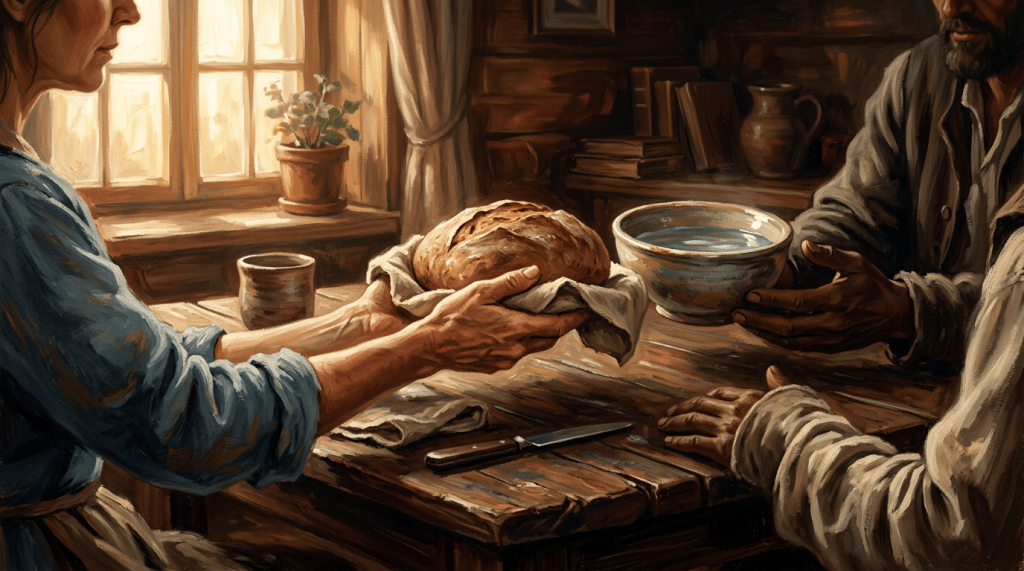
Two people sharing a loaf of bread and drinks at a wooden table

“Jesus said to him, ‘If you would be perfect, go, sell what you possess and give to the poor, and you will have treasure in heaven; and come, follow me.'”


Matthew 19:21 ESV


I read this statement Jesus made in Matthew 19, his statement in the Sermon on the Mount came to mind: “be perfect as the Father in Heaven is perfect.” I realized as I looked into it that the context in the Sermon on the Mount in which the statement made is similar. Both texts focus on the Ten Commandments, but Jesus takes them in a direction his audience likely did not anticipate.

In Matthew 19, a wealthy young man had come to him and asked him what good deed must be done to earn eternal life. Jesus responded first by saying that no one is good but for the Father in heaven. Jesus didn’t really answer the question to begin with. He needed to correct an assumption the young man was making, which is that people can be good enough to gain eternal life.

The young man wasn’t catching on, though. The man pressed Jesus further, asking which commandments must be kept to gain eternal life, as if there was some formula that would work. He wanted Jesus to boil it down to the right formula so he could check them off and get on with his life.

So Jesus played along and began to recite the commandments:


“And Jesus said, ‘You shall not murder. You shall not commit adultery. You shall not steal. You shall not bear false witness. Honor your father and mother, and, you shall love your neighbor as yourself.'”

Matthew 19:18-19 ESV


Notice that Jesus doesn’t go through all the Ten Commandments. If we are paying attention, we notice that Jesus started in the middle of the Ten Commandments, and he recited only five of them. In fact, he only recited the commandments on the horizontal plane – the commandments focusing on our relationship with others. He skips over the commandments focusing on our relationship with God (love the Lord your God, keep the Sabbath, etc.) I will come back to that in a moment, but I want to see how this passage ties back to the Sermon on the Mount first.

The entirety of the Sermon on the Mount is a reflection on moving from the commandments as a list of rules to a heart attitude toward God and people. Jesus upped the ante on people focused on keeping the commandments. Her repeatedly recited a rule, like you shall not murder, followed by a statement that goes to the heart: if you are angry with your brother, if you have contempt for him, if you call him a fool, you have violated the spirit of the rule, according to Jesus. (Matt. 5:21-22) If you do not commit adultery, that’s great: but if you lust after someone, you have violated the spirit of the rule, according to Jesus.

I think that these two things are going on. First, the real point of the rules is to focus us on the attitude of our hearts. If our hearts are wrong, we have violated the spirit of the rules. The rules are not what God ultimately wants us to master. He wants us to see the attitude of our hearts and recognize that something is amiss.

Second, the rules are intended to show us we don’t measure up. If we think that we are ok because we keep the rules, we are missing the point of the rules – that something is amiss, we don’t measure up, and we need help. As Jesus said to the Pharisees, “Those who are healthy have no need for a physician, but those who are sick. I came not to call the righteous, but sinners….” (Mark 2:17)

Actually, both of those points are really the same point, and the truth is that we are all sick (even the Pharisees). We are never going to measure up because something is a mess. We are fallen. We fall short. We need help.

Jesus wrapped up the discourse on keeping the commandments in the Sermon on the Mount by talking about loving our neighbors – and even our enemies. It was in this context that Jesus told us to be perfect as our Father in heaven is perfect.

Similarly, Jesus set up the wealthy young man by telling him he lacked something (as if he really had kept all the commandments in the first place): that he should sell all he has, give it to the poor, and follow Jesus. Of course, he went away sad and didn’t hear what else Jesus had to say.

If he had stuck around he might have heard Jesus say things similar to what he said in the Sermon on the Mount. He is not looking for rule followers. He is looking for people whose hearts have the right orientation. It’s not about following the rules; it’s about knowing that God loves us, receiving that love and loving others.

Continue reading “What Does it mean to Be Perfect As the Father Is Perfect” →

God and the Impossibility of Goodness

It’s easier for a camel to go through the eye of a needle than for us to be good enough for God.

The story of the rich young ruler resonates with me today in the seeming impossibility of living without sin. I suspect that I am not alone in the experience of certain sinful inclinations that I just can’t seem to shake. Try as I might, I fall into the same traps of temptation over and over again. I get angry at myself. I ask for forgiveness. I renew my resolve, but I inevitably trip and fall. And sometimes I despair.


“God cannot be mocked. Whatever a man sows, he will reap in return. The one who sows to please his flesh, from the flesh will reap destruction; but the one who sows to please the Spirit, from the Spirit will reap eternal life….” (Gal. 6:7-8)

I know this, but it doesn’t seem to help. My sinful flesh often overcomes the spirit within me. While the spirit is often willing, the flesh is weak; and sometimes, let’s be honest, my spirit isn’t as willing as it should be.

I think, “If I could just resist more and try harder and find just the right combination of thoughts and habits and resolve, I could lick this thing.” But, days come and go. Things change: busyness, or worry, or distraction, or boredom, or some dryness in my spiritual life, or difficulty, or disappointment or any number of things (or a combination of them) sets in, and when my guard is down, temptation comes and catches me off guard in a moment of weakness.

I truly believe it is possible to overcome the sin within me. Scripture seems to require it of me. What I reap I will sow. Yet I fail. I fully identify with Paul, who said:

“I do not understand what I do. For what I want to do I do not do, but what I hate I do. And if I do what I do not want to do, I agree that the law is good. As it is, it is no longer I myself who do it, but it is sin living in me. For I know that good itself does not dwell in me, that is, in my sinful nature. For I have the desire to do what is good, but I cannot carry it out. For I do not do the good I want to do, but the evil I do not want to do—this I keep on doing.” (Rom 7:15-19)

Continue reading “God and the Impossibility of Goodness” →

The Impossible Perfection of God

What is it that is impossible with man, but possible with God? What can we not do that only God can do for us?


In the Gospel of Mark, we read the story of the rich young man who came to Jesus and asked him what he must do to inherit eternal life. (Mark 10:17) After a brief discussion about the law and keeping its commandments, Jesus said to him, “One thing you lack: go and sell all you possess and give to the poor, and you will have treasure in heaven; and come, follow Me.” (Mark 10:21)

The rich young ruler went away saddened and grieving. (Mark 10:22)

Obviously, the rich young man found the instruction very difficult. He was evidently hoping for a different answer. He claimed to have kept the commandments of God from an early age, but Jesus brushed his boasting aside and dashed his hopes by demanding the “impossible” from him.

Jesus turned to his disciples as the example for what he was about to say was walking away, and commented, “How hard it will be for those who are wealthy to enter the Kingdom of God!” (Mark 10:23)

If we are being honest with ourselves, most Christians in the United States are wealthy compared to the rest of the world. We might even be considered wealthy compared to the rich young man who sought out Jesus in the First Century. Unless we gloss over what Jesus said, these are hard words to swallow.

They were hard words for the disciples also. Though they had left everything to follow Jesus, they were still “amazed” at what Jesus just said. (Mark 10:24)

As if the example wasn’t enough, Jesus said it again, “[H]ow hard it is to enter the kingdom of God!” and he added a word picture for emphasis:

“It is easier for a camel to go through the eye of a needle than for a rich man to enter the kingdom of God.” (Mark 10:25)

At these words, the disciples were not just amazed; they were “astonished”, asking, “Then who can be saved?” (Mark 10:26)

I believe they identified with the rich young man. I suspect they knew they had to more to give than what they had given. They might have also been thinking about the size of this following to which they had given themselves – it would be small indeed! Who could even qualify?!

Continue reading “The Impossible Perfection of God” →

Wealth, God and Ananias & Sapphira

Depositphotos Image ID: 8644150 Copyright: jalmeida

This is the third in a three part series on wealth and relationship with God. In the first part, we looked at the story of the rich young ruler. He was self-reliant, self-righteous and saddened at the prospect of parting with his wealth and following Jesus. In the second piece we looked at Zacchaeus, the tax collector, who responded joyfully to Jesus’ invitation to stay with him and offered, without prompting, to give half his wealth to the poor and payback four times what he took by fraud from people.

We have considered that God knows our hearts, and His knowledge of the rich young ruler and of Zacchaeus made a difference in how Jesus related to them. We have considered that our relationship with God does not depend on how many commandments we keep, how much we give to the poor or what we can do to earn God’s favor. We can’t be good enough, and we can’t do enough to earn God’s favor.

God’s favor is freely given to those who freely and genuinely receive Him. Eternal life isn’t earned; it is wholeheartedly received.

With the third story, we face some sobering truth. The stakes are high. The story of Ananias and Sapphira[1] shows us that our heart’s condition is not only important, it is ultimately a matter of life and death. Pretense leads to death; while genuineness of heart leads to life.

Continue reading “Wealth, God and Ananias & Sapphira” →

Wealth, God and the Rich Young Ruler

How difficult it is for those who have wealth to enter the kingdom of God! For it is easier for a camel to go through the eye of a needle than for a rich person to enter the kingdom of God.

Despositphotos Image ID: 1254235 Copyright:hsfelix
Depositphotos Image ID: 1254235 Copyright: hsfelix

In reading through the Gospel of Luke, the doctor, historian and traveling companion of Paul, two dialogues appear in chapters 18 and 19 about men of wealth. They are the stories of the Rich Young Ruler and Zacchaeus, the tax collector.

Both men are rich and are tied into the local power structure. They both seek out Jesus and encounter Him, but one turns away, saddened because of his wealth, while the other receives Jesus joyfully. And, then there is the story of Ananias and Sapphira. They had become part of the early church, but wealth became their undoing.

All three stories deal with wealth and possessions and relationships with God. And more importantly, they deal with the heart. We will review each story in this three part series on wealth and relationship to God.

Continue reading “Wealth, God and the Rich Young Ruler” →