Critical Race Theory from a Christian Perspective


I have been writing to encourage the evangelical church, in particular, to speak up and get involved in doing justice as God would have us do it. (Here and here.) We have been champions of proclaiming the Gospel, but we haven’t exactly been champions of doing justice.

My goal isn’t to shame anyone into jumping onto a cultural bandwagon, but to focus on God’s heart that is characterized by justice and our role in participating in God’s purposes. If we want to be involved in following Jesus as he followed the Father, I think we need to do justice.

He has told you, O man, what is good; and what does the Lord require of you but to do justice, and to love kindness, and to walk humbly with your God.

Micah 6:8

There is no condemnation for those who are in Christ, but God calls us to do justice.

At the same time, we need to be mindful, always, of truth. Biblical justice has a vertical element and a horizontal element: man to God and man to man. We need to be aligned in both directions with God and His character.

Critical race theory has become a viable contender in the modern cultural arena for defining injustice and prescribing how to fight it. Critical race theory, by its very nature, attempts to control the discussion. As Christians, though, we need to keep our focus on the Gospel as we wade into the fray.

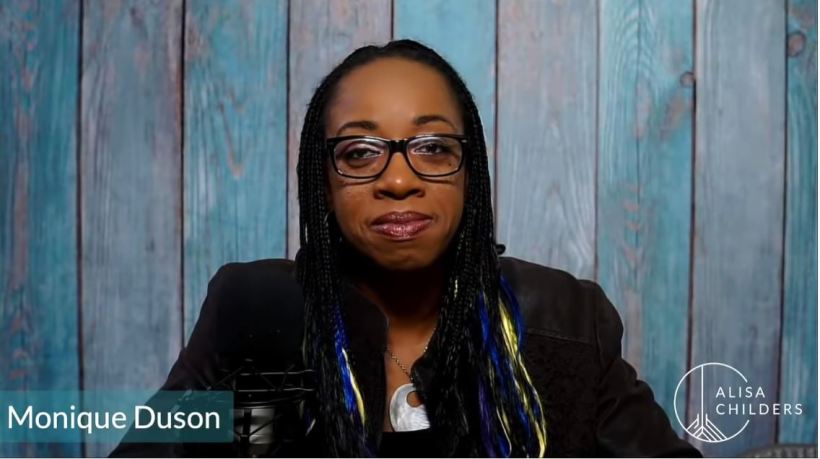
In this article, I summarize a conversation between Alisa Childers and Monique Duson on Race, Injustice, and the Gospel of Critical Race Theory. (The full interview is embedded at the end of this article.) I have been meaning to write on the subject of the difference between Gospel justice and social justice (which often devolves into justice without the Gospel), for well over a year. This, I think, is a helpful introduction to the subject.

I will address critical race theory (CRT) here, and I will follow with some thoughts on need for the evangelical church to be actively involved in doing true (biblical) justice.

Background.

Monique Duson grew up with critical race theory in south LA. The ideas that drive critical race theory (CRT) were her frame of reference before she even had a label for them. She was nurtured and educated by it. Her world was defined by an us-against-them orientation: whites against blacks.

She didn’t really know the philosophy or the foundations that under-girded that framework until she attended college at Biola University, a Christian institution. Even there, she recalls, she really didn’t question it or put it into a Gospel perspective.

In fact, she had always assumed “the Gospel” in the United States of America was a white concept that was part of the oppression of white power structures. She didn’t realize this construct comes from CRT, and she didn’t realize the historical Gospel isn’t “white” until after college when she was challenged to research it.

As she learned that Jesus wasn’t white and the culture in which the Gospel first introduced wasn’t white, Monique came to realize, “The Gospel we have perceived isn’t white Protestantism.” The Gospel predated the European influences that eventually spread the Gospel to the New World.

Because of Monique’s background and personal experience with critical race theory, she is uniquely able to identify where CRT and biblical notions of justice and the cure for injustice diverge. The rest of this article focuses on CRT as another gospel that is different than the true Gospel that Jesus preached.


Continue reading “Critical Race Theory from a Christian Perspective”

Evangelicalism and Injustice Part II

We must recognize injustice and speak to it if we are going to represent God, the Father, accurately to the world. 


In Evangelicalism and Injustice Part I, I discussed how the evangelical world has been a champion of preaching the Gospel, but we have not been champions of doing justice. In fact, we have shied away from it.

Less Gospel-orientated people, religious and otherwise, have rushed in to fill the void we have left, including people with philosophies and worldviews that are hostile and antithetical to the Gospel. I will address those things in a follow up post.

Meanwhile, the burden that weighs on my heart in these days is that our God is a God of righteousness and justice at the very foundation of His throne. (Psalm 89:14) This should be our foundation too as children of God our Father.

Jesus carried that great pillar of God’s character forward in the parable of the sheep and the goats, instructing his followers that those who will be blessed by God and receive their inheritance at the throne of God (calling Psalm 89 to mind) are the people who feed the hungry, give drink to the thirsty, invite the stranger in, clothe those in need, heal the sick and visit prisoners.

Jesus announced his ministry by reading from the Isaiah scroll. He said that God anointed him to preach the gospel to the poor, to proclaim release to the captives, and recovery of sight to the blind, and to set free those who are oppressed. (Luke 4:18-19, quoting from Isaiah 61:1)

The good news (the Gospel), in this way, is holistic. Jesus demonstrated that holistic approach of preaching good news and doing justice in his ministry. If we are to be his followers, we should do what Jesus did as he did what he saw the Father doing. (John 5:19)

When Jesus quoted from Isaiah, the prophet, he was calling to mind the great theme of all the prophets, which is the call of God to His people to do justice. Zechariah, for instance, says,

“This is what the Lord Almighty said: ‘Administer true justice; show mercy and compassion to one another.'” (Zech 7:9)

And he adds what true justice looks like:

“‘Do not oppress the widow or the fatherless, the foreigner or the poor. Do not plot evil against each other.'” (Zech 7:10)

James picks up the same theme in the New Testament.

“Religion that God our Father accepts as pure and faultless is this: to look after orphans and widows in their distress and to keep oneself from being polluted by the world.” (James 1:27)

James emphasizes the need for doing, not simply giving mental ascent to what Jesus says. The example he provides falls into the Old Testament definition of “doing justice”:

“Suppose a brother or a sister is without clothes and daily food. If one of you says to them, ‘Go in peace; keep warm and well fed,’ but does nothing about their physical needs, what good is it? In the same way, faith by itself, if it is not accompanied by action, is dead.” (James 2:15-17)

Evangelicalism has been very good at preaching and proclaiming.  Many evangelical organizations exist, like Administer Justice (which I mentioned in the first blog article), that both proclaim the good news and do justice (meet the needs of the poor, the oppressed, the prisoners, widows, orphans and strangers), but evangelicalism, as a whole, falls a bit short on the justice side of the equation. Let’s be honest.

Continue reading “Evangelicalism and Injustice Part II”

Evangelicalism and Injustice Part I

Evangelicalism has been very good at preaching the good news, but falls a bit short on doing justice.


I am taking a break from considering the difference between “the righteous” and “the wicked” in Scripture to return to a related topic that erupted publicly in recent weeks: racial injustice. It is related because God’s character is righteousness and justice at His core.

As an attorney, I have had the privilege (and sacred duty) to devote some time to a local organization known as Administer Justice that serves the poor, vulnerable and under-privileged in communities around the country. A great many of “those people” are minorities, immigrants and “the working poor”. I’ve had the honor of getting know some real servants of the Gospel in the process, like Bruce Strom, the founder and executive director of this organization.

I am reading through his book, Gospel Justice. I’ve owned the book for a long time, probably years. I started it a long time ago, and I am still not through it yet because ( I admit) that other, more “interesting” subjects and diversions have distracted me from the seemingly mundane subject of justice.

If I truly want to know God’s heart, to follow Jesus and to work out my salvation as God works within me to will and to act according to His good purpose, though, I need to be concerned about justice – because it’s at the foundation of God’s throne. (Psalm 89:14)

We can’t talk about justice in the United States in the 21st century without talking about racial disparities resulting from centuries of racial injustice. The recent events following the killing of George Floyd (and others) have focused national attention on the issue. As the national dialogue continues, we in the Body of Christ need to engage.

There is a great need for the Body of Christ collective to participate as God would have us get involved in the discussion, action and changes necessary to address racial injustice. My own neighborhood in the Body of Christ is the American evangelical church. Thus, I write this with my evangelical brothers and sisters in mind.

The following passage in Bruce Strom’s book inspires my thoughts today:

“The division between Jews and Gentiles was the great divide of the first century.
“In America that great divide is race, and it remains a leading contributor to injustice. In their book, Divided by Faith, Michael Emerson and Christian Smith examine the role of white evangelicalism in race relations. Based on extensive interviews and study, they conclude that the evangelical church, with its focus on individual salvation, not only misses the opportunity to break down the great divide between the races, but also contributes to it.
“This view is shared by my friend Ed Gilbreath, who wrote Reconciliation Blues. ‘A sad tendency of evangelical faith is to elevate the act of evangelism over the humanity of the people we want to reach…. Apparently, any time an ethnic minority speaks out against race-related injustice, he risks being branded a malcontent in need of therapy.’
“Racial injustice is real….
“We must not walk on by [like the priest and Levite in the parable of the Good Samaritan] as if racial injustice does not exist. We should listen to our neighbors of color who understand well the injustices in their community. And our friends of race should not give up, but seek opportunity to lead by example.”

I am reminded that the evangelical tradition is informed by people like Luther and Wycliffe. They championed the principal that salvation is by faith in the grace of God, not by works that we can do. That and the primacy of Scripture and the need for individual members of the Body of Christ to read Scripture for themselves and to pray to God our Father – not through some intermediary, but directly – one on one.

These things have driven the evangelical church to seek and save the lost, proclaiming the Gospel with the message of salvation to individuals who believe, repent of their sins and put their faith in the lordship and salvation wrought by Jesus on the cross. These are hallmarks of evangelicalism. They are indeed central to the purposes of God.

I am reminded further that, when Jesus stood up in the Temple to announce the beginning of his ministry in Luke 4, he read this from the Isaiah scroll:

The Spirit of the Lord is upon Me,
Because He anointed Me to preach the gospel…. (v.18)

When the evangelical church considers the Great Commission –  “[G]o and make disciples of all nations….” (Matt. 28:19-20) – preaching the Gospel comes primarily to mind.  Evangelicalism has been a champion of preaching the Gospel. 

But, I think that sometimes we forget that Jesus didn’t stop there. The passage in Isaiah from which Jesus read continues on well past preaching the good news (quoting from Isaiah 61:1):

He anointed Me to preach the gospel to the poor.
He has sent Me to proclaim release to the captives,
And recovery of sight to the blind,
To set free those who are oppressed,
To proclaim the favorable year of the Lord.

Continue reading “Evangelicalism and Injustice Part I”

Who Are the Righteous and the Wicked? Part II

Righteousness and justice are what they are because God is who He is.


Who are the righteous? Who are the wicked?

This was the question prompted in my heart recently as I read Psalm 1, which begins with a warning not to walk in step with the wicked, stand in the way of sinners or sit in the company of mockers. I describe how that question was prompted in Part 1 of this blog series.

Beyond equating the wicked with “sinners” and “mockers” (and speaking to the company we keep), Psalm 1 doesn’t go into much detail on the characteristics of the wicked (or the righteous). I realized as I responded to the prompting in my heart that I had some old assumptions about those things that might not be true, or at least not completely true, so I set out to dig a little deeper.

As Christians, we know that no one is righteous; we have all sinned and fallen short. We know that righteousness is credited to those who believe God and have faith (trust) in Him. We might assume, then, that there isn’t much more to it – that believing God, and the Bible and going to church is all it takes to make a person righteous; and, of course, that these things distinguish the righteous from the wicked.

This view, though, is only partly right. Even demons believe (Jam. 2:19), but that doesn’t make them righteous! We need to dig a bit deeper to develop a more complete understanding of what it means to be righteous. God, of course, is righteous, and our righteousness is gained only in relation to Him – by believing in Him – by what does that mean for us?

Continue reading “Who Are the Righteous and the Wicked? Part II”

Give Me Neither Poverty nor Riches

Lest I be full and deny you and say, ‘Who is the Lord ?’ or lest I be poor and steal and profane the name of my God

“Two things I ask of you; deny them not to me before I die: Remove far from me falsehood and lying; give me neither poverty nor riches; feed me with the food that is needful for me….”


.
Proverbs 30:7-9

I read this short passage in Proverbs in my early years as a follower of Christ. It might have been in college after I gave my life and my heart to the Lordship and salvation of Jesus Christ, or it might have been in the few years that followed. I remember praying these things to God earnestly, and I have remembered these words and my prayer ever since.

During my late 20’s and through my 30’s, I struggled through many difficult years with a young and growing family. I didn’t realize how much this prayer would mean for me. At the age of 28, married for 3 years and with 2 children, I was restless. We had no debt, but we lived hand to mouth. I felt God leading me (I believed) to law school, but I was also focused on what I needed to do to increase my income so that we were not one bad circumstance away from the poorhouse.

I believe God did lead me to go to law school, but I also let worry, and sometimes even fear,  creep in and sit at the threshold to my heart. Those three years of law school were very difficult. We had a third child at the end of my first year. The pressure of the work, of the necessity not to fail, of going into a hole financially, of an uncertain future and more was a very great burden. The pressures and the worry and fear overtook me.

I let those weeds grow up and choke the spiritual life in me. I didn’t maintain the discipline of regularly reading Scripture or daily prayer. My prayers were Hail Mary’s thrown up in the midst of the weariness and pressures of my life at that time. Even going to church was filled with tensions of herding three rambunctious boys into a car on Sunday mornings amid the whining, squabbling and desire simply to take a break. it became more of a duty that something I looked forward to.

Three more children, and new pressures and tensions as a new lawyer, struggling under the load of debt, and many, many activities threatened to snuff out the spiritual life in me. The worry, fear, busyness and lack of discipline on my part to take time out on a regular basis to sit before my God, listening for His voice, waiting on Him, being renewed by Him was a recipe for spiritual death.

In addition to praying the prayer of Proverbs 30:7-9, I prayed desperately to God before those days of tension, worry and fear not to let me slip ever from His hands. I didn’t pray that because I saw anything in my own heart that caused concern, but I had seen enough other people who seemed to have had it all spiritually together at one point walk (or slip) away into spiritual darkness.

It puzzled me then (in the joy of being a new Christian), and the inability to understand it at the time added to my concern that I might be no different than they. After all, everyone of us sins and falls short. There is nothing new under the sun. Though I had fully embraced Christ, and even left family and home and all that was familiar to me, to follow Him, Scripture gave me pause not to be so confident.

 As I look back, I see that I was right to pray those prayers. Not that I count any advantage to being right. Rather, I have learned that Scripture is full of wisdom to which we would well to pay attention. Above all, though, God is faithful! Continue reading “Give Me Neither Poverty nor Riches”