I have listened to all 30 episodes of Season 1 of the podcast, The Surprising Rebirth of Belief in God, by Justin Brierley. I have listened to dozens of podcasts, and I think this is one among the best, most well-produced podcasts I have found. The first episode of Season 2 inspires my writing today.
In this episode, Justin Brierley poses the question, “Whether the seeming rebirth of belief in God is right wing?” A return to Christian values seems to coincide with a resurgence in conservative politics, but, let’s look closer.
Is Christianity right wing? The African American church would beg to differ. Does Christianity have a right wing and a left wing? Or is Christianity another bird entirely?
At about the 45 minute mark in the podcast, Glen Scrivener identifies three strains of culture in the current western world. One strain is “blasting off into progressive liberalism.” Another strain is “snapping back to the worship of the strong”, a return to the world of Nietzsche. A third strain involves the “surprising rebirth of belief in God”, as Brierley puts it, where a trickle my become a flood, and Christian revival happens.
Scrivener is hopeful that the signs of Christian renewal in the west foreshadow revival, but he observes that these different strains of culture are moving forward at the same time, albeit in conflict with each other. They each have a trajectory that will continue into the future, and, “It will be a mess,” says Scrivener.
He believes Christian revival will happen, but he believes that progressive liberalism will also continue on its trajectory, divorcing itself more completely than it already has from nature and the Christian story. He believes that a devolution into what he calls “the default nature of the flesh” will continue as well, where might makes right.
Indeed, these things are happening now. Will they continue on the same trajectory into the future? Time will tell, but I think he is right: that there is a “post-Christian right” and a “post-Christian left” that are presently locked in a battle for the minds of the people of the western world.
I would add that the world, generally, is and will continue to be the devil’s playground until Jesus returns. At least, that is what the Bible says (millennium variations aside).
The absurdity of what is happening now is hard to reconcile with the reality of it. The history of how we got here seems to have been lost. Some Evangelical Christians are now cheering the process of undoing what Evangelical Christians fought hard to get not very long ago.
My thoughts today come from a man I have met, and I have heard speak at the Administer Justice Restore Conference in Elgin, IL in 2018. Soong-Chan Rah was professor of Church Growth and Evangelism at North Park Theological University just outside of Chicago at that time. Now he is professor of Evangelism and Church Renewal at Fuller Theological Seminary in California. He planted New Covenant Fellowship Church in Baltimore, MD, where he grew up, and he founded the Cambridge Community Fellowship Church in Massachusetts when he was at Harvard. He has multiple theology degrees. He has worked for InterVarsity Christian Fellowship, and he served on the boards of the Christian Community Development Association and World Vision, among other things.
Dr. Rah is not just a lifelong evangelical; he has undergraduate degrees in history and sociology. The combination of his personal history (born in Korea, grew up in the US from the age of about 5, raised by a single mother in the inner city), education, and experience give him an unique position from which to comment about the whirlwind of executive action Donald Trump has taken since the inauguration less than two months ago.
Dr. Rah sounded this alarm for the US Evangelical Church:
Wake up Evangelical Christians. The dismantling of USAID is not the confrontation of corruption and liberalism, it is a MIDDLE FINGER to Evangelical Christians who still adhere to the tenets of Scripture.
A short history lesson. Under the Bush administration, there was a move by evangelical Christians to access government funds to support the work of compassion and mercy. Government funding should not discriminate between a religious organization and a non-religious organization if the work is being done for the common good. This move was supported widely across the political spectrum as an action that prevented discrimination against Christian ministries. One of the key expressions of this policy change was access to USAID funds by Christian relief and development organizations. Christian organizations could now access USAID resources (e.g. – surplus US grain purchased by USAID in support of US farmers, in turn that grain became GIK donations to be distributed by US Christian organizations that often served international communities). In other words, one of the efforts by the US government to actually reflect the value of a Christian nation through the work of Christian organizations was completely wiped out while Evangelicals cheered two of the most non-Christian people in the world.
Wake up US Evangelicals. You are not just being played and used, the very people you cowtow to are actually mocking all the values you claim to espouse.
February 12, 2025
While I have no doubt that “corruption and liberalism” exists at USAID, many Christian organizations do their ministry with USAID support. Evangelicals fought for and earned a right at the table not that many years ago to receive federal funding to run the humanitarian programs supported by USAID. Organizations like Samaritan’s Purse, World Relief, and World Vision depend heavily on USAID and could not begin to do what they do without USAID support.
We need to be mindful that God calls His people throughout Scripture to do justice for widows, orphans, and strangers. Justice in the Bible includes caring for the weak and vulnerable in our society. Do you think that God does not bless a nation that taxes its citizens who have means to do justice for the poor and vulnerable who have no means?
USAID does just that domestically and around the world, and many Christian organizations like the ones I have mentioned do biblical justice with USAID funding. These organizations cannot do what they do on the scale they do it without this funding.
Many organizations would not fall into the category of doing biblical justice, of course. It should be no surprise to anyone that changes in the political powers every election cycle results in changes in how federal funding is used. That is the reality of a democracy. Do you really think that the current changes will not be changed again in four years?
The difference is that the infrastructure for this funding is now being completely dismantled. In just a few short weeks. Years of diligent and faithful effort by Evangelicals to fund ministries of justice are being undone in a virtual moment. The proverbial baby is being thrown out with the bathwater. Some might say that a wrecking ball is being taken to the hospital with the patients and hospital workers still inside!
The funding freeze, firings, and mandates to stop work have come with no attempt to sort the good from the bad. The axe has been laid to the trunk with no attempt to prune and preserve the tree.
As I have thought about these things, warnings of God’s judgment hang in the air. The warnings of God’s prophets are nearly always directed at God’s people because God expects His people to listen to and respond to what He says. Is not the Bible clear on what God desires from His people?
“He has shown you, O mortal, what is good. And what does the LORD require of you? To act justly and to love mercy and to walk humbly with your God.”
Diversity, Equality, and Inclusion (otherwise known as DEI) has become a pejorative label for the “evils” of progressives that is a target of the Trump administration in their take down of government as it existed when Donald Trump took office. I don’t want to talk about politics. I want to address something to the Church in America. Something I think we need to think about prayerfully in these times.
I have been through a DEI session as a mandatory component of my professional continuing education. My experience is limited, so I discount it, but it will serve my purpose of introducing the subject I want to address.
Honestly, I would characterize the DEI session I went through as cringy. It was uber sincere, preachy, and not a little condescending. I also didn’t think it was very effective for these and other reasons. Well-intentioned, maybe. I will give it the benefit of the doubt, but I am afraid it rubbed me the wrong way – privileged white man that I am.
I can see how people outside the church might feel about the uber sincerity, preachiness, and condescension of Christians. It can be … well, cringy. I find it ironic that the progressive world (it seems to me) has overtaken the Church in self-righteous condescension, preachiness, and overall cringe in its own beliefs that it appears to be trying to cram down the throats of people it views as less than.
But, I digress. I want to take a step back and re-examine the ideas of diversity, equality, and inclusion. I am not going to do a deep dive, but I want to recapture these words that have been hijacked by political operatives and used alternatively as political bludgeons and pejoratives.
Diversity was created by God when he confused the languages of the people. God confused their languages because the people had unified together with one common language to make a name for themselves and to resist God’s instruction to be fruitful and multiply over the earth. God “confused the language of the whole world” to scatter people around the world as He originally intended. (Genesis 11:1-9)
From this, we see that God is in control, and He has a plan. Well, He is still in control, and He still has a plan. People are either working with Him, or they are working at cross purposes to His plan.
As Christians, we don’t ever want to be working at cross purposes to God! Diversity was God’s idea going all the way back to Genesis, and He shows where He is going with it in Revelation. This is the vision He gave John to share with the world to let us know His end game:
“After this I looked, and there before me was a great multitude that no one could count, from every nation, tribe, people and language, standing before the throne and before the Lamb. They were wearing white robes and were holding palm branches in their hands.  And they cried out in a loud voice:

“Salvation belongs to our God,
who sits on the throne,
and to the Lamb."

Revelation 7:9
God’s plan is to bring all the nations, tribes, and languages back together in all their diversity! Every different nation, and every different tribe, in all their different languages – diversity. But, they will be unified in their worship of the Lamb who sits on the throne. (Notice, it isn’t the Lion of Judah who appears on the throne, but the Lamb of God.)
God celebrates the diversity He created by gathering all the nations, tribes, and tongues together from around the world where they were scattered. Diversity is not pejorative. It is something God created in His wisdom that we can celebrate as we worship Him in one voice and many tongues.
If we pray authentically as Jesus taught us, we pray, “Our Father, who is in Heaven, hallowed be your name. Your kingdom come and your will be done on earth as it is in Heaven!” If we are praying for God’s kingdom on earth – now – as it is in heaven, we cannot really mean that if we do not embrace the diversity that God created on earth.
Elon Musk: 100 million people with Neuralink implants in the future | Lex Fridman Podcast
My writing today comes from my quiet time when I read the Bible in the morning. I have been sensing the importance of hope in recent days (or weeks) in the light of the troubling times we live in. It’s easy, even as a Christian, to lose hope in these times. I do.
Just a week ago, I had a conversation with my 31-year old about a great leap in technology being pioneered by Microsoft that could increase technological advancement exponentially. (See Microsoft’s NEW Quantum Chip is Mind Blowing!) Glenn Beck speculates, “If they can put that one chip in your phone, it would make your phone as powerful as the best supercomputer with a server farm the size of the planet earth.”
Or conversation focused on his wife’s concern (and mine) that such a technological advancement may exceed our ability to do good with it. Imagine people having that power at their fingertips….
Six months ago, Elon Musk discussed the distinct possibility of fitting 100 million people with Neuralink implants in the future. This device implanted in the brain would allow “superhuman abilities”. It would replace cell phones. We would essentially have computers in our brains.
Musk somewhat presciently said, “The problem will be figuring out what we want….” A person who wants to cause harm could cause greater harm exponentially faster and exponentially more devastating than can be done now with our merely human brains, like going from muskets to a nuclear capabilities.
Lex Friedman commented, with maybe greater prescience, “I think it’s exciting and scary for people because … it changes the human experience in ways that are very hard to imagine.” Interestingly, Musk agreed, “We would be something different.”
This uncertainty suggests we should be cautious with technology that may fundamentally change the human brain. The specter of the availability to change the human brain to make us different in ways we can’t even predict raises similar ethical questions as the ability to clone humans.
Not only should we be circumspect and careful with these things; we need to be cautious about trusting such powerful technology to people with varying worldviews. Do we want a materialist driven people who believe there is no God, nor objective morality, nor any no purpose in life other than what we want it to be to be in control of such technology. What about an Islamic world? Or a Trump and Musk world that is driven by the almighty dollar?
Pick your suspect worldview. I wonder, “Can we handle it?” And, “Are we playing God?” And, “What unintended consequences might we trigger?”
As I write these things, I can hear another voice in my head nagging me to reconsider my cautionary approach. “Wouldn’t it be great to control your world with your mind?!” Imagine how a Neuralink might empower and improve the life of a quadriplegic. It could be used for so much good!
In reality, such technology is likely to be used both for good and to be abused. That is the pattern of humanity. Whether it might be used more for the good than abused is something no one can predict, though it may depend on how slowly, cautiously, and circumspectly we roll it out.
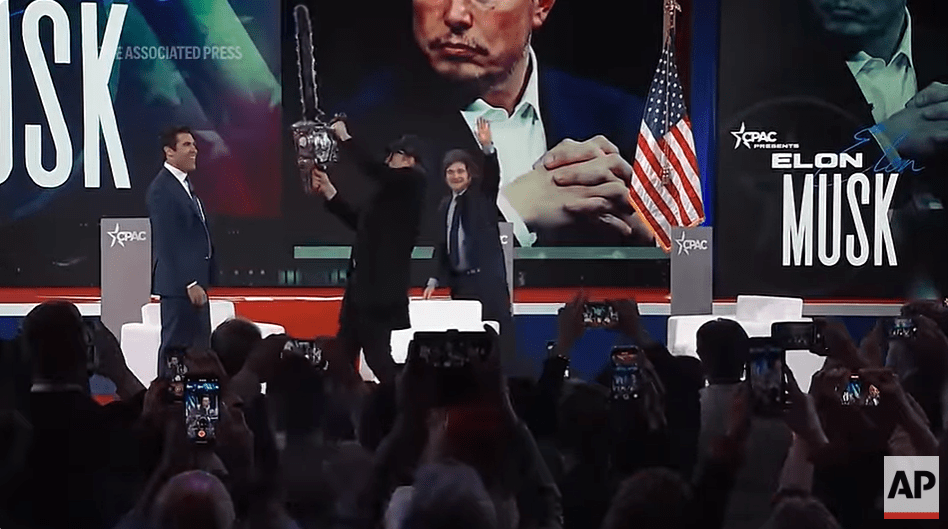
On that score, consider what Elon Musk is doing with the power Trump has given him in the federal government. He has wielded that power with glee like a chain saw massacre. He even boasted about it:
This is the same man who wants to put his technology in your brain.
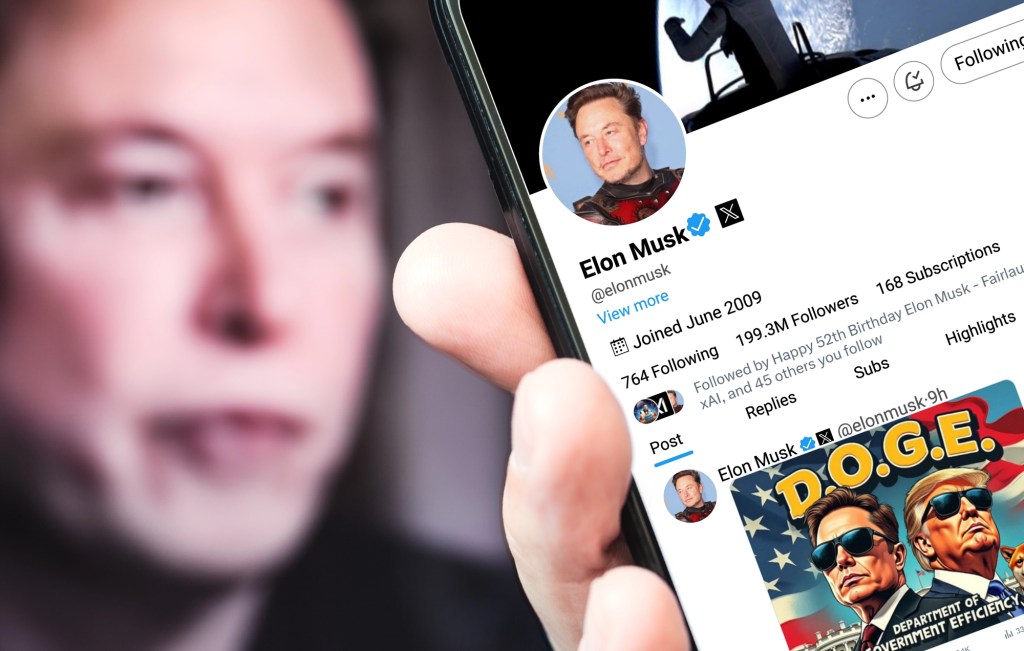
I might be tempted to think that I am being overly cautious, but recent developments highlight the concerns. Elon Musk has been invited into the inner workings of our government by Donald Trump. He has been given unprecedented access to personal and private information of all people who live in the US. Together they have been freezing funds, firing people, and shutting down programs at an unprecedented rate.
I have likened what they are doing to a corporate Board of Directors for a hospital identifying inefficiencies and wasteful spending and taking a wrecking ball to the hospital with the patients, doctors, and nurses still in it. In weeks, they have have attempted to freeze the expenditure of billions of dollars already committed to operating programs in this country and around the world, and they are gutting and shutting down those programs.
The rashness and imprudence of doing what they are doing is almost unimaginable, and they are doing it because they have the power to do it. Right now, there is no check or balance in the way. They are moving faster than the other branches of government can respond.
We don’t know, yet, what the fallout will be. We are seeing only anecdotal results right now – jobs lost, summary deportations, 50 year contracts terminated with veteran agencies, etc. – in less than two months. Trump and Musk have enthusiastically wielded the power they now have with no apparent thought or care to the lives they have disrupted and the people they have hurt in the name of efficiency because they can.
We have a tendency to run further and faster with technology than our ethical bandwidth can keep up. The industrial revolution led to abuses like child labor and competition among nations that presaged the two great World Wars. Those technological advances made those wars more deadly than ever before – with tanks, guns, planes, toxins, and bombs (conventional and nuclear) – that were more devastating than the weaponry available in prior wars.
The kinds of technological advances Microsoft and Musk are exploring could lead to unimaginable abuses of power. That power will be exponentially greater than what we have now, and it could easily trigger the end of human civilization in the wrong hands.
The technology that fueled the World Wars is nothing like what we have now. The nuclear technology that ended WWII and advancements in technology that exist today could easily end human life on earth in the time it takes to push a button.
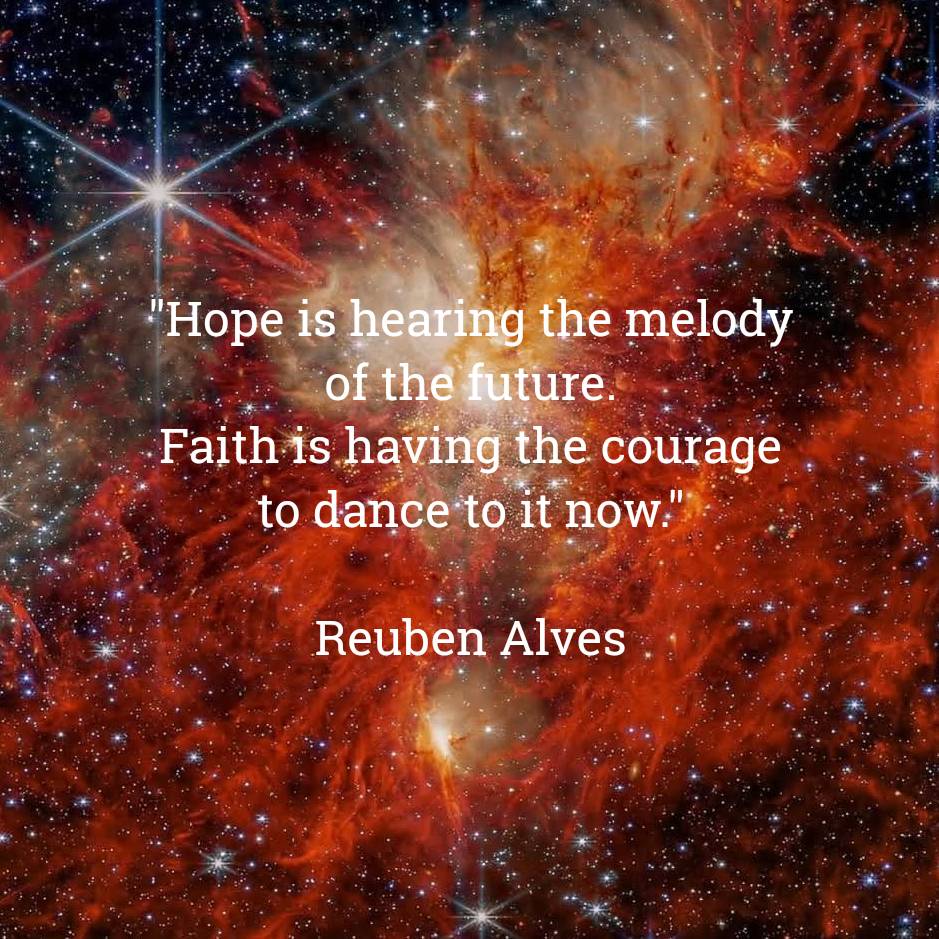
In that context, I read my daily Bible reading plan to today that included a quotation from Brazilian theologian, Reuben Alves, that I have included here. So, I turn now to hope, fueled by faith, and informed by love.
Judging by my social media feed, this question is poignantly apropos. It’s not just “people in the world” I see at odds with each other. I see many people posting memes under the banner of Christ, getting their lobbing verbal grenade’s at “the people in the world” and fellow Christians, alike.
I confess I have difficulty not being blunt, and for that I ask for your grace when I say that the spectacle saddens me. Humans have always lived in a world dominated by rising and falling empires, but Jesus came preaching a kingdom not of this world. Almost 2000 years after Jesus died and rose again to emphasize the Good News he proclaimed, we still fly our empire banners alongside Christ.
It wasn’t always like that, though. For almost three centuries after Jesus died on the cross at the hands of the Roman Empire, his followers proclaimed the Gospel without any influence or power in the world. His followers were mocked, derided, and marginalized, and they suffered cycles of persecution culminating in the Great Persecution.
Beginning in 303, Emperor Diocletian, who established a tetrarchy with Maximian, Galerius, and Constantius (the father of Constantine), issued a series of edicts demanding that Christians comply with traditional (pagan) religious practices. (See Wikipedia) Diocletian presaged the Great Persecution when he took power in 284, purging the army of Christians and surrounding himself with public opponents to Christianity. He led an “activist government” and promoted himself as “restorer of past Roman glory”. (Ibid.) (Making Rome great again?)
Diocletian finally ordered “a general persecution” on February 23, 303. The reign of persecution was short-lived (unless you endured it, I suppose). Constantius, the father of Constantine, restored legal equality for Christians in Gaul in 306, and Maxentius usurped Maximian’s control in Italy and North Africa in the same year with a promise of religious toleration. When Licinius ousted Maximinius in 313, the persecution was formally ended.
The political ebbs and tides of the time (with implications for the church) are reminiscent of our political shifts from right to left to right in recent years. Perhaps, little has changed in that way, yet the change that followed in 313 was unprecedented, and this change set the course of the Church on a path it had never before traversed.
Eusebius, the Christian historian, wrote as a contemporary of Constantine with glowing approval of the events that changed the course of Christianity forever. Eusebius is the person who preserved the details of Constantine’s personal story of conversion to Christianity.
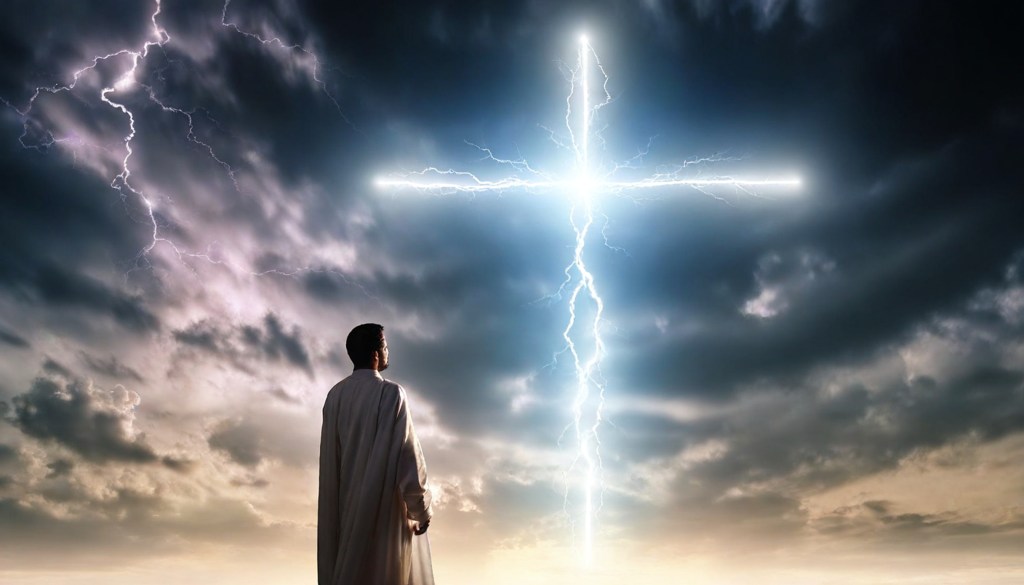
As the story was told by Constantine, he had a vision in 312 shortly before an imminent battle with a challenger to the throne of the Roman Empire, Maxentius, whose army outnumbered Constantine’s. Constantine saw in the sky a giant cross with the inscription, “In this sign conquer!” The vision was followed by a dream that evening in which Jesus purportedly came to him and told him to conquer in his name. Thereafter, Constantine established the cross as the standard for his army and the banner under which the Roman armies marched to battle and conquered in the name of Christ, the lamb of God who died that we might live.
In the podcast (titled Post Christian) featuring the Australian journalist, Greg Sheridan. John Dickson commented on the approval by Eusebius of Constantine’s use of the cross as a symbol of conquering on behalf of the Roman Empire this way:
“A people used to mockery and social exclusion – and worse – were now invited into the very center of power. And perhaps most bizarrely, the Christian sign of humble self-sacrifice – a cross – was now the formal path – the very symbol – of the Roman war machine. It is so hard to get my head around when I consider what Jesus said about the cross – his cross – and its social implications.”
Juxtaposed to the image of Roman armies conquering under the sign of the cross in the name of Jesus, Dickson recalled the story of James and John, the sons of Zebedee, who asked Jesus asking to seat them on the right and the left of Jesus when Jesus rose to power. These brothers, like many First Century Jews, expected a conquering Messiah. They interpreted the prophets to predict a Jewish Messiah “who would lift Israel above Rome and crush the enemies of God.”
Jesus gave them a response they didn’t expect and likely didn’t understand at the time:
“You don’t know what you are asking,” Jesus said. “Can you drink the cup I drink or be baptized with the baptism I am baptized with?”
Mark 10:38
The other disciples became indignant with James and John thinking, perhaps, they they deserved glory and recognition also. They, like many before and after them, may have viewed religion as a path to power and influence, and they may have been annoyed at the audacity of James and John out of jealousy. At this, Jesus brought them together and set them straight.
“You know that those who are regarded as rulers of the Gentiles lord it over them, and their high officials exercise authority over them. Not so with you. Instead, whoever wants to become great among you must be your servant, and whoever wants to be first must be slave of all. For even the Son of Man did not come to be served, but to serve, and to give his life as a ransom for many.”











 Navigating by Faith