Reflections on Praying, “Thy Kingdom come, Thy Will Be Done, on Earth As It Is In Heaven”

Intellectual faith vs. doing faith

Neighbors cleaning a sunlit city street together

When Jesus taught his disciples to pray he taught them to recognize God: “Our Father, who art in heaven, hallowed be thy name.” Immediately after recognizing God for who He is, Jesus taught us to pray, “Thy kingdom come, Thy will be done on earth as it is in heaven.” These things are the foundation of our prayer life with God, according to Jesus.

As I think about this today, the realization strikes me that praying, “Thy kingdom come,” needs to be accompanied by a willingness to reflect God’s kingdom and God’s will in the way we live. If we pray for God’s kingdom to come on earth as it is in heaven and don’t think that prayer means anything for us in the way that we live, do we really mean it?

These thoughts came to me as I was worshipping God and thinking about the song we were singing, which was an expression of faith in the promises of God. If we

pray or sing these words to God without any intention to reflect the God we are worshiping and praying to in our daily lives, is our worship and prayer anything other than a clanging gong or a banging cymbal that Paul speaks of in 1 Corinthians 13?

When Jesus began his public ministry, the message he preached was the coming of the kingdom, which he said is near at hand. (Mk. 1:14-15l Matt. 4:17, 23) Jesus said that the reason he was sent was to preach the coming of the kingdom of God. (Luke 4:3)

When Jesus spoke in his hometown synagogue, he said it a little bit differently: he said that he came to preach good news to the poor, to proclaim freedom to prisoners, to give sight to the blind, and to set the oppressed free. (Luke 4:18-19)

Throughout his public ministry Jesus demonstrated what he came to do. He touched lepers, though doing so would make him unclean under Jewish law, and he healed them. He gave sight to the blind. He healed the sick and the lame. He set people free from demonic influences. He forgave sins. He lived out a tangible demonstration of what it means for the kingdom of God to come, and he extended God’s favor to Samaritans, a Canaanite woman, and a Roman centurion.

He also challenged the religious people of his day. He repeatedly healed people on the Sabbath. He even went right into the synagogues and healed them in front of the religious leaders, knowing that it would provoke them in their religiosity, because they didn’t understand what it means for God’s kingdom to come on earth as it is in heaven.

The religious leaders were angry when Jesus challenged their understanding of the law and therefore of God. In their best moments they were just confused.

When Jesus healed ten lepers and instructed them to go show themselves to the priests, only the Samaritan leper came back and thanked Jesus. The priests asked, when would this kingdom that Jesus was preaching come? Jesus said, God’s kingdom isn’t any particular place, because God’s kingdom is within us. (ἐντός (entos), meaning inside (us) (adverb or noun) — within (us), sometimes translated “among us” or “in our midst”)

They still didn’t know what he meant. All they could see was that he was breaking the rules – the requirements they had established to protect people from breaking the mosaic Law of not working on the Sabbath. They didn’t understand that the Lord of the Sabbath was standing in front of them, telling them they were getting it wrong.

Jesus said the kingdom is in the midst of His followers. He come to announce that God’s kingdom has come, though it is also still to come. He introduced his kingdom, and he called his followers to recognize it, to repent, and to live in its reality.

The question I want to ask today of myself and anyone who might be reading this is this: Are we doing that?

Continue reading “Reflections on Praying, “Thy Kingdom come, Thy Will Be Done, on Earth As It Is In Heaven”” →

Redeeming Diversity, Equality, and Inclusion

DEI has become a weaponized, pejorative term.


Diversity, Equality, and Inclusion (otherwise known as DEI) has become a pejorative label for the “evils” of progressives that is a target of the Trump administration in their take down of government as it existed when Donald Trump took office. I don’t want to talk about politics. I want to address something to the Church in America. Something I think we need to think about prayerfully in these times.

I have been through a DEI session as a mandatory component of my professional continuing education. My experience is limited, so I discount it, but it will serve my purpose of introducing the subject I want to address.

Honestly, I would characterize the DEI session I went through as cringy. It was uber sincere, preachy, and not a little condescending. I also didn’t think it was very effective for these and other reasons. Well-intentioned, maybe. I will give it the benefit of the doubt, but I am afraid it rubbed me the wrong way – privileged white man that I am.

I can see how people outside the church might feel about the uber sincerity, preachiness, and condescension of Christians. It can be … well, cringy. I find it ironic that the progressive world (it seems to me) has overtaken the Church in self-righteous condescension, preachiness, and overall cringe in its own beliefs that it appears to be trying to cram down the throats of people it views as less than.

But, I digress. I want to take a step back and re-examine the ideas of diversity, equality, and inclusion. I am not going to do a deep dive, but I want to recapture these words that have been hijacked by political operatives and used alternatively as political bludgeons and pejoratives.

Diversity was created by God when he confused the languages of the people. God confused their languages because the people had unified together with one common language to make a name for themselves and to resist God’s instruction to be fruitful and multiply over the earth. God “confused the language of the whole world” to scatter people around the world as He originally intended. (Genesis 11:1-9)

From this, we see that God is in control, and He has a plan. Well, He is still in control, and He still has a plan. People are either working with Him, or they are working at cross purposes to His plan.

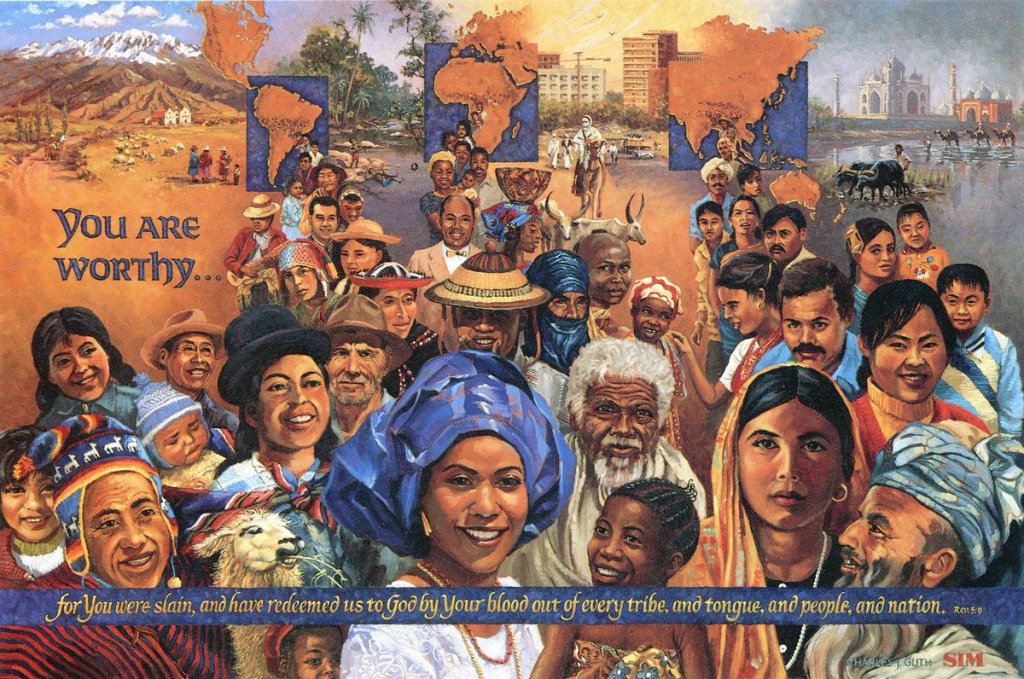
As Christians, we don’t ever want to be working at cross purposes to God! Diversity was God’s idea going all the way back to Genesis, and He shows where He is going with it in Revelation. This is the vision He gave John to share with the world to let us know His end game:


“After this I looked, and there before me was a great multitude that no one could count, from every nation, tribe, people and language, standing before the throne and before the Lamb. They were wearing white robes and were holding palm branches in their hands.  And they cried out in a loud voice:

“Salvation belongs to our God,
who sits on the throne,
and to the Lamb."

Revelation 7:9

God’s plan is to bring all the nations, tribes, and languages back together in all their diversity! Every different nation, and every different tribe, in all their different languages – diversity. But, they will be unified in their worship of the Lamb who sits on the throne. (Notice, it isn’t the Lion of Judah who appears on the throne, but the Lamb of God.)

God celebrates the diversity He created by gathering all the nations, tribes, and tongues together from around the world where they were scattered. Diversity is not pejorative. It is something God created in His wisdom that we can celebrate as we worship Him in one voice and many tongues.

If we pray authentically as Jesus taught us, we pray, “Our Father, who is in Heaven, hallowed be your name. Your kingdom come and your will be done on earth as it is in Heaven!” If we are praying for God’s kingdom on earth – now – as it is in heaven, we cannot really mean that if we do not embrace the diversity that God created on earth.

Continue reading “Redeeming Diversity, Equality, and Inclusion” →

Envisioning Where We Are Heading: The Kingdom of God

When pray these words that Jesus taught us to pray:

Our Father in heaven,
hallowed be your name.
Your kingdom come,
your will be done….

This is what the Father’s will ultimately looks like:

After this I looked, and behold, a great multitude that no one could number, from every nation, from all tribes and peoples and languages, standing before the throne and before the Lamb, clothed in white robes, with palm branches in their hands…. (Rev. 7:9)