And God Said

God is a communicator, and He made us for communication with Himself.


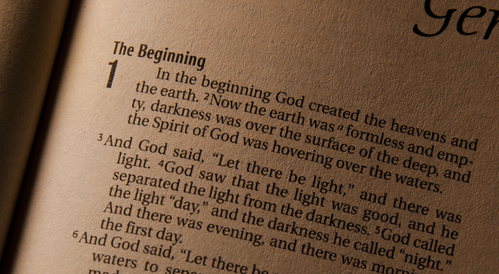
The parallels between Genesis 1 and John 1 are obvious. Genesis 1 reads:

In the beginning God created the heavens and the earth. (Genesis 1:1)

John 1 reads:

In the beginning was the Word, and the Word was with God, and the Word was God. He was with God in the beginning. Through him all things were made; without him nothing was made that has been made. (John 1:1-3)

These parallels convey the idea that God is “verbal” by His very nature, and He communicated the universe into existence. Indeed, the creation story as it unfolds in Genesis bears this out:

  • And God said, “Let there be light,” and there was light. (gen. 1:3)
  • And God said, “Let there be a vault between the waters to separate water from water.” (Gen. 1:6)
  • And God said, “Let the water under the sky be gathered to one place, and let dry ground appear.” (Gen. 1:9)
  • Then God said, “Let the land produce vegetation…. (Gen 1:11)
  • And God said, “Let there be lights in the vault of the sky to separate the day from the night….” (Gen. 1:14-15)
  • And God said, “Let the water teem with living creatures, and let birds fly above the earth across the vault of the sky.” (Gen. 1:20)
  • And God said, “Let the land produce living creatures according to their kinds…” (Gen. 1:24)
  • Then God said, “Let us make mankind in our image, in our likeness….” (Gen. 1:26)

It’s interesting, isn’t it, that a plural pronoun is used for God in Genesis 1:26. To be verbal by nature, communicative by His very essence, God must have relationship within Himself. In John 1, we read that “the Word was with God, and the Word was God”, and then John goes further to say this:

The Word became flesh and made his dwelling among us. (John 1:14)

Of course, he is talking about Jesus – God who became like us, the creatures He created in His own image. Of God and Jesus, John said,

“He came to that which was his own, but his own did not receive him. Yet to all who did receive him, to those who believed in his name, he gave the right to become children of God….” (John 1:11-12)

Continue reading “And God Said”

Taking the Bible Literally? Or Seriously?


Some people urge Christians to take the Bible literally. I don’t think taking the Bible literally is taking the Bible seriously enough. I think it’s a far more important matter to take the Bible seriously.

Consider John 1:1-3

In the beginning was the Word, and the Word was with God, and the Word was God. He was with God in the beginning. Through him all things were made; without him nothing was made that has been made.

John Lennox, the brilliant Oxford mathematician, relates a conversation he had with Peter Atkins, the prolific atheist scholar. When Lennox referred Atkins to John, Chapter 1, Atkins called Lennox naïve to believe that God has lungs, a voice box and a voice. Of course, that isn’t how Lennox (or anyone who takes the Bible seriously) understands those words at all.

I find it interesting that both atheists and fundamentalists tend to adhere to a literal reading of the Bible. The only difference between them is that one believes all of it, and the other believes none of it.

A literal reading of John 1:1-3 clearly misses the point. No one believes that God has lungs, a voice box and a voice. Rather, God is so “Other” from us that we must use devices, like metaphors, to conceptualize God. Metaphor conveys meaning in ways that meaning cannot be conveyed literally.

People often misunderstand what it means to read something “literally”. Lennox suggests that understanding the metaphor is reading the Bible literally. The metaphor is the literal meaning that is intended.

We have to take the Bible very seriously in order to understand this and to see the actual meaning that is there. When we read the Bible always “literally”, we are not taking the Bible seriously enough! (Not to mention that no one actually read every verse of the Bible literally, not even the literalists!)

Continue reading “Taking the Bible Literally? Or Seriously?”

Love: Who is Your Enemy?

Creative Commons

Asking who is your enemy may seem like a strange way to begin a blog article about loving your neighbor, but bear with me. My question is inspired by a different, but related, question. My question is inspired by the question asked by an expert in the law many years ago: “Who is my neighbor?”

This question followed a theological dialogue between the expert in the law and Jesus in which the expert in the law sought to test Jesus. (See Luke 10:25-29) As Jesus often did, though, the test put to Jesus turned into a challenge to the so-called expert.

The expert in the law asked Jesus the loaded question, “What must I do to inherit eternal life?” Jesus answered with his own question, “What is written in the law?… How do you read it?” Not to be shown up, the expert in the law answered:

“‘Love the Lord your God with all your heart and with all your soul and with all your strength and with all your mind’; and, ‘Love your neighbor as yourself.’” (quoting Deuteronomy 6:4 and Leviticus 19:18)

The expert in the law was probably looking for some debate, but Jesus wasn’t interested in debate. Instead, he simply concluded, “You have answered correctly…. Do this and you will live.”

The expert in the law had the tables turned on him. He wanted to test Jesus, but Jesus put the test to him, and now he was in defensive mode. He might said, “Wait a minute!” And then the question followed that leads me to my question, “Who is my neighbor?” If we have to love our neighbors, and if loving our neighbors is the measure for inheriting eternal life, we better know who are neighbors are!

But there is a back story here that leads from the one question to the other question. Apparently, the First Century Palestine Jews had interpreted Leviticus 19:18 to mean, “Love your neighbor; hate your enemy.”

How do we know that? It isn’t found anywhere in Scripture, but Jesus quoted the statement in the Sermon on the Mount when He said, “You have heard that it was said, ‘Love your neighbor and hate your enemy….’” Ah, and now you know where I am going, because Jesus followed with this:

“But I tell you, love your enemies and pray for those who persecute you, that you may be children of your Father in heaven. He causes his sun to rise on the evil and the good, and sends rain on the righteous and the unrighteous. If you love those who love you, what reward will you get? Are not even the tax collectors doing that? And if you greet only your own people, what are you doing more than others? Do not even pagans do that? Be perfect, therefore, as your heavenly Father is perfect.” (Matthew 5:43-48)

Lest there be any doubt who my neighbor, Jesus stretched it so far that love must reach all the way from my friends to my enemies and everyone in between!

And that leads me to the question, “Whos is my enemy that I must love?”

Continue reading “Love: Who is Your Enemy?”

Progression of Revelation in the Bible Part 2

In the Bible, we see a progression from Law to the spirit of the law, and from law to grace, and the seeds of that progression are there in the very beginning.


In Progression of Revelation in the Bible Part 1, I made the point that the Old Testament Scriptures anticipate and point toward Jesus. Jesus said he was the fulfillment of the Law and the Prophets. The thrust of the Scriptures from the Old Testament to the New Testament also progresses from physical to spiritual, from law to grace. I will pick up on those themes and get into the progression from law to grace in this piece.

Before doing that, though, I am taking a short sidetrack to recall an observation I made years ago as a college freshman in a world religion class. As I as I studied (and read) the Bible for the first time in my life I realized that the fabric of the Scripture, from beginning to end, is an intricately woven tapestry. I wasn’t a believer then, but I could see (as a budding English Literature major) the incredible, unlikely harmony of the Scriptures.

I say unlikely, because the Old Testament and New Testament are a combination of writings that were penned by dozens of people and collected over a period of many centuries. All of them wrote down the revelation each one of them received from God. The “book” of the Bible would be, perhaps, the finest masterpiece of cohesive literature ever written if it were written by a single author, but it’s cohesiveness and internal integrity is all the more noteworthy by the fact that it was written by dozens of authors across a large expanse of time.

People who understand the Bible only on a surface level claim it is full of contradictions. We should hardly find it surprising if it was full of contradictions, having been written by so many people over such a long time, but the thing is: a deeper reading of the Bible reveals an uncanny, transcendent, incredibly subtle and nuanced consistency and harmony.

The intricacy and harmony of the Bible is quite stunning given its authorship: the fact that it was written by people, and not by the hand of God Himself.

And this fact led me to another thought when I first read the Bible in its sweep from beginning to end: if God is God, 1) He could reveal Himself in a way that creatures made by Him could understand His communication; and 2) He could preserve the integrity of that communication. Why? Because He is God.

I didn’t become a believer immediately at that point in my life, but I could not deny the uncanny tapestry of the Scriptures.

I recall these things as I consider the Qur’an, and the progressive nature of the two religions’ Scriptures. In the Qur’an, statements in the later sura expressly contradict and abrogate (negate) earlier sura. The later sura are also the problematic ones in which we see statements about killing infidels, etc.

In the Bible, by contrast, we see the earlier Scriptures affirmed, explained and extended in the person of Jesus. We see a progression from Law to the spirit of the law, and from law to grace, and the seeds of that progression are there in the very beginning.

Continue reading “Progression of Revelation in the Bible Part 2”

Progression of Revelation in the Bible Part 1

The progression of the revelation in the Scriptures takes us from the faith of Abraham, to the Law of Moses, and full circle back to the beginning and the ultimate purposes of God.


My new favorite Podcast is the Unbelievable Podcast by Justin Brierley on the Premier Christian Radio in the UK. I was listening this morning to a dialogue with Abdu Murray, a Muslim, turned Christian, and Aliyah Saleem, a Muslim turned atheist. The discussion got me thinking about the idea of progressive revelation in both scriptures, the Bible and the Qur’an.

In Islam, the later sura exceed the earlier sura in importance. When a statement in a later sura contradicts a statement in an earlier sura, the doctrine of abrogation applies. The earlier statement is negated by the later statement. Thus, the statements found in the later sura carry the most weight.

A similar, but very different, idea arises in Christianity. Christians interpret the Old Testament through the lens of Jesus in the New Testament. In Christianity, however, statements in the Old Testament are not abrogated (negated); rather they are affirmed, explained and extended.

Jesus doesn’t give us the option of ignoring or negating the Old Testament. Perhaps, the most famous example of the way Jesus interpreted the Old Testament is found in the Sermon on the Mount where Jesus said,

“Do not think that I have come to abolish the Law or the Prophets; I have not come to abolish them but to fulfill them. For truly I tell you, until heaven and earth disappear, not the smallest letter, not the least stroke of a pen, will by any means disappear from the Law until everything is accomplished.” (Matthew 5:17-18)

Rather than abrogation, we get the idea of progressive revelation. Jesus affirms, builds on and extends the intent and purpose of the revelations revealed in the Old Testament. Even more significantly, Jesus says He is the fulfillment of the Law and the Prophets.

Continue reading “Progression of Revelation in the Bible Part 1”