
In my last blog post, I wrote about the crippled woman Jesus healed in the synagogue, to the synagogue leader’s chagrin (The Danger of Being Too Set in Our Interpretation of What God Requires and What He Is Doing). The synagogue leader thought Jesus shouldn’t be working/healing on the Sabbath, so he instructed the crowd that they could come any other day of the week to be healed, but not on the Sabbath. (Luke 13:10-17)
It seems ridiculous to us, but who knows what doctrines, dogmas, understandings, and ways of thinking we have that get in our way of recognizing God and what He is doing in our present time. If we shrug our shoulders at the seeming insignificance of the Sabbath concern, we will miss the weight of this encounter.
The keeping of the Sabbath was a sacred tradition that goes all the way back to Genesis, when God rested after the six (6) days of creation. (Gen. 2:2-3) Moses passed on the commandment directly from God when the Hebrews were delivered out of Egypt: “Six days you shall labor and do all your work. But the seventh day is a sabbath to the Lord your God; you shall not do any work….” (Ex. 20:9-10)
The Sabbath was reinforced by Moses as part of the covenant relationship established by God with the Israelites. Many centuries before Jesus, God told Moses:
“Say to the Israelites, ‘You must observe my Sabbaths. This will be a sign between me and you for the generations to come, so you may know that I am the Lord, who makes you holy. Observe the Sabbath, because it is holy to you. Anyone who desecrates it is to be put to death; those who do any work on that day must be cut off from their people.” (Ex. 31:13-14)
Can you see why the first century Hebrews held so tightly to their Sabbath doctrine? It was a commandment; it was sacred; it was an intimate sign of their covenant with God going back many centuries; and the penalty of violating the Sabbath in the Mosaic law was death (or being cut off from the people).
For that reason, the Jewish leaders added strict protocols to the observance of the Sabbath to be sure that no one violated it, even inadvertently. Thus, when Jesus did something highly irregular, like calling a crippled woman forward in the synagogue in the first place, and then healing her, the synagogue leader was legitimately concerned, in his mind, about a violation of that sacred commandment.
Yet, in his concern for not offending God and for observing law, he failed to recognize God in the flesh standing right before him! Ironically, the Law that was intended to point the Hebrews to God got in the way of the him recognizing God.
God commanded them to keep the Sabbath at the risk of death and exile! Thus, they believed they couldn’t be too careful! What are we to make of this?
One clue is in the details of the response by Jesus. He called the religious leaders hypocrites because they untied their livestock and took them out to get water on the Sabbath. (Luke 13:13) If they believed that caring for their animals on the Sabbath was ok on the Sabbath, they should have recognized that healing a person was ok also.
“Yes, but God commanded!”, the synagogue leader might have said. I suppose Jesus might have asked in return, “Commanded what?” The synagogue leader might have protested further, “But we cannot be too careful! These things are not to be taken lightly. We need to err on the side of caution, lest we step over the line!”
These things should not be taken lightly, no doubt, but the synagogue leader obviously missed something of essential importance. What he missed, I think is better understood in the context of some global criticisms Jesus expressed toward the religious leaders of his day (which likely are as applicable today as they were then):
“Woe to you, teachers of the law and Pharisees, you hypocrites! You give a tenth of your spices—mint, dill and cumin. But you have neglected the more important matters of the law—justice, mercy and faithfulness. You should have practiced the latter, without neglecting the former. You blind guides! You strain out a gnat but swallow a camel.” (Matt. 23:23-24)
The Law and all of its rules were not meant to be the end all be all. Paul says the law was a guardian or tutor to lead us to Christ. (Gal. 2:24) Perhaps partially, to help us recognize our need for Christ in our inability to keep the Law. Perhaps, partially, to provide rituals by and through which a relationship could be established with God. Perhaps, in other ways as well.
The point is that the Law was never meant to define the totality of God’s relationship with people. What God wanted, which is what the Law was intended to teach, was for the Hebrews to love Him and for them to love each other.
Jesus said as much when he said the Law can be summed up succinctly in two phrases: Love God, and love your neighbor.
This was not a new concept when Jesus spoke those words, though. Jesus was once asked, “What is greatest commandment?”, by a teacher of the Law. When Jesus said the greatest commandment is to love God, and the second greatest commandment is to love our neighbor, the teacher commended Jesus for the answer, demonstrating that the teacher of the Law knew the answer, himself. (Mark 12:28-34)
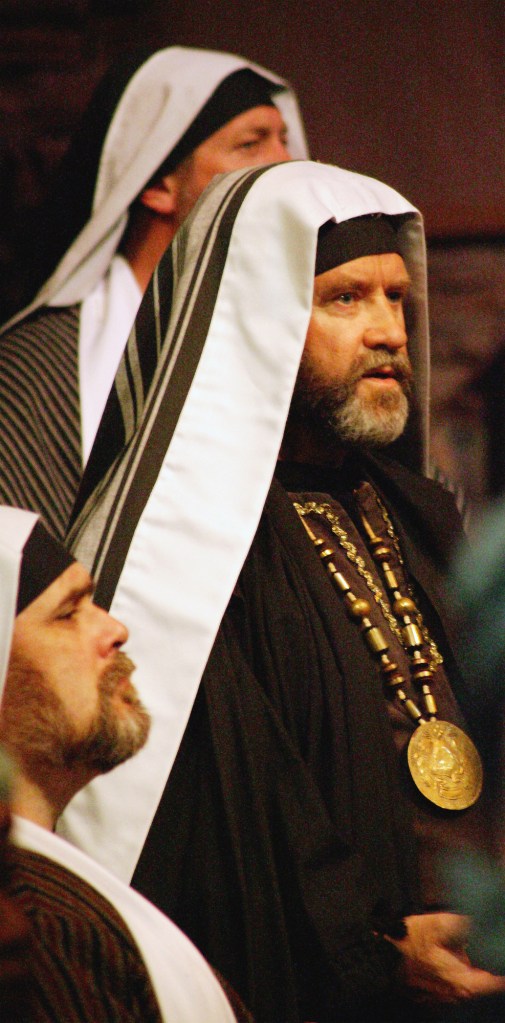
When the teacher of the law commended Jesus for the answer, Jesus told the teacher that he answered “wisely” and, therefore, is “not far from the kingdom of God.” (Mk. 12:34) In other words, the key to unlocking the “mystery” of the Law is to understand that it is meant to teach us to love God and love our neighbors. If we fail to see that, we are missing the boat
When we hold too tightly to our doctrinal constructs to the point that we miss the ultimate point, like the synagogue leader did, we fail to understand God; we fail to recognize God when He is acting in our midst; and we risk being on the “outside” with God, though we may be good, religious people in every other way.
Jesus said,
“The eye is the lamp of the body. If your eyes are healthy, your whole body will be full of light. But if your eyes are unhealthy, your whole body will be full of darkness. If then the light within you is darkness, how great is that darkness!”
Matthew 6:22-23
How do we apply this? How do we make sense of the things God has commanded us without missing the forest for the trees? How do we take a lesson from the synagogue ruler? I am no theologian, but I have some thoughts.
Continue reading “The Importance of Humility, Openness, and Generosity toward the Holy Spirit in Reading Scripture”





 Navigating by Faith