Is the Bible Scientifically Accurate?

Doesn’t the God of the universe know these things? Why doesn’t He get the facts right?!

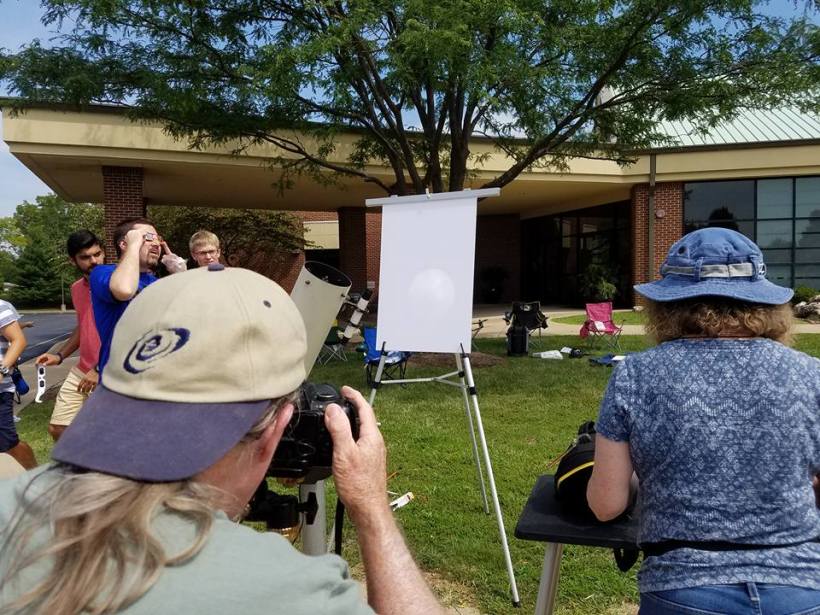
Photo taken of friends at a church in Missouri viewing the eclipse

I listened to a presentation by Jon Jorgenson on Science vs. the Bible in which he addressed the question whether the Bible has any scientific errors. Jon’s YouTube channel is aimed at teenagers and young adults, and he is a prolific producer of inspirational and devotional material.

He acknowledges, the answer, literally, is yes. For instance, in Genesis, the author describes the Moon as a “lesser light”, but we know the Moon is not technically a light. It doesn’t generate light of its own like the Sun.

Another example is the parable of the mustard seed. Jesus calls the mustard seed the smallest of all seeds. We know that there are other seeds in the world that are smaller than mustard seeds.

For these reasons, we cannot honestly say that the Bible, on its face, taken literally, is scientifically accurate. It simply isn’t.

Jon offers that we shouldn’t expect the Bible to be scientifically accurate because it isn’t meant to be.  2 Timothy 3:16 states: “All Scripture is inspired by God and profitable for teaching, for reproof, for correction, for training in righteousness”. (NASB) From this, he makes the point that the Bible is written for a different purpose.

Still, one might ask, doesn’t the God of the universe know these things? Why doesn’t He get the facts right?!

Continue reading “Is the Bible Scientifically Accurate?”

Does God Live Under Your Bed?

A loving God who is just and fair would not foreclose a connection to those who are born without the intellectual capacity to understand or know what is required of them

Depositphotos Image ID: 154118170 Copyright: ImageSource

I read an autobiographical account by CS Lewis in college in which he recounted his journey from atheist to agnostic to Christian. The twists and turns of his journey were fascinating to me. I gained much insight into my own journey and how God works in the hearts of people who are inclined to follow the prompts.

His journey was like mine in some respects and much different in others. Just as I see how uniquely tailored and personal those prompts were for me, they were just as uniquely tailored for CS Lewis.

The God revealed in the Bible is a Person, and He is personal. He made us in His image. He made us to have relationship with Him. He relates to us as no one can. He knows our innermost being. I have found all these things to be true to my own experience.

After CS Lewis conceded the intellectual point that the universe was more likely created by a Causal Agent than not, he began to sort through the various possibilities for what that Causal Agent could be. Searching out the various world religions, he found that one stood out. One was not dependent on man’s own capacity to know or to understand. All other religions required special knowledge, understanding, and effort to achieve a connection with that Causal Agent.

He reasoned that a loving God who is just and fair would not foreclose a connection to those who are born without the intellectual capacity to understand or know what is required of them. Such a God would have to be accessible by all people, regardless of capacity. The complexities of religion did not seem appropriate to Lewis as he contemplated these things.

Continue reading “Does God Live Under Your Bed?”

Intellect and Faith

Photo by Tyler Drendel - Sunset at Fermi Lab
Photo by Tyler Drendel – Sunset at Fermi Lab

Following from part one of twobeing honest about the who and what of our underlying presuppositions

Think about it: can a finite being measure or define, let alone manipulate, an infinite God?

If God is “big” enough to create a universe so large that we cannot see past the beginning or the end, how do we expect to measure such a God?

We are more comfortable in our own element. We can understand the what and the how of the world we live in, but the who is another matter altogether. Non-believers go no further and declare, the “what” and the “how” to be all there is.

At the same time, believers should not be afraid of facts or science. Facts and science help us to know and understand the what and how of creation – and they point to the Who. If we have an attitude open to the Who, we will see the evidence for God. In fact, it will seem self-evident. If a person wants “proof” before belief, such a person will never be satisfied – especially when the proof is a priori limited to the what and the how.

Continue reading “Intellect and Faith”

A Time for Courage

 (c) Can Stock Photo

(c) Can Stock Photo

We don’t always think about the courage necessary to be a follower of Christ.  Sure, we know the words that Jesus spoke: If you deny me before men, I will deny you before the Father.[1]  But we tend to view those words through the fear of being found wanting.

Fear is a bad motivator. I don’t think our tendency to be afraid of losing our salvation serves us very well.  Perfect love casts out all fear. God is looking for the courageous, not the fearful.

Jesus actually spoke those words in the context of fear.[2] And the message from Jesus is: do not fear! Continue reading “A Time for Courage”

Be Faithful to the Gospel This Election Season

canstockphoto2856260/csp2856260

Our freedoms in this country may just be the one thing that most undermines the Christian faith in the United States of America. This election cycle has had me doing lots of soul searching. In the process of that soul-searching, it dawns on me that our freedom to choose which person we will vote for in November puts us squarely in a position where we have to compromise our faith.

People have been talking about Donald Trump as if he were the Nebuchadnezzar of the present day, but he isn’t. The people in the days of Nebuchadnezzar had no choice. In the present day, we do have a choice. When Daniel was faced with compromising his faith or being a loyal servant of Nebuchadnezzar, he chose not to compromise his faith, in spite of the consequences.

He could have easily justified a different choice. Continue reading “Be Faithful to the Gospel This Election Season”