Who Is God? How Can We Approach Him? What Do the Answers Mean for Us Today?

Many things to which we devote our energies are good, but they become idols when they become our “ultimate things”.

Who will approach God? Who is the King of Glory? These are questions David poses in Psalm 24, one of the Messianic Psalms.

He begins with recognizing who God is. God is the creator of everything there is, and He possesses and has authority over all that He created.

The earth is the Lord’s, and everything in it,
    the world, and all who live in it;
for he founded it on the seas
    and established it on the waters.

Psalm 24:1-2

Though the nations all around David had their own gods in various images and likenesses, David recognizes that there is only one, creator God. One God made the heavens and the earth, and there is no god like Him. In that context he asks the question:

Who may ascend the mountain of the Lord?
    Who may stand in his holy place?

Psalm 24:3

How does one approach a God like that? How do created beings, such as ourselves, approach the God who created us? David understands that we can only approach such a God on His own terms:

The one who has clean hands and a pure heart,
    who does not trust in an idol
    or swear by a false god.

Psalm 24:4

Only a person with clean hands and a pure heart can approach a God like that. Only a person who trusts in such a God, alone, can approach Him. Only a person who understands truth and is free of deceit.

Can any of us say that we meet these conditions?

If we think honestly on these things, we have to realize that we don’t. The truth is that no one is righteous, not even one person. (Psalm 14:3; Psalm 53:3; and Romans 3:10)

Think of David, the very person who wrote this Psalm. He didn’t meet those conditions, and he certainly knew it. He is one of the most flawed people of all the people of faith in the Bible. He knew where he stood with God.

The problem: we want clean hands and a pure hear; we want to trust in God alone, and we want to hold to nothing but the truth. The truth is, though, that no one meets these conditions. No one can approach a holy God!


Yet, this Psalm exalts in the anticipation of connecting with such a God – a God who made and possesses the universe, a God who can only be approached with cleans hands, a pure heart, with singleness of devotion and in the fullness of truth. This is because David anticipates something. And this is where the Psalm shifts:

They will receive blessing from the Lord
    and vindication from God their Savior.
Such is the generation of those who seek him,
    who seek your face, God of Jacob.

Psalm 24:5-6

The resolution to the problem is that we do not approach God: He approaches us. We must receive from God his blessing and vindication. It is nothing we can ascend to, nothing we can achieve.

God knows this well, and He provided a way. As with Abraham for whom God provided a ram caught in the thicket to sacrifice in place of his son, Isaac, God has provided for us what is necessary to clear the way for us to receive Him. Through Christ, we are made holy, clean and new.[i]

The Psalm is considered “Messianic” because David anticipates our need for God to come to us, to provide for us. He says:

Lift up your heads, you gates;
    be lifted up, you ancient doors,
    that the King of glory may come in.

Psalm 24:7

Thus, David exalts not in the prospect that someone might ascend to heaven, but in the anticipation that God will descend to us. God meets us where we are. But there is more to this than God simply meeting us where we are: we need to be ready to receive Him.

Before the church service that inspires this article this morning, I read an article in my newsfeed: How the Capitol attacks helped spread Christian nationalism in the extreme right, from the Religious News Service. It may seem like a strange tie in to Psalm 24, but I hope you will stick with me to see the connection.

Continue reading “Who Is God? How Can We Approach Him? What Do the Answers Mean for Us Today?”

Tribalism and the Body of Christ: What Unifies Us, & What Separates Us is Key

We can’t avoid the conflict of differing views, but we need to be careful how we differ with people and over what we differ with them.

I have been listening to the podcast, Truth Over Tribe, beginning with the episode, How Tribalism Is Ruining Your Life, on Podbean. Check it out.

Whether you label it polarization or tribalism, I have seen people entrenching and doubling down in their political positions more than at any other time in my life. Thus, the podcast resonated loudly with me.

In writing this piece, I am not focusing on people, generally, or the state of governmental affairs. My focus here is the body of Christ and it’s witness in the world. People have always been divided. We have always had wars and fighting to prove it. The Church, however, should be different. The Church should stand a part, like a city of a hill.

Continue reading “Tribalism and the Body of Christ: What Unifies Us, & What Separates Us is Key”

How the “God of the Old Testament” vs. God of the New Testament Idea Might Inform Our Politics

We should have the same mindset as Jesus in doing politics.


In the short YouTube segment, Are There Two Different Gods in the Old and New Testaments? (Part Two), Gareth Black does a good job describing why God appears differently in the Old Testament than in the New Testament. There is one God, but He relates differently to people.

I have explored this dichotomy before, but I don’t want to focus on it here, other than to set the stage for what I really want to lay out. The difference in the way God related to people at different times might just become a guide for Christians doing politics.

First, we know the orthodox view: that the God of the Old Testament is the same God revealed in the New Testament through Jesus. While, heretics abound, this is the accepted view. Still, it sometimes seems like a tough pill to swallow.

God in the Old Testament focuses on commandments. He seems full of judgment and anger. The Ten Commandments God gave Moses became legion with all the ceremonial laws, food laws, cleansing laws, and dozens of other laws people were commanded to follow.

In the New Testament, it may seem like Jesus paid “lip service” to the laws (saying he didn’t come to abolish the Law), because he simplified them into just two commandments: love God and love your neighbor. Easy, right?

At the same time, Jesus seemed to turn up the heat. In the same discourse in which he said he didn’t come to abolish the law, he told his audience the following:

  • It’s not enough to refrain from murdering people; harboring disdain in your heart is like committing murder;
  • It’s not enough to refrain from committing adultery; lusting after a person in your heart is like committing adultery.

He said more than that, but you get the point. So, it’s as simple as loving God and neighbor. At the same time, it’s as difficult as controlling what is in your heart!

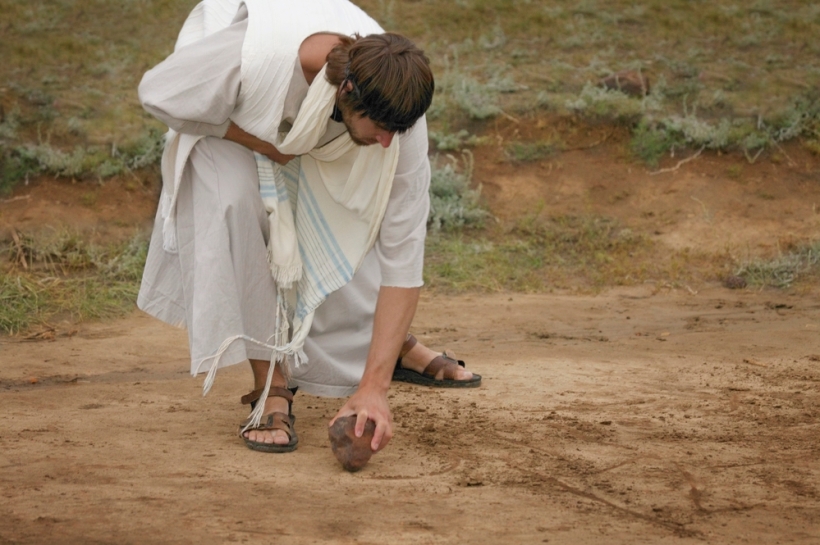
To say that Jesus went easier on people is to ignore these things that he said. At the same time, Jesus confronted the men who wanted to stone the woman caught in adultery and saved her. He said he didn’t condemn her (though he also told her, “Go and sin no more.”)


What in the world is going on? If it seems difficult to sort out what is going on here, join the club.

Black offers one explanation in the video. He says God relates to people differently at different times, just as a parent relates differently to their children at different times. Parents tend to be strict with little children, imposing lots of rules about bedtimes, eating, watching TV, playing video games, doing homework and doing chores and so on.

That relationship can get contentious at times, especially as children get older and become more difficult. After children move out of the house, though, the relationship changes. It’s not that parents think the rules were bad; rather the children become adults, and become responsible for setting their own rules.

The analogy isn’t exactly the same with God, but similar. Paul says the Law was given to us as a guardian (tutor, schoolmaster, instructor, etc.). (Galatians 3:24) The Law was given to teach us something, to lay a certain foundation of understanding. The idea that Paul probably had in mind was a stern, taskmaster, training the children up with discipline.

The taskmaster’s relationship to the children is different than a parent’s relationship. A tutor only trains the children for a time when they are young. The instructor’s job is to make sure the children learn their lessons, and that is the only focus.


A parent is always a parent and never ceases to be a parent who loves and wants the best for the children. A taskmaster doesn’t love the children like a parent does.

But, it’s more complicated than that, and this is the key. The prophet Jeremiah talked about it in the context of a new covenant this way:

“I will put my law within them, and I will write it on their hearts. And I will be their God, and they shall be my people.” (Jer. 31:33)

This is God’s ultimate goal: that we would be receptive, willing and able to receive God’s law in us, written on our hearts.

God isn’t looking for law followers, but for children who desire to be like their father. He wants us to internalize His values and be like Him – not because we must, but because we want to!

Until Christ came, men were under the Law, but Christ came to earth in the form of a human and fulfilled the Law. He died to take the penalty for our transgression; he rose from the dead to demonstrate his authority and power over death; and he ascended to heaven, leaving the Holy Spirit as a guide and comforter for us.

The Holy Spirit is how God now writes his Law in us, on our hearts. The Law is set aside, now, with its commands and regulations. (Eph. 2:15) God is looking for people willing to receive is Spirit and internalize His character in themselves as His children.

But what does this have to do with politics?

Continue reading “How the “God of the Old Testament” vs. God of the New Testament Idea Might Inform Our Politics”

What It Means to Follow Jesus in Babylon

Live your lives, Increase and multiply. Seek the welfare of this world, BUT ALWAYS REMEMBER that this world is passing away

I tried to set the stage for what it means to follow Jesus in Babylon with a prior post: God’s Ways: a Primer for What It Means to Follow Jesus in Babylon. It is a kind of running start – a view from 40,000 feet. The purposes of God establish the context for understanding how we follow Jesus in Babylon.

Jesus, of course, did not live in Babylon during the 30-some years he walked the earth. I am speaking figuratively here. Jesus urged people to follow him, to live as he did and to “walk” as he walked – to be imitators of Jesus as he was an imitator of God the Father. We follow Jesus wherever we are.

Most people reading this blog don’t live in Babylon either, as in the ancient city. Rather, Babylon is symbolic of our lives in this world. Just as the exiles found themselves living as foreign people in a foreign land filled with foreign gods, followers of Jesus today are aliens and strangers in this world living among people who do not bow down to our God.

When Jeremiah wrote to the Jewish exiles in Babylon right after they were taken captive, right after they lost everything (their homes, their lives as they knew them, the Temple around which their community was organized), his words would have been difficult to receive.

“Thus says the Lord of hosts, the God of Israel, to all the exiles whom I have sent into exile from Jerusalem to Babylon….”

Jer. 29:4

That God “sent” them into exile would have been a painful reminder of all the warnings of the prophets leading up to the final siege of Jerusalem, captivity, and long march to Babylon. Jeremiah had their attention, though. The unthinkable that Jeremiah had long been predicting actually happened.

In that context, this is what he said:

“Build houses and live in them; plant gardens and eat their produce. Take wives and have sons and daughters; take wives for your sons, and give your daughters in marriage, that they may bear sons and daughters; multiply there, and do not decrease. But seek the welfare of the city where I have sent you into exile, and pray to the Lord on its behalf, for in its welfare you will find your welfare.”

eremiah 29:5-10

I don’t think we can emphasize enough the timing of these words: this was the very beginning of the exile. They just lost everything. They just got there. Their future was uncertain. Though they had some hope of returning to their homeland (because the prophets who warned them of the exile also predicted their return), their hope was faint at this point. 

I assume that most of the people reading this blog are not exiles, though many hundreds of thousands of people are refugees in this modern world. Even those of us who are not refugees are not “of this world” if we belong

In the rest of this blog, I will relate those words Jeremiah wrote to the exiled Jews in ancient Babylon to our lives in our modern “Babylon” today, and I will add in the warning, and the encouragement, that Jeremiah gave in the letter that are also instructive to us today. I believe Jeremiah’s words of instruction are how we should follow Jesus in Babylon.

Continue reading “What It Means to Follow Jesus in Babylon”

What Does the Church Have to Do with Judging Outsiders? Politics, the Gospel and Whose Side Is God On?

Paul said, “What business is it of mine to judge those outside the church?”

Paul said, “What business is it of mine to judge those outside the church?” (1 Cor. 5:12) This is where my mind went when I watched An (Un)Civil War: The Evangelical Divide posted online recently by CBS News. In the next moment, I was asking question Joshua asked the commander of the army of the Lord: “Are you for us or for our enemies?” (Joshua 5:13)

If you know the Lord’s answer to Joshua’s question, think about it for a moment. The subject here is the modern form of evangelicalism that is highlighted in the CBS piece linked above: hyper patriotic, nationalistic and political. I will come back to the Lord’s response to Joshua before I conclude. (You can read the passage now if you are too curious to wait.)

I hardly watch the news anymore, and CBS is certainly not my “go to” news source. I don’t have one. The portions of the CBS piece that are ringing in my head are the clips of the evangelical leaders preaching and explaining themselves in their own words.

I do understand that these clips are selected and don’t represent all that these leaders stand for or all that they might say. What they reveal, though, is enough to move me to write.

The clips show various preachers unapologetically “speaking the truth” from the pulpit, which the commentator calls “sermonizing a brand of social conservatism defined by conspiracy and apocalyptic rhetoric”. The words of the commentator are not what catch my attention, but they should be noted for the way they are perceived.

The piece focuses on what is described as a “power struggle” in evangelical circles. That is how the world sees the difference in opinions by evangelicals: a power struggle inside Christianity “at war within itself”.

One firebrand pastor (Greg Locke) touts the amount of support for his position, seeming to affirm the perception that it’s all about power and influence. In the world of politics, the number of evangelical constituents (over 1 in 4 Americans) is a matter of power and influence to political pundits. Locke’s comment and the concern expressed in the media piece align on that basis.

(I question whether 1 in 4 Americans are really evangelicals in the way I and most people of genuine faith define evangelicals. The statistic is a political one, not a religious one, but that is a topic for another day.)

One pastor is heard saying, “But we shouldn’t talk politics in religion. Says who? Satan?! That’s the only way they control us!”, he says. “To get us to be silent.”  

Indeed, power, influence, and control are at the center of this phenomenon. At the same time, Locke claims that the Bible is the issue, “Here is what the Bible says. Boom! We’re going to go with it!”

Locke views himself as fighting for the Bible, fighting for ‘God and country”, trying to wrestle the United States out of the grip of the left and Satan. But, is that really what is going on? What about the Bible?

Are they actually preaching what the Bible says?

There is so much to be said here, but I want to focus on just three things: 1) what the Bible says; 2) what the message of the Gospel is; and 3) whose side God is on in this struggle.

Continue reading “What Does the Church Have to Do with Judging Outsiders? Politics, the Gospel and Whose Side Is God On?”