Thoughts on the Sanctity of Human Life, Injustice and Unity in the Church in the United States

God’s desire is to save us, to have relationship with us, to renew our minds and to conform us to His image.

Reading in Exodus today, I observe that two passages in the first two chapters have poignant application to the Body of Christ in the United States today. I see two predominant lines of injustice in the United States to which the Church collectively has given its attention that are identified in these first two chapters of Exodus.

At the same time, the Church is divided on justice issues. I don’t say this to condemn or to be judgmental. It’s simply a fact that I think we need to recognize soberly, honestly and humbly.

We might find many examples, but the one that comes to mind – the one that is, perhaps, most poignant in this given time – is the division between black and white and the division between supporters and and non-supporters of Donald Trump.

I know: I said one example, and it seems I given two here. These are two examples, but they coalesce into one. The proof for that is in the statistics that show that approximately 80% of white evangelicals support Trump, and approximately 80% of black “evangelicals”[i] do not support Trump.

Now, I recognize that these statistics are sweeping generalizations, but generalizations do tell a story. There is some reflection of truth in them. I also don’t mention Trump to be divisive here. The example simply is provided for illustration.

Churchgoing African Americans can be as theologically conservative on things like what it means to be born again as white evangelicals, but their individual and collective experiences give them a different perspective on life. Their view of the world and injustice is different than their white, evangelical counterparts, for the most part, and influences them to have different political affiliations.

My reading in Exodus (which I will get to) is timely because today is Sanctity of Life Sunday. I didn’t even realize it when I did my daily reading after I woke up this morning.

I didn’t realize it until I tuned into the Manchester (NH) Vineyard Community Church service this morning. I have never tuned into their services, until today, though I know people affiliated with them. When I set out to participate in a more local church service, I believe God drew my attention away to this one.

It was a great message, and I gained some perspective from it that, perhaps, God wanted me to have in writing this. With that introduction, let me explain the passages in Exodus that prompt my writing. Those texts include Exodus 1 (about the killing of babies) and Exodus 2 (about slavery).   

I will take these things one at a time and draw some conclusions consistent with the burden God has placed on my heart over the years. In another article, perhaps, I will explain how my perspectives have changed and, hopefully, shed some light on how the church can come together in the full council of God to advance His justice and righteousness.

Before I get into my immediate thoughts, though, I need to say that I speak with no condemnation in my heart

Just as Jesus said to the woman caught in adultery that he did not condemn her, I am reminded that God sent his son into the world not to condemn the world; God sent His son into the world so that the world might be saved through him. (John 3:17)

I do not say these things to condemn anyone because Jesus has redeemed us!


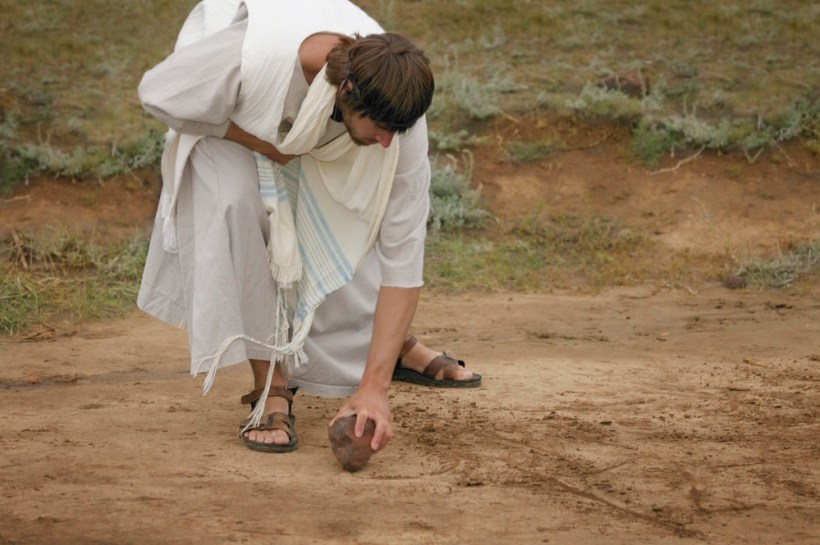
In the story of the woman caught in adultery, the Pharisees and Sadducees brought her to Jesus to challenge him because the Law required her to be stoned. They wanted to see what Jesus would do, but Jesus seemed to ignore them and began writing in the sand.

Some people believe that Jesus may have written the Ten Commandments out in the sand. When he looked up from from writing, Jesus “invited” them, saying, “He who is without sin may cast the first stone.” Then, he continued writing in the sand.

Some people believe he was writing down the sins those men had committed. They would say the men walked away silently because they realized that no one is without sin.


The wages of sin for every person is death.

Whatever he wrote, we know how the dialogue went next. “Jesus stood up and said to [the woman], ‘[W]here are they? Has no one condemned you?,” John 8:9) When she replied, “No one”, Jesus said, “Neither do I condemn you.” (John 8:10)

Jesus didn’t condemn the men either, because he told us he came not to condemn, but to save. I imagine that, Jesus would have received, forgiven and invited the men to follow him, if they had stayed and repented.

God desires to save us, to have relationship with us, to renew our minds and to conform us to His image. Our sin is the reason God became flesh and died for us. He came not to condemn, but to demonstrate His great love for us and to save us from the sin that enslaves us.

One last thing before I get into what I believe God has put on my heart to share: salvation and sanctification is a process. It starts where we are. When we are born again, God begins to work in us to will and to act according to His purposes and to conform us to His image, but we start that process in different places.

One point made in the sermon today, is that “a person doesn’t have to be pro-life to be saved”. People are saved by grace; it’s a gift that we haven’t earned. There will be no exam in heaven we must answer satisfactorily for salvation. It’s already been accomplished for us by Christ’s death and resurrection.

At the same time, if we are born again, God has begun a work within us. He has begun to renew our minds, and change our hearts, and we have begun to learn to think God’s thoughts after Him and become like Him.

With that said, I will address the two texts I read today in Exodus 1 and 2 that speak to me about the Church, collectively, in the United States. In writing this article, my hope is to provide some biblical basis on which we might begin to bridge the divide along racial and political lines and come together as the body of Christ. I hope to provide some perspective and understanding that will bring us together in Christ.

Continue reading “Thoughts on the Sanctity of Human Life, Injustice and Unity in the Church in the United States”

Toward an Understanding of the Wrath of a Loving God

If there is no God whose wrath will produce ultimate justice, we who are justice-minded have no recourse other than to respond in kind


I am currently reading, A Gentle Answer: Our “Secret Weapon” in an Age of Us Against Them, by Scott Sauls. The following statement in the book reminded me of similar observations made by Miraslav Volf:

“Some [people] object [to the idea of God’s anger] strongly: ‘…. If there is a God at all for me, it’s not an angry God. My God is loving. My God would never lash out or punish or judge or get angry at people.’ When I hear someone discount or downplay the biblical idea of God as a judge, whose holiness sometimes includes expressions of anger, I wonder if they have ever been the bullied kid, or the abused woman, or the oppressed slave, or the assault victim? I wonder if they have sat down and listened to the story of a holocaust victim, or of someone whose child was kidnapped, or of a woman whose husband abandoned her for a younger mistress?’”

I have heard Tim Keller talk on the subject, and the most poignant source of his ideas that he quoted was writings by Miraslov Volf, the Croatian theologian, professor of Theology and Director of the Yale Center for Faith and Culture at Yale University.

Volf was influenced by his own experience with the Yugoslav Wars, characterized by the ethnic cleansing that raged in what is now known as Croatia in what is, perhaps, his most influential writing: Exclusion and Embrace: A Theological Exploration of Identity, Otherness, and Reconciliation (1996). According to Wikipedia, “Exclusion and Embrace deals with the challenges of reconciliation in contexts of persisting enmity in which no clear line can be drawn between victims and perpetrators and in which today’s victims become tomorrow’s perpetrators—conditions that arguably describe the majority of the world’s conflicts.”

That context might represent a large portion of the world we live in at various times and places. Think Hatfields and McCoys, for instance. In a later work, Volf reflected:

“I used to think that wrath was unworthy of God. Isn’t God love? Shouldn’t divine love be beyond wrath? God is love, and God loves every person and every creature. That’s exactly why God is wrathful against some of them. My last resistance to the idea of God’s wrath was a casualty of the war in former Yugoslavia, the region from which I come. According to some estimates, 200,000 people were killed and over 3,000,000 were displaced. My villages and cities were destroyed, my people shelled day in and day out, some of them brutalized beyond imagination, and I could not imagine God not being angry. Or think of Rwanda in the last decade of the past century, where 800,000 people were hacked to death in one hundred days! How did God react to the carnage? By doting on the perpetrators in a grandparently fashion? By refusing to condemn the bloodbath but instead affirming the perpetrators basic goodness? Wasn’t God fiercely angry with them? Though I used to complain about the indecency of the idea of God’s wrath, I came to think that I would have to rebel against a God who wasn’t wrathful at the sight of the world’s evil. God isn’t wrathful in spite of being love. God is wrathful because God is love.

“Once we accept the appropriateness of God’s wrath, condemnation, and judgment, there is no way of keeping it out there, reserved for others. We have to bring it home as well. I originally resisted the notion of a wrathful God because I dreaded being that wrath’s target; I still do. I knew I couldn’t just direct God’s wrath against others, as if it were a weapon I could aim at targets I particularly detested. It’s God’s wrath, not mine, the wrath of the one and impartial God, lover of all humanity. If I want it to fall on evildoers, I must let it fall on myself – when I deserve it.

“Also, once we affirm that God’s condemnation of wrongdoing is appropriate, we cannot reserve God’s condemnation for heinous crimes. Where would the line be drawn? On what grounds could it be drawn? Everything that deserves to be condemned should be condemned in proportion to its weight as an offense – from a single slight to a murder, from indolence to idolatry, from lust to rape. To condemn heinous offenses but not light ones would be manifestly unfair. An offense is an offense and deserves condemnation…” (From Free of Charge: Giving and Forgiving in a Culture Stripped of Grace pp. 138-139)

These poignant reflections work toward the “appeal”, or at least makes some sense of, the idea of a wrathful, but loving God. I sense, though, that people of modern sensibilities may still be reluctant to credit the goodness of a wrathful God. This is where Miraslov Volf brilliantly exposes the faulty thinking of the western mind that has been largely untouched by evils that are reality in many other areas of the world: Continue reading “Toward an Understanding of the Wrath of a Loving God”

When Truth Stumbles in the Public Squares

Have you ever considered how vital truth is to justice? 


“Justice is turned back, and righteousness stands far away; for truth has stumbled in the public squares….”

Thus, said the Prophet Isaiah (Isaiah 59:14 ESV) to the nation of Judah approximately 700 years before the new millennium that begins at 1 AD. Thus, might a modern prophet say today, over 20 years into the new millennium beginning with 2000 AD. Justice is still turned back while truth stumbles today in the public squares.

Fake news is the story of our times. We can’t trust anything written or said in the public squares. Never has so much information been available to people; but the glut of information comes without a guaranty: Buyer beware.

Indeed, information has become a commodity that is bought and sold. We get to choose our own facts. We can take our facts from Fox News, CNBC, Dailywire, Buzzfeed, and hundreds (probably thousands) of sources – served up just the way we like them.

We’ve also dispensed with the distinction between fact and opinion. Facts now are served up with ready interpretations. We used to call it “spin”, but we don’t even bother anymore. Facts are sorted for us as well, packaged together in neat bundles, with the pesky counter facts removed for our convenience.

Have you ever considered how vital truth is to justice?

Should there be any wonder that justice is turned back as truth stumbles in the public square?

“Behold, the Lord ‘s hand is not shortened, that it cannot save, or his ear dull, that it cannot hear; but your iniquities have made a separation between you and your God, and your sins have hidden his face from you so that he does not hear…. No one enters suit justly; no one goes to law honestly; they rely on empty pleas, they speak lies, they conceive mischief and give birth to iniquity…. [W]e hope for justice, but there is none; for salvation, but it is far from us. For our transgressions are multiplied before you, and our sins testify against us; for our transgressions are with us, and we know our iniquities: transgressing, and denying the Lord, and turning back from following our God, speaking oppression and revolt, conceiving and uttering from the heart lying words.”

Isaiah 59:1-2, 4, 11-13 ESV

The way to justice is the way back to God. The way to justice requires truth, honesty, integrity and righteousness.

Contemplating the Failure of Our Attempts at Justice

Even when we strive in good faith with our best efforts, we often fail.


“Like a pregnant woman who writhes and cries out in her pangs when she is near to giving birth, so were we because of you, O Lord; we were pregnant, we writhed, but we have given birth to wind. We have accomplished no deliverance in the earth….” (Isaiah 26:17-18 ESV)

These words were written approximately in the 700’s BC by the prophet, Isaiah. Yet, there are as relevant today as they were almost 3000 years ago.

That is my opinion, of course. What do I know?

As an attorney, I am in an unique position to speak to the American system of justice. I have seen it operate from the inside out, and I have participated in it for going on 30 years, so I think I have sufficient insight to be able to provide a well-informed opinion on the subject.

I was intrigued, even stricken by a bit of awe, in law school as I studied the history of American jurisprudence (with its roots in English common law, but for Louisiana, which has roots in the French legal system of justice). The principals, which build on themselves going back to ancient times, and the care and thought that informed American Jurisprudence is something for which I developed quite an appreciation. Many of those principals were, in turn, developed in view of the ancient texts that we call the Bible.

I graduated from law school at the age of 31, having much “real world” experience under my belt before law school, but I was filled, nevertheless, with the kind of naivete and idealism that is informed by the theory but is untried in the practice.

I have tried hard to carry with me the ideals of justice that inform our legal system, and I have fought for almost 30 years, now, to implement them to the extent that they are within my control of influence. Unfortunately, one person is not able to move those wheels of justice that grind very far off the course on which they doggedly and often very bluntly drive forward leaving casualties of justice in the great ruts they create.

Relative to current events, a 2018 report to the UN on the criminal justice system in the United States reveals some gross disparities in the outcomes. “African-American adults are 5.9 times as likely to be incarcerated than whites and Hispanics are 3.1 times as likely.” The report summarizes the disparities in this way:

“The source of such disparities is deeper and more systemic than explicit racial discrimination. The United States in effect operates two distinct criminal justice systems: one for wealthy people and another for poor people and people of color. The wealthy can access a vigorous adversary system replete with constitutional protections for defendants. Yet the experiences of poor and minority defendants within the criminal justice system often differ substantially from that model due to a number of factors, each of which contributes to the overrepresentation of such individuals in the system.”

Racial disparities in our criminal justice system are only one area in which our system of justice fails to provide the justice it promises. On the ground level, I saw the failure of justice nearly every time I stepped into a courtroom in thousands of ways, big and small.

Continue reading “Contemplating the Failure of Our Attempts at Justice”

Being Innocent as Doves and Wise as Snakes in the World of Justice

We do a yeoman’s job of distinguishing ourselves from the world, but we are not doing well distinguishing ourselves to the world. 


I have been wrestling with the divergent views of social justice, critical theory and gospel justice for some time now. They all “compete” in the same arenas, have some overlapping commonality, but they diverge in some very fundamental ways. I am not going to get into those difference here, but I want to try to open a discussion about how we, as Christians, move in these areas and discuss them in ways that honor the desire of Jesus to leave the 99 and go after the lost sheep.

I am writing this after reading a well-written article by Natasha Crain, 5 Ways Christians are Getting Swept into a Secular Worldview in This Cultural Moment. I like that she starts out by acknowledging that George Floyd’s death, which prompted a massive public response, was unjust, and that racism is not only wrong; it is not biblical. She acknowledges that Christian can agree with the secular world on those points.

She goes on to describe five (5) ways in which Christians get swept along by secular currents that are not biblical in attempting to respond to injustice. Critical theory (and critical race theory), in particular, is antithetical to Christianity in some of its core tenets. Though she doesn’t really say it directly, critical race theorists and Christians can both agree that injustice exists and even on that much of what that injustice looks like. The real divergence is in the worldview that informs and under girds critical race theory and its proposed solutions.

I am not going to talk about the details of those differences either. (I did a little bit of that in Critical Race Theory from a Christian Perspective.) What I want to address, using Natasha Crain’s article as a backdrop, is the extent to which I believe the evangelical church failed to address justice issues as God would have us address them.

We are good at preaching the good news (the Gospel), and good at proclaiming truth (including articles like Natasha Crain’s article detailing what is wrong with the critical race theory and social justice efforts the truth and/or leave the Gospel out of the equation), but we are not so good at doing justice. (I have written about this recently here, here and here.)

I see many articles like Natasha Crain’s article, and I hear many voices warning about the evils of critical race theory and social justice initiatives that are divorced from the Gospel, but we need positive voices to speak into the area of justice from the position of the Gospel at the same time. Justice is at the very foundation of God’s throne. (Psalm 89:14) We can’t ignore it!

In that vein, I will add to the voice of Natasha Crain who addressed five (5) areas in which Christians are getting swept into a secular worldview at this time. I don’t disagree with her on her assessment, but I think we need some counterbalance in this discussion that emphasizes God’s heart for justice. Continue reading “Being Innocent as Doves and Wise as Snakes in the World of Justice”