Sam Harris Podcast Interview with Bart Ehrman – Part 3 – Withering Sun

Some seed falls on hard rocky ground. It grows up fast, but its roots are shallow. When the heat of the sun comes, the plant shrivels and dies.


In previous installments, I have written two blog articles on my observations regarding an interview of Bart Ehrman by Sam Harris on What is Christianity. Bart Ehrman is an agnostic, New Testament scholar at Princeton, and Sam Harris is one of the so-called “new atheists”. In the first article, I relate portions of Ehrman’s story about his “loss of faith”, and I question whether he really had anything but a very shallow idea of faith to begin with. In the second installment, I talk about a certain wooden fundamentalism that continues to be apparent in how Ehrman sees the Bible. It’s a kind of all or nothing approach. Previously, he accepted all of it; now he accepts none of it.

Before moving on to other observations, I want to stop and raise a couple of points related to the portion of the interview already covered. First of all, I want to go back to the comment made by Ehrman about the charismatic youth leader who influenced him in a local Campus Crusade for Christ chapter. Erhman describes the “sinner’s prayer” he recited as an induction. The same youth leader urged him to go to Moody Bible Institute if he wanted to be a “serious Christian”.

Erhman was obviously influenced by this charismatic youth leader. Many of us are similarly influenced by charismatic people that we meet along the way. Some of us are influenced to do things that we might not otherwise do and which have no lasting import to us when we leave the circle of that influence.

Continue reading “Sam Harris Podcast Interview with Bart Ehrman – Part 3 – Withering Sun”

Ritual, Spirit and Truth

Depositphotos Image ID: 23471738 Copyright: ChiccoDodiFC

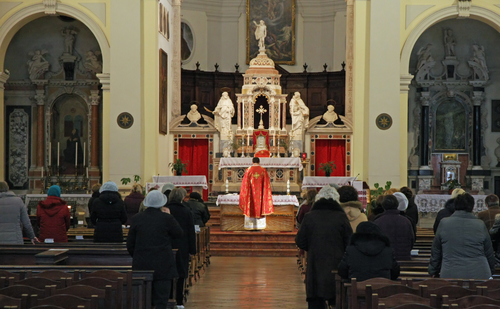
I was raised Catholic. I say that often. Not that it is a bad thing. It’s just my experience. During my time in the Catholic church, through my childhood and early adulthood, I had no connection with God. I can’t lay the blame for that at the feet of the Catholic Church. That was just where I was.

When I became a Believer, when I accepted Christ as my personal Lord and Savior, my life changed. I also began to see the Catholic Church in a different light. I was never into the ritual and observance, which is a major component of the Catholic Church. Not that other denominations and religions don’t have central religious rituals. All religions have ritual observances and traditions.

Those ritual observances and traditions are not, in themselves, bad, but they can create a facade that hides emptiness, darkness and sin. They can create an appearance of piety with no spiritual reality behind them. They can be more superstitious than spiritual, like stroking a rabbits foot for good fortune. In these and other ways, ritual observances can become a substitute for relationship with God.

Continue reading “Ritual, Spirit and Truth”

Where Do You Stand in Relation to God?

If we choose to continue to go our own way, and insist upon our own values and ends, God will let us go. Love does not coerce or force itself upon another.

Depositphotos Image ID: 100613226 Copyright: tokkete

We live in a world that defies God. That is the point of the Adam and Eve story. The temptation to go our own way is great. In fact, like sheep wandering without guidance, ignorant of the dangers that lurk around us, we have all gone astray. That is our lot.

From Adam and Eve, throughout all of the Old Testament, this is the story of the world. This is the world into which God came, having reduced himself from the greatness of being our creator[1], to become one of us, in the form of the man Jesus[2].

That God loves us could not be more intimately or completely demonstrated for us than in the life of Jesus. Though he was God[3], he did not hold on to His privilege and power over us. He emptied himself for us. He came humbly and obedient to his own purpose, which was to lay down his own life for us[4] in a demonstration of love and compassion the world had never seen before and has never seen since.

God came into the world, and the world did not recognize him or receive Him[5]. Yet God was faithful to his purpose. He was faithful in his love for us. He was faithful to fulfill what he came to accomplish, which was to redeem us.

He came while we were yet sinners[6]. He didn’t wait until we became holy, righteous and good. He would have still been waiting. He came to heal us from all that makes us broken, which is our innate inclination to separate ourselves from God and to go our own ways.

This is the world and the reality in which we live. The world sets itself in opposition to its creator. Many people pay lip service to God, but their hearts are far from Him[7]. They deny Him in the way they live their daily lives. Though they honor Him with their lips, their actions belie them.

The good news, which is what Gospel means, is that God loves us anyway. He came for us while we were in this very condition, knowing the worst of us. God became man and lived among us knowing how corrupt we were, that we would reject him and knowing that we would attempt to put him to death. He came anyway. This is the extent of God’s love for us.

Our choice of how we will live in this world has consequences because of God’s love and the fact that He made us in His own image, to love him back. We are not compelled to love Him, but we are given the freedom to love Him. We are not robots or automatons who have no choice. But our choice is eternally significant.

Continue reading “Where Do You Stand in Relation to God?”

Can We Be Certain of God’s Existence? The Role of the Holy Spirit

Doubt is the common experience of saints and sinners alike.


Can we be certain of God’s existence? The short answer is, no. If the question is whether we can have something like mathematical certainty or proof, we have to answer that question in the negative. There is no evidence, no proof, or argument that can provide certainty that God exists for finite beings such as ourselves.

Such evidence, proof, or argument would have to be built on premises that are 100% certain, and that kind of certainty is impossible for beings that are not all-knowing. The best we can do is to arrive at evidence, proofs, and arguments that suggest a probability that God exists. The same is true, or course, for the proposition that God does not exist. Even then, the proof for a negative is always subject to change if such evidence turns up.

To this extent, doubt is the common experience of saints and sinners alike.

To put this another way: Can we be sure that God doesn’t exist? The only certainty is that we can’t be certain.

Many believers have doubts, and many nonbelievers have their own doubts.

Continue reading “Can We Be Certain of God’s Existence? The Role of the Holy Spirit”

Spirit and Truth vs. Self-Made Religion

It isn’t things from outside that corrupt a person, but things from inside.

Depositphotos Image ID: 91001324 Copyright: carlosyudica

In a previous blog article, I talked about the shadow of things to come. Paul says that following rules and observing religious ritual is just a shadow of things to come. Later in the same chapter in Colossians, Paul explains in more detail what he is getting at. When we are focused only on the do’s and the don’ts and on observing religious rituals, we are focused on the wrong things.

“If with Christ you died to the elemental spirits of the world, why, as if you were alive in the world, do you submit to regulations – ‘Do not handle,  Do not taste,  Do not touch’ (referring to things that all perish as they are used) – according to human precepts and teachings? These have indeed an appearance of wisdom in promoting self-made religion and asceticism and severity to the body, but they are of no value in stopping the indulgence of the flesh.” (Colossians 2:20-23)

Paul isn’t advocating that followers of Christ abandon self-discipline and self-control and do whatever they like. “Are we to continue in sin that grace may abound? By no means!” (Romans 6:1-2) But, following Jesus doesn’t mean stepping up religious observances and following rules and regulations more closely. The focus on rules and rituals entirely misses the point.

Continue reading “Spirit and Truth vs. Self-Made Religion”