Do We Have Any Evidence of the Resurrection? A Critique of Skepticism and Proof

People confuse proof, as in a mathematical proof, and proof, as in an offer of evidence that tends to support a proposition.


Some people say that we have absolutely no evidence for the resurrection (and no evidence that God exists in the first place). Nothing could be further from the truth. We have evidence. The issue isn’t a lack of evidence; the issue is how we approach the evidence and weigh it it.

A person who approaches “supernatural” phenomenon with purely materialistic assumptions will weigh the evidence differently than one who is open to nonmaterialistic possibilities. Jesus, though, lived in time and space in history. Many people in the first century who saw him die claim to have seen Jesus and interacted with him in the flesh after he died, and those people were willing to die for what they saw.

That is evidence. Full stop. People may be skeptical of it. People may assume Jesus couldn’t have risen from the dead, despite what people think they saw, because miracles don’t happen. But, now I am talking about how people approach and weigh the evidence.

People confuse proof, as in a mathematical proof, and proof, as in an offer of evidence that tends to support a proposition. Fallible, finite human beings deal almost exclusively in the latter realm of evidence, even in science, because we don’t know what we don’t know.

Mathematical proofs are an achievable goal in mathematics (though sometimes not even then). Such proof is impossible outside of mathematics.

Science does not provide us that kind of certainty, either. Science changes all the time on the basis of new evidence, and things we thought we knew in the past are constantly being adjusted, or even discarded, on the basis of additional evidence.

Finite beings such as ourselves are limited in our knowledge, our access to knowledge, and our understanding of how the knowledge we have fits together. We have to be humble as we cautiously put our confidence in the things we think we know because we are limited in our ability to know and understand our world, and we will always lack absolute proof for most, if not all, things.

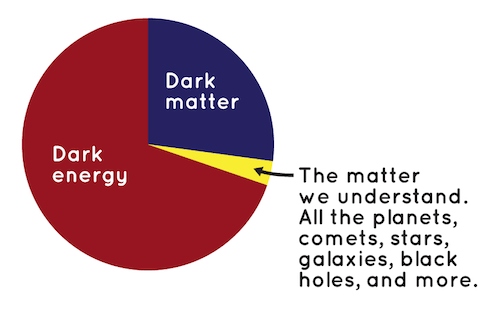
The extent of our limitations can even be quantified. For instance, 95% of the physical universe is invisible to us! The vast, unseen reaches of the universe are comprised of things like dark matter and dark energy that we cannot see and know little about, except for what we can infer about them. We aren’t sure what these things are, but we know they exist by the affects we see on the matter we see and know.


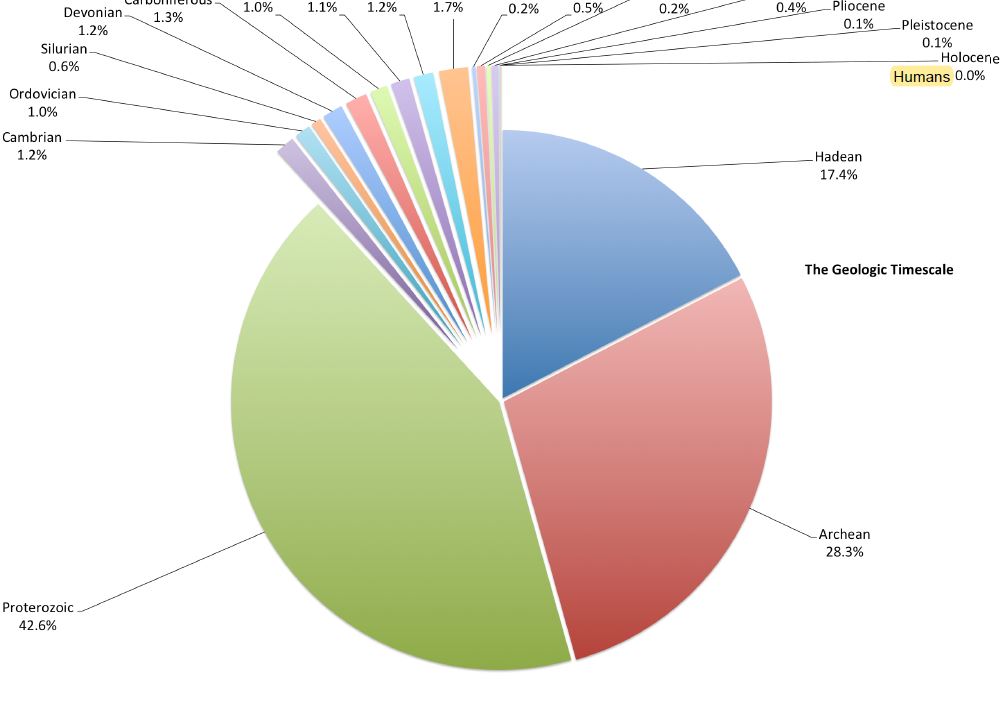
According to scientific consensus, the universe is about about 13.7 billions years old, and the earth is about 4.543 billion years old (give or take about 50 millions years), and homo sapiens appeared only 300,000 years ago (and maybe even only190,000 years ago). Assuming those calculations to be true, human-like beings have existed for only 0.0066% of the time the earth has existed and only 0.002% of the time the universe has existed. (If my math is correct.)

If we view the existence of the earth (not even the universe) on a 24-hour scale from the beginning to the present time, life began at 5:00 AM, the first vertebrates appeared at 8:00 AM, and human beings appeared just a fraction of a second before midnight.

Homo sapiens have only developed knowledge and the ability to communicate and preserve a record of it for about 5,500 years. We have been developing and recording our knowledge for only 0.00022% of the time the earth has existed, which is only 0.00007% of the time the universe has existed.


During that relatively short, 5500-year time period we have developed the capability to see only about five percent (5%) of the universe, though we have actually examined very little of it – and then only at very great distances. We hnave only explored more than five percent (5%) of the oceans on this earth – a very small planet orbiting a very small sun in a very small solar system in the inconceivably large expanse of what we we call the universe.

The body of our scientific knowledge has grown tremendously, even exponentially, especially in the last 200 years, but we have only just begun to know and understand the universe we live in. If humans live another 5,500 years, we will not have explored all of the universe, and we will not know all that there is to know.

Our world is grand and almost inconceivably complex. The DNA of a single human cell contains so much information that if it were represented in printed words, simply listing the first letter of each base would require over 1.5 million pages of text! Imagine how much information exists in the universe and how much we don’t know.

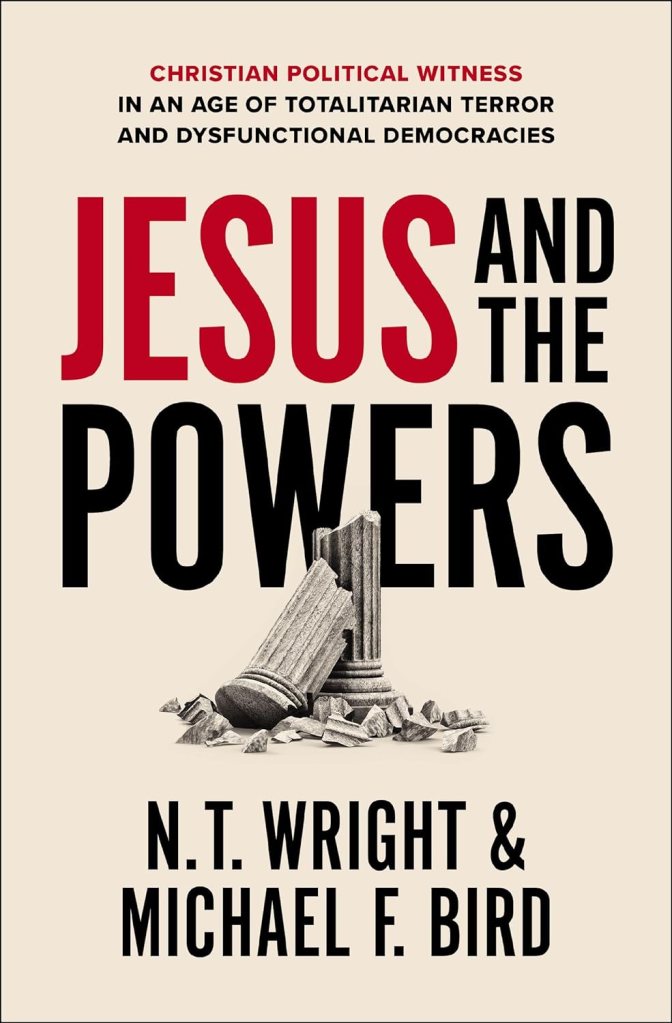
We will likely never know all there is to know about the expanse of the universe and everything in it, large and small, in all the years mankind is on the earth. Thus, we are in no position to write off the possibility of God creating the universe and Jesus rising from the dead.

The title to this piece is (admittedly) a bit misleading, so I need to provide the following disclaimer. Some people will read the title and assume that I am attempting to prove the resurrection. I am not doing that. I am offering only the beginning of proof (as in offering evidence) in this article, but it is evidence. You can weigh it how you will.

We should at least be open to consider what evidence there is for the existence of God and not write off the possibility that God exists. If God exists and made the universe out of nothing, which is what the Bible claims in Genesis 1, John 1, and Hebrews 11, then He could certainly raise Jesus from the dead.

How arrogant it would be for us to determine for ourselves (categorically) that there is no God, that He did not create the universe, and that Jesus did not raise from the dead. We don’t know what we don’t know, and we don’t understand perfectly what we think we know.

With that said, I want to provide some minimal facts that provide some evidence that tends to support the resurrection. These things are not proof; they are an offer of proof. We cannot achieve definitive proof, but there is evidence for the credibility of the claims made that Jesus rose from dead.


Continue reading “Do We Have Any Evidence of the Resurrection? A Critique of Skepticism and Proof”

Should Christians Be Like Elijah and Call Down Fire on People Who Reject Them?

God has been working out His plans and unfolding His purposes – the redemption of mankind and of His creation – throughout history


I am reading through Kings and Chronicles right now in my annual trek through the Bible, and the Prophet, Elijah, has been the “star” these last few days. Elijah means “Yahweh is my God” in Hebrew. He is known for his great faith and is one of the most prominent and revered prophets in the Old Testament.

Elijah is known for his fierce faith in the face of difficult circumstances when Ahab, the King of Israel, and his domineering, foreign wife, Jezebel killed off most of the faithful Hebrew prophets and instituted the worship of Baal and Asherah for the nation of Israel.

Elijah stood defiantly against Ahab and Jezebel who sought to kill him for his defiance Elijah is, perhaps, most known for his public challenge to the prophets of Baal and Asherah that culminated in a powerful demonstration of Yahweh’s superiority to those foreign gods.

This story and another story in a similar vein to it are the backdrop for this article. If Elijah is an exemplary man of faith, to what extent should we follow his example today in the expression of our faith in the face of governmental and cultural opposition?

Continue reading “Should Christians Be Like Elijah and Call Down Fire on People Who Reject Them?”

A New (Old?) Take on Inerrancy

The Bible is the book God wanted us to have, and He wanted us to have it the way it is.


I did the research and wrote a thesis in college in support of the concept that Scripture is inerrant. I have mentioned this before. I was not a religion major in college only because I did not turn in my thesis.

I didn’t turn it in because I was having a hard time getting to where I wanted to go using Scripture and the scholarly work that was done up to the early 1980’s. I could not support my thesis with integrity, so I shelved it and did not return to the subject for almost 40 years!

I had a high view of Scripture then, and I have a high view of Scripture now. I read the Bible daily for personal guidance and edification. I believe the Bible is the inspired Word of God (which I can support from Scripture itself. (2 Timothy 3:16-17))

I believe, like the Moody Bible Institute, that the Old and New Testaments are divine revelation from God. The original autographs were verbally inspired by the Holy Spirit. The revelation is God’s self-disclosure recorded in human language. God is the source of it.

I stop, though, in going further to say that every word is true, and the Bible is free from error. The very statement begs the questions: which version? Written in which language? And other questions.

I agree with the Moody statement that the Bible is the supreme source of our knowledge of God and of salvation through Jesus Christ. I agree that it is “our indispensable resource for daily living”. I agree, also, that humans are left to interpret the Bible, and our interpretation is guided by “our reception and understanding of that which God revealed”.

I stop short of saying that God “recorded” Scripture, because we all know that it was written down by men. This difference distinguishes the Bible from the Quran and the Book of Mormon, both of which are claimed to have been dictated to men in a trance-like state.

I agree that “revelation is a divine act”, and “interpretation is a human responsibility”. I agree that our interpretation is fallible, but I must admit the possibility that the writing down of the Bible may, also, be fallible.

I say these things not to argue with anyone about the reliability of Scripture, and I do not desire to make a mountain out of a molehill. I go far down the road on my confidence in the reliability and trustworthiness of Scripture. I have written on the subject many times, and I have even given presentations on the topic.

I also recognize that I am fallible and must remain humble in my approach, so take what I say with a grain of salt and make your own determinations. I share my thoughts for what they are worth.

When I was in college sitting in a World Religion class, reading the Bible for the first time in my life, I was struck by a thought that I believe to this day came from the Holy Spirit (along with others). My professor was liberal and progressive, so I can’t “blame” it on him.

It occurred to me that, if God is real, and the God of the Bible is the creator of the universe, then He could orchestrate His communications to humans in a way that they could understand them and preserve the important points for posterity. If God is sovereign, He can do that.

I believe the Bible is the book God wanted us to have.

NT Wright

I still believe that, but I also like the way NT Wright puts it: “I believe the Bible is the book God wanted us to have.” I can buy that! Other things NT Wright says about the character of Scripture also make sense to me, so I will mix his words with mine in the remainder of this piece.

Continue reading “A New (Old?) Take on Inerrancy”

Christianity’s Ties to the Scientific Method

Christianity was the fertile soil in which scientific method and modern science began to grow


I have heard a number of people assert that Christianity gave birth to the scientific method. Perhaps, the first time I heard that claim was from John Lennox, the famous Oxford University professor of mathematics. I was intrigued, but I didn’t take the time to research his claim at the time.

I have heard the claim repeated multiple times, most recently by Dr. Michael Guillen the astrophysicist, former Harvard professor and TV personality. In fact, he devoted a podcast to the subject (embedded below), so I figured it was time to learn more.

I started with Wikipedia, which has a page on scientific method. Wikipedia begins with Aristotle and focuses on rationalism as the basis for scientific method.

Properly speaking, rationalism is not a method. It is a philosophy, a way to approach the world. Rationalism and Aristotle, though, seem to have led the way to the development of the scientific method.

Aristotle’s inductive-deductive method that depended on axiomatic truths and the “self-evident concepts” developed by Epicurus was an early conception of the way to do science. It was jettisoned, however, for something more like the modern scientific method beginning around the 16th Century. Perhaps, this is why Guillen doesn’t mention Aristotle, except in passing.

After those early pioneers, Wikipedia references some great Muslim thinkers who were influenced by Aristotle (including Avicenna (Ibn Sina) and Averroes (Abū l-Walīd Muḥammad Ibn ʾAḥmad Ibn Rušd)). They placed “greater emphasis on combining theory with practice”, focusing on “the use of experiment as a source of knowledge”. Guillen starts his history of scientific method with these early “flashes” of scientific method in the Muslim world.

These men of the Islamic Golden Age pioneered a form of scientific method, but the inertia did not continue. Moses ben Maimon (Maimonides), the great Jewish theologian, physician, and astronomer, developed a similar emphasis on evidence. He urged “that man should believe only what can be supported either by rational proof, by the evidence of the senses, or by trustworthy authority”. He foreshadowed a future scientific posture, but his prescience also did compel further advancement at the time.

Dr. Guillen credits Robert Grosseteste and Roger Bacon with the formation of the first actual principles of scientific method. Their ideas “caught fire” in Christian Europe from the tinder of academies that began just after the turn of the first millennium, igniting a blaze that would fuel scientific inquiry and endeavor for centuries to come.

“Concluding from particular observations into a universal law, and then back again, from universal laws to prediction of particulars”, Grosseteste emphasized confirmation “through experimentation to verify the principles” in both directions.

Roger Bacon, Grosseteste’s pupil, “described a repeating cycle of observation, hypothesis, experimentation, and a need for independent verification”, including the recording of the way experiments were conducted in precise detail so that outcomes could be replicated independently by others. Bacon’s methodology lead to the modern emphasis on peer-review in science, says Guillen.

Wikipedia mentions Francis Bacon and Descartes. Bacon and Descartes emphasized the importance of skepticism and rigid experimentation, expressly rejecting Aristotle’s dependence on first principles (axioms). Guillen, however, glosses over Descartes to get to Galileo Galilei and Isaac Newton.

Galileo Galilei introduced mathematical proof into the process and continued to distance science from reliance on Aristotelean first principles. Galileo and Newton reformulated the terms of scientific method that would inform modern scientists ever afterward.


That the two latter men were men of faith, along with Grosseteste (a Catholic Bishop) and Roger Bacon, his student, is significant. Maimonides and the Islamic thinkers before him were also men of faith. These men who pioneered the way to modern science were all monotheists who believed in a creator God. 

Science did not really take off until the 17th Century. The trailblazers of the modern scientific method were religious men, and the modern scientific method was born in the religious environment in Christian Europe lead, primarily, by men of faith.

Why did science catch fire in Christian Europe and not in other parts of the world? Why not in China? Or in the world of the eastern religions? This is a question Guillen poses, and he provides a possible answer.

Continue reading “Christianity’s Ties to the Scientific Method”

What We Can Learn from the Letter to Diognetus

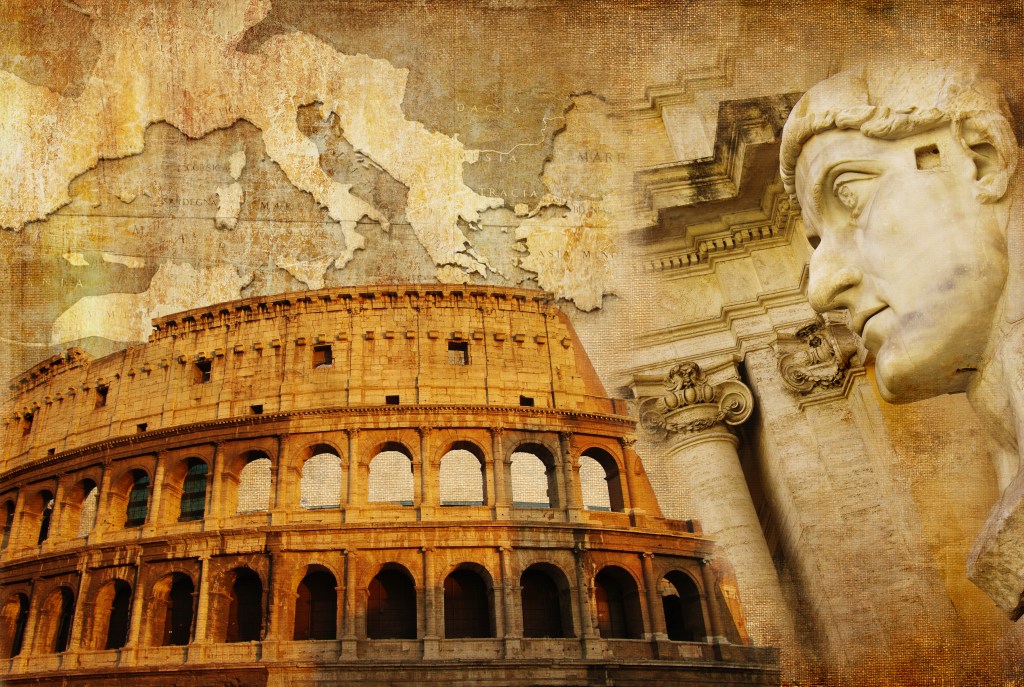
Map of the Roman Empire, 2nd century AD. Publication of the book “Meyers Konversations-Lexikon”, Volume 7, Leipzig, Germany, 1910

Fellow blogger Joel Edmund Anderson wrote a short summary of the Letter to Diognetus on his blog, Resurrecting Orthodoxy (March 19, 2022). This is part of his series on early church fathers.

I feel like we tend to believe that we have advanced from our peers centuries ago, and I am ever skeptical of that advancement. I tend to believe the writer of Ecclesiastes:

What has been will be again,
    what has been done will be done again;
    there is nothing new under the sun.

Ecclesiastes 1:9

Yes, we have made great technological advancements, but how different are people, really? I direct your attention to the Ukraine where Russian bombs fall on hospitals, schools and people fleeing a war with very questionable motivations.

Lest we be too smug, more people died at the hands of despotic rulers in the 20th Century than all the previous centuries combined.

But, I don’t want to preach, and I don’t exempt myself from my personal indictment. I am not exempt. People are still people, and we have a tendency to do bad things.

On this point, though, I like reading the thoughts of ancient minds to remind myself of the ways in which we tread the same ground. The Letter to Diognetus is a good example, and I commend the article I have linked for your consideration.

Joel Edmund Anderson observes that the Letter to Diognetus is the first communication (in records we have) attempting to explain Christianity to pagans. It was written early, around 130 AD, and it distinguishes Christianity from Judaism and from paganism.

Who is Diognetus? What was the occasion for the letter? Was the letter sent unsolicited? Did Diognetus inquire about Christianity? Was it the product of a discussion? Who wrote the letter? We don’t know.

I imagine the letter wasn’t unsolicited. Writing utensils and parchment, papyrus or whatever medium was used then not in abundant supply in the 2nd Century. Writing was an effort.

That the letter was preserved speaks, perhaps, to the way the letter was received. Whoever received this letter thought it was valuable enough to keep it and preserve it.

As I read the summary of the letter today, though, I am interested in several points made in the letter and how they relate to us 19 centuries later.

Continue reading “What We Can Learn from the Letter to Diognetus”