I recently returned from a trip to Budapest Hungary. Traveling to foreign lands and meeting foreign people expands our horizons and opens us up to new perspectives, and sometimes helps us to understand ourselves better.
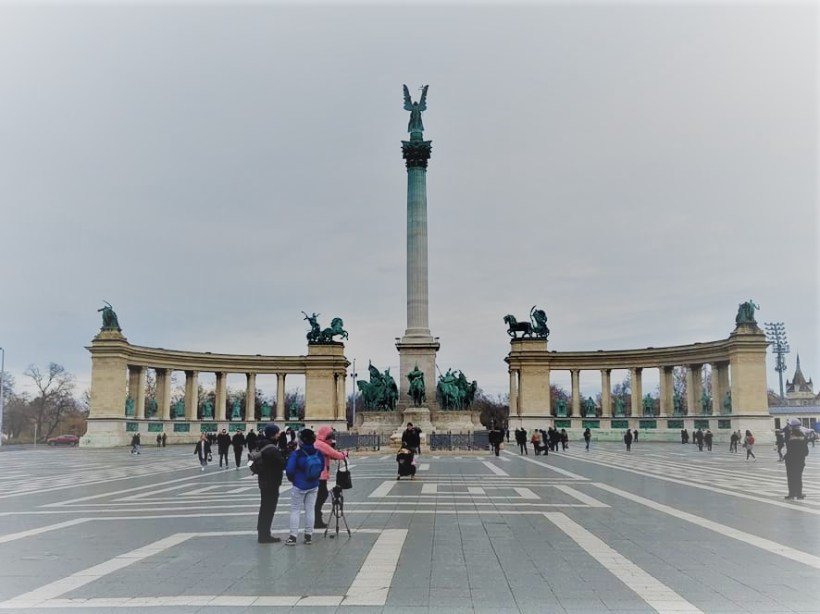
I didn’t know much of Hungary before we left, not nearly as much as I know now. We had the intimate advantage of a guided tour by our own daughter who is living there now. She regaled us with some of the rich history that is proudly displayed throughout the sprawling city.
Budapest is a City full of strong, stately buildings and monuments to its past, good and bad. We have our own monuments to the past that are no less stately, though many centuries more recent, but viewing the unfamiliar Hungarian monuments got me thinking.
Why do we do this? Why do we erect such proud monuments to our past?
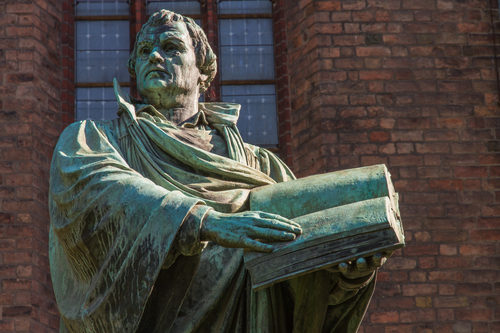
Today us Reformation day. I don’t really care about Halloween, so I figure I should say something about the Reformation.
You might call me a reformed Catholic. I grew up in the Catholic Church. When I encountered Jesus Christ, the living Son of God, who shed His glory to become a man, walked in obedience to His own purposes, died on the cross for our sins, and rose again from the dead, my life changed.
When I accepted Jesus Christ as my Lord and Savior, I left the Catholic Church for greener pastures. I have been involved with and visited many churches since then, and I am still looking for greener pastures. Along the way, I have learned that Catholics haven’t cornered the market on rigid structures and white-washed tombs.
One of the most common skeptical positions in regard to the Bible is that we can’t trust it because it has changed over time. We don’t even have the original text anymore. We don’t have any of the manuscripts, and most of the manuscripts we do have are copies of copies that were produced centuries, sometimes many centuries, later.
The “telephone game” that children play has been used as an illustration of how easily things that are communicated get twisted and changed so that we can’t even tell what the original meaning was by the time the communication comes back to us after being repeated over and over from one person to the next. This illustration is applied to the Bible as proof that it can’t be trusted because it has been translated and copied over and over and over again. How do we even know what the original text said?!
These are serious contentions. An honest person cannot just brush these contentions aside, but it isn’t the end of the story.
Yes, faith is a foundation of Christian belief, but Christian faith is not a blind faith as some suppose. Christian faith means putting our trust in God, and not in ourselves, but Christian faith also does not insist or even ask us to throw out our minds in the process.
In fact, we are specifically instructed to love God not only with our hearts and strength, but with our minds!
As I have stated previously, doubt and skepticism are not sin according to the Bible. Thomas doubted, and he became known for his skepticism but he was a follower of Jesus. He was an original follower of Jesus, and he traveled with Jesus from the beginning of his public life to his death. He wasn’t just known for his doubt, however; he was also known for his faith!
Paul urged the Thessalonians to “test everything”, and hold on to what is good. The Bible urges us to have “honest skepticism”, which should not be confused with skepticism for the sake of skepticism. A person who is skeptical of everything, even the certainty of truth, should not even bother looking into anything because the exercise is pointless.
The quest for truth is pointless for the pure skeptic who is unwilling to commit to any truths. He already knows where he will end up! The contention that there is no objective truth is a self-defeating statement. The statement, itself, is offered as an objective truth, therefore it isn’t even true of itself!
But we digress. Whether the Bible can be trusted is the question, so let’s dive in.
Jesus doesn’t tackle the issue of racism or diversity directly, but He lived in a complicated time. He was Jewish, living in a tight-knit Jewish community, which was governed and ruled by foreigners, the Romans. The Jews had a history of living alongside foreigners and were at various times throughout that history governed by them against their will.
Many of the foreigners were very closely related, like the Samaritans, who were of Jewish descent, and the Canaanites before them. The northern kingdom (Israel) and southern kingdom (Judah) split and became foreigners to each other.
The Jews in Jesus’s day believed there were only two types of people: Jews and everyone else (Gentiles). They seemed to have forgotten that the very first words God spoke to Abraham, when He chose to bless Abraham and his progeny, was that God would make a blessing to all the nations. (Genesis 12:1-3) God didn’t choose them simply to bless them, but to bless all nations through them.
Jesus was that blessing. Jesus is traced back to Abraham. He is from the line of Abraham, Isaac and Jacob. He is the root of Jesse’s seed, father of David. Jesus is the Promised One.
Jesus also claimed to be God in the flesh, so, how Jesus viewed others is the key to understanding what the Bible says about racism and diversity.
Though Paul is often accused of being misogynistic, we find that he carried over a similar view of women from Jesus, declaring that there is neither male nor female in Christ.
I have been exploring an answer to the question: whether the Bible is sexist and racist. The discussion was introduced in Part 1, sexism was tackled in Part 2 by looking at the sweeping theme of the Bible in dealing with men and woman, and an overarching view of what the Bible has to say about racism was addressed in Part 3. In both cases, I started at the beginning, where the Bible expresses poetic form God’s ideals and purposes in creating humankind.
Regarding sexism, Genesis provides a glimpse into God’s motivations, intentions and purposes for men and women. God created an idyllic habitation for men and women to live in harmony with Him and nature, but He allowed people to have free will. In fact, it was part of the plan.
Free will introduced the possibility that people would choose their own values over God’s values and go their own ways. We are told Adam and Eve, the first people (or representative people) did choose their own way, and that choice introduced sin into the world.
Sin means “to miss the mark”. The “mark” would include, among other things, God’s values. People have chosen their own values over God’s values, and the result is that we live in a world in which God’s values are distorted from what He intended. But what are God’s values?
God created men and women as counterparts who, together, reflect the image of God. Neither one is valued higher than the other. We see that God intended them to be fruitful and multiply, to diversify, and not to hunker down in one place with one language in a homogeneous civilization. God wanted diversity.
These are the overarching themes of the Bible. We see them in the penultimate vision of heaven that John describes in Revelation 7:7-9.
The Old Testament is largely the story of how God chose one people through whom He intended to bless all the nations of the world, but His chosen people continually chose to go their own way. They largely did not reflect God’s values in the way they lived.
The Church, today, is not much different in its failure to reflect God’s values in they way they live. Paul says, though every man may be a liar, still God is true. (Romans 3:4) We can’t judge God’s values by what we see people doing – even church people.
In fact, only one person in history, we are told, truly reflected all that God is – Jesus. Jesus was “the image of the invisible God” (Colossians 1:15) and the “exact representation of His nature”. (Hebrews 1:3) Jesus said, “Whoever has seen me has seen the Father.” (John 14:9) In this segment, therefore, we will look at what Jesus said and did that can be applied to the subject of sexism.







 Navigating by Faith