
When You Are Bitterly Disappointed and Angry at the World

God waits to be gracious


The Book of Jonah is an important story, but not for its historical significance. Whether the story is historical fact is not what’s important. If that is our only focus as we read and think about Jonah, we are missing the point.

Jonah is the story of a reluctant prophet. When God commands him to go to the wicked City of Nineveh and warn them to repent to avoid judgment, Jonah heads the opposite direction by ship. God stirs up a great storm, and Jonah is swallowed by a whale. After three days, Jonah prays and submits to God, and the whale vomits him up on the shoreline.


Unable to run from God’s command, Jonah heads off to Nineveh where he delivers the warning. The wicked people of Nineveh repent, and God relents from the judgment He planned, but God’s mercy on Nineveh causes Jonah to be bitterly disappointed and angry.


Jonah was disappointed because Jonah wanted what Jonah wanted. He didn’t want what God desired. He was focused on what he thought should happen. He thought Nineveh should pay the price for its wickedness, but God had different plans.

God was patient with him and went to great lengths to show Jonah His heart for a people Jonah despised. We might credit Jonah for his (reluctant) obedience, but Jonah doesn’t understand God’s sovereignty, mercy, and compassion, even at the end.

God’s determination to spare the people of Nineveh “seemed very wrong” to him, “and he became angry.” (Jonah 4:1) If it were up to Jonah, the people of Nineveh would have been destroyed like Sodom and Gomorrah. Jonah identified with God’s judgment, but he didn’t understand God’s compassion.

Jonah reminds me of Elijah, who was known for his boundless faith in (and preoccupation with) God’s power. Elijah is known for calling down fire to consume a sacrificial bull that he soaked with water, showing up the false profits who could not get their gods to consume a dry sacrifice. When Elijah exposed them for the false prophets they were, he agitated the crowd to march the false prophets down the mountain where Elijah slaughtered them.

I imagine Elijah and Jonah would have gotten along well…. Or maybe not. Though they are much alike, Elijah was a loner, and perhaps Jonah was also. Elijah complained that he was the last of God’s prophets, though 100 of God’s prophets remained in the land. Perhaps, Elijah thought he was too good for them.

Jonah and Elijah wanted to see God’s judgment. They wanted the people to burn for their wickedness. They were personally affronted when God showed patience and reluctance to rain judgment down on the people who deserved it.
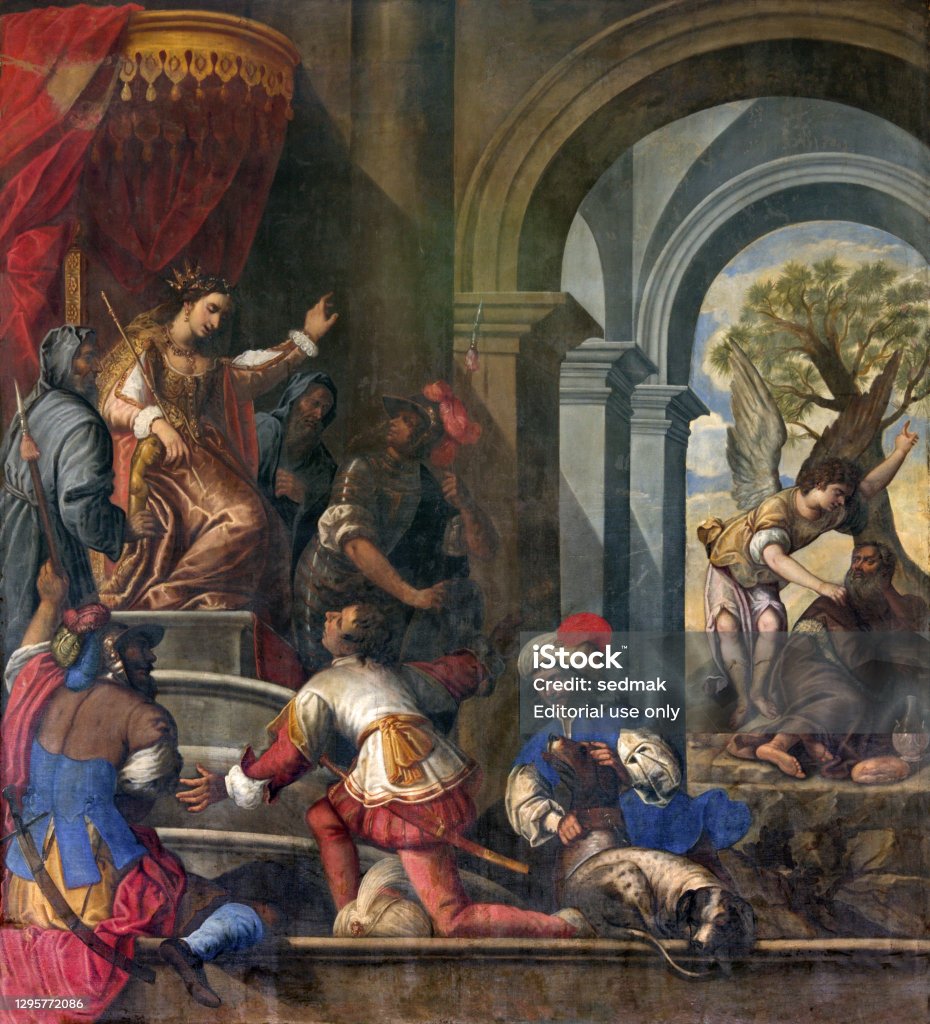

Despite the awesome display of God’s awesome power summoned by Elijah’s undaunting faith before King Ahab and his prophets, the wicked Queen, Jezebel, was not moved. She ordered Elijah to be arrested and killed on sight.


When Elijah heard her decree, he fled into the desert, where he sat down under a broom tree in bitter disappointment and anger at the way things turned out.  

Couldn’t Elijah call fire down on Ahab and Jezebel? Why didn’t he do it? Elijah had just slaughtered all the King’s prophets after showing them up with fire from the heavens. When Jezebel wasn’t phased, Elijah fled in fear.

Elijah may have run in a moment of fear, but his fear turned to anger and disappointment, like Jonah. Both of them ended up under a tree that provided them shade. God ministered to both of them in their dejected state.

Elijah kept going south, all the way to the mountain where God met Moses on the Sinai Peninsula. In the cave where he took shelter, God came to him, asking, “Elijah, why are you here?” Then, Elijah let God have the full weight of his disappointment and anger:

“I have been most zealous for the Lord, the God of hosts, but the Israelites have forsaken your covenant. They have destroyed your altars and murdered your prophets by the sword. I alone remain, and they seek to take my life.”

1 Kings 19:10

But, God was patient. He told Elijah to stand at the mouth of the cave so the Lord can “pass by”. “A strong and violent wind rending the mountains and crushing rocks” came, but the Lord wasn’t in the wind. Then an earthquake came, but the Lord wasn’t in the earthquake. After the earthquake, came a fire, but the Lord wasn’t in the fire. (1 Kings 19:11-12)

Finally, “a light silent sound” came, and the Lord said to Elijah, again, “Why are you here?” God was not in the mighty displays of wind, earthquake, and fire. God was in a still, small voice.

Yet still, Elijah was fixated on his own disappointment and anger and responded exactly as he did before:

“I have been most zealous for the Lord, the God of hosts, but the Israelites have forsaken your covenant. They have destroyed your altars and murdered your prophets by the sword. I alone remain, and they seek to take my life.”

1 Kings 19:14

Elijah’s disappointment, anger, and indignation turned toward God. “They destroyed your alters and murdered your prophets!” Elijah said. It’s everyone’s fault but his. It’s ultimately God’s fault, right? Because Elijah knew what God could do. God could have destroyed Ahab and Jezebel in a ball of fire, but He didn’t.

In similar fashion, God asked Jonah twice, “Why are you angry?” (Jonah 4:1 and 4:9) Twice Jonah responds exactly the same way: “It is better for me to die!” (Jonah 4:3 and 4:8) It’s the same pattern for Elijah and Jonah.

At the end of Jonah, God asks the rhetorical question, “Should I not have concern for the great city of Nineveh?” But, Jonah doesn’t respond. (Jonah 4:10) Jonah didn’t want God’s compassion for Nineveh. He wanted them to burn.

We don’t know what became of Jonah, but we do learn the rest of the story of Elijah. God sends him back to Damascus to anoint a new King and pass his prophetic torch to Elisha. (1 Kings 19:15-18) When Elijah pronounced God’s judgment on the wicked King Ahab, the King humbled himself and repented, and God spared him (just like Nineveh). (1 Kings 21:27-29)

Eventually, Ahab’s son, Ahaziah, took over, and Elijah continued with his righteous taunts. Ahaziah sent fifty men to summon Elijah before him, and Elijah called down fire to destroy them. (2 Kings 1:10) Ahaziah sent another company of fifty men to summon Elijah, and Elijah called down fire again to destroy them. “(2 Kings 1:12)


Elijah is the prophet who called down fire. He was a man of great faith. He had great confidence in God. He was a firebrand, himself, in his sense of God’s righteousness and communication of God’s righteousness to the false prophets, the unrighteous and wicked leaders of his time, and even on the remnant of God’s prophets who escaped the sword only hid away in a cave.
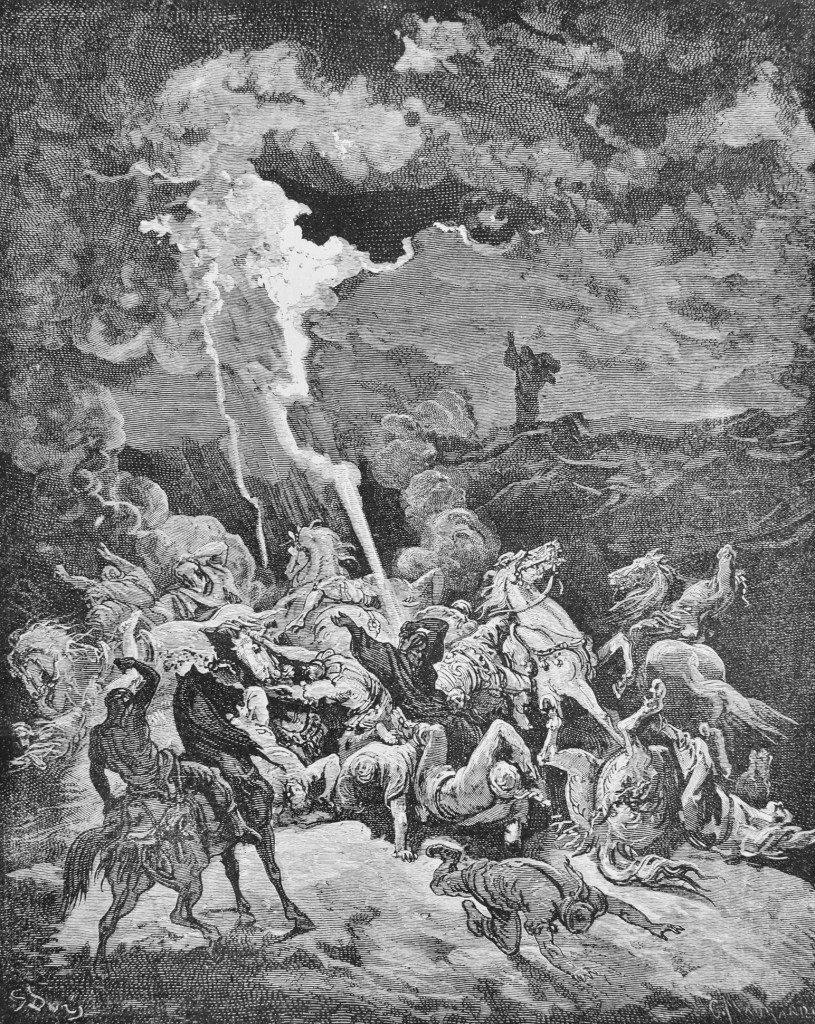

Jonah had similar confidence in God. After the people of Nineveh repented and God relented, Jonah said, “I knew it! That’s what I said! That’s why I went the other way, because they don’t deserve it! Just take my life.” (Jonah 4:2-3)(my paraphrase)

Jonah and Elijah are held out in the Bible as God’s prophets and men of great faith, but they are flawed. They are self-righteous. They have a hard edge. The desire judgment, and they don’t love as God loves.

Their disappointment and anger stems from their desire to see the wicked people destroyed. God’s desire is ever to save, to have compassion, and for people to repent so God can show mercy. God’s great desire is not to judge, but to be gracious:

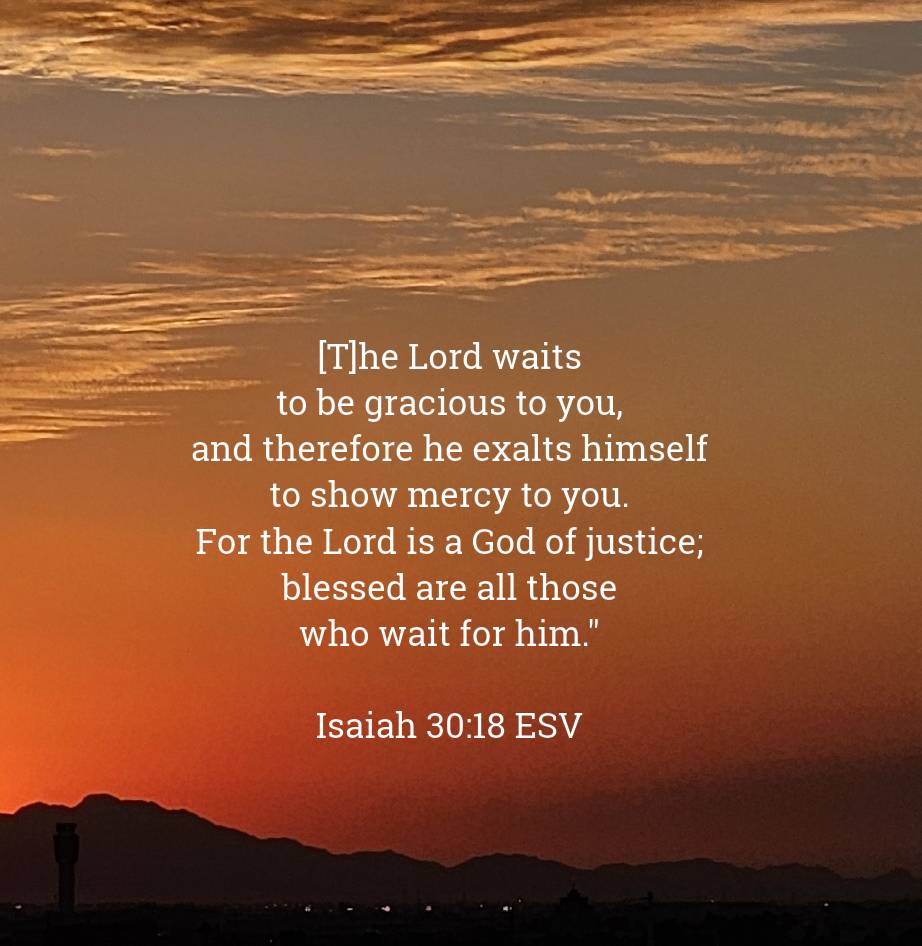
Truly, the Lord is waiting to be gracious to you,
    truly, he shall rise to show you mercy;
For the Lord is a God of justice:
    happy are all who wait for him!

(Isaiah 30:18) God’s justice is ultimately to be gracious and to show mercy. Justice and mercy are not divorced from each other; they are intertwined. His judgment is meant to bring us to repentance so that He can have mercy on us.

When we have our act together and have great faith, our temptation is to desire judgment for its own sake, but God is not like that. Jesus, who was the exact representation of God in the flesh, shows us God’s heart when his disciples returned from traveling the countryside to tell people about the kingdom. The disciples wanted to call down fire on the people who rejected them and refused to welcome them, and Jesus rebuked them.

When we find ourselves disappointed and angry at a world full of sinners who deserve judgment, we need to think of Elijah and Jonah and the counterexample of God in dealing with Nineveh and Jesus in rebuking the disciples. God is “merciful and gracious, slow to anger, and abounding in steadfast love.” (Exodus 34:6-7) God takes no pleasure in the death of the wicked. (Ezekiel 18:23 and 33:11)

We can laud Elijah and even Jonah for their faith and (ultimately) their obedience, but we need to recognize that they didn’t understand God’s heart of compassion for people. They didn’t understand God’s desire for mercy and grace. God ultimately wants more than our raw belief and cold obedience; He desires “mercy, not sacrifice.” (Hosea 6:6 and Matthew 9:13)

God wants out hearts, and He wants us to see the world as He sees it. He wants us to love even our enemies (the wicked) and to sacrifice ourselves for the good of others as He sacrificed Himself for us in Christ. Thus, Jesus emphasized forgiving as we have been forgiven and showing mercy as God has shown mercy to us:

“Judgment without mercy will be shown to anyone who has not been merciful. Mercy triumphs over judgment.”

(James 2:13) When we are tempted to be judgmental and righteous, we need to remember that God has been gracious to us, and He desires – above all – to be gracious to the world. When we are bitter and angry at the sin in the world, we need to remember that Jesus came into the world not to condemn it, but to save it, just he saved us.

Justice and Mercy and the Faithfulness of God

God waits to be gracious


Isaiah says. “[T]he Lord waits to be gracious to you.” He desires and longs to be gracious. In modern vernacular, we might say that God cannot wait to be gracious to us! 

We may think that God exalts Himself in showing judgment. We might imagine Jesus coming on a white horse judging and making war in righteousness with a sword coming from his mouth as the supreme exaltation of God. (Revelation 19-11-16) But, God doesn’t exalt Himself in showing Judgment. He exalts Himself in showing mercy.

God is God. He could judge the world at any time. He could utterly overwhelm us with presence and power right now. He could wipe humankind off the face of the earth in a moment, but He doesn’t do that.

God waits to be gracious to us, and He exalts Himself by showing mercy. God’s greatness is seen most authentically in showing mercy.

This is because God is a God of justice. We might be tempted to think that justice is the opposite of mercy, but justice turns out to be wrapped up in mercy. The greatest expression of God’s justice is on display in God showing mercy.

Justice, then, is not in opposition to mercy; justice and mercy are not opposites. They are brothers. Justice and mercy are mutually dependent on each other. One does not exist without the other.

For this reason, James says, “Judgment will be without mercy to anyone who has not shown mercy.” James 2:13 We might think we want judgment to come, but it’s justice with mercy that we want and need. If think we do justice without showing mercy, we are do neither, and neither justice nor mercy will be done. 

Mercy triumphs over judgment, according to James. That means that mercy is God’s ultimate goal. Not judgment, but mercy

As Christians, we should know this. Jesus came not to condemn, but to save. He is the Good Shepherd who leaves the 99 in search of the one, lost sheep. Jesus came not for the righteous but for this sick with sin. He came not to judge but to save.

Jesus warned the Pharisees about heaping heavy, cumbersome loads on other people’s shoulders. (Matthew 23:4) He warned them about shutting the door of the kingdom of heaven in people’s faces. (Matt. 23:13) And, he warned them about neglecting the more important matters of the law—justice, mercy and faithfulness. (Matt. 23:23)

Justice is not justice without mercy. God is just, merciful and faithful. So, we wait – so we trust – in Him. He who is merciful and just is faithful and just to forgive us when we confess our sins (1 John 1:9) because God waits to gracious.

We should wait always to be gracious and merciful because God is merciful in His justice with us.

A Christian Lawyer’s Thoughts on Rights, Law & Justice: the Orientation of a Believer

Biblical justice for the common person is more about what you do than about how you are treated


We live in a world punctuated with individual rights and laws that allow redress for nearly every possible wrong that might be conceived under the sun. American litigiousness is notorious, perhaps, because of this expansive construct of individual rights.  

Laws are intended to set parameters on human activity according to a basic set of societal values that are calculated to promote human flourishing. When we feel we have been unjustly or unfairly treated, we have the authority granted by our laws to assert our rights to obtain justice.

We roll our eyes at the frivolous lawsuits held up for the amazement and ridicule of a curious public, but many real injustices and real wrongs still occur in our modern world. People are still people, and we don’t always do right be each other.

Actual malicious intention is exhibited in the never ending scams perpetrated on elders and other unsuspecting victims. They get more and more sophisticated as time goes by. These scams target the most vulnerable people in our community, and these scammers intentionally rob people of millions (maybe even billions) of dollars every year.

People also do wrong against others less intentionally. Either through negligence (not caring enough to protect others from our actions or failures to act) or through protecting ourselves to the detriment of others. Injustices and wrongs are a part of every day life, unfortunately.

The legal systems of civilized societies exist to provide recourse in a controlled way that preserves order and achieves some measure of justice, however slowly those wheels turn. The alternative is the wild west where justice happens as quickly as a finger on a trigger or the time it takes to tie a noose. Such “justice” is often little more than a power wielded by the strong over the weak.

We are sometimes conflicted by these things, especially in the circumstances of egregious injustice. Hitler is the ultimate example. We want justice to be swift and unforgiving. We are willing to forgo the protocols intended to safeguard our system of justice when we feel the ends justify the means.

We would never want to be on the other side of that equation, though, especially if we didn’t do it! Beyond that, I like to say that no person really wants justice when we stand before God, because God’s strict justice would be unrelenting and unforgiving. It allows for no mercy, when what we really want (and need) from God is His mercy!

Fortunately, we have a God who is merciful and slow to anger. (Exodus 34:6) He is “compassionate and gracious … and abounding in mercy.” (Psalm 103-8) God desires to be merciful to us rather than to demand our sacrifice (Hosea 6:6), and He desire us “to act justly and to love mercy”. (Micah 6:8)

When we think of justice, we might immediately think of criminal justice and the punishment for committing crimes. We might immediately think of God’s justice and punishment for unrepentant sinners.

Biblical justice, however, focuses more on doing right by people (acting justly), and it is intimately connected to loving mercy. In the biblical system of justice, judgment without mercy is meted out only to the one who has shown no mercy (James 2:13), and that should change the way we view justice.

Continue reading “A Christian Lawyer’s Thoughts on Rights, Law & Justice: the Orientation of a Believer”

You Might Be A Pharisee If ….

Just when we become proud of our own spiritual advancement we are most in danger of spiritual catastrophe!


[29] “Woe to you, experts in the law and you Pharisees, hypocrites! You build tombs for the prophets and decorate the graves of the righteous. [30] And you say, ‘If we had lived in the days of our ancestors, we would not have participated with them in shedding the blood of the prophets.’

Matthew 23:29-30

Reading this passage in Matthew today reminded of the old bit by the comic, Jeff Foxworthy. If Jeff Foxworthy was a comic in 1st Century Judea, he might have said, “You might be a Pharisee if ____________________ (fill in the blank).”

In a similar vein, we could say, “You might be a Pharisee if you think you would not have opposed Jesus if you lived in Judea in the 1st Century.”

Of course, Jesus wasn’t being funny when he confronted the Pharisees, and this wouldn’t be a comedic schtick.

I don’t think Jesus was saying it was wrong for people to build tombs to the prophets or decorate them with flowers. Jesus was saying it was wrong to say (and think) they would have treated the prophets any differently.

The Pharisees are to us what the prophets were to the Pharisees. We may be tempted to think that we would embraced Jesus if we lived in 1st Century Judea, and would not have opposed him or called for his crucifixion if we we were in the crowd that shouted, “Crucify him!”.

But, that is no different than how the Pharisees thought and what the Pharisees claimed about the prophets that were resisted, derided, and sometimes killed by the “religious” people of their day. Jesus was clearly implying that the religious people of his day (the Pharisees), were no different than the religious people in the days of the prophets.

Can we say, then, that we are different than they?

Only if we adopt the same thinking as the Pharisees! (If I am understanding Jesus accurately.)

The Pharisees thought of themselves more highly than they should have. John came preaching repentance, for the Kingdom of God is near! But, the Pharisees didn’t repent. They didn’t think they needed to repent.

When Jesus – who was God in the flesh – came into the world, the Pharisees didn’t recognize Him or receive Him. (John 1:9-11) They did not prepare themselves for his coming by repenting, as John the Baptist exhorted. They adopted the wrong attitude about what God was doing in their time, and they didn’t hear and respond to what God God’s messenger was saying.

Pharisees say the right things, and they do the right things, but they fool themselves. What the Pharisees said and did was a façade. Their hearts were not aligned with their actions. They claimed to be experts in the Law, but Jesus called them blind guides leading blind followers. (Matt. 15:14)

Pharisees were concerned with appearances and the way people saw them. Pharisees were not as concerned with their heart attitudes. Jesus called them “white-washed tombs” that were empty inside (full of dead people’s bones and uncleanness). (Matt. 23:27-28) We need to be careful that we do become like the Pharisees.

Continue reading “You Might Be A Pharisee If ….”

The Surprising Context of the Idea that God’s Ways Are Not Our Ways, and God’s Thoughts Are Not Our Thoughts

How many times have you heard someone say, “God’s thoughts are not our thoughts, and His ways are not our ways”? Think about the context in which those words tend to be spoken….

The death of a loved one, a difficult time you are going through, plans that don’t work out, change you long for doesn’t happen, or unexpected change throws your life into chaos: these are the kinds of circumstances in which these words are often spoken.

Bad things are happening, or the good things we hope for seem never to come. That’s when someone says, “You know, God’s ways are not our ways.” The implication is that we should trust Him anyway, and that is good advice, but it’s often not very comforting in the moment.

Speaking those words in those kinds of circumstances also takes them completely out of the context in which they were spoken by the Prophet, Isaiah, whose words they are:


“Seek the Lord while he may be found; call to him while he is near. Let the wicked one abandon his way and the sinful one his thoughts; let him return to the Lord, so he may have compassion on him, and to our God, for he will freely forgive. 

“’For my thoughts are not your thoughts, and your ways are not my ways.’ This is the Lord’s declaration. ‘For as heaven is higher than earth, so my ways are higher than your ways, and my thoughts than your thoughts.'”

Isaiah 55:6-9 CSB


Until today I had not considered these verses in the context of the previous two verses. Or in the context of the whole chapter, for that matter. In fact, Isaiah 55 begins with the words, “Come, all you who are thirsty!”[i] I encourage you to read all of Isaiah 55, which I have provided at the end of this article.

But the focus of this article is the two verses spoken right before the enigmatic words of comfort that we often hear: “For my thoughts are not your thoughts, and your ways are not my ways.”

These verses are spoken in the context of encouragement to seek God and return to him so that God may have compassion on you, for God freely forgives. This is the context for the statement that God’s thoughts are not our thoughts, and His ways are not our our ways.

The implication here is that God forgives where we are not likely to forgive. God has compassion where we fail to have compassion. God freely forgives where we have much difficulty forgiving, and He has compassion when we would not have compassion.

That God’s thoughts are higher than our thoughts is often mentioned in the context of things we do not understand about life, such as the death, tragedy, catastrophe, and hopelessness. We think of the negative things that happen to us and the good things for which we hope that never seem to come about.

While it’s true that God sees things we do not see, and He has purposes that He is working out in history, throughout the earth, and even in our own loves that we do not understand, Isaiah’s statement that God’s way are not our ways, and His thoughts are not our thoughts, was not spoken in that context at all.

God’s thoughts are not our thoughts because He has compassion that we do not have and do not understand! God’s ways are not our ways because God freely forgives those who turn to Him.

Thank about that: This means that God is much more compassionate and forgiving than we understand or give him credit for.

We sometimes fixate on God’s judgment. We struggle with God’s wrath and the problem of pain and suffering in the world. In these contexts is when we heard it said that God’s thoughts are higher than our thoughts, and His ways are higher than our ways.

God is much more compassionate and forgiving than we understand or give him credit for

The real import of these versus, however, it’s not that God is mysterious in some dark and tragic way, but that God is mysterious in a compassionate and forgiving way!

We may actually have more difficulty understanding the compassion of God, than the wrath of God sometimes. We may have more difficulty understanding the forgiveness of God than the judgment of God. We may not like the idea of God’s wrath or judgment, but we somehow grasp it in a twisted kind of way, even if only to hold it against him.

Yet, we sometimes struggle to understand His great compassion and forgiveness.

Why would God empty himself of His glory, give up His divine privileges, make Himself nothing (Phil. 2:7), and enter into His creation in the most vulnerable way? Why would He humble Himself in that way and be obedient like a servant (Phil. 2:8) to submit himself to the worst that his own creation could do to Him? Humiliating and excruciating death on a Roman cross!

And then, after all of that, the words of Christ, who was God Incarnate, spoken as he died on a Roman cross are the most mysterious thing we could ever imagine:” Father forgive them, for they know not what they do.” (Luke 23:34)

Continue reading “The Surprising Context of the Idea that God’s Ways Are Not Our Ways, and God’s Thoughts Are Not Our Thoughts”