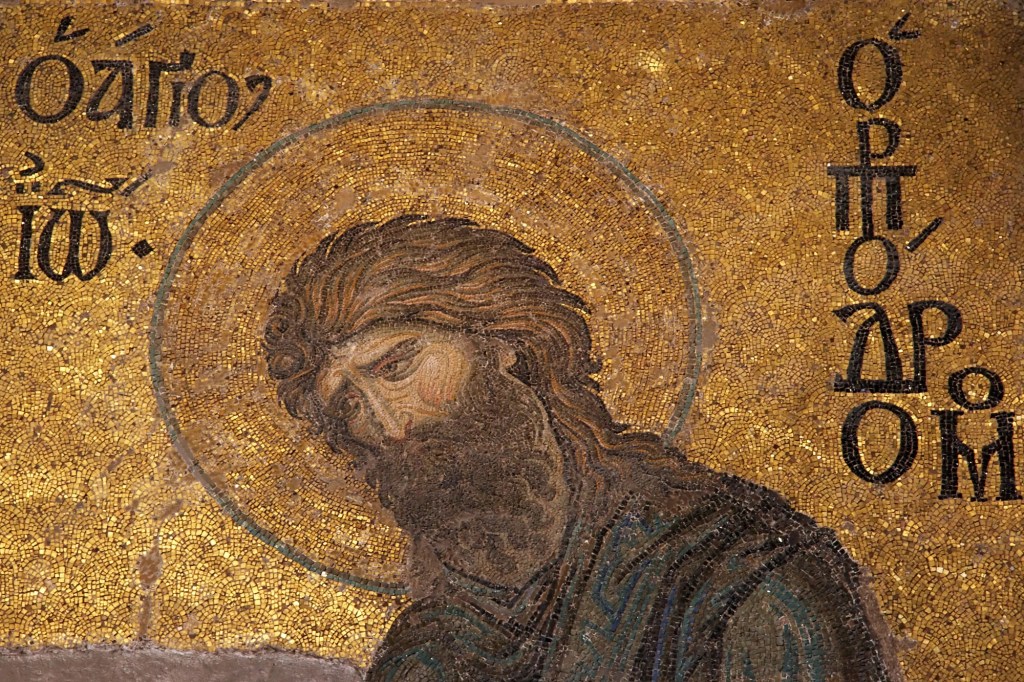
Do Our Past Actions Impact Our Present Choices?

‭”[T]he Pharisees and the experts in religious law rejected God’s purpose for themselves, because they had not been baptized by John.”

My thoughts today might seem a little obscure, but let me set the stage first.  Imagine the scene when two followers of John the Baptist were sent to ask Jesus a question. News of what Jesus was doing had traveled far and wide. People even reported that Jesus brought a dead man to life!

This is the backstory. Jesus happened upon a funeral procession. (Luke 7:11-17) The dead man being carried to his final destination was the only child his mother had, and she was a widow. Jesus was filled with compassion, ands he did the unbelievable. Jesus brought that dead man back from death!

This man and his mother were locals. They lived in a nearby town. They were talking, and it wasn’t just them. People saw it, and they were talking about it also. A crowd had witnessed the whole spectacle.

News about Jesus spread throughout Judea and the surrounding country, so that people were coming to Jesus from all around. John the Baptist heard about these things also, and he sent two of his followers to ask, “Are you the one who is to come, or should we expect someone else?”

(Luke 7:20) (As an aside, Luke does not tell us why John did not come himself, but we know from Mathew that John was in prison. (Matthew 14:1-12)

The “one” John the Baptist wondered about is the Messiah who had long been expected. John and his ancestors kin had been reading about the Messiah in the prophets for centuries. The time seemed right. Many had come recently, claiming to be him, but they were killed, and their following faded. Still, expectation was in the air.

John was imprisoned because he was open and blunt with criticism of Herod the Tetrarch, the local governor, who married his brother’s wife. Herod imprisoned John to silence him.

John was equally straightforward and to the point with the question he sent his followers to ask, “Are you the one?”

John the Baptist’s followers arrived on the scene as Jesus was curing people with diseases, sicknesses and evil spirits, healing people and even giving sight to the blind. When they asked him whether he is the one, or whether there is someone yet to come, Jesus said

“Go back and report to John what you have seen and heard: The blind receive sight, the lame walk, those who have leprosy are cleansed, the deaf hear, the dead are raised, and the good news is proclaimed to the poor. Blessed is anyone who does not stumble on account of me.”

Luke 7:22-23

These words were familiar to John. They come from the book of Isaiah, one of those the prophets that foretold the Messiah to come (see Isaiah 35:5 and 61:1). The Messiah was predicted to be the cornerstone of a new order, but the prophets also warned that he would be rejected, and he would be a stumbling block for many. (See here)

The Pharisees and religious leaders also would have known exactly what Jesus alluded to in his response to John’s followers, though they didn’t even ask the question, and they probably were not privy to the answer. For them, Jesus was a stumbling block. The way Luke describes their response is what prompts me to write today.

Continue reading “Do Our Past Actions Impact Our Present Choices?”

The Untitled God Song and the Deity of Our Existential Angst

The solution to our existential angst and a “god like me”


I saw Haley Heynderickx this evening at Space in Evanston, IL. She was (once) an obscure, modern folk artist. Then, a song of hers went viral on TikTok. (So, my son tells me.) The crowd this evening was young, even for this trendy venue on Chicago’s ever hip north shore.

Existential angst (or dread, depending on your flavor of melancholy) is the thread that runs through her work. She is a siren for the spirit of this age. Her chords strike true with my son, who turned me on to her, and with my daughter, who accompanied us to the show.

I was young once also, and the existential angst of my youth drove me on a quest that led me to the threshold of Jesus, the Lamb of God who was slain for the sins of the world. A different generation, now, leans into a similar ages old myopia.

“Meaningless! Meaningless!”
….
“Utterly meaningless!
Everything is meaningless.”

Ecclesiastes 1:2

This words may have accompanied a more ancient tune played on a lyre from a more distant youth, but the melody sounds the same.

Existential first visited me one night when I was too young to have a vocabulary for the experience. We watched old home movies from a projector in our living room. Younger ghosts of my parents and grandparents played on the grainy screen in washed out black and white.

I remember it like a dream sequence. The images and feelings of the past are equally washed out in my mind now, but the poignance and clarity of the dread that I felt is clear.

This was, I believe, the first time I became aware of the unforgiving and unrelenting passage of time. This was the first time, perhaps, that I stared the inevitability of death in the face, and the eyes of death stared back, penetrating into my soul.

The next sequence in this dream is now (and always has been) more palpable and imminent than those grainy home movies. Later that night, I found myself detached …. floating in a yawning chasm of outer space …. utterly alone and disconnected.

I don’t know to this day whether I had a dream when I fell asleep that night or whether it came to me in a ghastly vision. It doesn’t matter. If claustrophobia can be felt in an endless void, the experience would be close to what I felt. Angst and dread have nothing on the feelings I had that night.

I say this to frame my thoughts as I recall the song with which Haley Heynderickx closed out the evening: the Untitled God Song.

Continue reading “The Untitled God Song and the Deity of Our Existential Angst”

When Jesus Said Literally Not to Take Him Literally

Jesus often used literary devices to convey nuanced, spiritual meaning.


As an English Literature major in college, I have always been interested in literary devices. Symbolism, hyperbole, allegory, imagery, metaphor, analogy, and simile are some common literary devices, and we can add parable to the list.

Jesus often spoke in parables, but he also used other literary devices. The statement that it’s easier for a camel to go through the eye of a needle than for a rich man to enter the kingdom of God is both figurative and hyperbole.

According to the Oxford Dictionary online, “figurative” means “departing from a literal use of words; metaphorical.” Many literary devices are figurative, including all the ones I listed in the opening paragraph. Literary devices make our communication more interesting, and they communicate truth in a way that is more nuanced, robust, and multi-dimensional than literal statements.

Jesus often used literary devices to convey nuanced, spiritual meaning. For instance, in the Sermon on the Mount, Jesus encouraged a more nuanced (spiritual) understanding of sin when he said:

“You have heard that it was said, ‘You shall not commit adultery.’ [Literal] But I tell you that anyone who looks at a woman lustfully has already committed adultery with her in his heart.” [Figurative]

Matthew 5:27-28

In fact, Jesus used figurative language often. To some people, he spoke only figuratively! (Matthew 13:34) (in parables) He even spoke figuratively to his disciples, and he seems to express frustration when they didn’t get it:

“When the disciples went to the other side, they forgot to take bread. ‘Watch out,’ Jesus said to them, ‘beware of the yeast of the Pharisees and Sadducees.’ So they began to discuss this among themselves, saying, ‘It is because we brought no bread. When Jesus learned of this, he said, ”You who have such little faith! Why are you arguing among yourselves about having no bread? Do you still not understand? Don’t you remember the five loaves for the five thousand, and how many baskets you took up? Or the seven loaves for the four thousand and how many baskets you took up? How could you not understand that I was not speaking to you about bread? But beware of the yeast of the Pharisees and Sadducees!’ Then they understood that he had not told them to be on guard against the yeast in bread, but against the teaching of the Pharisees and Sadducees.” [emphasis added]

Matthew‬ ‭16:5‭-‬12‬ ‭NET‬

The “yeast of the Pharisees and Sadducees” is a figurative statement. Jesus wasn’t talking about bread (literally). When the disciples didn’t get what he was talking about, Jesus told them literally not to take him literally! He also seems to suggest that seeing the figurative meaning is a matter of faith. (Not the other way around.)

Jesus used the metaphor of yeast to convey the idea of the corrupting influence of the Pharisees and Sadducees in the community. We have to discern, though, what he meant. Was he talking about their thinking, their teaching, their attitudes, their assumptions, their hypocrisy, all of the above, or something else? …. Truth be told, I am not exactly sure exactly what all he meant by their “yeast”.

That’s the thing with figurative speech. It isn’t as precise. It doesn’t carry with it a detailed explanation, but figurative speech can be more profound than literal speech, and it can carry fuller and deeper meaning.

Often though, figurative meaning requires deeper thinking and discernment to determine all the meaning. The meaning has a surface level meaning and a deeper level meaning. The meaning may even be multi-layered, which explains why we often “see” new things in Scripture the more we read it and become familiar with it.

The Jesus had to provide some explanation to the disciples in the example above, because they didn’t fully understand it (telling them that he wasn’t making a point about bread at all), but Jesus doesn’t fully explain exactly when he meant by the “yeast” of the Pharisees. What is it about the Pharisees and Sadducees that Jesus was talking about? He doesn’t really say!

People we we label “fundamentalists” have developed the idea that we do not take the Bible seriously if we do not take it literally. The ministry of Jesus is replete with examples that run completely counter to that idea, but it’s easy to understand why people might want to read the Bible literally. It’s easier! We don’t have to wonder what is meant if we simply take it literally. At that same time, we run the risk of missing the whole point if we insist on reading everything literally.

Continue reading “When Jesus Said Literally Not to Take Him Literally”

What Is the Place of Christians in the World?

“By faith [Abraham] made his home in the promised land like a stranger in a foreign country; he lived in tents, as did Isaac and Jacob, who were heirs with him of the same promise.”

Apocaliptical scene to the Rome cityscape matte painting

I go back from time to time to the early “church fathers” for perspective. Most recently, I have focused on what we call The Epistle of Mathetes to Diognetus (the “Letter”). Even when translated from the Greek language in which it was written, the words and thoughts ring foreign to our American ears.

As I read this early Letter, I am impressed that Christians in the 21st Century have much to learn from 2nd Century Christians. They lived into the message of Jesus in ways that we seem to have long since forgotten

We don’t know who the author was. The Greek word, “mathetes“, merely means “student”. The person or ruling family to which the letter was written is also uncertain. We only know it was written in the early to mid 2nd Century.

The Church had grown slowly but steadily into the 2nd Century. Persecution ebbed and flowed around those early Christians, but they were more generally ignored and almost universally despised. In many ways, Christians were a complete oddity. They didn’t fit into the pagan (Greco/Roman) culture or the Jewish culture.

Christianity was centered in Jerusalem until the Roman war against the Jews and the destruction of the Temple in 70 AD. Christians scattered at that point, though Jerusalem remained one of many hubs of Christian life. The 2nd Century was a time of decentralization and spreading out throughout the Roman Empire and beyond – into areas of Africa and Asia, some of which were controlled by the Roman Empire, and some not.

According to the Letter, Christians were not physically, culturally, or linguistically distinguishable from the people in the many places in which they lived. They were distinguishable in other ways:

“But, inhabiting Greek as well as barbarian cities, according as the lot of each of them has determined, and following the customs of the natives in respect to clothing, food, and the rest of their ordinary conduct, they display to us their wonderful and confessedly striking method of life. They dwell in their own countries, but simply as sojourners. As citizens, they share in all things with others, and yet endure all things as if foreigners. Every foreign land is to them as their native country, and every land of their birth as a land of strangers.”

The Epistle of Mathetes to Diognetus
chapter 5

The most distinguishing feature of those Christians, according to the author of the Letter, was their “striking method of life”: they lived as strangers in their own countries. Though they were citizens in those countries, they “endure all things as if foreigners”.

We might be tempted to think that the “uprootedness” of early Christians was merely a product of rejection and persecution by non-Christians, but the Apostle Peter suggests otherwise: Christians are a “royal priesthood” and a “holy nation” who live as “foreigners and exiles” in this world. (1 Peter 2:9,11) This echoes the writer of Hebrews, who described all great people of faith as “foreigners and strangers on earth”. (Hebrews 11:13)

These passages in the New Testament epistles highlight a fundamental trait of Christians in the world at that time. But not just at that time; Jesus spoke to all his followers (including us) when he said, “[Y]ou are not of the world” (John 15:19), and, “My kingdom is not of this world.” (John 18:36)

How strange are these words and concepts to modern Americans! From the earliest days of our youth, we are taught about our freedoms and rights as American citizens. In contrast, 1st and 2nd Century Christians enjoyed some rights as citizens of the various countries in which they lived (maybe not as robust as the rights we enjoy), but they lived as if they had none. And, this was their “distinguishing “striking” feature as a people! It is what made them stand out.

They marry, as do all [others]; they beget children; but they do not destroy their offspring. They have a common table, but not a common bed. They are in the flesh, but they do not live after the flesh. 2 Corinthians 10:3 They pass their days on earth, but they are citizens of heaven.

the Epistle of Mathetes to Diognetus
chapter 5

Second Century Christians lived as if they were really not of this world. And, this “feature “striking method” of living was noticeable. They adapted and fit into their surroundings and culture wherever they lived, except for this one thing: they lived like they were not citizens of the countries in which they lived – even if they were actually citizens.

They were outsiders wherever they lived because they lived like citizens of heaven. They fit in wherever they went, but they stood out by their allegiance to loving God and loving others. How strange and foreign that may seem to us!

Continue reading “What Is the Place of Christians in the World?”

You Might Be A Pharisee If ….

Just when we become proud of our own spiritual advancement we are most in danger of spiritual catastrophe!


[29] “Woe to you, experts in the law and you Pharisees, hypocrites! You build tombs for the prophets and decorate the graves of the righteous. [30] And you say, ‘If we had lived in the days of our ancestors, we would not have participated with them in shedding the blood of the prophets.’

Matthew 23:29-30

Reading this passage in Matthew today reminded of the old bit by the comic, Jeff Foxworthy. If Jeff Foxworthy was a comic in 1st Century Judea, he might have said, “You might be a Pharisee if ____________________ (fill in the blank).”

In a similar vein, we could say, “You might be a Pharisee if you think you would not have opposed Jesus if you lived in Judea in the 1st Century.”

Of course, Jesus wasn’t being funny when he confronted the Pharisees, and this wouldn’t be a comedic schtick.

I don’t think Jesus was saying it was wrong for people to build tombs to the prophets or decorate them with flowers. Jesus was saying it was wrong to say (and think) they would have treated the prophets any differently.

The Pharisees are to us what the prophets were to the Pharisees. We may be tempted to think that we would embraced Jesus if we lived in 1st Century Judea, and would not have opposed him or called for his crucifixion if we we were in the crowd that shouted, “Crucify him!”.

But, that is no different than how the Pharisees thought and what the Pharisees claimed about the prophets that were resisted, derided, and sometimes killed by the “religious” people of their day. Jesus was clearly implying that the religious people of his day (the Pharisees), were no different than the religious people in the days of the prophets.

Can we say, then, that we are different than they?

Only if we adopt the same thinking as the Pharisees! (If I am understanding Jesus accurately.)

The Pharisees thought of themselves more highly than they should have. John came preaching repentance, for the Kingdom of God is near! But, the Pharisees didn’t repent. They didn’t think they needed to repent.

When Jesus – who was God in the flesh – came into the world, the Pharisees didn’t recognize Him or receive Him. (John 1:9-11) They did not prepare themselves for his coming by repenting, as John the Baptist exhorted. They adopted the wrong attitude about what God was doing in their time, and they didn’t hear and respond to what God God’s messenger was saying.

Pharisees say the right things, and they do the right things, but they fool themselves. What the Pharisees said and did was a façade. Their hearts were not aligned with their actions. They claimed to be experts in the Law, but Jesus called them blind guides leading blind followers. (Matt. 15:14)

Pharisees were concerned with appearances and the way people saw them. Pharisees were not as concerned with their heart attitudes. Jesus called them “white-washed tombs” that were empty inside (full of dead people’s bones and uncleanness). (Matt. 23:27-28) We need to be careful that we do become like the Pharisees.

Continue reading “You Might Be A Pharisee If ….”