Most people know well the checkered history of Christianity on racism, especially in the United States. Much less is said (and therefore known) on the checkered history of science on racism in the west. One reason for that difference in our collective memories is the Enlightenment narrative: that science rescued the world from Christianity. More on that below.
I am not writing today to criticize Christianity less or science more for the moral failing of the history of racism in America. I am writing to bring some clarity where a popular narrative muddies the waters.
I think most people can agree that American (and British) Christianity has a racist past, but we have short (and biased) memories on this score. History is replete with dominant people groups subjecting other people groups to slavery, genocide, and other atrocities. It wasn’t just Americans, or western civilization, or Christians that perpetuated the evil of slavery.
That we even call those things atrocities today is a credit to Christianity. The story of Jesus voluntarily dying at the hands of the dominant power of his day, urging his followers to live lives of self-sacrifice, and looking after the benefit of others as he did changed everything.
It took three centuries, but the cross eventually became the symbol of this religious movement characterized by self-sacrificial love.
Prior to the death of Jesus, the cross was the ultimate symbol of the exultant might of the dominant state over its subjects. Those in power determined the values of the society they ruled, and those values were imposed with Draconian force on those who lived under that power. “Might makes right” was just the way the world was for most of history.
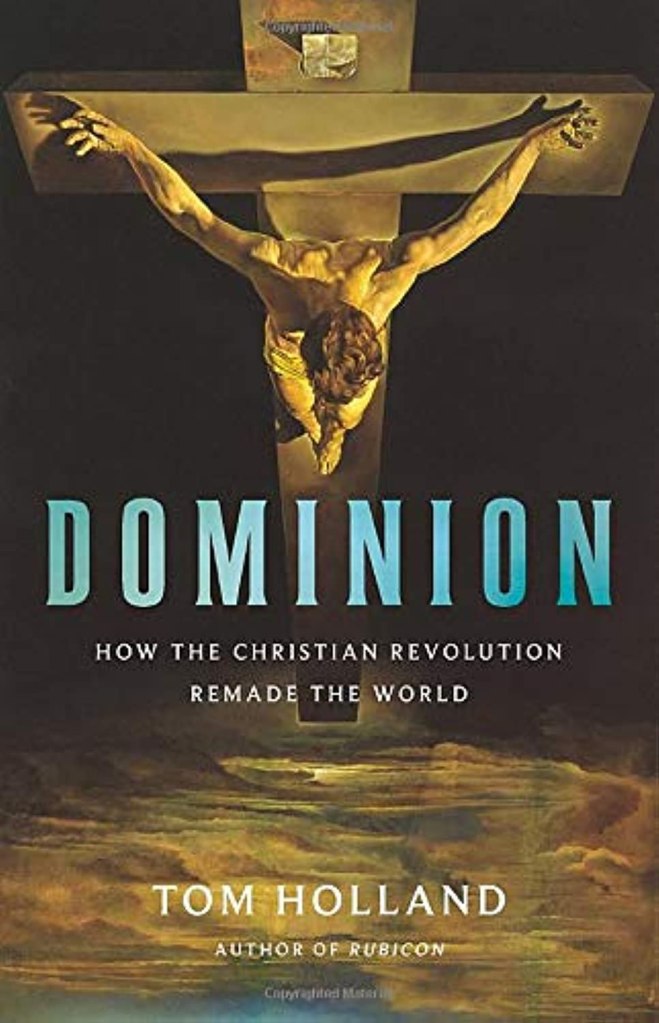
Tom Holland, in his seminal book, Dominion: How the Christian Revolution Remade the World, found the nexus for a radical change in the west in the crucifixion of Jesus. That event and the movement it inspired changed forever how the west (and now the rest of the world) views power and morality.
Tom Holland was an atheist When he did the research for this book. His area of expertise is Greco-Roman history. He was steeped in the brutish nature of the Roman world that championed power and elite, male dominance over all that was weak.
When he set out to trace his secular humanist values in western civilization, he knew there was some discontinuity between the Greco-Roman values he knew so well and his own, modern notions of basic human rights, so he was curious to locate the origin of that seismic shift.
His book, Dominion, traces our modern values from the roots where he found them in the history of western civilization. He found they go back to Jesus of Nazareth and the people who gave their lives to follow him.
The death of Jesus on the cross radically subverted the assumptions that ruled the world to that point. The Greco-Roman world that valued and honored power above all things gave way over time to the man who is claimed to be the Savior of the world who let himself be led like a lamb to his own slaughter. His life and message of self-sacrificial love became the bedrock for modern civil rights, human dignity, and the assumption that the powerful should shelter and care for the weak.
The criticism of Christians for racism and its worst manifestation – slavery – is deserved. Mostly because Christians “should’ve known better”. Of all people, Christians should have known better!
The water gets murky, though, in our modern memory because it has been influenced by a narrative that obscures the truth. The narrative that exposes the failing of Christianity often does so by directing attention away from the nonreligious world of reason and science, as if there is “nothing to see here.”
This view that rose to prominence during the Enlightenment is prevalent still today. It puts the full weight of condemnation for our failings on religion (and Christianity in particular). This is a false narrative, and, it obscures the truth and warps our perceptions that still persist.
There is nothing inherently wrong with science and reason. It is people who are flawed, and the flaws of people are not confined to science, or religion, or to any particular ideology or worldview. No ideology or worldview is immune.
I recently heard Tim Alberta say that some modern evangelicals have picked up a sword, and that sword is Donald Trump. Such a sword is needed for success in a culture war, and a culture war mentality drives the politics of many, if not most, of evangelicals today.
Many evangelicals are concerned, if not fearful, of current cultural trends. People are pulling away from and rejecting traditional Christian values in the US. The change has been rapid (as far as cultural trends go). American society is going the way of Europe and Canada in letting go (and outright rejecting) Christian labels, overtly Christian thinking, and church attendance.
Perhaps, nothing demonstrates the cultural movement away from Christianity in the United States like the book, The Nones: Where They Came From, Who They Are, and Where They Are Going, by Ryan P. Burge. The author says that only five percent (5%) of Americans claimed “no religion” in a 1972 poll. That number rose to over twenty three percent (23%) by 2018. This made “nones” as numerous as Catholics or evangelicals in the US in 2018.
Nones are predominantly young Americans, but this trend does not just affect the nation’s youth, and it has picked up momentum since COVID. Robb Redman reports from various sources on community trends and culture for worshipleader.com, including the following:
70% of Americans were church members in 1999 (Gallup);
Less than 50% of Americans were church members in 2023 (Id.);
45 million Americans have stopped going to church in that time;
41% of Americans 39-57 went to church regularly in 2020 (Barna);
28% of Americans 39-57 went to church regularly in 2023 (Id.).
Ryan Burge partnered with Jim Davis and Michael Graham to explore the reasons for this precipitous decline in church membership and attendance and the rise in self-described nones in their recent book, The Great Dechurching. This book has become the topic of much conversation in the short time since it was published. I haven’t read the book yet, so I posed the question, “What are the top five reasons people have stopped going to church, listed from most common to least common”, to two different AI platforms. The results from Bing Co-Pilot are as follows:
Judgmental attitudes (87%)
Distrust of organized religion (74%)
Too focused on Money (70%)
Busy schedules (67%)
Loss of Habit (58%)
The Co-Pilot response summarized studies done by the Pew Research Center, Gallup Polls, the Barna Group, the Public Religion Research Institute and various academic studies to generate this list. I note that the first three reasons people have given for not attending church are issues with the Church I am referring to the Church (capital C) because I don’t know how this breaks down among denominations. The other two main reasons are unrelated to the Church; they reflect personal and societal lifestyle issues.
Chat GPT reported different results, citing some of the same sources (Pew and Barna) and some different sources (General Social Survey and books and articles, generally, including Sociology of Religion by Diana Butler Bass, an academic book). The Chat GPT list is not as straight forward:
“A growing disconnection with church teachings or religious beliefs” (about 60%-70%);
“Negative experiences, such as feeling judged or encountering hypocrisy” (about 30%-40%);
“A perceived irrelevance of church” and disconnectedness of the church to modern issues (about 25%-35%);
Busyness, lifestyle, time constraints, and changing priorities (about 20%-30%); and
Exploring alternative spirituality and religious practices (about 15%-25%).
Again, the first three (3) (and the most prominent) reasons for not attending church deal with the Church, itself. Worldviews are shifting away from the views held by the Church (which seems to indicate we are losing this “culture war”). The Church is perceived as disconnected from modern life and the modern world and not relevant to it, and the Church is perceived as overly negative and hypocritical.
The one area of overlap is the high percentage of people who list judgmental attitudes, including negative experiences and hypocrisy) as major reasons of not attending church. This is obviously a key issue (ranking 1st and 2nd respectively).
I find this to be highly problematic for the Church because the Paul plainly said the Church should not be (presently) judging the world (according to Paul (See What Business Do We Have Judging the World?)) And, Jesus said we should be known by the love we have for each other.
It seems pretty obvious to me in my own anecdotal experience that the American Church, generally, has some significant issues in this regard. We are not following Paul’s instruction not to judge the world, and we are failing to love each other well.
I recently watched a Gavin Ortlund critique of fundamentalism in the Church today that focuses on these issues. He says it well when he describes a segment of the Church that is focused more on what followers of Christ should against, rather than than what we should be for. When our focus is on the negative, our positive message is likely to be eclipsed and obscured and it lost in the noise.
I realize, of course, that this “indictment” of the Church generally, is a very broad brush. The church I attend does not fit this mold. Most of the Christians I have close relationships with do not fit this mold. We don’t have to look very far or deep on social media, however, to see evidence of judgmental attitudes, hypocrisy, and negativity.
It’s interesting to me that resources Co-Pilot pulled from identify more negatives (distrust of organized religion and too focused on money) in the top three reasons for not going to church, while the Chat GPT sources identified “growing disconnection with church teachings or religious beliefs” and perceived irrelevance of church” and disconnectedness of the church with modern issues. Distrust and money-focused have nothing to do with message, but disconnection with church teachings and a perceived irrelevance with modern issues has everything to do with message (theology).
Exploring alternative spirituality and religious practices (the 5th reason noted by the Chapt GPT response is related to the disconnection responses. I don’t know whether these things are causal or just symptomatic. If people were finding what they were looking for in church, they wouldn’t disconnect and look elsewhere. If their church experience wasn’t negative, they might still be connected.
On the other hand, both sources identify other things that are going on. Busyness, lifestyle, time constraints, and changing priorities are “neutral” pressures that are affecting not just churches, but service organizations, fraternal organizations, and other traditional ways people have gathered together.
We see a spike in this trend of disconnection from Church membership and attendance after COVID (pun intended). COVID seemed to supercharge changes that were already in the works in many areas of life. People were already disconnecting from face-to-face contact with other people with the proliferation of hand-held devices and social media going back at least to 2012. COVID isolated people even further.
Sociologist, Jean Twenge, finds sharp changes in teen behavior and mental health starting in 2012, which she attributes to teen use of smartphones and other hand-held devices. Her findings about the changes in the behavior of teens is a yardstick to measure the pulse of society.
A published interview with Twenge as Time Magazine’s Person of the Week, reports that “Gen Z is in the grips of a historic mental health crisis, with teenagers struggling with record levels of depression, anxiety, and loneliness.” Twenge, who has studied many generations of teens, discovered “big and sudden” changes in Gen Z starting around 2012, when hand-held devices became normalized among teens.
Those changes included, among other things, a doubling in the diagnosis of clinical depression among 12-17 year-olds from 2011 to 2019. At the same time, teens reported significantly less face time with other people corresponding significantly with more screen time. I have heard her say that teen pregnancy is down (which seems to be a good thing) because teens spend more time on their phones in their bedrooms alone than spending time with each other (which is problematic).
So, what does this have to do with Donald Trump and Christians fighting a culture war to try to preserve their power and influence in a society that seems to be pulling away from us? I seem to have wandered far afield, but now I am going to pull it in and get to the point.
It seems our culture needs Jesus more than ever. At the same time, people are do not see the benefits of knowing Jesus. At the very time when people need the grace and love of Christ most, people are being pushed away by judgmental attitudes and negative experiences. As people are struggling with isolation, polarization, and mental health issues, the Church is becoming more irrelevant, disconnected, and inaccessible to them.
Ironically, it seems to me, we are not only losing this culture war, the culture war seems to be the very thing that is pushing people away and isolating them from us. As we are circling our wagons defending ourselves against these “outsiders”, and attacking them from behind our theological walls, we have lost sight of the fact that Jesus sent us out into the world to bring the Gospel to the lost.
I am not sure how to write about the things that I believe God has laid on my heart today. I will start, though, by explaining the combination of things that give rise to my thoughts, and I will try my best, relying on the leading of the Holy Spirit and whatever wisdom I have, in humility and full reliance upon the grace of God, to address these things that weigh on my heart today
My thoughts rise out of a combination of my daily scripture reading and regular podcast listening. I have been reading through the New Testament on a year long plan created by the Bible Project. I am in Romans 14 today. These are some excerpts from Romans 14 that stand out:
“Now receive the one who is weak in the faith, and do not have disputes over differing opinions…. “Who are you to pass judgment on another’s servant? [speaking of followers of Christ as servants of God]…. “But you who eat vegetables only – why do you judge your brother or sister? And you who eat everything – why do you despise your brother or sister? For we will all stand before the judgment seat of God…. So then, let us pursue what makes for peace and for building up one another.”
Romans 14:1,4, 10, 19
I have not reproduced the entire Chapter here to be efficient with space, but I encourage anyone who wants to dig in deeper to read all of Romans 14. I have added emphasis where the text has spoken to me.
Paul’s example of eating meat vs. not eating meat is one that doesn’t divide people in churches today, though it might divide vegans and vegetarians from “meat eaters” in our contemporary secular society. (What we eat and our religiosity about it has divided people, I guess, for 2000 years.)
“One person believes he may eat anything, while the weak person eats only vegetables. Let not the one who eats despise the one who abstains, and let not the one who abstains pass judgment on the one who eats, for God has welcomed him.”
Romans 14:2-3
Frankly, people tend to become divided over just about anything and everything. Paul uses the example of eating and of sacred days to illustrate his point about not despising and not judging each other when we have disagreements:
“One person esteems one day as better than another, while another esteems all days alike. Each one should be fully convinced in his own mind. The one who observes the day, observes it in honor of the Lord. The one who eats, eats in honor of the Lord, since he gives thanks to God, while the one who abstains, abstains in honor of the Lord and gives thanks to God.”
Romans 14:5-6
Paul says that each of us must give account to God for our own lives. Each of us must follow our own consciences that guide us with the help of the Holy Spirit, and we need to allow space with an attitude of grace for other people to work out their own salvation with fear and trembling in the same way.
Of course, we also have the Holy Spirit to guide us. How our own consciences and the Holy Spirit guide us is a bit of a mystery, though. They are not the same things. We have the Holy Spirit, but we also have our individual consciences. Paul references them both in his writings, and each plays a part in the way we understand and follow Christ in our lives.
The Holy Spirit, of course, is infallible, but our consciences are not.
And, that is the rub. We have this treasure in earthen vessels. We are finite beings, and our individual (and collective) perspectives are limited by the age we live in, the country and culture we are born in, our own abilities, experiences, and myriad factors that influence and shape us. How we internalize and process what the Holy Spirit “says” to us is going to vary from person to person and from people to people.
I recently heard someone say that we each approach Scripture from where we sit. People sit in difference “places” in respect to the Gospel at different times in history, in different cultures, and in different areas of the world. Experts in missions warn of the danger of unwittingly smuggling in our own human perspectives when we take the Gospel to different people groups.
The differences in perspective are not just factors for disparate people groups in far flung regions of the world. People in the seemingly homogenous sphere of the United States of America in the 21st Century are not so homogenous – even among Bible-believing, Jesus-loving people.
I’ll give you an example that stopped me in my tracks in 2016. Polls report that about 80% of people who identify as evangelical (which means white in political polls) voted for Trump, while 80% of blacks who attend church on a regular basis and are theologically conservative did not vote for Trump.
These are people who would largely agree with each other on traditional Christian values, but they “sit” in different places in respect to how they live out following Jesus politically. For white evangelicals, abortion is the political benchmark. For churchgoing blacks, racial and minority issues are paramount.
I should not have to say that God grieves all injustice and all sin. It’s easy to label each other “white supremacists” or “woke progressives” and miss the obvious fact that we all claim Jesus as our Lord and Savior. We all have the Holy Spirit to guide us, and we do the best we can from where we sit to follow the Spirit and our consciences.
Having listened to many black voices since 2016 (because I realized I was missing something), I learned that most black Christians believe that abortion is wrong. They believe in traditional family values, and they are at odds with the Democratic party on those issues. I also learned that a large segment of those “white evangelical’s” in political polls don’t even attend church more than once or twice a year, if that.
Another less controversial example from my own life illustrates what Paul talks about in Romans 14. I grew up in a family of responsible social drinkers. Family gatherings included a “cocktail hour” before meals, but I never observed family members getting drunk.
During my rebellious youth, and before I became a believer, however, I was a reckless, irresponsible drinker. I drank often and to great excess. When I became a Christian, I didn’t touch alcohol for many years, and I was tempted to believe that no one else should either.
My views on this subject have been tempered by the wisdom that comes with age and experience and the gentle grace of the Holy Spirit. Paul would say I was weak in my faith, and I admit that I became judgmental over it because I projected my weakness onto everyone else.
Paul says in Romans 14 that people who are weak in their own faith become judgmental. The danger of people who have a strong faith and a secure conscience is to despise those who are weaker. Paul urges us to resist both tendencies.
But, let me get to my point. I am increasingly concerned with judgmental attitudes over issues on a par with eating, drinking, and sacred days are doing damage in the modern Church. Paul would say that we need to focus our attention on “pursu[ing] what makes for peace and for building up one another.” Unfortunately, we spend far too much energy judging each other and tearing each other down.
This is nothing new, of course. Paul wrote an entire letter to the Church in Corinth that he led off with this exhortation:
“I urge you, brothers and sisters, by the name of our Lord Jesus Christ, to agree together, to end your divisions, and to be united by the same mind and purpose.”
Paul famously says in Roman 1:20 that people everywhere are without excuse in their denial of God and suppression of the truth because God’s invisible attributes and His eternal power and divine nature have been clearly seen and are understood through the creation. This is one of the most often quoted verses in the first couple of Chapters of Roman.
I have often quoted Romans 1:20 as a defense of the faith to unbelievers, but Romans 2:1 catches my eye today. It begins with same phrase, “Therefore, you are without excuse….” Except this verse is clearly directed to an audience of Roman believers.
I wonder how I have missed the parallel nature of this statement to believers. Just as nonbelievers are without excuse in their unbelief, Paul says believers are without excuse in a different sense:
“Therefore you are without excuse, whoever you are, when you judge someone else. For on whatever grounds you judge another, you condemn yourself, because you who judge practice the same things.”
Romans 2:1
I have to admit my own tendency to focus on Romans 1 and Paul’s statements that the world is without excuse, because God made himself known, and people in their depraved minds chose not to honor God, embracing sin instead. I tend to focus on the list of sins, including men and women trading natural relations for unnatural ones.
It seems that the world focuses on those things as well. Christians and non Christians alike, and this list of sins has become become a dividing line in the ongoing battle of a “culture war” that wages in the United States.
While Romans 1:20 and the list of sins that follow it seems to have captured our attention, I wonder today why we seem to glossed over what Paul says in Romans 2:1?
The parallel nature of the two verses demands some attention. We dare not focus on one half of the equation to the exclusion of the other half of the equation.
Paul says in Romans 1:14 that he is a debtor to Greeks and barbarians and to the wise and the foolish because the Gospel has the power for salvation. (Rom. 1:16) The righteousness of God is revealed in the Gospel from faith to faith. (Rom. 1:17)
Then, Paul says that the wrath of God is revealed against the ungodliness and unrighteousness of people who suppress the truth (Rom. 1:19) because God has made it plain to them…. Therefore, they are without excuse.
Paul doesn’t stop there, however, and neither should we. In Romans 2, Paul starts out saying that people who judge others are also without excuse! On whatever grounds we judge others, we condemn ourselves because we practice the same things.
This is a sobering statement, and one which we ignore to our detriment and the detriment of the preaching of the gospel.
Again, it’s important to note that Paul is talking to the believers in Rome. He is not talking to heathens and barbarians and people who are given over to their carnal desires.
Five chapters later Paul talks personally about believers’ struggles with sin (Romans 7:15-20), doing the things we don’t want to do and not doing the things we know we should do. Paul is brutally honest about the fact that sin is still a problem for the believer. If anyone ways he is without sin, he makes God out to be a liar! (1 John 1:10)
Of course, believers should resist sin and learn to overcome it. This is a lifelong process, and we only overcome by the work of the Holy Spirit in us as we yield to His direction in our lives.
Yet, the holiest of people – Paul – admits to failing from time to time and giving into or returning to some form of sin. It doesn’t what what the sin is. The sin that causes us to stumble may be different for each one of us. That fact is that we sin, even though we don’t want to sin anymore.
The import of this for the believer, Paul is saying, is that we, should not adopt a judgmental attitude toward anyone. Not even to those who God has given over to their carnal desires. In judging others, we condemn ourselves, says Saint Paul. Paul also days,
“What business of mine is it to judge those outside the church? Are you not to judge those inside?”
1` Corinthians 5:122
The timing of this fresh revelation from my daily scripture reading is interesting. My social media feed has been full of judgmental tirades over the opening ceremonies at the Paris Olympics. I did not watch them, but I have certainly become aware of how everyone feels about those ceremonies, particularly Christians.
I know I am late to the discussion, but I have resisted the temptation to jump into the fray. It seems there is much to be offended about, yet the parallelism of Romans 1:20 and Romans 2:1 gives me pause. The judgmentalism of offended Christians screams for a response.
What business is it of mine to judge those outside the church? …. God will judge those outside….
1 corinthians 5:12,13
Paul wrote these words to the Corinthians while urging them to deal with sexual immorality in the church that was so bad it would not have been tolerated by pagans. (1 Corinthians 5:1)
I am reminded of these words that Paul wrote as I listen to Gospel Shoes by the folk/Americana group, Watchhouse (formerly Mandolin Orange) from Chapel Hill, NC. This isn’t a “Christian” song written by people who profess to be Christian, but it speaks with poignancy, clarity, and tenderness. This version is particularly well done:
Some set their heads to swimming, nothing to lose Drift about their good times, slivers in their boots Some walk the straight and narrow, only passing through Trading this world over for a pair of gospel shoes
The opening stanza of the song contrasts the “pagans” of the world with the “Christians” (more or less). Andrew Marlin (the writer of the song) may put it another way. He might say that he is contrasting “normal”, average, typical people with “religious”, church-going people.
To be fair, the caricatures of religious people do not accurately describe most of the people in my church (or in any church I have gone to, for the most part). BUT, those caricatures do have some elements of truth to them about some people, or some segment of people, who are religious in our society.
Those who “set their heads to swimming, nothing to lose”, are living this life for all it can give them because they believe this life is all there is. They “drift about their good times” because they have no particular aim, meaning, or purpose. They are looking for whatever fun and pleasure they can get, though they accumulate “slivers in their boots”.
Those who “walk the straight and narrow, only passing through”, are the religious people, of course. They are people who profess to believe in a better life after death, “trading this world over for a pair of gospel shoes”.
The term, “gospel shoes”, finds some resonance in Isaiah:
“How beautiful on the mountains are the feet of those who bring good news, who proclaim peace, who bring good tidings, who proclaim salvation, who say to Zion, ‘Your God reigns!’”
Isaiah 52:7
The word, “gospel”, of course means “good news”. The feet are beautiful of those who say “God reigns!” because it is news of peace, good tidings, and salvation. Or so it should be. Paul says, our feet should be “fitted with the readiness that comes from the gospel of peace.”
Ironic, isn’t it? That Paul in talking about the “armor of God” includes “shoes” made of the “gospel of peace”. (Ephesians 6:15) It’s no wonder that we send mixed messages out into the world. But, that isn’t the “fault” of scripture; it’s our misunderstanding of it and of the upside down nature of the kingdom of God that Jesus preached.
The armor of God does not protect us against people (flesh and blood) but against dark spiritual forces. (Eph. 6:12) We are not intended to use the armor of God as a weapon against people.
Of course, some people often don’t want to hear about God. They don’t want to do be accountable, so the news of God is not “good” to them. The people who set their heads to swimming, who think they have nothing to lose and drift about the good times, however, are bound to gather slivers in their boots.
Drifting through life doing “whatever feels good” inevitably results in hardship and heartache. These are people, however, for whom God emptied Himself to become human in Jesus and for whom Jesus gave up his life, dying on a cross. He didn’t come to condemn them; he came to save them. (John 3:16-17)
Those slivers in their boots are problems that will fester and get worse. People often do not wake up to the folly of our youth until we have accumulated more hardship, difficulty, and pain than we can handle. And sometimes, those slivers cause problems that linger for a lifetime.
God who loves “those people” so much that He gave His son for them. He loves them no less than any religious person in the world, no matter how devout. Thus, God desires to reach them with His Gospel, the good news that there is a way for them to avoid the pain of their own doing and judgment that inevitably follows this life and enter into relationship with the God who created them and loves them.
As I recall Paul’s words to the Corinthians, I am struck that we often seem to have gotten things backwards. Instead of loving the world and seeking to reach them with the good news, we condemn the world and preach judgment.











 Navigating by Faith