What Does the Global Church of Jesus Christ Look Like? And Why It Matters?

The church we know in the United States doesn’t look like Church worldwide.


I read today this tweet by David Cassidy (found here):

The average Christian in the world is not male but female[1], not white but brown or black[2], third world, not first world[3], far more Pentecostal than Presbyterian[4]. The “average” Christian in the world today is a 22-year old brown female[5]. She has not been to your conference…

…she has not read CS Lewis or Christianity Today; she has not read your blog, nor mine, and does not go to Starbucks or care one bit about alternative endings to Game of Thrones or if the latest lyric from Hillsongs [sic] agrees with our confessional standards.

She is also likely the vessel God will use to prophesy to the next generation. She’s not afraid of suffering either: Over 215 million believers are persecuted with intimidation, prison, and even death for their faith in Jesus Christ across the world (Open Doors, USA)[6]

42% of the world’s population is under 25[7], half in sub-Saharan Africa and South Asia[8] The median age of the global population is 28[9]. If your ‘mission’ is preservation or expansion of White Christian USA nationalism, you need to wake up & repent

South American and Central American churches are thriving and reviving. Thank God. We have to be about global mission and embrace all people everywhere with the love of God. That starts with neighbors next door but won’t stop there.

White American Nationalist Christians need to be at the feet of these global Christian communities and LEARN again the power of prayer, the presence of God’s power in the absence of political power, and the joy of the Gospel. Man, I have so much to learn!

Much of this tweet rings true to me based on what I have been reading over the past several years, but I spent some time fact-checking the various statements. The results of what I found are linked above to the references below.

I was able to verify most of the statements. The only ones I couldn’t verify are the statements about the average age of Christians worldwide and the median age of the world population, which was 28 a few years ago, but more recent numbers show a rise to 30. Studies also seem to show that the average age of religious people in the world is increasing (especially in the west), but I couldn’t find anything specific to Christianity.

Still, most of what David Cassidy says in this tweet is true and can be verified. The key points being that Christianity is not a white, European-centric or western … at least, not anymore. It wasn’t when it started, and it isn’t anymore.

Think about that for a moment…. While American Christianity still looks very white, with European origins and a paternalistic feel, the church worldwide looks very different.

Continue reading “What Does the Global Church of Jesus Christ Look Like? And Why It Matters?”

God Is Always Doing a “New Thing”

We need to be open to hear God’s voice and the direction He wants us to go in these present times


I think many Christians, most of them, look a bit skeptically at the charismatic element of the Church universal. We conjure up images of the prosperity Gospel and “holy rollers”. The New Testament, though, reads like a charismatic diary.

 The dispensationalists will say that God worked like that only for a time, only until the New Testament was “codified” into a cannon. Now we don’t need God to speak to people directly through prophetic words and such. We don’t need signs and wonders because we have the Bible now.

They might be right, but maybe not. God doesn’t fit into the boxes we prepare for Him.

I have come to view all the movements in the history of the Church as various times in which God emphasized specific things to His people for specific purposes. The move to get the Bible in print in plain language for the masses enabled worldwide, grassroots growth of the Gospel. The move to emphasize that salvation is by God’s grace that we receive through faith was necessary to counter error in the notion of how salvation works.

In my view, denominations formed around these movements as people put down tent stakes and tried to camp on those things God was emphasizing at particular times, but God is always doing a new thing.

Not that God changes, or that the truth changes. We change, and the flow of history changes. God is always working through it all to accomplish the ends that He has planned from the beginning.

I think we can never go wrong asking the question: What is God doing now? What does God intend for a time such as this? What is God saying in these times?

So, I am open to the possibility, which I think is a probability, that God is still “speaking” in these times through people to whom God is willing to entrust His voice. There are disparate voices, of course, even in the Church, but it’s always been like that.

I don’t believe God will say anything that contradicts what He has said in the past, but He might be saying things that contradict what we believed in the past. God might be calling us to new ways of doing things.

When God became flesh and lived among the people to whom He had intimately and directly revealed Himself, they didn’t recognize Him. The disciples on the road to Emmaus were amazed as Jesus opened the Scripture to them to reveal all the ways it spoke of Him. They didn’t see it until He opened it up to them.

In the same way, we need to have the humility to recognize that we might have wrong ideas about things. Maybe they aren’t “wrong”, but they just aren’t effective any longer in this time. The last thing that I want is to remain standing still when God is moving.

We need to be open to God showing us “new things” that we didn’t previously understand or appreciate. We have to consider the possibility that we might not recognize God when He is speaking today in the same way that God became flesh, came to His own people, and His own people didn’t recognize Him.

I say these things only as a preface to talk about an article, Continue reading “God Is Always Doing a “New Thing””

Being Innocent as Doves and Wise as Snakes in the World of Justice

We do a yeoman’s job of distinguishing ourselves from the world, but we are not doing well distinguishing ourselves to the world. 


I have been wrestling with the divergent views of social justice, critical theory and gospel justice for some time now. They all “compete” in the same arenas, have some overlapping commonality, but they diverge in some very fundamental ways. I am not going to get into those difference here, but I want to try to open a discussion about how we, as Christians, move in these areas and discuss them in ways that honor the desire of Jesus to leave the 99 and go after the lost sheep.

I am writing this after reading a well-written article by Natasha Crain, 5 Ways Christians are Getting Swept into a Secular Worldview in This Cultural Moment. I like that she starts out by acknowledging that George Floyd’s death, which prompted a massive public response, was unjust, and that racism is not only wrong; it is not biblical. She acknowledges that Christian can agree with the secular world on those points.

She goes on to describe five (5) ways in which Christians get swept along by secular currents that are not biblical in attempting to respond to injustice. Critical theory (and critical race theory), in particular, is antithetical to Christianity in some of its core tenets. Though she doesn’t really say it directly, critical race theorists and Christians can both agree that injustice exists and even on that much of what that injustice looks like. The real divergence is in the worldview that informs and under girds critical race theory and its proposed solutions.

I am not going to talk about the details of those differences either. (I did a little bit of that in Critical Race Theory from a Christian Perspective.) What I want to address, using Natasha Crain’s article as a backdrop, is the extent to which I believe the evangelical church failed to address justice issues as God would have us address them.

We are good at preaching the good news (the Gospel), and good at proclaiming truth (including articles like Natasha Crain’s article detailing what is wrong with the critical race theory and social justice efforts the truth and/or leave the Gospel out of the equation), but we are not so good at doing justice. (I have written about this recently here, here and here.)

I see many articles like Natasha Crain’s article, and I hear many voices warning about the evils of critical race theory and social justice initiatives that are divorced from the Gospel, but we need positive voices to speak into the area of justice from the position of the Gospel at the same time. Justice is at the very foundation of God’s throne. (Psalm 89:14) We can’t ignore it!

In that vein, I will add to the voice of Natasha Crain who addressed five (5) areas in which Christians are getting swept into a secular worldview at this time. I don’t disagree with her on her assessment, but I think we need some counterbalance in this discussion that emphasizes God’s heart for justice. Continue reading “Being Innocent as Doves and Wise as Snakes in the World of Justice”

The Need for the Church to Address Racial Injustice

Everyone agrees there is a racial disparity problem. Only people on the fringes deny the problem.


I believe the Bible teaches that Christians who seek to follow Jesus as he followed the Father should be as earnest in doing justice as they are in preaching the Gospel. The Gospel and justice go hand in hand. The evangelical church, however, has fallen short on the justice side of the equation.

I believe the evangelical church has left a void in the area of justice that has allowed new, competing philosophies to take over the cultural space. Critical race theory has become the loudest voice in that arena.

Many Christians who are justice-minded have gravitated toward critical race theory to give a voice to the injustice they see because the church is not speaking to it. Without realizing that critical race theory may be another gospel that runs antithetical to the true Gospel, they may be embracing ways of thinking that could be harmful.

Critical race theory defines the problem and the solution in terms that do not align with the Gospel and to biblical truth. That is not to say there is no redeeming value to critical race theory, that it is inherently evil, or that people who espouse CRT are wicked or evil.

CRT is a man-made construct, and it’s not the Gospel. Inevitably it’s a solution that doesn’t get to the heart of the problem and doesn’t bring about true justice.

The Gospel offers true justice.

The Gospel says that all humans are made in the image of a holy God. All human beings, therefore, have intrinsic value that cannot be denied. We honor God and do right be each other by recognizing that in our thoughts and actions.

Love God and love your neighbor is the simple formula for recognizing the reality of human value in our thoughts and actions. This simple phrase is the summation of the Law of God boiled down to its essence. If we actually did that, there would be no injustice.

The problem with men is sin (missing the mark), transgression (breaking trust with God and people) and iniquity (brokenness). We often don’t do the right things we know we ought to do. W often want to go our own ways and to please ourselves rather than love God and love our neighbors.

The Gospel teaches that we have all fallen short (missed the mark). We have all broken trust with God and people. We are broken in our own ways, and we need help we cannot provide for ourselves.

Jesus offers the solution to the sin problem by taking on the sin of all people (of all races) on himself and setting us free (ultimately) from the consequences of sin. Jesus does that so we can have relationship with God who, then, begins to work within us to will and to act according to His good purpose.

That reality is borne out in the process of personal sanctification (vertically) and in just relationships with our fellow man (horizontally).

We do not achieve salvation by anything that we do. It’s a free gift available to all of us by grace. We simply need to embrace it. Salvation takes away the shame and the ultimate consequence of sin, which is death (physically and spiritually).

Salvation also frees us up to live as God intended by the help of the Holy Spirit who takes up residence within people who yield to Him. We demonstrate that by our love for God and our love for people. We no longer live for ourselves; we now live for God and others if we have truly been born again and received God’s gift of salvation and His Spirit.

Racism is the sin of partiality. (James 2) In Christ, there is no Jew nor Gentile; no male nor female; and no black, nor white or brown. We are all one in Christ, and the ultimate goal of the Gospel is to unite all humanity in Christ with God the Father. The picture of that ultimate goal was given to the Apostle John in a vision:

“After this I looked, and behold, a great multitude that no one could number, from every nation, from all tribes and peoples and languages, standing before the throne and before the Lamb….” (Rev. 7:9)

Most people can see there is a racial disparity problem in the United States. We might not agree on all the causes or what to do about it. Only people on the fringes deny the problem of racial injustice.

The evangelical church, unfortunately, has had a very spotty track record on the issue of racism. A large segment of the evangelical church supported slavery in our more distant past. It was also a segment of the evangelical church who championed abolition and freedom.

Many Christians with a heart for justice are (rightfully) responding to the voices speaking to the issue of racial disparity, but many of those voices are using CRT as their guide. We have, to some extent, failed to develop a robust, biblical response to racial injustice, so people even in the church use the language that is available.

Continue reading “The Need for the Church to Address Racial Injustice”

Critical Race Theory from a Christian Perspective


I have been writing to encourage the evangelical church, in particular, to speak up and get involved in doing justice as God would have us do it. (Here and here.) We have been champions of proclaiming the Gospel, but we haven’t exactly been champions of doing justice.

My goal isn’t to shame anyone into jumping onto a cultural bandwagon, but to focus on God’s heart that is characterized by justice and our role in participating in God’s purposes. If we want to be involved in following Jesus as he followed the Father, I think we need to do justice.

He has told you, O man, what is good; and what does the Lord require of you but to do justice, and to love kindness, and to walk humbly with your God.

Micah 6:8

There is no condemnation for those who are in Christ, but God calls us to do justice.

At the same time, we need to be mindful, always, of truth. Biblical justice has a vertical element and a horizontal element: man to God and man to man. We need to be aligned in both directions with God and His character.

Critical race theory has become a viable contender in the modern cultural arena for defining injustice and prescribing how to fight it. Critical race theory, by its very nature, attempts to control the discussion. As Christians, though, we need to keep our focus on the Gospel as we wade into the fray.

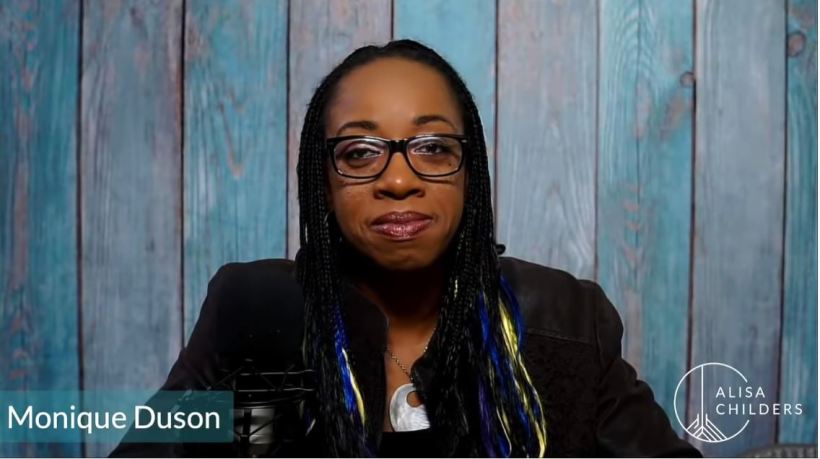
In this article, I summarize a conversation between Alisa Childers and Monique Duson on Race, Injustice, and the Gospel of Critical Race Theory. (The full interview is embedded at the end of this article.) I have been meaning to write on the subject of the difference between Gospel justice and social justice (which often devolves into justice without the Gospel), for well over a year. This, I think, is a helpful introduction to the subject.

I will address critical race theory (CRT) here, and I will follow with some thoughts on need for the evangelical church to be actively involved in doing true (biblical) justice.

Background.

Monique Duson grew up with critical race theory in south LA. The ideas that drive critical race theory (CRT) were her frame of reference before she even had a label for them. She was nurtured and educated by it. Her world was defined by an us-against-them orientation: whites against blacks.

She didn’t really know the philosophy or the foundations that under-girded that framework until she attended college at Biola University, a Christian institution. Even there, she recalls, she really didn’t question it or put it into a Gospel perspective.

In fact, she had always assumed “the Gospel” in the United States of America was a white concept that was part of the oppression of white power structures. She didn’t realize this construct comes from CRT, and she didn’t realize the historical Gospel isn’t “white” until after college when she was challenged to research it.

As she learned that Jesus wasn’t white and the culture in which the Gospel first introduced wasn’t white, Monique came to realize, “The Gospel we have perceived isn’t white Protestantism.” The Gospel predated the European influences that eventually spread the Gospel to the New World.

Because of Monique’s background and personal experience with critical race theory, she is uniquely able to identify where CRT and biblical notions of justice and the cure for injustice diverge. The rest of this article focuses on CRT as another gospel that is different than the true Gospel that Jesus preached.

Continue reading “Critical Race Theory from a Christian Perspective”