Pulling at the Threads of the Christian Paradigm that Uniquely Influenced the Western World

Down at the bedrock of modern, western values remains a Christian foundation.

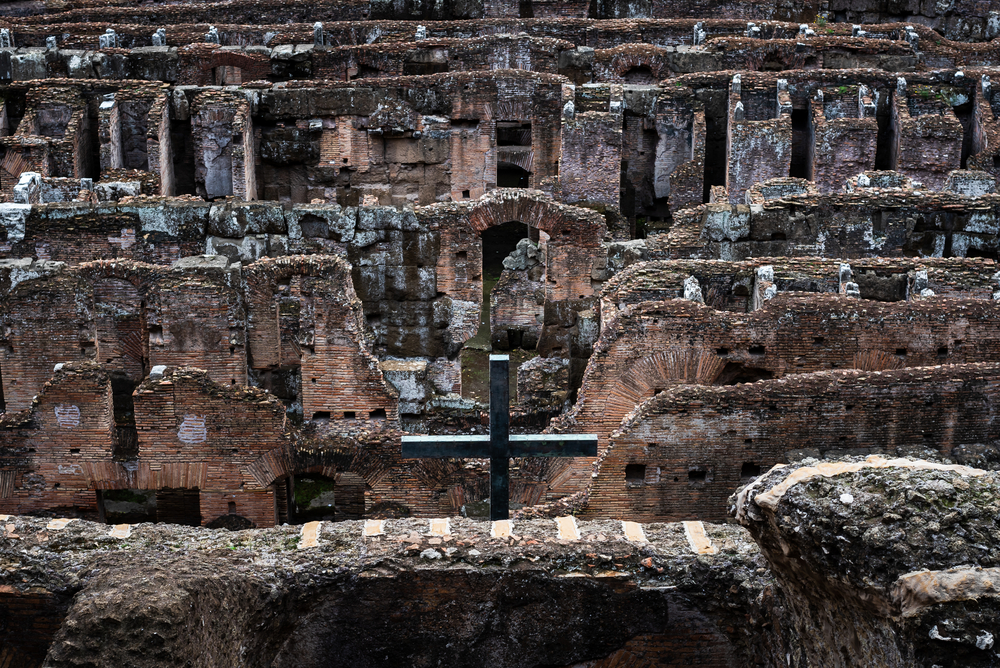
Galleries under the central arena of the Colosseum in Rome, Italy

I read Tom Holland’s new book, Dominion, about a year ago, and I have written about it a few times. Many Christians would not think to read a history about Western Civilization by a self-described secular humanist (once atheist, perhaps now agnostic) historian.

Most non-Christians are likely to be uncomfortable with the chronicle Holland describes of the radically influential role that Christianity played in the development of Western Civilization, providing the foundation, in fact, for secular humanist ideals. When Holland dug down to the bedrock of modern, western values, he was surprised himself to find them anchored on a Christian foundation.

Holland did not set out to write a Christian apologetic, and he seems to remain somewhat uncertain how to process what he “discovered”. What he found, though, changed his mind about Christianity. He gives a brief explanation in the following clip:

Though Holland has had a turnabout on his view of Christianity, he finds himself caught in an odd position wrought by the unexpected discovery that his lifelong, secular humanist values flow from the radical catalyst of Christian influence and remain embedded ubiquitously in its very fabric. The awkwardness of his current position is evident in his interviews and discussions about the book.

Christians and secular thinkers, alike, wrestle with his book. Holland doesn’t hide any warts, and he doesn’t pull any punches. Neither does he obfuscate the thoroughly paradigmatic shift in Western thinking that Christianity worked into a society that once proudly and unashamedly championed strength and privilege over the poor, the weak, and the lowly.

Holland exposes the metanarrative developed during the Enlightenment and thereafter that belies the foundation on which the Enlightenment structure was built. Far from advancing the progression of human values, the Enlightenment threatened to undo the distinctly Christian concern for the poor, weak, and lowly while attempting to wrest western civilization from the hold of the Divine. Humanism saved the Christian ethic, albeit divorced from Christ.

Consider the full title of Darwin’s great tome which staked out the ground of a scientific (and social) revolution free from God’s interference:

“The Origin of Species by means of Natural Selection or the Preservation of Favoured Races in the Struggle for Life”

The title of Darwin’s book championing the evolutionary paradigm, harkens back to the Greco-Roman value system that despised the poor, the weak and the lowly. That value system did not just turn a callous eye at wanton and discriminate cruelty, it cheered on the strong while they snuffed out the weak. It was national sport!

The very reason the full title never “stuck” (I now believe) is due to a fundamental, pervasive, and thoroughly entrenched counter-value of the intrinsic worth of human life that is uniquely Christian in its source.

The intrinsic value of all human life, from the greatest to the least, from the wisest and strongest to the weakest and most imbecilic, from the fittest to the most infirm, is traceable to the Christian belief that all human beings are made in the image of God. That the survival of the fittest did not take hold as a western social or ethical value is attributable to the deeply ingrained Christian ethic that survived yet, despite the efforts to eradicate its God from modern equations.

Modern humanists may attempt to recast Darwin into a humanistic mold, but the idea of “social Darwinism” bears his name through no model of random, unguided selection. According to John G. West, Charles Darwin, himself, set in motion the inertia for eugenics, among other things, that were associated with social Darwinism:

Darwin himself in The Descent of Man provided the rationale for what became the eugenics movement, and how the vast majority of evolutionary biologists early in the twentieth century were right to see negative eugenics as a logical application of Darwin’s theory.

While the defense of Darwin against the charge of social Darwinism has largely succeeded in popular and polite company, the very title of the Origin of Species (by means of Natural Selection or the Preservation of Favoured Races in the Struggle for Life) belies the success of that effort. The fact that the full title is merely a parenthetical today is evidence only of a concerted rescue campaign.

Christian values survived despite the Enlightenment coupe, not because of it. Humanism today assumes the evolutionary paradigm for its science alongside the uniquely Christian paradigm of intrinsic human value. That the two assumptions do not fit well together seems to be lost on modern minds.

Continue reading “Pulling at the Threads of the Christian Paradigm that Uniquely Influenced the Western World” →

Separating the Church from Babylonian Morality in the Race Discussion

If we fall into a politically partisan conversation, the Gospel takes a back to secular politics.

The following thoughts and observations come from and are inspired by a conversation between Preston Sprinkle and Dr. Ed Uszynski. (See Episode 877: Race, CRT, and Evangelicalism of Theology in the Raw.)

Sprinkle and Urszynski are in agreement that Christians generally are doing a poor job of grappling with the issue of race in the United States. Most Christians are vocal in their criticism of secular solutions, but few Christians are really engaging with the underlying issues.

Critical Theory, CRT and Marxist ideology and terminology are fueling the discussion in the secular culture. Identity politics, systemic racism, police brutality is the language commonly used in the secular world to frame the discussion. Whether Christians are condemning these concepts or aligning with them, Christians are not offering much in return.

In the podcast, one the two men (I can’t remember which) said that we should have different language inside the Church. We should have Gospel language that addresses injustice.

“We should have a theological understanding of the concept of justice…. We should be immersed in care and concern for vulnerable populations, regardless of color, regardless of gender, regardless of background. We should be robustly able to think about what it means to care for the least of these, to watch out for people who are being taken advantage of…. That’s a biblical idea that we should be deeply immersed in theologically and biblically.”

That, however, isn’t happening in most Christian circles. People who are engaging in the conversation are engaging in it with the secular terminology and don’t recognize that we need to separate ourselves from that secular perspective. We are defining ourselves in relation to secular concepts, rather than driving the conversation from a biblical perspective with biblical concepts and biblical terminology.

Christian are either adopting CRT in church, which is the primary, secular approach, or Christians are rejecting CRT without offering a Gospel orientated alterative. People address CRT (by opposing it), but they are largely not addressing or effectively engaging the race conversation on a theological level.

“We have done a horrible job, generally, in embracing, and believing and obeying the rich theological theme of what the Kingdom of God is designed to look like and how it is designed to function in terms of its multiethnic backbone.”

Continue reading “Separating the Church from Babylonian Morality in the Race Discussion” →

A Critique of Some Reasons Why Christians Oppose Critical Race Theory

Has CRT become a scapegoat that masks and exasperates the real problem?

Critical Race Theory (CRT) has caused quite a stir in Christian (and conservative) circles, while racial tensions remain inflamed in the United States after a summer of COVID fear and racial unrest. While we are currently in a period of relative calm, it seems like the volcanic activity continues churning under the surface, and it’s only a matter of time before that tension erupts again after another callous killing.

Since last summer, I have focused often on issues of race in my writing, and race continues to occupy my mind. Thus, when a friend recommended some episodes from Theology in the Raw on the subject of CRT and race, generally, I listened to them. I was thrilled to find the discussions civil, intelligent and enlightening.

I have listened to several episodes now, but the one I am writing about today is episode #844. I am going to summarize parts of it with my own comments, but I highly suggest listening to the whole discussion if you have the time and inclination.

In this podcast, Preston Sprinkle’s guest, “Pastor T”, explains some of the frustrations that black people have with white people (conservative and progressive) in the conversation about race. Pastor T explains that the black Church is more aligned with conservatives on theological lines, but they tend toward progressives on political lines because of silence and lack of engagement with black plight in America by white evangelicals.

Take a moment to listen to Pastor T explain (at approximately 24 minutes in):

I will pick up the conversation in the context of the reasons why Christians oppose CRT. Pastor T identifies at least three (3) areas of concern expressed by some Christians: 1) it leads people away from the Gospel and causes people to deconvert; 2) it is a false religion that threatens Christianity; and 3) it is a progressive ideology that threatens conservative values and democracy.

The first group of people oppose CRT because they see CRT drawing people away from the church, away from Christianity and away from the Gospel. They see people “deconstructing” and leaving their faith. They believe that CRT is to blame, at least in part.

A slightly different reason that people oppose CRT is a concern that CRT is a false gospel advocated with religious zeal usurping real religious zeal in the truth of the Gospel. This is objection is a worldview concern – opposition to a competing worldview.

This view sees CRT as racializing the world because CRT divides the world into oppressor groups and oppressed groups. It posits that people in the oppressor group can never be justified; and the people in the oppressed group are justified simply by virtue of their grievances. These are secular constructs, not biblical ones.

The third group of people might use the language of theology, but their focus is more political. They say that CRT is not good for society, democracy, or the country. They oppose the Black Lives Matter movement and the movement to defund the police, for instance, as unwise, unhelpful, destructive, and (also) contrary to the Bible.

Pastor T began the discussion by acknowledging the legitimacy of these concerns. He affirms that we should be concerned about rival claims to salvation and eternal life and the basic teaching of the Gospel.

Pastor T is a conservative Christian, as are many black Christians in their theology. His observations suggest that we are separated more by race than by theology in the American Church. Perhaps, the disconnect between the black Church and the white Church over CRT in America has more to do with racial experience and perspective than the Gospel. That is becoming more evident to me as time as goes on.

Continue reading “A Critique of Some Reasons Why Christians Oppose Critical Race Theory” →

Risky Living: Tempting Death

Most of us try to avoid risks, but the risk of death for all of us is 100%!

Evel Knievel (Robert Craig Knievel), an American motorcycle daredevil and entertainer. Photo from http://cliffordsphotography.com/

This is a continuation of Risky Living: God Risk and Bad Risk. In that piece, I explored the difference between good risks and foolish risks. I was prompted to begin writing on the subject by a dream that I explained in the previous piece and the “lockdown” order covering most of the United States in April of 2020.

It is now April 2021. Much has happened, though much remains the same. This article I started a year ago has evolved. The path these thoughts have lead me down end in death, which is where the path of each of us will end. Before we get there, though, I will pick up again with the subject of my reckless youth.

I should have known at a young age that I had an affinity for recklessness. As a pre-teen, I loved the idea of somersaulting from a high dive, and I was even tempted into thinking I could jump extremely close to the edge of a concrete pool from a high dive without hitting the edge. Fortunately, I never attempted it, but no one who knew my thoughts or inclinations would be surprised at the series of unfortunate misadventures I experienced in high school.

I was no Evel Knievel, but I totaled two cars before I was 18. I climbed three water towers in the dark after nights of drinking. I don’t remember driving home after some of those nights of drinking. I once jumped from a dead tree overhanging a cliff into the dark waters of a quarry in rural Vermont. I was run over by the car I was riding in driven by a 15-year old with no license.

There is more, but the point isn’t to glorify anything that I did. The point isn’t to beat myself up for it either. I was seeking. Maybe I was seeking a little harder than other people. It may have started out as attempts to gain attention, fit in and be noticed, but it became much more than that.

I was trying to fill a void. I was fighting back against the apparent meaninglessness and purposeless of the world. I just didn’t know it, then.

I thought that gaining the attention and what I thought was the respect of my peers at the time would be fulfilling. I thought the thrill of overcoming fear would satisfy me. I thought that drugs and alcohol would fill up the emptiness in me and drown out the self-loathing.  None of the things accomplished those nebulous goals (or much of anything for that matter).

Evel Knievel took risky living to a whole new level, of course. My run-of-the-mill recklessness doesn’t hold a candle to Evel Knievel and the fame, fortune and international attention he gained by his precipitous endeavors (at significant cost to his own body). But, for what purpose? For what ultimate end?

I don’t presume to know what his answer might be if he was still alive to tell us. According to Wikipedia, Evel Knievel died in 2007 of pulmonary disease at the age of 69. He wanted a museum to be built in his name that would contain all of the memorabilia from his career, but that dream was never fulfilled. His memorabilia is scattered among transportation museums and private collections. In a generation or two, he will likely be just a footnote in history.

Continue reading “Risky Living: Tempting Death” →

Racial Justice: Having the Same Attitude Jesus Had

Jesus was the ultimate privileged individual in history. He was God who gave up His divine privilege to become one of us.

I consider myself fortunate to have been raised by parents who spoke about the evils of racial prejudice. I was rightfully appalled when I heard a racial comment spoken by a classmate in 1st grade. I was deeply affected by the assassination of Dr. Martin Luther King, Jr. when I was eight, so much that I remember what it was like walking to school the following day.

Dr. King’s death was a momentous event in my life. It affected me profoundly, but the darkness I glimpsed in the moment was as far away from me as the clouds way up in the bright morning sky that day as I walked to school.

As fortunate as I was to have had the good example of my parents’ just position on the issue of racism, I have been very slow to realize, personally, the real impact of racism in the routine lives of my brothers and sisters of color. The racism I understand (very incompletely) has has only slowly come into focus for me from the other side of that world.

I have never experienced racism directed at myself. I have not lived with the ever-present reality of racism bearing down on me from seen and, mostly, unseen sources (now).

I have never walked into a retail store knowing that someone, somewhere in that store, was watching me, suspicious of my every move. I have not driven my car in my own neighborhood conscious of the fact that eyes were following me, wondering what I am up to. I have not been stopped multiple times in my life on a pretense, though I was doing nothing wrong.

I do know the fear of being found out when I was doing something wrong, but that isn’t the same thing. I remember as a rebellious youth the fear that gripped me when I encountered a squad car at an intersection or when a squad car pulled behind me while I had an open container of alcohol in my car. But I could control my circumstances and change my ways to eliminate that fear.


I don’t know what it’s like to live in constant fear of circumstances I can’t control or predict – circumstances controlled by the fate of my birth in modern America with dark-colored skin.

As a child, I had hope and faith that we could truly see Dr. King’s dream come true: the dream that is deeply rooted in the American dream – that this nation would rise up and live out the true meaning of its creed:

“We hold these truths to be self-evident, that all men are created equal.”

We have made great strides, but the racism in this country is deeply rooted and pernicious than I believed it to be when I was child.

The deaths of Ahmaud Arbery and George Floyd are just the most recent examples of decades, generations and centuries of this cancer. The rioting that occurred last year is hard to understand from a purely rational perspective by those who don’t personally know the pain, grief, frustration and anger that wells up in response to injustice. Meanwhile, many people like me, people of good will, sit silently by.

We have not, yet, achieved the goal of the civil rights movement that was inspired by the tragic death of Dr. King. Half a century later, we aren’t colorblind. In fact, colorblindness has become a way of denying the racial disparities that still exist. Racial issues have gone underground and have become more insidious.

How does a white guy like me, who once thought that we had overcome racism with civil rights laws on the books, speak to these largely underground racial strains that remain? How do I conduct myself?

Some would say I have no legitimate voice to speak to these issues, but need to speak.

Continue reading “Racial Justice: Having the Same Attitude Jesus Had” →