Favoritism in the Bible, The Here & the Hereafter

God’s mercy shows no bounds, and He is equally merciful to all of us.


“Now in those days, when the disciples were growing in number, a complaint arose on the part of the Greek-speaking Jews against the native Hebraic Jews, because their widows were being overlooked in the daily distribution of food.”

Acts 6:1

Even in the early church led by the 12 apostles who lived with Jesus and learned at his feet, the Church was susceptible to favoritism. The early church embraced a radical, communal life in which they pooled their resources, and everyone in need was taken care of. More or less!

The native, Hebrew widows were being taken care of, but the foreign, Greek-speaking widows were being overlooked. Things were not perfect then, and they never are. People are people, and we tend to fall short, even in our best moments.

People naturally tend to look after our own. “Me and mine”, as Pete might have said in the iconic Coen brothers film, O Brother Where Are Thou?

This human characteristic is not all bad. It prompts mothers and fathers to care for and look after their own children. It inspires family members to look after other family members and friends to look after friends.

At the same time, this human characteristic causes us to care more for our own children and families than for others and to care more for our friends than for our neighbors. It causes us to “take care of our own” to the exclusion of “others”, and that can lead to things like racial discrimination, nepotism, and a failure to have empathy for strangers.

James, the half-brother of Jesus, also deals with favoritism in his letter to the early Church. (James 2:1-13) He called the Church to account for showing “special attention” to men “wearing fine clothes” by giving them the best seats while making the poor churchgoers stand or sit on the floor. (James 2:1-4)

James called favoring the wealthy over the poor sin in no uncertain terms! (James 2:9) He described it as breaking the law of God – the law of loving your neighbor as yourself. (James 2:1-2)

James was clear that this kind of favoritism has no place in the family of God. If any favoritism is sanctioned by God, it is the kind of favoritism that focuses on the poor, the less fortunate, and the people that are marginalized by our human tendencies to show favoritism for our own, personal benefit.

When our favoritism is motivated by selfishness, it is sin. James was particularly strong in his condemnation of favoritism motivated by selfish desires. If we “favor” the marginalized, the vulnerable, and the ones who have less influence in this world, we do it without expectation of personal benefit, and we follow in the example of Jesus.

Continue reading “Favoritism in the Bible, The Here & the Hereafter”

Thoughts on the Great Commission: Our Finite Tendency to Miss What God is Doing in Our Time

What are we missing? What dogmatic understanding have we clung to that is correct in some aspect, but not completely accurate?

Go into all the world and tell the gospel to all creation

‭As I read through the New Testament this year as part of my daily reading plan, I have finished the Gospels, and I am well into the Book of Acts. As I read through the Gospels, I was mindful of the context in location, time period, and the history of the area and the people of Israel, surrounding nations, and the Greco-Roman world leading up to the time that Jesus walked the earth. I have also been mindful of the sweep of this history as it has played out since that time to the present day.

As a believer in the story of God revealing himself to human beings in this history that we continue to live into, I am also mindful that this time was pivotal. God becoming incarnate (taking on human form and fully living into His own creation), is the centerpiece of our story. It ties the story together from the beginning to the end that will play out into the future fulfillment of God’s ultimate plans.

Abraham and his descendants have been the focus of this story from the time that he heard God encouraging him to leave his family and homeland and strike out to a land God would show him, full of the promise descendants as numerous as the sands of the shores of the sea and the stars in the sky. But the story has taken an unexpected turn – unexpected, at least, for those descendants who have been living into this story for millennia by the time of Christ.

But it shouldn’t have been unexpected. That original promise to Abraham included blessing for all the nations of the earth. This was God’s plan from the beginning – from the creation of Adam and Eve and the command to “be fruitful and multiply.”

The covenant God made with Moses with those descendants of Abraham, however, took on a life of its own – at least as far as they perceived it. They were (more or less) faithful to that covenant. At least, they clung to that story despite their failings to be faithful and despite their myopic view of what God was doing.

It was myopic because they lost sight of God’s intention to bless the nations of the earth through them. This blessing was embedded into the original promise to Abraham, and it was always intended to be part of the story. Yet, they had lost that thread.

Thus, when God entered into the story to move it along and begin to work out the thread of His ultimate plan, they didn’t recognize Him. The people God chose through whom He would work out this plan unwittingly resisted it.

Yet, God in His sovereignty was not surprised by this. He used their resistance to move the story forward. Jesus knew this when he read from the Isaiah scroll in his hometown synagogue:

“The Spirit of the Lord is on me,
    because he has anointed me
    to proclaim good news to the poor.
He has sent me to proclaim freedom for the prisoners
    and recovery of sight for the blind,
to set the oppressed free,
to proclaim the year of the Lord’s favor.”

Luke 4:18-19

When Jesus told them, “Today this scripture is fulfilled in your hearing”, they were not ready to receive it, though the fulfillment of it was long-awaited by them. Jesus knew their rejection of him would be the catalyst God would use to unfold the rest of the story:

“Jesus said to them, ‘Surely you will quote this proverb to me: ‘Physician, heal yourself!’ And you will tell me, ‘Do here in your hometown what we have heard that you did in Capernaum.’”

Luke 4:23

Jesus, the fullness of God in human form (Col. 2:9), knew he would die at the insistence of his own people, but this was meant to be.

“And being found in appearance as a man,
    he humbled himself
    by becoming obedient to death—
        even death on a cross!”

Pjilippians 2:8

God worked through this people He chose to prepare for the time He would enter the story, and their rejection of Him would be the turning point.

Continue reading “Thoughts on the Great Commission: Our Finite Tendency to Miss What God is Doing in Our Time”

A Tale of Two Processions, Two Kingdoms, and the Triumph of God

Two processions, two kingdoms clashing, and God’s triumph in the death of God incarnate on the cross


Episode 124 – Statement of Triumph – from the BEMA Podcast, with Marty Solomon and Brent Billings, inspires my writing today. It was the subject of discussion for the Saturday morning Bible study I have attended off and on with an exceptional group of men for several years.

The subject was Matthew 21:1-11. The chapter heading in the NIV translation (which would not have appeared in the original text, because there were no chapter headings in the original text) is “Jesus Comes to Jerusalem as King.”

This is usually how we read it: a “triumphal” entry. We celebrate Jesus entering Jerusalem as a king. It was triumphal, but not perhaps in the way we tend to think about it. Certainly, not in the way the fledgling followers of Jesus perceived it when they witnessed it.

Marty Solomon sets the stage in the podcast. He emphasizes that Jesus rode into Jerusalem on a donkey. It was during the week of Passover, an unusually tense time in this region of the Roman world. The uneasy tension existed at that time in that region because it was home to the only group of people in the Roman Empire who refused to worship the Emperor.

The Jewish people were stubbornly true to their God. Even so, Rome allowed the Jews to have their own ruler, Herod the Great. Herod was powerful in his own right, but he was happy to rule alongside the Romans, and the Romans accommodated him to maintain stability in the region.

Even so, this small piece of real estate was problematic for Rome. It sat at the crossroads of the earth. The Hebrew people long inhabited it, but they were a headache for Rome because of their entrenched religious traditions and unabated worship of their God.

When Herod the Great died, three of his sons took over different areas of the land Herod ruled as a vassal of the Romans. Herod Philip ruled the north (Caesarea Philippi). Herod Antipas ruled the middle region, and Herod Archelaus ruled in the south (Judea).

Archelaus only lasted two years, so Rome brought in its own ruler, Pontius Pilate (the Roman Bulldog), to maintain Rome’s control over the region. Pilate didn’t live in the sacred City, Jerusalem. Pilate lived in Caesarea Maritime (Caesarea, By the Sea), a city built by Herod to honor Caesar.

The week of Passover would have been a particularly tense time in Jerusalem because Jews from all over gathered there to celebrate the feast that remembered their great deliverance and triumph over the superpower of an earlier time, Egypt. The last thing Rome wanted was for this celebration to become a rally for rebel Jews fueled up with wine and the legend of their former deliverance.

If there was any holiday that might make the Romans nervous in Judea, it was Passover. Zealots were always stirring up trouble, and Passover would be an opportune time for a Jewish revolt against the Roman rule of this territory that the Jews long held out as their own. After all, the Jews still believed this land was to be theirs again based on their understanding of prophecies about a military coup to be led by a messiah (savior) in the line of their once great King, David.

Every year at this time Pontius Pilate would head south from Caesarea down the coastal road to Joppa. He would head east from Joppa to make his way into Jerusalem. Pilate would enter Jerusalem from the west. He traveled with great pomp and a show of force, with an army of soldiers, trumpeters, heralds, banners, and pronouncements. Pilate would lead the way on a white stallion symbolizing Roman conquest and rule.


This show of power, of course, was intentional.The article, In Through the Back Door, September 24, 2022, by Terry Gau describes these yearly processions made by Pilate into Jerusalem at the beginning of Passover week. John Dominic Crossen and Marcus Borg, memorializes the historical context in their book, Last Week, setting the stage for the final chapter of Jesus’ ministry on earth. The procession is described this way:


Traditionally, Pilate paraded into Jerusalem on the first day of Passover Week, entering the west gate – the front gate – with legions of chariots, horses, and foot soldiers, dressed for battle and armed with swords and spears.  Rome’s authority would not be questioned.  The majesty with which Pilate enters the front door of the city was meant to inspire awe and fear, respect and obedience.”


Marty Solomon imagines it this way:


You could have heard him coming from miles away. The message he wanted to send to the Jews was clear. ‘Don’t even think about it! Keep everything under control, or Rome will crush you!’”

BEMA Podcast, Episode 124


Pilate would stay in Herod’s palace in Jerusalem for the week until the festivities ended. Then he would go back to Caesarea. He wasn’t there to celebrate, though. He was there to ensure things didn’t get out of control and to keep the peace.

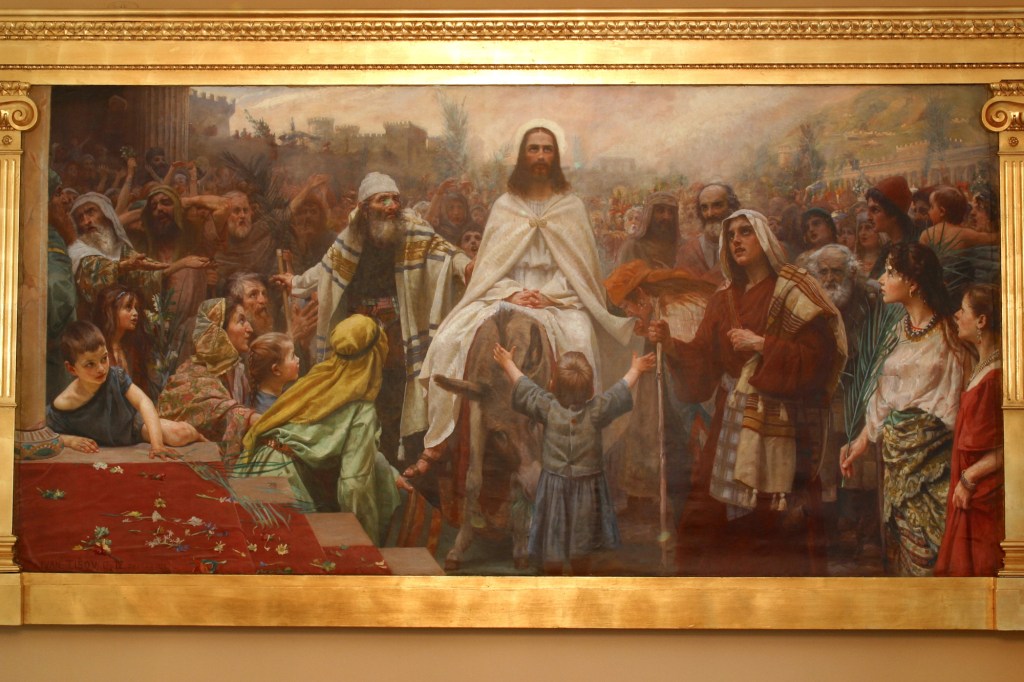
During one Passover week under the rule of Pontius Pilate in Judea another procession took place. It may have even happened on the same day at the same time that Pilate was entering the City from the west. This procession took place on the east side of Jerusalem where Jesus, riding on a lowly, young donkey with a small, rag tag bunch of unarmed disciples entered through the east gate – the back door to Jerusalem.


This parade was just as carefully staged as Pilate’s entry into Jerusalem. It was a counter-procession, a different vision of what a Kingdom should be, a subversive action against the powers that ruled Jerusalem. Jesus’ humble, yet triumphal, entry into Jerusalem stood in contrast to the magnificence and brutality on display at the opposite end of the city. Jesus brings peace, while Pilate brings a sword.”

In Through the Back Door


This was the backdrop for episode 124 of the BEMA Podcast and of our discussion. I sit writing at a temporary table with one chair left in my house that is all but cleaned out and being readied for sale. My future is uncertain as I recount one of the most pivotal times in human history and the dealings of God with man and its meaning for us, today.

Continue reading “A Tale of Two Processions, Two Kingdoms, and the Triumph of God”

God’s Radical, Generous Unfairness

This theme is, perhaps, more prominent in Scripture than we might realize.


If you are like me and most people I know, the parable of the workers in the vineyard is hard to understand and appreciate. This parable that Jesus told is recorded in Matthew 20:1-16. Jesus set the context of the parable with the statement,

For the kingdom of heaven is like a landowner who went out early in the morning to hire workers for his vineyard. He agreed to pay them a denarius for the day and sent them into his vineyard.”

matthew 20:1-2

The context of this is a parable is the kingdom of heaven.

According to the parable, a vineyard owner hired some workers for the day to work in his vineyard. Those first workers began early in the morning, and they agreed to work for a denarius. The comments in the margin of the NIV translation notes that a denarius was the usual wage paid for a day’s work at that time. This makes sense so far.

As the parable goes, the vineyard owner went back out to the marketplace throughout the day, and he continued to solicit people to come work in the vineyard, saying, “I will pay you whatever is right.” And so, additional workers began working at 9:00 AM, at noon, at 3:00 PM, and again at 5:00 PM.

When the work day ended at 6:00 PM, the vineyard owner told his foreman,

“Call the workers and pay them their wages, beginning with the last ones hired and going on to the first.”

Mathew 20:8

Beginning with the workers who started at 5:00 PM, each one was paid a denarius. The workers who began at 3:00 PM were also paid a denarius, and so on.

When the workers who began the day early and worked through the entire day stepped forward, they expected to get more than the other workers. Each one, however, only received a denarius.

They naturally began to complain to the vineyard owner about the unfairness of the vineyard owner. Why should the workers who worked only an hour (or three hours or just half a day) receive the same compensation as the workers who worked all day? Doesn’t that seem unfair?

The early workers agreed to work for a denarius; they got what they agreed to work for; and a denarius was, in fact, the going rate of compensation for a day’s work. From that standpoint, the wage they were paid was fair, but why should a worker who worked for only one hour be paid the same wage?

The relative compensation seems patently unfair to us. Though the first workers got what they bargained for and got what was considered to be a fair wage, the later workers got the same wage for less work.

One thing I had not noticed before is that the point of this parable is to provoke our sense of fairness. How do we know that?

Go back and look at verse 8: Jesus says the vineyard owner specifically informed the foreman to pay the last workers first … in front of all the other workers. If he had paid the first workers first, they would have gotten what they expected, been satisfied with it, and left – not knowing that the later workers were paid the same wage. Instead, he made a point of paying the last workers first.

This parable “works” precisely because it offends our sense of fairness. It seems God expects it to offend us! But what does that say about God?

Continue reading “God’s Radical, Generous Unfairness”

St. Augustine on the Literal Meaning of Genesis

How Augustine read Scripture in light of experience and reason.


People cite the great church father, Augustine, in defense of the view that the earth is only thousands (rather than billions) of years old. Indeed, I believe this was (more or less) Augustine’s view, based on the science and knowledge that was available to him in the 5th Century when he lived. Augustine believed the earth was young.

That isn’t the end of our understanding of Augustine, though. To understand Augustine, we might be aided by a basic review of the mythological, philosophical and scientific views that were prevalent in his world at the time.

According to my inquiry on Bing Co-Pilot, the mythology of the time didn’t attempt to date the age of the earth. Science (such as it was) also had not established a position. Philosophy, however, provided two opposing views.

The philosophical camps were led by Aristotle and Lucretius. Aristotle argued that the earth was eternal, and Lucretius argued that the earth formed relatively recently (based on a lack of records prior to the Trojan War). (The Trojan War dates to the 11th or 12th Century BCE.) Thus, the two competing views in Augustine’s day were 1) eternal earth or 2) young earth. There was no inkling in Augustine’s time that the earth might be very old, but not eternal.

Interestingly, Aristotle’s view of an eternal earth shifted to an eternal universe, and that view became the accepted scientific view that lasted well into the 20th Century. This was Einstein’s view when he developed the Theory of Relativity.

The past eternal view of the universe was only debunked and rejected by the scientific consensus in the second half of the 20th Century, and then only very reluctantly. (Even now, some scientists demonstrate a desire to find support for a past eternal universe, but support for that view seems to get thinner and thinner as time goes on.)

In the uncertain stew of mythology, philosophy, and science in the 5th Century, Augustine acknowledged that a literal, 6-day reading of the creation story in Genesis is not an irrational interpretation. That is basically how he put it.

He didn’t endorse that view, however. He thought the better view was that the “days” in Genesis 1 do not correspond to earthly (24 hour) days. Even in his exploration of a “literal” reading of Genesis, Augustine incorporated allegorical nuance.

Augustine did not believe that “literal” and “allegorical” meanings were mutually exclusive, and neither did most of the early church fathers. What Augustine and the early church fathers meant by the “literal” meaning of Scripture was what the people who wrote the original words literally meant and how the audience to whom they communicated understood them.

In this effort to understand what the writers meant, the early church fathers assumed that the original meanings included metaphor, symbolism, and literary devices. None of the early church fathers (that I am aware of) argued for the modern sense of strict literalism in the interpretation of Scripture.

Though most early Christians believed literally in the historicity of the biblical accounts (to use a modern term), they also accepted the richness of allegorical meaning in Scripture at the same time. In fact, the metaphorical meaning of Scripture was assumed to be the deeper, more spiritually significant meaning.

Augustine (along with Clement of Alexandria and Origen) ultimately rejected the calendar-day view of the Genesis creation story in favor of instantaneous creation with a kind of day/age view of the creation passage in Genesis. The great Jewish theologians, Philo and Hilary of Poitiers also took this view that God created the earth instantaneously.

We should recognize that the day-age view that Augustine and others preferred was probably not the consensus, but it also wasn’t considered heresy. The theology and the philosophy were unsettled, and science had not yet developed as we know it. The Church allowed for robust disagreement on the age of the earth, because it was not considered essential doctrine.

I should stop here, at the risk of pointing out something you already know, and look at the meaning of the Hebrew word, יוֹם (yom). This word is translated into the English word, day, in Genesis 1. As with most Hebrew words, yom has many nuanced meanings and applications, both literal and figurative. The various meanings include:

  • Day, as opposed to night
  • Day as a division of time
  • Day as defined by evening and morning
  • Day as in a time (like harvest)
  • Day as in an age or epoch of time

In addition to the definitions, most Hebrew words have both literal and figurative meanings and applications. Thus, Augustine’s position that the days in Genesis can be read to mean an “earthly” or “ordinary” day did not exclude the idea of applying them more figuratively. That duality is consistent with the way Hebrew words and Hebrew language works. This built-in literal/figurative duality of Hebrew words informed the thinking of the early church fathers.

Augustine is famous for preferring allegorical readings and applications of Scripture. In his early two-volume work on Genesis in which he took issue with the Manicheans, Augustine explored the position that the days in Genesis are seven epochs of redemptive history corresponding with seven stages of the Christian life. (See Did Augustine Read Genesis 1 Literally? by Gavin Ortlund citing De Genesis contra Manichaeos 1.23.35-1.25.43, in Augustine, On Genesis, 62-68.)

When Augustine set out to write a “literal” interpretation of Genesis, he didn’t mean what people today might think he meant. Even his “literal” reading of Scripture was not strictly literalist. It was an attempt to understand what the original writers (literally) meant and what their audience understood it to mean.


Science in St. Augustine’s day was not advanced enough to weigh in on the age of the earth, but Augustine was a strong proponent of understanding facts and objective truth. The science of his day, for instance, had settled the spherical shape and circumference of the earth. That the earth was round and even the size of the perimeter of the earth was well established and understood among academics since before the time of Christ. (It is purely a myth, for instance, that Columbus had to convince people the earth was not flat.) Augustine’s view of scientific knowledge and its relationship to Scripture is what I want to highlight here.

Continue reading “St. Augustine on the Literal Meaning of Genesis”