Of Church Heretics and Heroes

Who are the William Tyndale’s in modern culture?

The Tyndale Monument, Gloucestershire, UK was built in honor of William Tyndale, a translator of the Bible, who was born nearby.

I listened recently to the Unbelievable podcast on the subject of William Tyndale. (Unbelievable? Why William Tyndale’s Bible changed the world: Melvyn Bragg and Ben Virgo) Tyndale lived from 1494-1536, during a time in which illiteracy was the rule, not the exception. The Bible was read only by the educated elite.

The 1600’s was also a time of great corruption in the church itself. The church was the largest employer in the land. It had great power, and it was corrupt. The vast majority of people, including clergy, were ignorant of Scripture. According to the experts on the Unbelievable podcast, many clergymen didn’t even know the 10 commandments. This was a very dark period in church history, the culmination of centuries of church/state alliance that twisted the Gospel to serve the power of kings and popes who lived like kings.

Tyndale was influenced by Martin Luther who also a rebel that opposed the church consensus and power structure of the day. Tyndale was influenced by John Wycliffe who a century before had translated the Bible into middle English, but the church opposed the “unauthorized” translation and rejected it. The church even declared Wycliffe a heretic after his death, and many of the Wycliffe Bibles were burned and not widely distributed.

Tyndale made it his life’s mission to translate the Bible into English for the common man. Though Wycliffe had already done that, the Bible was still virtually inaccessible to the vast majority of people, and even clergy were ignorant of it. He suffered exile for his efforts and was eventually arrested, jailed, convicted of heresy, executed by strangulation, and his body was burned at the stake.

We celebrate Tyndale now as a martyr for the faith who took up his cross and followed Christ even unto death, a leader of the reformation that led believers out of the corruption of the organized religion of his day.

He and other “rebels” paved the way for the Bible to be made available worldwide in every language spoken on earth. Tyndale now is the name of a major Christian publishing company. Luther is the namesake of a major church denomination. Wycliffe is the name of the organization that translates the Bible into the rarest languages of the farthest flung tribes of the world.

Just as Jesus opposed the Pharisees and Sadducees in the 1st Century, Tyndale opposed the popes and bishops in the 16th Century. Just as the Pharisees and Sadducees sought to stop Jesus and had him arrested, tried, convicted and executed for spreading the Gospel, the popes and bishops tried to stop Tyndale, had him arrested, tried, convicted and executed for translating the Bible including the words Jesus preached into English.

The main opposition to Jesus, and Tyndale, came from the religious leaders. Those religious leaders employed the power of the state to oppose the spread of the Gospel (in Jesus’s case) and the spread of the translation of the Bible into English (in Tyndale’s case).

When Pilate asked, “Shall I crucify [Jesus]?”, the chief priests said, “We have no king but Caesar!” (John 19:15) I think about these things in light of the current religious and cultural climate.

Tyndale was viewed as a rebel and, a renegade, a heretic. He opposed the status quo, including the status quo within the church. He was despised. He was opposed by the church. He could not even return to his homeland, England, for fear of his life, and he eventually lost his life to the church and state authorities of his day

Today, the church and state are no longer joined in power as in Tyndale’s day. Many modern Christians in the United States rue the loss of power and advantage, while modern secularists would like to negate completely all influence of religion on society. If Hilary Clinton had been elected, instead of Trump, most Christians feared an incremental loss of power and influence in the affairs of our nation. Christians have embraced Trump as the man to fight the tide of growing secularism and maintain Christianity in that position of power and influence.

But is that a good thing? We all know of the challenges, difficulties and even persecution of the church that result from state government that is opposed to the church, but history suggests that the confluence of state power with church governance leads to corruption of the church. Would we rather accept corruption in the church to avoid challenge, difficulty and persecution?

Listening to Tyndale’s story, makes me wonder, “What about the church today is like the church in Tyndale’s time?” What influence lingers or has crept in to modern Christianity that will cause future believers to look back and wonder at the corruption of the 21st Century church?

Who are the heretics of our time who will be hailed as heroes in future generations?

Nothing New Under the Sun

The writer of Ecclesiastes said about 1000 years before Christ that “there is nothing new under the sun”. People in the post modern world may disagree but there is one thing hasn’t changed.

BEIT SHEAN,ISR – JUNE 17: Visitor walks near Pillars in Ancient Beit Shean on June 17 2009. Beit She’an is one of the most ancient sites in Israel: it was first settled 5-6 thousand years ago.

“Now all the Athenians and the foreigners who lived there would spend their time in nothing except telling or hearing something new.”[1]

This was the explanation for the philosophers wanting to hear what Paul had to say when he was in Athens. They brought him to the Areopagus so they could hear “the new teaching” he was explaining in the synagogues and market places.[2] They wanted to hear what he had to say, presumably, because it was new.

I have a friend who is always looking for a new way of looking at things. He is a very philosophical and thoughtful person, but he thinks he would be bored in heaven (as he imagines the heaven of clichés would be – clouds and harps… and he is probably right about that[3]).

But the writer of Ecclesiastes said about 1000 years before Christ “of the writing of many books there is no end”; yet “there is nothing new under the sun”.[4] Ironic, isn’t it, that my friend who is always looking for some new thought to chew on is no different than the Athenians in Paul’s day who were interested in “nothing except telling or hearing something new” (nearly 2000 years ago), and 1000 years before that people were doing the same thing.  Yet, what is there that is really new?

Another good friend of mine, Gary Hill, who is a chief author of the Discovery Bible (an incredible NASB Bible packed with scholarly resources for the serious Bible reader[5]), described to me how seminaries require doctoral students to choose theses that have never been covered before. The pressure to come up with something new encourages people to go searching for premises that often stray from the the narrow path that Jesus talked about, who is in his very nature the way, the truth and the life.

The desire for something ever new is nothing new under the sun. It is an age old desire that the writer of Ecclesiastes criticized 1000 years before the Athenians idolized new ideas 2000 years before post modernists championed the idea “that truth is relative and truth is up to each individual to determine for himself.”[6] The idea that each individual can manufacture his or her own truth is simply an extension of this lust for something always new.

Though the writer of Ecclesiastes said about 3000 years ago that there is nothing new under the sun, the Athenians were still looking for something new 1000 years later.  Two thousand years after that, one thing hasn’t changed: people in the current, postmodern world are still looking for something new .

Oh that people would long for truth, rather than novelty, for faithfulness rather than change for the sake of change.

~~~~~~~~~~~~~~~~

[1] Acts 17:21

[2] Acts 17:19

[3] In reality, heaven is something we couldn’t even imagine. “Things which eye has not seen and ear has not heard,

And which have not entered the heart of man, all that God has prepared for those who love Him.” (1 Corinthians 2:9)

[4] See Ecclesiastes 12:12 and 1:9

“That which has been is that which will be,

And that which has been done is that which will be done.

So there is nothing new under the sun.”

[5] The philosophy behind The Discovery Bible is to empower people to appreciate the rich beauty of Scripture contained in the original Hebrew and Greek languages by gleaning insights from the original languages that don’t translate well into English. The Discovery Bible maps out all the emphasis in the original languages of Scripture.  It contains a symbol system for marking the original verb tenses that are quite different from English, adding depth and understanding of the word of God, along with other features.

[6] Postmodernism as described at http://www.allaboutphilosophy.org/postmodernism.htm

WordPress Audience, Please Respond

Dude with duct tape


So I went to post on Facebook the article linked below that I wrote today and got this message:

Your message couldn’t be sent because it includes content that other people on Facebook have reported as abusive.

Please read the article and let me know what you think about the Facebook message. You don’t have to like the article or agree with any of the ideas, opinions or conclusions that are expressed.

In fact, I would like to hear from those who don’t share my perspective of the world.

Whether you like the article or not, though, please respond and express your thoughts about the Facebook censorship. Thank you!

via God is the Fulfillment of the Desires He Built into Us

God is the Fulfillment of the Desires He Built into Us

We all have a conscience and a desire and need for the cleansing of our consciences.


“Have mercy on me, O God, according to your steadfast love; according to your abundant mercy blot out my transgressions. Wash me thoroughly from my iniquity, and cleanse me from my sin!” Psalms 51:1-2 ESV

I have written about how we can’t throw out the Old Testament and accept the New Testament in its place, as modern sensibilities might suggest. (See, for instance, Jesus and the “Old Testament God”) The Old Testament is the seed for the New Testament. Everything revealed in the New Testament was first revealed in the Old Testament. The Old Testament finds its fulfillment in the New Testament.

It seems that 21st Century people tend to want to view “the Old Testament God” as something different from the God revealed in the New Testament by Jesus, but Jesus affirmed the Old Testament.  Jesus says that the Old Testament also anticipates and points toward him.

“And beginning with Moses and all the Prophets, he explained to them what was said in all the Scriptures concerning himself.” Luke 24:27

The Bible verse of the day quoted above was prayed by David in Psalm 51. David expressed the desire of all of us when he asked God to have mercy on him, to “blot out” his transgressions, to wash away his iniquity and to cleanse him from his sins. We all have a conscience.

We all have failed our own consciences (let alone God’s standards), and we need cleansing and redemption. This is a deep longing within each one of us.

At the same time, we have the capacity to ignore our consciences and to deny that desire for cleansing and redemption. If we do that too often and too long, our consciences become callous and dull; the desire for redemption diminishes; and we no longer have the sensitivity God built into us that drives us toward Him.

C S Lewis talks about how our desires and our needs have a correlative reality in something that fulfills those desires and needs. He observes that we hunger, and there is food to meet that hunger; we thirst, and there is water to quench that thirst; we have sexual desires, and there is conjugal love we have with another person that fulfills that desire.

The satisfaction is only temporary, however. We have longings for more lasting satisfaction. That those desires are only temporally met and satisfied, says Lewis, suggests that there is something else, something more.

We also have a deeper and more fundamental longing within us to know God and to be known by God, for relationship with God and for eternal life. CS Lewis says that the reality we know, the satisfaction of temporary longings and desires, is some evidence of a more fundamental and satisfying reality that will fulfill our enduring and deepest longings.

The ancient writer of Ecclesiastes was, perhaps, thinking along these same lines when he said that God put eternity into our hearts, yet not so much that we know very much about it:

“He has made everything beautiful in its time. He has also set eternity in the human heart; yet no one can fathom what God has done from beginning to end.” Ecclesiastes 3:11 NIV

Continue reading “God is the Fulfillment of the Desires He Built into Us”

The Roots of Modern Ethics in the Ancient Near East

Of the origins of monotheistic religion and ethics.

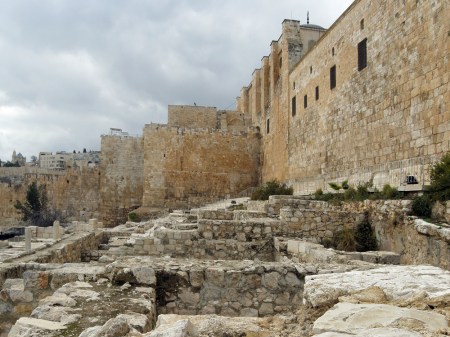
Jerusalem: The Temple Mount from the time of the Second Temple

When I was in college, the first class I took was World Religions. Though I graduated with an English Literature major, I also had enough credits to be a Religion major. I didn’t need the dual major. I only took the religion classes because they interested me.

I also became a believing Christian during my college years. It was a transition that took place between that World Religion class and the summer between Sophomore and Junior years. It’s a long story that I might tell in detail some time, but the point for now is that I did a lot of reading and thinking about these things in those years and in the decades since. It doesn’t make me a theologian, but I have more than a passing interest.

Early on I learned that the creation story and flood story in Genesis, among other things, have counterparts in other religions, including other religions in the same area of the world – the Ancient Near East. Phoenicians, Assyrians, Persians, and other people groups had similar myths that have been uncovered from that general time period.

I learned that Zoroastrianism shared attributes similar to the ancient Hebraic view of the world, including the idea a singular creator God, a dualistic cosmology of good and evil, the ultimate destruction of evil, judgment after death, etc. The scholarly understanding when I was in college was that Zoroastrianism predated Hebraic thought and influenced it.

It occurred to me at the time, not having any reason to doubt what I was taught, that Abraham may have been particularly open to his encounter with God if, indeed, he had lived in an area of the world and in a time in which there was this kind of influence. It made some sense. He was the right guy in the right place with the right influences setting the table for an encounter with God, the Creator of the world. Perhaps, Abraham brought the influence of monotheistic Zoroastrians into the pagan, polytheistic world of Canaan.

Recently I did some research on Zoroastrianism. Wikipedia acknowledges that Zoroastrianism has “possible roots dating back to the second millennium BC”, though the “recorded history” of Zoroastrianism dates back only to the 5th Century BC. (Wikipedia). The conjecture that Zoroastrianism dates back further to the second millennium BC is has no present support in the historical record.

If we date the accounts of Abraham and his descendants according the biblical chronology and references, that history goes far back into the second millennium BC, but the consensus of modern archaeologists and theologians reject that dating in favor of first millennium BC dating. (See Wikipedia, for example) Modern scholars don’t take the Bible at face value. In fact, they presumptively dismiss the Bible as historical record.

Scholarly views are not universal on this issue, of course. Not by a long shot. Modern archaeological and written evidence exists to suggest that the modern consensus is wrong about the timeline for the life of Moses, the Exodus and other things. (See for instance Patterns of Evidence: The Moses Controversy) The Patterns of Evidence theory is that historians and archaeologists who assume a particular timeline for certain events are not apt to see the evidence for those events if they occurred in a different timeline.

The Patterns of Evidence thesis is that evidence for the events described in the biblical narrative is there if we use the right timeline and look for them in the right time periods. Specifically, the biblical accounts of Moses, the Exodus, and entry into the land of Canaan are apparent in the archaeological record and historical data on the biblical timeline (second millennium BC), but they are not evident in the first millennium timeline applied by modern, skeptical scholars.

Certain archaeological finds, like the Ebla Tablets, also raise questions about the modern scholarly consensus. The importance of “looking” in the right places according to the right timelines is explored in Timing the Walls of Jericho.

Back to Abraham, though. He was reportedly from the area of Ur (in modern southwest Iraq), which is quite a distance from the area of Canaan (later Judea) where he ended up – about 1600 miles in fact. In Ur, he may have come in contact with Zoroastrians and similar influences. That idea intrigued me in college, and it still does. So I revisit that thought journey again today.

Continue reading “The Roots of Modern Ethics in the Ancient Near East”