The Primacy of Faith in a Post Post-Modern World

Seeking reality in a post, postmodern, metamodern world takes faith

Solitary wooden rowboat floating on calm, foggy water

The primacy of faith may never have been more prominent than it is today in this post-postmodern, metamodern world. AI experts say that “hallucinations” are inevitable and unavoidable in the way AI works. Skepticism has already become the default posture of people in this social-media dominated world in which fake news is old news. It’s no longer what you trust, but who you trust. “Pick your poison, and go with it” is the metamodern response.

The advent of AI and its looming takeover may unravel the very foundation of our confidence in knowledge. If skepticism has long been the province of intellectuals in the know, it is now the common denominator of everyone who trusts only what they know from the people they trust and news outlets that feed them.

If we are not postmodern enough already, our skepticism will increasingly become more necessary than ever. In just a few years of the AI revolution, determining what content on social media is AI, not AI, or only partially AI is becoming increasingly fraught. The challenge will only get more difficult as AI gets better. Even college professors have difficulty determining student work product from AI work product

AI is only going to get better (or worse, depending on your viewpoint). The capacity of AI to churn out convincing content with great confidence (and lurking uncertainty) may overtake our ability to keep up with it. Over fifty percent of all social media content is currently produced by bots, a form of AI, and that statistic is likely to climb higher. Human productivity cannot keep up with the productivity of AI.

AI feeds on itself. Garbage in produces garbage out. AI repeats itself by design, and it will inevitably repeat the good with bad, leaving us ever attempting to discern and decipher which is which.

In a world like the one we are facing, faith becomes more important than ever. By faith, I mean trusting and having confidence in something. What we put our faith in will become more and more important.

This revelation comes as postmodernism is breaking down. That postmodernist, existentialist angst is hard to live with. We have to put our faith somewhere – and this is the meta-modern trend that we are now facing. Faith – where we put our confidence – is the question of the day.

Metamodernism has taken hold on our culture and psyche according to people who study these things. Despite the post-modern assumption that we can trust nothing, we choose to trust something in a metamodern world because the alternative is untenable and unsustainable.

Social psychologists say that we are living in a world marked by anxiety, depression, suicidal ideation, and isolation, and these problems are falling with heaviest weight on our youngest population. In a world like that, they learn they have to cling to something. They have to find something solid they can hold on to. If they don’t, everything is always falling away from them. They have nowhere to stand.

In a world like that, faith is inevitable and unavoidable. It is necessary for survival.

Perhaps we are arriving at this place too late. It certainly isn’t too soon. In fact, the place where we now stand, where it seems there is nothing solid to stand on, was foretold thousands of years ago in the Book of Ecclesiastes.

Continue reading “The Primacy of Faith in a Post Post-Modern World”
Nothing New Under the Sun

The writer of Ecclesiastes said about 1000 years before Christ that “there is nothing new under the sun”. People in the post modern world may disagree but there is one thing hasn’t changed.

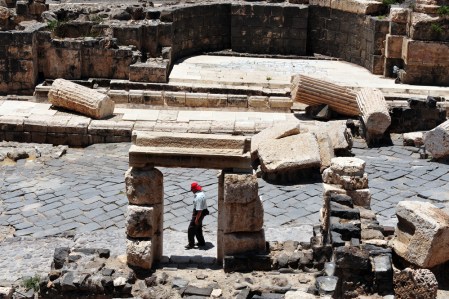
BEIT SHEAN,ISR – JUNE 17: Visitor walks near Pillars in Ancient Beit Shean on June 17 2009. Beit She’an is one of the most ancient sites in Israel: it was first settled 5-6 thousand years ago.

“Now all the Athenians and the foreigners who lived there would spend their time in nothing except telling or hearing something new.”[1]

This was the explanation for the philosophers wanting to hear what Paul had to say when he was in Athens. They brought him to the Areopagus so they could hear “the new teaching” he was explaining in the synagogues and market places.[2] They wanted to hear what he had to say, presumably, because it was new.

I have a friend who is always looking for a new way of looking at things. He is a very philosophical and thoughtful person, but he thinks he would be bored in heaven (as he imagines the heaven of clichés would be – clouds and harps… and he is probably right about that[3]).

But the writer of Ecclesiastes said about 1000 years before Christ “of the writing of many books there is no end”; yet “there is nothing new under the sun”.[4] Ironic, isn’t it, that my friend who is always looking for some new thought to chew on is no different than the Athenians in Paul’s day who were interested in “nothing except telling or hearing something new” (nearly 2000 years ago), and 1000 years before that people were doing the same thing.  Yet, what is there that is really new?

Another good friend of mine, Gary Hill, who is a chief author of the Discovery Bible (an incredible NASB Bible packed with scholarly resources for the serious Bible reader[5]), described to me how seminaries require doctoral students to choose theses that have never been covered before. The pressure to come up with something new encourages people to go searching for premises that often stray from the the narrow path that Jesus talked about, who is in his very nature the way, the truth and the life.

The desire for something ever new is nothing new under the sun. It is an age old desire that the writer of Ecclesiastes criticized 1000 years before the Athenians idolized new ideas 2000 years before post modernists championed the idea “that truth is relative and truth is up to each individual to determine for himself.”[6] The idea that each individual can manufacture his or her own truth is simply an extension of this lust for something always new.

Though the writer of Ecclesiastes said about 3000 years ago that there is nothing new under the sun, the Athenians were still looking for something new 1000 years later.  Two thousand years after that, one thing hasn’t changed: people in the current, postmodern world are still looking for something new .

Oh that people would long for truth, rather than novelty, for faithfulness rather than change for the sake of change.

~~~~~~~~~~~~~~~~

[1] Acts 17:21

[2] Acts 17:19

[3] In reality, heaven is something we couldn’t even imagine. “Things which eye has not seen and ear has not heard,

And which have not entered the heart of man, all that God has prepared for those who love Him.” (1 Corinthians 2:9)

[4] See Ecclesiastes 12:12 and 1:9

“That which has been is that which will be,

And that which has been done is that which will be done.

So there is nothing new under the sun.”

[5] The philosophy behind The Discovery Bible is to empower people to appreciate the rich beauty of Scripture contained in the original Hebrew and Greek languages by gleaning insights from the original languages that don’t translate well into English. The Discovery Bible maps out all the emphasis in the original languages of Scripture.  It contains a symbol system for marking the original verb tenses that are quite different from English, adding depth and understanding of the word of God, along with other features.

[6] Postmodernism as described at http://www.allaboutphilosophy.org/postmodernism.htm

Nothing New Under the Sun?

Photo by Amanda Leutenberg

“Now all the Athenians and the foreigners who lived there would spend their time in nothing except telling or hearing something new.”[1]

This was the explanation for the Athenians wanting to hear what Paul had to say. They brought him to the Areopagus so they could hear “the new teaching” he was explaining in the synagogues and market places.[2] They wanted to hear, presumably, because it was new.

I have a friend who, basically, doesn’t want to entertain the Gospel because it isn’t new. He is always looking for a new way of looking at things. He is a very philosophical and thoughtful person, but he thinks he would be bored in heaven (as he imagines the heaven of clichés would be – and he is probably right about that[3]).

But the writer of Ecclesiastes said two thousand years before Christ “there is nothing new under the sun”.[4] To prove a point, my friend who is always looking for some new thought to chew on is no different than the Athenians in Paul’s day, who were interested in “nothing except telling or hearing something new.”

Another good friend of mine, Gary Hill, who is a chief author of the Discovery Bible (an incredible NASB Bible packed with scholarly resources for the serious Bible reader[5]), described to me how seminaries require doctoral students to choose theses that have never been covered before. The pressure to come up with something new encourages people to go searching for premises that often stray from the way, the truth and the life.

The desire for something always new is nothing new under the sun. It is an age old desire that the writer of Ecclesiastes criticized 2000 years before the Athenians idolized new ideas 2000 years before post modernists championed the idea “that truth is relative and truth is up to each individual to determine for himself.”[6] The idea that each individual can manufacture his or her own truth is simply an extension of this lust for something always new. Continue reading “Nothing New Under the Sun?”