They Thought God Was Like Them

Examine yourselves to be sure you are in the faith.

Smiling man with dark shadow holding a knife behind him

But to the wicked person, God says:

What right have you to recite my laws or take my covenant on your lips? You hate my instruction and cast my words behind you. When you see a thief, you join with him; you throw in your lot with adulterers. You use your mouth for evil and harness your tongue to deceit. You sit and testify against your brother and slander your own mother’s son. When you did these things and I kept silent, you thought I was exactly like you. But I now arraign you and set my accusations before you.'”

Psalm 50:16-21


God’s Word is full of warnings to the wise. Take heed. God does not desire that anyone perish, but a day is coming when your life will end. A day is coming when this world as we know it will cease to exist. There will be a day of judgment for all of us.

God does not force us to love Him. He doesn’t require that we submit to Him. He gives us the terrible choice of determining how we will live. He will give us over to our desires on that day when we die, on that day when the earth ceases to be as we know it, and we will face the consequences of our choices – the way we chose to live – whether it be with Him or with our own selves at the center of our orbit.

These verses indicate that even a wicked person can recite God’s laws and claim to be in covenant relationship with God. Even a wicked person can claim to know Him. Jesus echoed the words of the Psalmist when he said,


Not everyone who says to me, ‘Lord, Lord,’ will enter the kingdom of heaven, but only the one who does the will of my Father who is in heaven. Many will say to me on that day, ‘Lord, Lord, did we not prophesy in your name and in your name drive out demons and in your name perform many miracles?’ Then I will tell them plainly, ‘I never knew you. Away from me, you evildoers.'”

Matthew 7:7:21-23


This word of warning applied to the religious. We can prophesy in God’s name. We can even drive out demons and perform miracles in God’s name. These signs do not make the person who performs them a child of God. Even false prophets are able to perform great signs and wonders. (Matt. 24:4; Mark 13:22)

Only the one who actually does the will of the Father is a child of God. (Matt. 7:21) Jesus said, “Everyone who hears these words of mine and puts them into practice is like a wise man who built his house on the rock.” (Matt. 7:24) Any other way to live is like “sinking sand” as the hymn goes.

The danger we all face is our own self deception. Perhaps, this is why the Prophet said, “The heart is deceitful above all things and beyond cure.” (Jeremiah 17:9) We cannot trust our own hearts.

Skeptics say that people have created God in their own image. That is true of the person who thinks God is just like them.

According to the writer of Psalm 50, wicked people who act wickedly can feel justified in their wicked actions, and God allows them to be deluded.


When you did these things and I kept silent, you thought I was exactly like you.”

Psalm 50:21


They are encouraged by God’s silence that they are right in in what they think and do, but God’s silence is not a sign of acquiescence. God’s arraignment and accusations hang over their heads.

I am struck by the need to know God, to know His character, and to yield our assumptions about God to the truth of who God really is. God’s silence in our lives is not approval. God often remains silent. God is often hidden. He is like a treasure to be found. God urges us to seek Him because in seeking Him, we must set aside ourselves to learn who He is.

These verses remind me of Hebrews 4:12: “The word of God is sharper than a double-edged sword.” It pierces. It divides. It discerns the thoughts and intents of the heart. If the word of God is doing its job, it cuts, it penetrates, it divides. If we yield ourselves to the word of God, it does its surgical work in us. Bur, only if we truly yield ourselves to that process.

I have often thought that Scripture does this kind of work. I felt it when I first began reading scripture before I was even a believer. I recognized in that time that scripture was exposing me to myself, and that I had a choice. I could allow it to do its surgical work, or I could harden my heart and choose to see in Scripture what I wanted to see.

Many people have said in derision of Scripture that people can make it say whatever they want. They are right, of course. Like the wicked person who acts wickedly and embraces wicked thoughts, while thinking that God is just like them.

The height of pride is to think God is like us. God opposes the proud, but He gives grace to the humble.

My prayer today is that God would rebuke me as He needs to; that He would soften my heart and do His surgical work in me; that I would not be deceived by my own thoughts and think that God is like me. I pray that God would reveal Himself to me and that I would know God for who He actually is.


so that Christ may dwell in your hearts through faith. And I pray that you, being rooted and established in love

Ephesians 3:17

The Book of Ruth: The Immigrant at the Center of God’s Redemption Story

Ruth pulses with the theme of redemption that includes foreigners in God’s redemptive plans

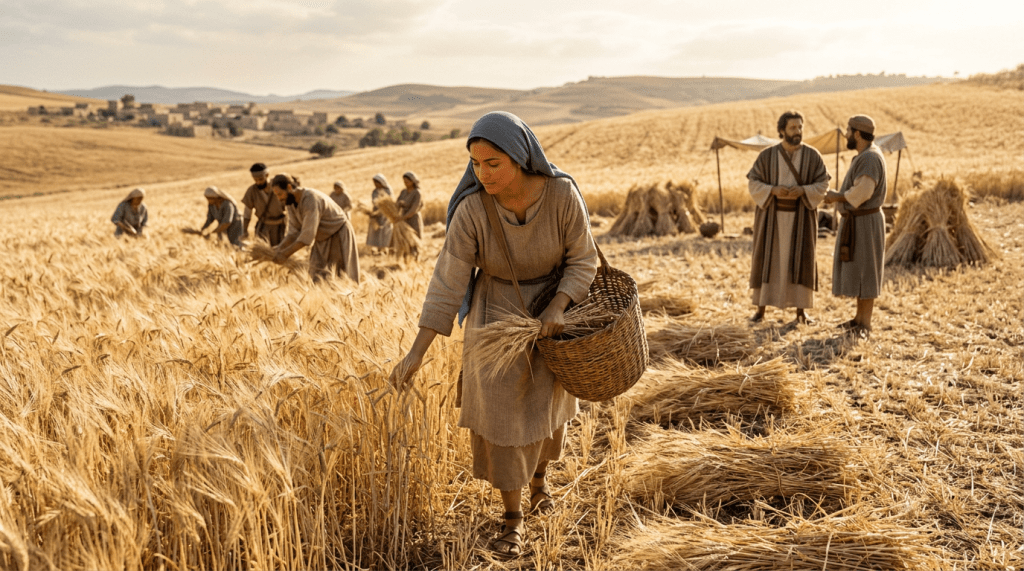
Group of people harvesting golden wheat in a field with baskets

After the downward moral spiral of the Book of Judges that ends with a shockingly horrific story about the Levite’s concubine, comes the Book of Ruth. Ruth follows Judges in the Old Testament, but the story takes place during the time of the judges, and Judges ends with a statement that characterizes the trajectory of the entire book:


In those days Israel had no king; everyone did as they saw fit.”

Judges 21:25


Despite the suggestion in this statement that kings might turn the people around from their waywardness, it doesn’t happen. The nation of Israel became polarized and divided after only three kings, and the downward moral cycle of a divided Israel continues through many generations of kings until God’s judgment on them leaves them exiled in Babylon.

We are hard pressed to find any judge in the day of the judges who is without blemish. Samson and Gideon are two of the most memorable judges, but Samson is undone by his lust for women, and Gideon progresses from a fearful doubter, to an unlikely hero, to an idolater who turns Israel from God.

Deborah appears in contrast as a strong and morally unyielding judge, though she is a woman, and her importance would have been discounted by patriarchal readers. (Judges 4-5) Ironically perhaps, another woman is the one shining, ray of hope in the time of the book of Judges – Ruth. Her story embodies the central theme of all Scripture – Redemption.

Ruth and Boaz Are Distinguished by Their Character

We might be surprised to note that Ruth is an ordinary woman. She isn’t even an Israelite. She is a Moabite (an immigrant in Israel), who was married to one of the sons of Naomi. We don’t even know which one. The Bible doesn’t tell us.

The men in this story take a back seat to the women. The book opens with the introduction of Elimelek. All we know about Elimelek, though, is that he is from the tribe of Judah and was living in Bethlehem before he leaves with his wife, Naomi, for Moab because of famine in the land.

Naomi’s husband (Elimelek) dies in Moab. Naomi’s two sons marry Moabite women, Ruth and Orpah. Then they die. All of this happens in the first five (5) verses of the book. The rest of the story focuses on the women – and Boaz, who becomes a kinsman redeemer.

Ruth could have gone back to her home and her clan but she chose to remain faithful to Naomi – a widow in her old age. She famously made this covenant with Naomi:


Where you go I will go, and where you stay I will stay. Your people will be my people and your God my God. Where you die I will die, and there I will be buried. May the Lord deal with me, be it ever so severely, if even death separates you and me.”

Ruth 1:16-17


There is nothing noteworthy about Ruth other than her tender faithfulness to distinguish her as anything but ordinary.

Boaz, the hero of the story, also has no apparent distinguishing feature – except for the way he carries himself. He is not a leader in Israel. He is not even the leader of his own family group. He is distinguished solely by his faithfulness to the spirit of the law, and his faithfulness as a kinsman redeemer anticipates the Great Redeemer himself – Jesus Christ.

Ruth is an Orphan, a Widow, and a Foreigner

The action in the story begins when Naomi hears that God has provided food in the land of Judah. Naomi had immigrated to Moab. Now that the famine was over and her husband and sons were dead, she decides to go back to home.

Naomi begins to set out for Judah, but she stops to invite her daughters-in-law to go back to their “mother’s home.” (Ruth 1:8) The offer to allow her daughters-in-law to go back to their mother’s home suggests they were fatherless.

Naomi was not rejecting them. She was offering them a way out. They would be foreigners in Israel, and widows, and fatherless – meaning they would have no clan to protect them and provide for them. Yet, Ruth decides to remain faithful to her mother-in-law’s and stick by her side

That Ruth a widow and a foreigner and probably an orphan is significant. God could have used the story of any Israelite orphan and widow to tell this story, but he chose a foreigner – an immigrant.

That point should not be lost on us. Jesus makes the same point in Luke 4:24-27, and the people in his hometown synagogue were so incensed by it that they sought to throw him off cliff. God is serious about blessing all the nations, even if His people are not.

God’s Care and Concern for the Foreigner

If Ruth was fatherless, as the text seems to suggest, she embodied all the categories of vulnerable people most often paired together in Scripture: orphan, widow, and foreigner. (Ex. 22:1-2; Deut. 24:17, 27:19; Jer. 7:6, 22:3; and Zech. 7:10) The poor and the needy are sometimes included in this list, but they are general terms. Orphans, widows, and foreigners were the people most likely to be poor and needy in Ancient Near Eastern communities because they were left on the fringes of patriarchal clans that were the lifeblood, support, and protection of people in that culture.

The Theme of Migration/Immigration in Ruth

The story of Ruth is set in the context of migration. The book opens with Naomi and her two sons migrating from Judah to Moab because of a famine. We might think of the great potato famine in Ireland that caused many Irish people to migrate to the United States. Whether it’s famine, war, oppression, or persecution, people migrate because of hardship. They always have, and they always will.

We might be tempted to judge Naomi and her sons for abandoning their heritage in Israel for greener pastures in Moab. But we don’t know their circumstances other than the famine. It’s easy and natural to judge people, but the Book of Ruth does not provide any sense that judgment is due. And if they have been in any way unfaithful to their own country, their own heritage, and to God, it is clearly forgiven in the context of the story.

Naomi’s sons marry Moabite women and settle down. Before they could have any children, one son dies and then the other son dies. Now, Naomi and her two daughters are all widows and childless – the people most likely to be poor and vulnerable.

Whatever benefits they thought they might have had in Moab, no nation in the ancient Near East had laws like the nation of Israel that protected the poor and the vulnerable like the Mosaic law. God required His people to share the harvest with widows, orphans, and foreigners by allowing them to glean from the edges of the fields. (Deut. 14:28-29; 24:19-21; & 26:12-13) The Jubilee instructions in Leviticus 25 incorporated protections for these vulnerable people groups in God’s instruction on how the Israelites were to live in the land.

Ruth Pulses with the Theme of Redemption

The leaders among the Israelites, as represented by the judges, were increasingly unfaithful to the Law, idolatrous, and unjust. In Ruth, we find ordinary people of God who are faithful to others, obedient to His commands, and living out the story of redemption that characterizes the arc and sweep of Scripture, from beginning to end.

The Book of Ruth pulses with the great theme of redemption and God’s intention to include the nations in God’s redemptive plans. God’s promise to Abraham to bless all the nations of the earth through Abraham’s descendants is repeated many times for emphasis (Gen. 12:2-3; 17:4; 22:17-18; 26:43-4; 28:13-14), and it isn’t forgotten. The drumbeat continued, though faint it may seem, as Israel and Judah wandered from the Law: Psalm 72:17; Isaiah 2:2-3; 49:6; 56-6-7; Micah 4:1-2.

From the the fall of Adam and Eve in the Garden (Gen. 2-3) to the gathering of people from every nation, tribe, and tongue before the throne of Jesus (Rev. 7:9), all of Scripture is one great redemption story. Ruth sits in the middle of that story foreshadowing the climactic act of redemption and blessing to all the nations – Christ and him crucified on the cross for our sins and the sins of the world.

Ruth the Moabite – the foreigner and outsider – is embedded by God into Israel’s royal lineage. From her womb flows Obed, the father of Jesse, the father of King David. (Ruth 4:18-22) The Gospel of Mathew traces her royal lineage to Jesus. (Matthew 1:5-6)

Boaz became a “kinsman redeemer” for Ruth when he married her; Jesus became the Great Redeemer of all mankind, marrying all who would believe in him to himself.

The kinsmen redeemer, is an archetype of Christ. Redemption, and the role of the foreigner in God’s redemptive plan for Israel and all the nations, are key themes in the Bible that coalesce in the Book of Ruth.