Jesus is the Alpha and the Omega, the beginning and the end. (Revelation 1:8; 21:6; and 22:13) Jesus was in the beginning with God, the Father, and the universe and all that is in it was made through Jesus. (John 1:1-3)
At this time of year, we celebrate God descending to become man in Jesus of Nazareth, born in Bethlehem into a common family in a far flung place. Jesus was God in his very nature, but he deigned to shed himself of that glory and power to become man, to become a servant to his own creation, and to humble himself to the point of death at the hands of his own creation. (Philippians 2:5-8)
In the end, Jesus will be exalted to the “highest place” with a “name that is above every name.” (Phil. 2:9) Every knee in heaven and on earth will bow to him, and every tongue will acknowledge that “Jesus Christ is Lord,” to the glory of God the Father.” (Phil. 2:10-11)
From the garden of Eden to the new heavens and earth and the New Jerusalem in which God will dwell with His people, God has had a plan from the beginning to the end. God set eternity in the hearts of people, but not so that we would know the beginning from the end. (Ecclesiastes 3:11) We don’t know, but God knows. Do we trust Him?
That is the question in my mind on this 1st day of the New Year in 2026. That is the question with which I challenge myself. Will I trust Him with my life? With the world? With the insanity that seems to characterize the year that just ended in United States of America where I live?
Since God created the universe and populated it with people and animals, God ordained and allowed people to populate the Earth. God didn’t dictate how the history of His creation would unfold. He created Adam and Eve with the capacity to live in sync with God and the universe, but He also gave them the capacity to go their own ways. God had a plan from the beginning, but He allowed the universe and mankind, His crowning creation, to unfold as it would.
I am beginning a new year of reading through the Bible as I have done many years in the past. I have read through the first handful of chapters in Genesis, and my thoughts gather around the question: will I trust God better in the New Year?
Do you trust God? Do you have faith? Those aren’t trite questions, and they don’t discount the desperation behind those who cry out to God for justice, for righteousness, for real change in the world and in our own circumstances.
Where is the justice in this world? The writer of Ecclesiastes looked for justice and observed, “In the place of justice – wickedness was there!” (Ecc. 3:16) I have seen injustice in the American court system myself. I see injustice every day in the news. Just today, I met with people who have suffered great injustice in the local legal aid clinic I run.
The injustice in this world is undeniable, and it can be utterly crushing for those on the wrong side of injustice. In truth, we have all been on the wrong side of injustice at times in our lives, big or small. Truly, the writer of Ecclesiastes was accurate when he said:
“I saw the tears of the oppressed— and they have no comforter; power was on the side of their oppressors— and they have no comforter.“
(Ecclesiastes 4:1) Injustice feeds injustice in a seemingly never-ending cycle. (Think about the Hatfields and the McCoys or the Palestinians and the Israelis.)
In our human minds, we imagine that injustice must be met immediately with action and force. Justice cries out for redress. We lament when justice does not come. We pray and cry out to God. When justice does not come for us, we might even be tempted to believe that God does not care or worse – the God does not exist.
The questions I pose, therefore, are not glib or lightly asked: Do you trust God? Do you believe?
When we are tempted to take judgment into their own hands, we fail to trust God if we act on that temptation. We become judge and jury. We usurp God’s justice in the process. (Vengeance is mine sayeth the Lord.) And, when become the judge and executioner, we make a mess of it in the process. We warp God’s justice to our conceptions of justice.
“Justice is not God wielding ‘the stick.’ It’s His desire to restore, redeem, reconcile, and mend all that’s broken in the world.” Chris Gresham-Britt
When the world talks about justice, the focus is on punishment. We don’t realize it as Christians that our view of justice is often more colored by the world than by God. Worldly justice is punitive.
If we are going to trust and believe God, we accept what the prophet says: that God desires mercy, not sacrifice. (Hosea 6:6) God desires to save and not to judge. That is why God sent His only Son into the world: not to condemn the world, but to save the world. (John 3:17)
God’s goal is redemption and destruction. God is just, but justice seems to be lacking in the world. Why? Peter says, we need to trust and be patient, as God us patient with us:
“[T]he Lord is not slow in keeping his promise, as some understand slowness. Instead he is patient with you, not wanting anyone to perish, but everyone to come to repentance.” (2 Peter 3:9)
God is waiting (longing) to have mercy on us! (Psalm 30:18) “[God takes] no pleasure in the death of the wicked, but rather that they turn from their ways and live.” (Ezekiel 33:11)
So, God waits patiently, withholding His judgment – withholding ultimate justice. He does this because He desires that none would perish, that all would turn to him and be saved. He waits to be gracious to us.
But we are impatient. We don’t want to wait. We want everything to be made right immediately, especially the injustices done to us, the people like us, and the people we know. “With the Lord a day is like a thousand years, and a thousand years are like a day” (2 Peter 3:8), but a day seems like a thousand years to us when are suffering or see suffering.
We cannot imagine the delicate and complex balance of God’s patience in waiting for people to come to repentance so that He can have mercy and the judgment that He will inevitably allow to be imposed on those who refuse to turn and repent. All the while, God hears the outcries of people suffering the injustices of their own folly and wickedness and the folly and wickedness of others – sowing the wind and reaping the whirlwind.
But, we do not see as God sees, and we do not know as God knows. Judgment is God’s business. It is not our business to judge the world. (1 Corinthians 5:12) That is where real faith comes – to leave the judging to God and to love the world as God loves the world, which is His instruction to us.
The whole law is summarized in two principles: love God, and love your neighbor. (Matthew 22:37-40; Romans 13:8-10; Galatians 5:14) That’s it. Just do it.
If you see a hurting neighbor, don’t judge; just help. Like the Good Samaritan, cross the road (go out of you way) to help your neighbor. Bear one another’s burdens. By doing these things, you will fulfill the law of love. (Romans 13:8-10)
In the end, justice will come quickly, but will God find faith on earth?
Do you trust God? Show it by loving others and leave the judgment to God. Do you have faith that God will bring justice? God’s justice is always colored by his desire to be gracious and compassionate. Be a vessel of God’s justice that is tempered by mercy and love, and love your neighbor.
I am always excited to find new things in the Bible, which is a regular occurrence still, by the way, after 45 years of reading the Bible. I should add that many of new insights I find in my own reading (if not all of them), have been found before by others before me. I am always a bit surprised, but also amazed, that nothing is new under the sun.
The insight I want to share today is not one that I discovered on my own, but I have some thoughts to add as I meditate on it. This is the story of two nets in two boats piloted by Peter three years apart. We began with Peter’s introduction to Jesus in Luke:
“[1] One day as Jesus was standing by the Lake of Gennesaret, the people were crowding around him and listening to the word of God. [2] He saw at the water’s edge two boats, left there by the fishermen, who were washing their net. [3]He got into one of the boats, the one belonging to Simon, and asked him to put out a little from shore. Then he sat down and taught the people from the boat. [4] When he had finished speaking, he said to Simon, ‘Put out into deep water, and let down the nets for a catch.’ [5] Simon answered, ‘Master, we’ve worked hard all night and haven’t caught anything. But because you say so, I will let down the nets.’ [6] When they had done so, they caught such a large number of fish that their nets began to break. [7] So they signaled their partners in the other boat to come and help them, and they came and filled both boats so full that they began to sink. [8] When Simon Peter saw this, he fell at Jesus’ knees and said, ‘Go away from me, Lord; I am a sinful man!’ [9] For he and all his companions were astonished at the catch of fish they had taken, [10] and so were James and John, the sons of Zebedee, Simon’s partners Then Jesus said to Simon, ‘Don’t be afraid; from now on you will fish for people.” [11]So they pulled their boats up on shore, left everything and followed him.”
Luke 5:1-2, 4-9 NIV
This, of course, is the story of Jesus calling Peter, James, and John to follow him and become fishers of men. The bolded language, “their nets began to break,” is the key to the insight.
The emphasis we often see in this story is the willingness of Peter to do as Jesus says and of these men to leave everything and follow Jesus, and that is a good emphasis indeed. This is best way to respond to God in the flesh (or in the spirit) when we come to realize His presence in our lives. Nothing we pursue in this is more important than giving ourselves, our careers, and our time to God!
Jesus called them to follow him and become fishers of men. He called them from their own pursuits and living for themselves to pursuing God living for God – to do His will and to accomplish God’s purposes, rather than their own careers and purposes.
The emphasis I see today, however, is something that might be noticed only in retrospect. The point is not readily noticeable at first, and that is part of the point of the lesson of Peter’s nets.
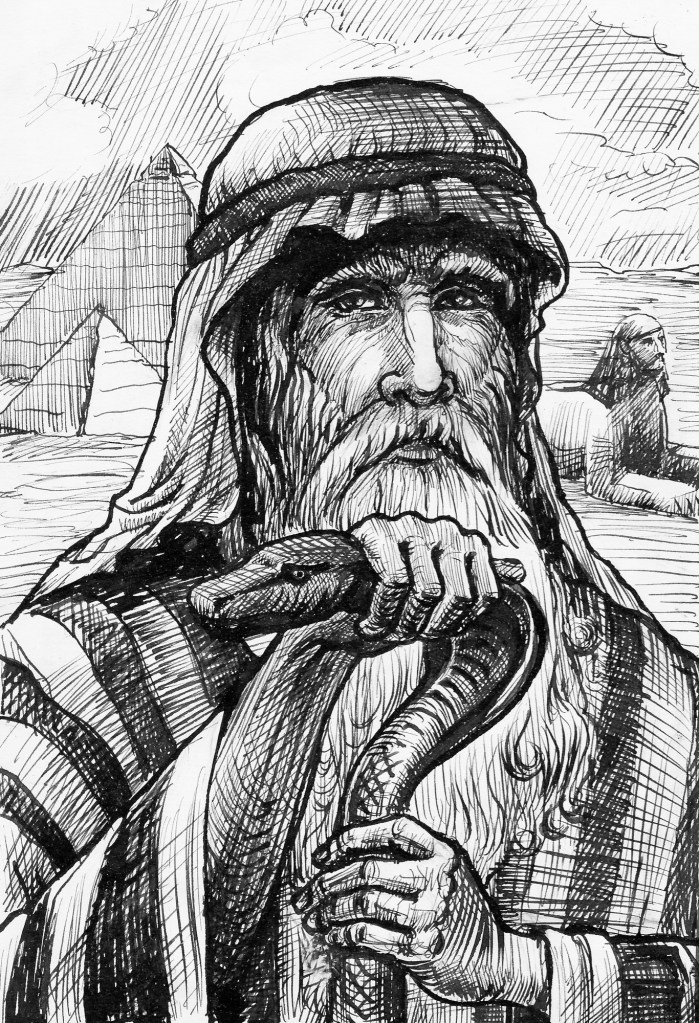
Egypt, Sinai, Mount Moses: view from road on which pilgrims climb the mountain of Moses
The passage in Numbers 20:1-13, which I quote below (in the NIV), has puzzled me in the past. It didn’t sit well with me, and I figured I simply didn’t understand it well.
As with many things I don’t understand well, I often “shelve” them for later consideration. Later is now, as I have just read through the passage again in my yearly journey through the Bible. This is the setting:
“In the first month the whole Israelite community arrived at the Desert of Zin, and they stayed at Kadesh. There Miriam died and was buried.”
Miriam, the sister of Moses and Aaron, had just died. Not much is said about her death, but Moses and Aaron must have been grieving. That grief on top of resistance from the Israelites they were trying to lead according to God’s direction, and the harsh circumstances of the desert must have weighed heavily on them.
“Now there was no water for the community, and the people gathered in opposition to Moses and Aaron. They quarreled with Moses and said, ‘If only we had died when our brothers fell dead before the Lord!'”
I believe their “brothers” who “fell before the Lord” refers to Korah who led a rebellion against Moses. (Numbers 16) Korah challenged Moses and his right to lead the Israelites, because Korah was not happy with his clan’s roll in caring for the Tent of Meeting. In challenging Moses, he was basically saying, “Who put you in charge?!”
Instead of confronting Korah directly, Moses set up a test before the people to allow God to identify who was in charge. When Korah and his clan burned incense, the ground rumbled, and Moses told the people to back away from Korah and his tribe of rebels as the ground swallowed them up.
Not long afterward, the wanderings of the Israelites brought them to the Desert of Zin, where the Israelites became so angry and distraught about the conditions in the desert that they wished they died with Korah in rebellion against God. The desert conditions must have seemed pretty inhospitable. Moses was losing the hearts of the people, and they were turning against him. Again! The people said:
“‘Why did you bring the Lord’s community into this wilderness, that we and our livestock should die here? Why did you bring us up out of Egypt to this terrible place? It has no grain or figs, grapevines or pomegranates. And there is no water to drink!’”
Of course, Moses was God’s man. That fact was demonstrated graphically in the Korah situation, but they continued to take their dissatisfaction over their circumstances out on Moses. Instead of God, they blamed Moses for their situation. When Moses and Aaron the assembly of the people, the made a beeline for the entrance to the tent of meeting where they “fell facedown”, and “the glory of the Lord appeared to them.”
Moses and Aaron knew the score. They knew that the people were really finding fault with God, not Moses or Aaron. They were intimate enough with God to know that God was not to be trifled with.
When the glory of God appeared to them, they should have been emboldened to stand resolute on their confidence in God’s direction. They should not have doubted that God was with them. Right?
Of course, the Israelites should not have doubted that God was with them, either. God’s visibly demonstrated Himself to them over and over again. His visible presence went with them in a pillar of cloud by day and fire by night. They had seen the demonstrations of the power and holiness of God at the Red Sea, at Mount Sinai and in the ground swallowing up Korah and his band of rebels.
What more did they need to see to understand that God was with them?
Yet, they did not trust that God had their back. God gave them manna every morning, and God gave them so much meat when they demanded meat that it came out of their nostrils. Yet, they continually grumbled and complained and wished they were back in Egypt.
Something had to be done to put down the unrest!
“The Lord said to Moses, ‘Take the staff, and you and your brother Aaron gather the assembly together. Speak to that rock before their eyes and it will pour out its water. You will bring water out of the rock for the community so they and their livestock can drink.’” (Emphasis added)
The instructions were simple and pretty clear: take the staff and speak to the rock.
“So Moses took the staff from the Lord’s presence, just as he commanded him. He and Aaron gathered the assembly together in front of the rock and Moses said to them, ‘Listen, you rebels, must we bring you water out of this rock?’”
Moses started out all right. He took the staff as he was commanded, but things begin to go off the rails after that. Moses was obviously perplexed that the people were so angry, and he might have been taking it personally. Instead of speaking to the rock, Moses turned and spoke to the people, and he was full of wrath for them in that moment.
It’s hard for me to blame Moses for feeling this way. I am sure I would take it personally also. It was personal!
The people were obstinate. What more could Moses do to demonstrate that God put him in charge?! Yet, they continued to challenge Moses and blame him for their unsatisfactory conditions.
Moses knew better, but it seems his own emotions got the best of him. He took their opposition personally, and his anger led him to forget God’s instructions to him:
“Then Moses raised his arm and struck the rock twice with his staff. Water gushed out, and the community and their livestock drank.”
The result was good, right?
But, Moses didn’t do exactly what God commanded him. God told him to speak to the rock. Instead, Moses spoke to the people, and Moses struck the rock with his staff. These clues pop when God responds:
“But the Lord said to Moses and Aaron, ‘Because you did not trust in me enough to honor me as holy in the sight of the Israelites, you will not bring this community into the land I give them.'”
I have long thought that the punishment didn’t fit the crime. Perhaps, I didn’t understood the significance of these things. God’s response seemed harsh in light of the faithfulness of Moses before Pharaoh, in receiving and delivering the Ten Commandments, and in putting up with the grumbling, and complaining, and obstinance, and waywardness of the Israelites, but maybe I was missing something.
Keep in mind that Moses grew up in luxury and privilege in Pharaoh’s household. The Israelites were “his people”, but only by genetics. Moses put up with a lot with these people he didn’t grow up with and didn’t even know very well. It seemed to me that Moses had been pretty faithful to God but clearly, his disobedience to God was more significant than I have appreciated.
We do not walk alone; we walk with God and with each other. Perhaps, my experience will be helpful as I have been helped by others who have had similar experiences.
I was praying one morning recently for God’s help to guide me away from the paths of thought and actions that take me down. I had been wrestling lately with old sin and losing the battle.
I do not often get so personal on this blog, but God knows all. He knows my heart, my thoughts, my actions – everything. He knows the words I speak before I even say them (or write them as the case may be). Nothing is hidden from Him.
I do have people who are close to me who I confide in and help me sort through these things. Still, being so personal is hard.
To get to the point, I have been married for 38 years as of November, but my wife informed me last June that she hasn’t been happy in a long time, and she moved out. I have been sad and depressed since she left.
Her leaving, and the present silence and emptiness in my life without her have filled my thoughts and haunted my waking hours since then. I have spent most of my life working to support my family. Our kids are out on their own now, and I was beginning to let myself think about retirement for us.
Now, everything has changed. At the age of 63, I am adrift. My future is uncertain. I am sad for her, and I am sad for me and I fear the future will not be easy for either of us.
I doubt she will not be happier now. I have often said and believe that the grass isn’t always greener….. But, she doesn’t seem to see it that way. Perhaps, she is willing to trade one kind of unhappiness for another.
Maybe I haven’t been happy myself for a long time, but I don’t really think about it. I have come to believe that happiness is fleeting. I can live with unhappiness. I would rather search for a joy that lasts forever than settle for mere happiness that is here today and gone tomorrow.
Maybe that attitude doesn’t make for a good marriage. I don’t know. I do know that I am no hero in this story. I have failed in many ways, and my failures hang like a dark cloud over me. They threaten to crush me.
I have not written much since June because of these things. I haven’t had the inspiration or the energy to write. Yet, I feel God called me to write, so I am trying to plod on.
I don’t want to dwell on these thoughts, but this is where I was when I approached God one recent morning. My failures, disappointments, regret and other negative emotions are ever before me, and they threaten to undo me.
Not the least of which is the gravitational pull to give in to old ways of thinking and to succumb to old habits. I have at various times lost the will to overcome and fallen back, and I have despaired in my falling back.
As I asked God to help me, to rescue me from my thoughts that threaten to take me down, a verse I read in my daily Bible reading that morning seeped back into my conscious thoughts, and I engaged with it:
“And Noah and his sons and his wife and his sons’ wives entered the ark to escape the waters of the flood.”
Genesis 7:7 NIV
Noah, who was said to be “blameless in his generation”, was saved from the judgment of God by building an ark. That ark was the vessel that lifted Noah and his family above the waters and carried them on to safety.











 Navigating by Faith