by Daniel Wolfe, J.D., Ph.D.
(The views expressed in this article are solely those of the author and do not necessarily reflect the views of any employer, organization, or institution with which the author is affiliated. )
“Trust in God and be true to yourself.” — Donald Trump (attributed to his mother)
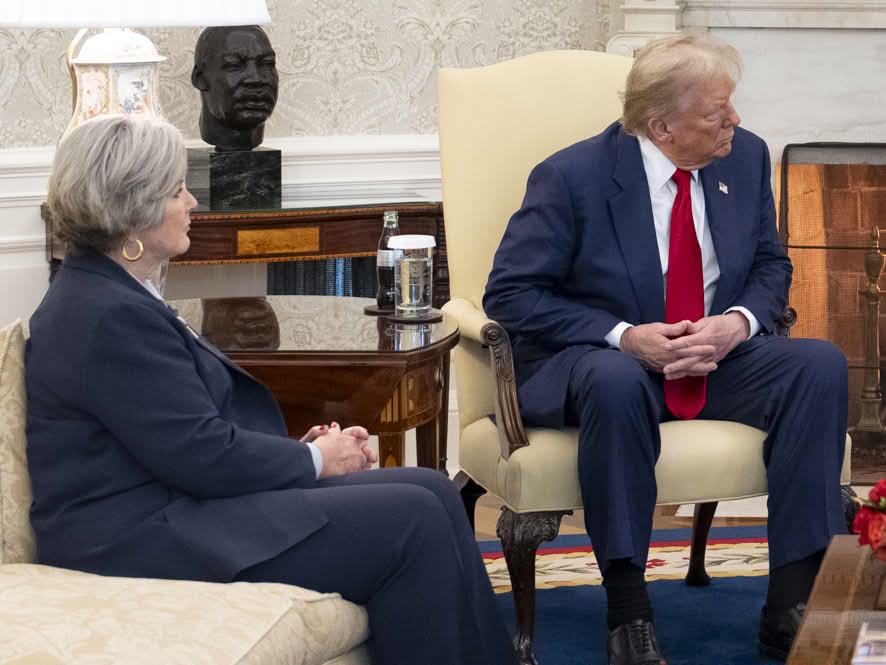
In a career defined by glitz, volatility, and domination, Donald Trump has rarely ceded power or emotional intimacy to anyone—especially not to women. And yet, two women stand apart from the parade of advisers, media figures, and family members who have passed through his orbit: Mary Anne MacLeod Trump, his late mother; and Susie Wiles, his current White House Chief of Staff and perhaps the most enduring political influence in his life.
From a psychodynamic standpoint, their connection is more than incidental. Wiles’s quiet dominance, maternal distance, and unflappable loyalty appear to mirror key psychological traits that Trump associated with his mother—a woman he revered, idealized, and never fully reached. As Trump now enters what may be the final chapter of his public life, Wiles is not merely a staffer. She is, in many respects, a surrogate matriarch—a stabilizing figure who satisfies his need for emotional containment, maternal loyalty, and internal order.
The Queen from Tong: Mary Anne MacLeod Trump’s Silent Influence
Born in 1912 in the Village of Tong on Scotland’s windswept Isle of Lewis, Mary Anne MacLeod was the tenth of ten children in a Gaelic-speaking, deeply Presbyterian household. The family home had no indoor plumbing, and her childhood was shaped by poverty, discipline, and religious rigor. At 18, she boarded the SS Transylvania and sailed to New York City, alone, with $50 to her name and a stated intention to become a domestic servant.
What followed was a dramatic social ascent. Mary Anne met Fred Trump, a rising real estate developer, at a party. They married in 1936 and had five children. Though she never shed her Scottish accent, she fully embraced American prosperity and Protestant respectability. She became active in the Daughters of the American Revolution, volunteered in hospitals, and dressed with regal precision.
As reported by journalist Mary Pilon in The New Yorker, friends and family members remembered Mary Anne MacLeod Trump as “tight-lipped,” “polished,” “proper,” “unassuming,” “friendly,” and “pleasant”—a reserved woman of dignity and discipline, but not demonstratively affectionate. Trump himself noted her deep reverence for public ceremony, stating, “Her loyalty to Scotland was incredible. She respected and loved the Queen.” He also credited her with influencing his “sense of showmanship.” (Pilon, 2016).
In her memoir Too Much and Never Enough, Mary Trump—herself a clinical psychologist—describes how her grandmother’s illness and retreat from family caregiving duties created emotional voids. Mary and her siblings took on caretaking roles in her absence, leading to feelings of abandonment and shaping Donald Trump’s later emotional defenses. She further details how Fred Trump Sr.’s emotional detachment and controlling behavior created insecurity in the family and contributed to Donald Trump’s narcissistic tendencies.
And yet Donald idolized his mother. “Part of her disinterest was, I believe, interpreted by Donald as exclusivity,” Mary Trump writes. “She was mysterious. The less she said, the more he needed to earn her attention.” From a psychodynamic perspective, this creates a powerful early template: a mother who is emotionally withheld but idealized—instilling in the child a lifelong yearning to gain her approval, or to replicate her presence through proxies.
In object relations theory, such a mother becomes an internalized object—a kind of psychic icon. She represents containment, elegance, structure—but also loss and emotional distance. The boy grows into a man who seeks out women who resemble her not in warmth, but in silence, dignity, and control.
The Strategist in the Shadows: Who Is Susie Wiles?
Susie Wiles is no stranger to male power. The daughter of legendary NFL broadcaster Pat Summerall, she grew up surrounded by high-stakes masculinity. But unlike many women in Trump’s orbit—Hope Hicks, Kellyanne Conway, Kayleigh McEnany, Karoline Leavitt—Wiles is not a media figure. She is a tactician. Her professional life has been spent in the background, managing Republican campaigns with ruthless efficiency, from Jack Kemp to Rick Scott to Ron DeSantis—and finally to Donald Trump.
She first joined the Trump campaign in 2016 to oversee Florida, and her work was credited as critical to his win. She returned in 2020 and again in 2024. In the chaos of Trump’s third presidential campaign, Wiles outlasted and outmaneuvered more combative or flamboyant aides. By 2025, she was named Chief of Staff—the first woman to ever hold the role under Trump. And perhaps the only one who truly commands his respect.
What makes Susie Wiles unique is not charisma or ideological purity but emotional restraint. She doesn’t grovel. She doesn’t scold. She doesn’t leak to the press. According to Politico Magazine and West Wing Playbook, Wiles is a discreet, disciplined strategist. She rarely seeks publicity and is consistently portrayed as a “steady hand” who effectively manages Trump’s impulses and internal chaos.
From a psychological standpoint, this demeanor taps directly into the mother archetype that Trump internalized: a woman who offers structure without intrusion, loyalty without dependence. She doesn’t try to be his friend or surrogate daughter. She is, psychologically, his mother in political form: elegant, efficient, and emotionally self-contained.
Recent reporting in Vanity Fair highlights the candid nature of Wiles’s own reflections on President Trump and members of his Cabinet, revealing an unusually frank assessment of internal dynamics, including comments on Trump’s personality and other senior officials—remarks that drew swift criticism from within the administration as being misrepresented or taken out of context. Vanity Fair journalist Chris Whipple, who conducted months of on-the-record interviews with Wiles, subsequently defended the accuracy of his piece, noting that all conversations were recorded and verified.
The Vanity Fair profile also underscores Wiles’s complex role: though she offered unusually candid characterizations of Trump and others in his orbit—comments that were later disputed as being selectively framed—she remained publicly loyal, reiterating her defense of Trump’s leadership and the administration’s accomplishments. This juxtaposition further illustrates the delicate psychological balance Wiles maintains: revealing enough about internal pressures to demonstrate credibility, yet steadfast in her alignment with Trump’s public persona.
The Vanity Fair interviews portray Wiles as central to both decision-making and narrative control inside the West Wing, a portrayal that has attracted debate not only about the content of her remarks but also about the media framing of her role—revealing once again how Wiles both shapes and buffers Trump’s inner circle.
A Psychodynamic Reading: Maternal Transference in Power Relationships
In classical Freudian terms, Wiles may represent a maternal transference object—a figure onto whom Trump projects unresolved feelings and unmet needs from childhood. Where Mary Anne withheld affection, Wiles withholds emotion. Where Mary Anne offered structured approval, Wiles offers structured control. And unlike Trump’s past advisers, Wiles never threatens his fragile ego. She doesn’t seek glory. She simply stays—a feat few others have achieved.
Psychological profiles consistently depict Donald Trump as a grandiose, high-energy, low-agreeableness figure—a volatile combination described by Dr. Dan McAdams as “sky-high extraversion … rock-bottom agreeableness … and grandiose narcissism” (McAdams, 2016). Indirect diagnostic work (Immelman & Griebie, 2020) places him squarely in narcissistic, dominant, and impulsive personality patterns. Mental health experts in The Dangerous Case of Donald Trump warn of malignant narcissism—a severe form characterized by interpersonal cruelty and paranoia (Lee, 2019). Clinicians like Craig Malkin and theorists such as Kohut and Bosson also point to the deeper emotional void underlying Trump’s persona—one that maternal transference figures may uniquely address. Therapists such as Wendy Behary similarly argue for a behavioral-based understanding of his narcissistic structure.
Nancy McWilliams (2011) describes narcissistic personality organization as marked by internal fragility, frequent use of idealization and devaluation, and a reliance on external validation. She explains that analysts working with this type often become unconscious “containers” for projected emotions, experiencing emotional obliteration, boredom, or invisibility.
As interpreted from McWilliams, transference figures often exert their power not through what they do, but through how they resonate. They become stand-ins for an early internal object—particularly in individuals who, like Trump, display signs of narcissistic personality structure: grandiosity, need for adulation, fear of shame, and an unconscious desire for omnipotent control.
What narcissistic individuals crave, McWilliams notes, is not just admiration—but a “containing other”: someone who does not collapse in the face of their outbursts, and who does not betray them by seeking autonomy. Wiles plays that role impeccably. She withstands Trump’s rage, channels it, and survives it. She offers maternal containment, not romantic or filial rivalry. That is what keeps her in his orbit.
Other advisers have challenged Trump (John Kelly), manipulated him (Steve Bannon), or infantilized him (Rudy Giuliani). Wiles does none of that. Instead, she mirrors back the qualities Trump yearned to see in his mother: discretion, loyalty, restraint, and elegance.
The Politics of Maternal Containment
This is not just a psychological curiosity. It is a political reality. Wiles has arguably had more sustained influence over Trump than any adviser since the beginning of his political career. She shaped the tone of his 2024 campaign—more disciplined, less erratic. She consolidated staffing, minimized legal exposure, and even managed access to the President.
Unlike previous chiefs of staff, Wiles does not appear to negotiate with Trump’s narcissism. She regulates it. That regulation—the ability to soothe without submitting—represents a maternal function in psychodynamic theory. And in Wiles, Trump may have finally found the mother he idealized but never emotionally possessed.
It also explains why he hasn’t turned on her. Trump, infamous for discarding aides with theatrical vengeance, has remained steadfastly loyal to Wiles. Even when others within his inner circle reportedly questioned her influence, he resisted. Just as a child resists separating from a “good enough” mother (in Winnicottian terms), Trump clings to Wiles not just as a strategist, but as a psychic anchor. In effect, Wiles might stabilize Trump not by commanding him, but by quietly containing him, as a good-enough mother does for an emotionally vulnerable child.
A Closing Reflection: The Boy and the Queen
As Donald Trump enters the final act of his storied and polarizing career, it is Susie Wiles—not his children, not his ideological acolytes—who quietly holds the reins. She does so not by reflecting Trump’s aggression, but by embodying his mother’s mystery: a woman whose silence commands, whose order contains, whose loyalty never fully soothes the ache it addresses.
In Wiles, Trump may see a second chance to earn the approval he never quite captured from Mary Anne. And in his loyalty to her, one glimpses the enduring truth of psychodynamic theory: that the past is never past. It is alive, enacted, and dressed in new clothes—this time, in a red blazer, seated quietly in the West Wing, holding the world’s most unmanageable man in the palm of her maternal hand.
References:
- Behary, W. Quoted in: “Is Donald Trump Actually a Narcissist? Therapists Weigh In!” Vanity Fair, Henry Alford (November 11, 2015). Is Donald Trump Actually a Narcissist? Therapists Weigh In! | Vanity Fair
- Immelman, A., & Griebie, A. M. (2020). “The Personality Profile and Leadership Style of U.S. President Donald J. Trump in Office.” Paper presented at the Annual Scientific Meeting of the International Society of Political Psychology, Berlin. (PDF) The Personality Profile and Leadership Style of U.S. President Donald J. Trump in Office
- Kruse, M. (2024). “The Most Feared and Least Known Political Operative in America.” Politico Magazine, April 26. How Susie Wiles Became the Most Admired and Feared Political Operative Nobody Has Ever Heard Of – POLITICO
- Lee, B. X., ed. (2019). The Dangerous Case of Donald Trump: 27 Psychiatrists and Mental Health Experts Assess a President. 2nd ed., St. Martin’s Press. The dangerous case of Donald Trump : 27 psychiatrists and mental health experts assess a president
- McAdams, D. P. (2016). “The Mind of Donald Trump.” The Atlantic, June. https://www.theatlantic.com/magazine/archive/2016/06/the-mind-of-donald-trump/480771/
- McWilliams, N. (2011). Psychoanalytic Diagnosis: Understanding Personality Structure in the Clinical Process. 2nd ed., Guilford Press. https://www.guilford.com/books/Psychoanalytic-Diagnosis/Nancy-McWilliams/9781609184940
- National Archives and Records Administration. (1930). SS Transylvania Passenger Manifest, Ellis Island/Port of New York Records. Immigration Records – Our Heritage Records
- Pilon, M. (2016). “Donald Trump’s Immigrant Mother.” The New Yorker, June 24. Donald Trump’s Immigrant Mother | The New Yorker
- Trump, M. L. (2020). Too Much and Never Enough: How My Family Created the World’s Most Dangerous Man. Simon & Schuster. Too Much and Never Enough: How My Family Created the World’s Most Dangerous Man: 9781982141462: Trump Ph.D., Mary L.
- “Is Donald Trump Actually a Narcissist? Therapists Weigh In!” Vanity Fair, November 2015. Is Donald Trump Actually a Narcissist? Therapists Weigh In! | Vanity Fair
- Whipple, Chris. (2025, December 16). Susie Wiles, JD Vance, and the “Junkyard Dogs”: The White House Chief of Staff on Trump’s Second Term (Part 1 of 2). Vanity Fair. Susie Wiles, JD Vance, and the “Junkyard Dogs”: The White House Chief of Staff on Trump’s Second Term (Part 1 of 2) | Vanity Fair
- Whipple, Chris. (2025, December 16). Susie Wiles Talks Epstein Files, Pete Hegseth’s War Tactics, Retribution, and More (Part 2 of 2). Vanity Fair. Susie Wiles Talks Epstein Files, Pete Hegseth’s War Tactics, Retribution, and More (Part 2 of 2) | Vanity Fair






 Navigating by Faith