Ritual, Spirit and Truth

Depositphotos Image ID: 23471738 Copyright: ChiccoDodiFC

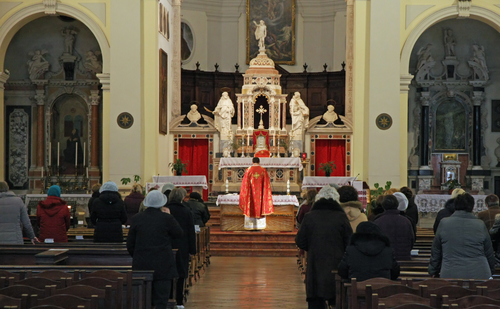
I was raised Catholic. I say that often. Not that it is a bad thing. It’s just my experience. During my time in the Catholic church, through my childhood and early adulthood, I had no connection with God. I can’t lay the blame for that at the feet of the Catholic Church. That was just where I was.

When I became a Believer, when I accepted Christ as my personal Lord and Savior, my life changed. I also began to see the Catholic Church in a different light. I was never into the ritual and observance, which is a major component of the Catholic Church. Not that other denominations and religions don’t have central religious rituals. All religions have ritual observances and traditions.

Those ritual observances and traditions are not, in themselves, bad, but they can create a facade that hides emptiness, darkness and sin. They can create an appearance of piety with no spiritual reality behind them. They can be more superstitious than spiritual, like stroking a rabbits foot for good fortune. In these and other ways, ritual observances can become a substitute for relationship with God.

Continue reading “Ritual, Spirit and Truth”

Spirit and Truth vs. Self-Made Religion

It isn’t things from outside that corrupt a person, but things from inside.

Depositphotos Image ID: 91001324 Copyright: carlosyudica

In a previous blog article, I talked about the shadow of things to come. Paul says that following rules and observing religious ritual is just a shadow of things to come. Later in the same chapter in Colossians, Paul explains in more detail what he is getting at. When we are focused only on the do’s and the don’ts and on observing religious rituals, we are focused on the wrong things.

“If with Christ you died to the elemental spirits of the world, why, as if you were alive in the world, do you submit to regulations – ‘Do not handle,  Do not taste,  Do not touch’ (referring to things that all perish as they are used) – according to human precepts and teachings? These have indeed an appearance of wisdom in promoting self-made religion and asceticism and severity to the body, but they are of no value in stopping the indulgence of the flesh.” (Colossians 2:20-23)

Paul isn’t advocating that followers of Christ abandon self-discipline and self-control and do whatever they like. “Are we to continue in sin that grace may abound? By no means!” (Romans 6:1-2) But, following Jesus doesn’t mean stepping up religious observances and following rules and regulations more closely. The focus on rules and rituals entirely misses the point.

Continue reading “Spirit and Truth vs. Self-Made Religion”

An Inkling of Transcendence: Lewis and Tolkien

Some say today that science is the study of everything that exists. If Lewis, Tolkien and Williams were millennials today, they would “call BS”.

Despoitphotos Image ID: 121201272 Copyright: chrisdorney

“[His] father had taught him to absorb doubt and disbelief into his beliefs.”

This statement from the book, Inklings, by Humphrey Carpenter, is spoken of Charles Williams, who was a regular participant in the informal discussion group, the Inklings, formed by CS Lewis and JRR Tolkien at the University of Oxford, England. The group met at various times in Lewis’s classroom and a local pub from the late 1930’s to 1949. Charles Williams was an early member of the group and continued as a regular until his death in 1945. Williams grew up “a devout churchman” but was encouraged by his father “to appreciate the force of atheistic rationalism and to admire such men as Voltaire and Tom Paine”.

Lewis, of course, was an atheist when he arrived and began teaching at Oxford. His journey from materialism to agnosticism to Christian theism is chronicled in his autobiographical work, Surprised by Joy. Tolkien was already a Christian when Lewis joined him as a professor at Oxford, and Tolkien influenced Lewis in his transition to Christianity. Williams came along later. These men were attracted to each other as much by their love of language, literature and poetry as their faith, though their views on literature and faith often diverged sharply.

These three men, and others who joined them, were powerhouses of thought and creativity. CS Lewis, of course, wrote many books from fiction to philosophy. JRR Tolkien wrote, perhaps, the greatest mythological series of the 20th century in the Hobbit and the Lord of the Rings Trilogy. Charles Williams, though lesser known, was a prolific writer, literary critic, publisher and student of English literature who could recite hundreds of passages from sheer memory.

They influenced each other, despite their very distinct differences, and their collective influence has been felt by generations from their day to ours. They were Christian men, believing very authentically in the Bible as scripture, but they were also fierce academics who held their faith up to the rigors of intellectual exercise.

Continue reading “An Inkling of Transcendence: Lewis and Tolkien”

Rejecting the Right God

If anyone is going to reject God, they should at least be sure to reject the right One (or ones).

It occurs to me that the “new atheists” are rejecting the wrong God (or gods, if you like). They are famous for saying that they don’t believe in the Christian God any more than they believe in Zeus or the Flying Spaghetti Monster, but does that make any sense?

Does anyone believe that a flying spaghetti monster or Zeus are possible competitors for the category, God of the universe? It seems to me that, if someone is going to reject God, they ought to be rejecting the right One (or ones). There aren’t that many contenders

Not all gods are “created equal”. Zeus or a “flying spaghetti monster” are not on a par the Christian concept of God, to say the very least. The same can be said of the Islamic view of God or any other major world religion view. The concept and “proofs” of God are much more sophisticated than the weak understanding displayed in a comment that likens them to flying spaghetti monsters and Roman mythology.

The ignorance of the new atheists about these things is rather shocking, though it shouldn’t be altogether surprising. They admit they find no use for such things as gods. Most of them have spent no time studying or considering a robust concept of the divine. The ignorance is, therefore, willful and inexcusable.

Anyone can knock a flying spaghetti monster out of the air. Try taking on the transcendent of God who created the universe. That’s a more noble task.

I can’t do justice to the subject in a short blog, but I will try to summarize my thoughts. The only serious contenders for consideration as God are the gods of the major world religions. They can’t all be true, of course, because they are incompatible with each other[1], so which one, if any of them, is the most likely candidate?

I will weigh in, for what is worth, but I would like first to address the modern, western concern over the idea of an exclusive God. Some people with western sensibilities seem to believe modern people should not be so exclusive in our conceptions of God and religion. They say there are many religions, and “Why can’t they all be true?

Having studied world religions in college, I can say that there are many similarities in world religions, but there are some significant differences also. For instance, it’s hard to reconcile the way different religions deal with suffering.

On the various conceptions of God, the various religions are fundamentally different and mutually exclusive. They may have some appearance of sameness on the surface, but they are fundamentally different.

Those differences ultimately mean something. We don’t brush incongruities aside in scientific endeavors just to be polite. We take them seriously in the pursuit of truth. If the various religions have opposing truth claims where does that leave us?

Continue reading “Rejecting the Right God”

Religious Pluralism Sounds Nice, but Is It True?

It should be no surprise, if there be such thing as truth, that people all over the world would have some knowledge and understanding of the truth. Thus, we should not be surprised at all to find aspects of truth in all the world religions.

canstockphoto15425896
(c) Can Stock Photo / rolffimages

One expression of pluralism is the idea that all truth claims are equally valid. (Pluralism doesn’t necessarily require this.) So does that include the truth claim that all truth claims are not equally valid? Think about it. This expression of pluralism that is quite popular today is already in trouble right from the start.

Religious pluralism is “the acceptance of all religious paths as equally valid, promoting coexistence”.

Religious pluralism sounds nice, and the motives for wanting to believe in religious pluralism are largely nobles ones. The idea of religious pluralism is born out of a desire for unity, respect for others and harmony, but can we live by it?

That we want religious pluralism to be true doesn’t mean it is true. We would like for gravity not to be “true”, especially while climbing a ladder, but wishing it so does not make it so.

My thoughts today are spurred on by a presentation by Vince Vitale on religious pluralism. You might want to listen to what he has to say about it before or after considering my thoughts.[i] He addresses several bad assumptions and several good desires that lead to pluralism. I only address two of the three assumptions here.

Continue reading “Religious Pluralism Sounds Nice, but Is It True?”