I have listened to all 30 episodes of Season 1 of the podcast, The Surprising Rebirth of Belief in God, by Justin Brierley. I have listened to dozens of podcasts, and I think this is one among the best, most well-produced podcasts I have found. The first episode of Season 2 inspires my writing today.
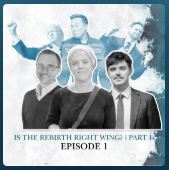
In this episode, Justin Brierley poses the question, “Whether the seeming rebirth of belief in God is right wing?” A return to Christian values seems to coincide with a resurgence in conservative politics, but, let’s look closer.
Is Christianity right wing? The African American church would beg to differ. Does Christianity have a right wing and a left wing? Or is Christianity another bird entirely?
At about the 45 minute mark in the podcast, Glen Scrivener identifies three strains of culture in the current western world. One strain is “blasting off into progressive liberalism.” Another strain is “snapping back to the worship of the strong”, a return to the world of Nietzsche. A third strain involves the “surprising rebirth of belief in God”, as Brierley puts it, where a trickle my become a flood, and Christian revival happens.
Scrivener is hopeful that the signs of Christian renewal in the west foreshadow revival, but he observes that these different strains of culture are moving forward at the same time, albeit in conflict with each other. They each have a trajectory that will continue into the future, and, “It will be a mess,” says Scrivener.
He believes Christian revival will happen, but he believes that progressive liberalism will also continue on its trajectory, divorcing itself more completely than it already has from nature and the Christian story. He believes that a devolution into what he calls “the default nature of the flesh” will continue as well, where might makes right.
Indeed, these things are happening now. Will they continue on the same trajectory into the future? Time will tell, but I think he is right: that there is a “post-Christian right” and a “post-Christian left” that are presently locked in a battle for the minds of the people of the western world.
I would add that the world, generally, is and will continue to be the devil’s playground until Jesus returns. At least, that is what the Bible says (millennium variations aside).
The absurdity of what is happening now is hard to reconcile with the reality of it. The history of how we got here seems to have been lost. Some Evangelical Christians are now cheering the process of undoing what Evangelical Christians fought hard to get not very long ago.
My thoughts today come from a man I have met, and I have heard speak at the Administer Justice Restore Conference in Elgin, IL in 2018. Soong-Chan Rah was professor of Church Growth and Evangelism at North Park Theological University just outside of Chicago at that time. Now he is professor of Evangelism and Church Renewal at Fuller Theological Seminary in California. He planted New Covenant Fellowship Church in Baltimore, MD, where he grew up, and he founded the Cambridge Community Fellowship Church in Massachusetts when he was at Harvard. He has multiple theology degrees. He has worked for InterVarsity Christian Fellowship, and he served on the boards of the Christian Community Development Association and World Vision, among other things.
Dr. Rah is not just a lifelong evangelical; he has undergraduate degrees in history and sociology. The combination of his personal history (born in Korea, grew up in the US from the age of about 5, raised by a single mother in the inner city), education, and experience give him an unique position from which to comment about the whirlwind of executive action Donald Trump has taken since the inauguration less than two months ago.
Dr. Rah sounded this alarm for the US Evangelical Church:
Wake up Evangelical Christians. The dismantling of USAID is not the confrontation of corruption and liberalism, it is a MIDDLE FINGER to Evangelical Christians who still adhere to the tenets of Scripture.
A short history lesson. Under the Bush administration, there was a move by evangelical Christians to access government funds to support the work of compassion and mercy. Government funding should not discriminate between a religious organization and a non-religious organization if the work is being done for the common good. This move was supported widely across the political spectrum as an action that prevented discrimination against Christian ministries. One of the key expressions of this policy change was access to USAID funds by Christian relief and development organizations. Christian organizations could now access USAID resources (e.g. – surplus US grain purchased by USAID in support of US farmers, in turn that grain became GIK donations to be distributed by US Christian organizations that often served international communities). In other words, one of the efforts by the US government to actually reflect the value of a Christian nation through the work of Christian organizations was completely wiped out while Evangelicals cheered two of the most non-Christian people in the world.
Wake up US Evangelicals. You are not just being played and used, the very people you cowtow to are actually mocking all the values you claim to espouse.
February 12, 2025
While I have no doubt that “corruption and liberalism” exists at USAID, many Christian organizations do their ministry with USAID support. Evangelicals fought for and earned a right at the table not that many years ago to receive federal funding to run the humanitarian programs supported by USAID. Organizations like Samaritan’s Purse, World Relief, and World Vision depend heavily on USAID and could not begin to do what they do without USAID support.
We need to be mindful that God calls His people throughout Scripture to do justice for widows, orphans, and strangers. Justice in the Bible includes caring for the weak and vulnerable in our society. Do you think that God does not bless a nation that taxes its citizens who have means to do justice for the poor and vulnerable who have no means?
USAID does just that domestically and around the world, and many Christian organizations like the ones I have mentioned do biblical justice with USAID funding. These organizations cannot do what they do on the scale they do it without this funding.
Many organizations would not fall into the category of doing biblical justice, of course. It should be no surprise to anyone that changes in the political powers every election cycle results in changes in how federal funding is used. That is the reality of a democracy. Do you really think that the current changes will not be changed again in four years?
The difference is that the infrastructure for this funding is now being completely dismantled. In just a few short weeks. Years of diligent and faithful effort by Evangelicals to fund ministries of justice are being undone in a virtual moment. The proverbial baby is being thrown out with the bathwater. Some might say that a wrecking ball is being taken to the hospital with the patients and hospital workers still inside!
The funding freeze, firings, and mandates to stop work have come with no attempt to sort the good from the bad. The axe has been laid to the trunk with no attempt to prune and preserve the tree.
As I have thought about these things, warnings of God’s judgment hang in the air. The warnings of God’s prophets are nearly always directed at God’s people because God expects His people to listen to and respond to what He says. Is not the Bible clear on what God desires from His people?
“He has shown you, O mortal, what is good. And what does the LORD require of you? To act justly and to love mercy and to walk humbly with your God.”
We have a somewhat romanticized view of immigration in the US. All of us in the United States reading this article are the benefactors of immigration, unless your ancestors were all Native American. Thus, the vast majority of us have benefitted from the various waves of immigration to the US in the past.
My ancestors immigrated at various times from England, Wales, Germany, Switzerland and France. It’s no wonder, then, that I view our history of immigration with some appreciation and sentimentality, and I believe most people with European ancestry feel like I do in that respect unless.
If you have much Native American or African ancestry, then, your view might be a bit different. If you have Chinese ancestry, you might feel differently. If you had German ancestry in 1750’s, you also might feel differently, but I will get to that.
We also tend to view our immigrant ancestors as hard-working, honest, and lawful people checking off the right boxes, jumping through the right hoops and diligently observing the protocols demanded of them to enter the country. We have earned the right to be citizens through their noble and respectful efforts.
Most of us, me included in years past, don’t really know the history of immigration to the United States other than the generalized and romanticized notions we carry from the US history we learned s children.
I am not a big fan of the new approach to American history that downplays the great positives that characterize the birth of our nation and its unique place in the world as a leader in many facets of human existence from governance to industry, science, and technology, medicine and human rights and in many other ways. At the same time, I think we should be honest about our history.
Immigration in the New World was relatively open, with exceptions, before 1882. Benjamin Franklin advocated in 1751 to exclude Germans and Africans from settling in the New World because he was “partial to the complexion of my country”.[1] Alexander Hamilton “warned of the dangers of absorbing and especially naturalizing too many foreigners”.[2] In fact, it seems that fear of immigrants is (at least) as old as the New World itself.[3]
People like Thomas Jefferson and George Washington opposed those views at the time, though Jefferson’s opinion may have been motived by a perception that German immigrants were more apt to support him politically. Some things don’t change!
I am not going to recount all the history of immigration in the United States. I am sure I don’t know the half of it, but a few noteworthy historical markers might be instructive in these times.
My interest here is the evangelical church in the United States, of which I am a member. How should we as a church orient ourselves to the immigration issues in our time in light of Scripture?
I recently read an article by Ed Stetzer and Andrew MacDonald, Waking Up After QAnon: How Can the Church Respond, posted by Christianity Today. The secondary headline is: Evangelicals disproportionately believed conspiracy theories in 2020. How do we recover?
I do not agree completely with everything in this article, but I think it is more “right” than wrong. The following assertion, for instance, certainly rings true to me:
“For years a segment of Christianity has sought to reclaim the United States of America as a Christian nation—or at the very least a nation founded upon Judeo-Christian values. However, they have, at the same time, witnessed the American culture (and, yes, what they see as American elites—media giants, big tech, politicians, and Hollywood) adopt a more secular and progressive agenda.”
I am familiar with the thinking of patriotic Christians because I “grew up” in Christianity in an atmosphere influenced by the Moral Majority and efforts to reclaim the Christian heritage of this country. It was a patriotic movement made “sacred” with Christian reference and fervor.
The community in which I was engaged out of college joined the effort. It seemed that some momentum was being generated in the direction of reclaiming the United States as a Christian nation…. at least while I remained in that community. When I left to go to law school, my perspective changed.
Looking back, I see that patriotic Christianity appeals to a certain narrative of faith and a desire to protect what is familiar and comfortable. It affirms a sense of place in the world as an American Christian who believes fully that the United States was blessed by God more than other nations in the world and stands like a city set on a hill for the world to see.
While I think there may be some truth to that blessing from God, we shouldn’t confuse His blessing for a time (and for His greater purpose) with our own desires for prosperity, influence, protection of lifestyle, culture and familiar life. God raises kings, and he takes them down.
The patriotic movement in the church going back in time was influenced, in part, by the “prosperity gospel”. The focus was on faith. A certain exhilaration accompanies the thinking that we are part of a sacred movement of God’s people uniquely blessed with faith. It was a kind of manifest destiny for the church.
I imagine the 1st Century Jews saw the world similarly, though they didn’t have the prosperity or power of American Christians in 21st Century. Their sense of being God’s people and being culturally “right”, however, made it difficult for them to accept that God loved Gentiles. That tribalism caused the first schism in the early church.
The American exceptionalism that is part of the allure of this politically-charged faith embraces modern Israel and the Jewish state. They see a kinship there, and I believe we are prone to the same kind of error that the early church fell into.
Moving on from that community of my early walk in Christ and seeing faith and the world from different angles changed my perspective. I loved my time in the community of my early Christian years. They did many things right, and they were eager and earnest in their faith in refreshing ways, but I have come to see that patriotic element differently. God is bigger than our patriotic ideas of Him.
(Not that all the people in the church I attended wandered down that road. I know many of them still, and many of them did not get swept up in the patriotic fervor. They have adjusted and adapted, and their perspectives have changed also.)
The real point here is that God has a global and universal purpose. We are as much a part of that purpose as our brothers and sisters in China, or India or in the African American churches in the US.
That is not to say that everyone is right about the way they view the world. We all have our own unique vantage points and perspectives, and for that reason I need to listen to others because they offer perspective that I have trouble seeing from my own, limited position.
Perhaps, if we can all come together in the shared experience of Christ who died for all mankind and learn to set aside the things that divide us, we can catch a more global and universal glimpse of what God is doing in the world. The Stetzer and MacDonald article makes the following statement regarding the headlong embrace of Donald Trump:
“Christians need to understand how this foolishness not only hurts relationships in the local church and community but diminishes our witness. In such situations, our gospel witness is at stake and we cannot afford to be passive.”
This is a major concern. We may have trouble seeing the ways in which we have wandered off the narrow path unless we take time to listen to what other believes are saying.
I have been writing about and trying to convey a certain perspective on racial tensions in the United States and the response of the American Church to those tensions, but I fear I haven’t done the subject justice. An article I read today on the Resurrecting Orthodoxy blog[i] clarifies some of my thoughts and prompts this article. The author’s subject is the book by Esau McCaulley, Reading While Black: An African American Biblical Interpretation as an Exercise in Hope. (I have the book and intend to read it myself.)
To be clear, when I speak of the “American Church”, I am really thinking of my own tribe – the evangelical church in the United States. My tribe are the people who the political pundits label “white evangelicals”. I don’t like the label, but these are “my people”.
That doesn’t mean that “we” don’t have African Americans, Mexicans and Latin Americans, and other ethnicities in our churches. We do. We are predominantly white, though, in the evangelical circles in which I have grown up as a Christian since my college days.
Regardless of the pews where people sit on Sundays and who sits next to them, political pollsters separate “white evangelicals” from their black counterparts. This distinction has bothered me because it suggests a false dichotomy.
Theologically, we agree on primary beliefs. The article on Reading While Black describes those beliefs as follows:
“(1) The importance of a ‘born again’ experience, (2) The demonstration of the Gospel in missionary and social reform efforts, (3) The upholding the authority of Scripture, and (4) The stress on the sacrificial death of Jesus as what makes redemption possible.”
On this point, Joel Edmund Anderson, the author of the article says:
“… I couldn’t help thinking as I read the book that the book’s title is actually misleading, for I didn’t see McCaulley’s black ecclesial interpretation of the Bible to really be a black interpretation at all. It was a faithful Christian interpretation.” (Emphasis in the original)
This observation underscores the main point of my article today: white Christians and black Christians agree many things at the heart of faith. We agree on the necessity of being born again, the missionary nature of the Gospel, the authority of Scripture, and the redemption from sin through the sacrificial death of Jesus on the cross.
We don’t agree, though, on politics, and we vote very differently. Polls clearly show that white evangelicals voted about 80% in favor of Donald Trump, while black “evangelicals” voted just the opposite – about 80% against Donald Trump.
It’s tempting to try to explain that difference away on the basis of conservative and progressive/liberal ideologies and miss the clear common ground in our biblical beliefs. It’s also tempting to blame this difference on race alone. Race surely is a key distinctive. But why?







 Navigating by Faith