Putting Experience into Gospel Perspective

Love, truth, and personal experience


I think most people are skeptical of other people’s experiences. It’s only natural to be skeptical of experiences we have not had and do not share. When people have had experiences in common with or similar to us, we are much less skeptical. It’s also natural to assume the validity and legitimacy of experiences that we share in common or similar to the experience of others.

We have an affinity for people with whom we have shared experiences and for people whose experiences are similar to ours. Shared experiences bind us together. Those shared experiences affirm us and become part of our individual and common identities.

We let our guards down with people with whom we have shared experiences, and we can “be ourselves” with them. We want to affirm them because they affirm us.

These are all good things in and of themselves, but the affirmation is not always positive. Shared experiences can form the basis of co-dependency that is unhealthy and even destructive.

If we spend all our time with people with whom we share experiences, we can become insular and narrowminded. If we don’t venture beyond those circles of commonality, we may find ourselves in an echo chamber of conformation bias that blinds us to the false stories we tell ourselves and reinforces our narrowmindedness.

Common experiences can also have the opposite effect. People who spend significant time in other countries and with people not like them tend to be more openminded, more humble, and more accommodating of people who see the world differently.

As Christians, the common experience of being “in Christ” with people who are very different from us in ethnicity, native language, economic strata, age, etc. is mind and heart expanding. The usual commonalities that define us – like Jews and Gentiles, male and female, slave and free – give way to a greater identity that we find together in Christ.

Being in Christ should be a defining commonality for Christians, though we often default back to commonalities that are of lesser significance. We need to guard against that.

Jesus challenges every Christian to stretch ourselves in these things – to strive to make our shared experience in Christ the commonality that is preeminent in our lives. That commonality should be the one thing that unites us, though we may have little else in common.

Jesus also urges us to stretch back from that one commonality to engage a world that does not share that one common, all encompassing identity that unites Christians around the world. Jesus bids us to go out into the world to share the Gospel with people who do not yet share that common identity.

In doing that, we need to use other, lesser commonalities to bridge the gap, to make connection, to open doors to sharing the Gospel. Jesus is our ultimate example. In Jesus, God became flesh so that He could share in our humanness and, therefore, to connect with us so that he could share the good news with us.

We often become insular in our Christian community, however. It’s comfortable there, and the effort to connect with people who do not share the most important aspect of our lives is hard work.

We sometimes vacillate between the groups of people with whom share certain commonalities like chameleons, fitting in where we go. It’s hard to maintain our distinctiveness as Christ followers among people who do not know Jesus. Yet, this is our calling.

The religious community in the first Century was insular. The religious leaders criticized Jesus for making those human connections with the world – the tax collectors, prostitutes, and sinners of his day.

If Jesus was born today, I am convinced he would be criticized for hanging out with the LGBTQ community, Muslims, and atheists. The people in those communities would be just as critical of Christ followers as they were in the 1st Century, yet our commission is to bridge the gap to share the good news. I don’t think the dynamics were any different when Jesus walked the earth in the flesh than they are today.

We cannot let our experiences define how we operate in the world. They can be good and bad, positive and negative, helpful in living out the Christian life and unhelpful, depending on our perspective. They can define us and bind us in our closedmindedness, or they can be tools for making critical connections in furtherance of the plans and purposes of God.

My thoughts today are inspired by something Preston Sprinkle said in response to a questions posed by a listener to his podcast, Theology in the raw. Sprinkle gets much criticism from within the Christian community for his efforts to bridge gaps with the modern world – especially the LGBTQ community.

I appreciate his heart and his attempts to make connections with the “sinners” of the world. Of course, we are all sinners. We know that, but we have a hard time putting it all in perspective. It’s difficult and sometimes messy work trying to remain pure and undefiled in the world and to “go into” the world at the same time with the Gospel.

One thing that he said seemed important enough for me to write it down. He said:

“I don’t determine my theology from other peoples experiences. You can’t. Which experience are you going to choose to determine it? .. . But I do think listening deeply to other people’s experiences should shape how we think theologically, how we hold on to our theology. Listening well to other people helps us put our theology into the conversation with real people.”

If you will indulge me, I am going to try to break down what I think he is saying. I think it is critical to our role as ambassadors of Christ to get this right.

Continue reading “Putting Experience into Gospel Perspective”

Each: How to Be a Ruler in Your Corner of the Kingdom of God Today

We are vassals of King Jesus, a royal priesthood, ambassadors of Christ


“Behold, a king will reign in righteousness, and princes will rule in justice. Each will be like a hiding place from the wind, a shelter from the storm, like streams of water in a dry place, like the shade of a great rock in a weary land. Then the eyes of those who see will not be closed, and the ears of those who hear will give attention.”

Isaiah 32:1-3 ESV

A king will reign in righteousness!

What king in the history of the world has ruled in righteousness?

Maybe there is one I don’t know about. If you believe the Bible, though, no man is righteous. Not one. (Romans 3:10-12)

Only one person in history might fit this description, and his name is Jesus. Pilate called him “king of Jews”, and Jesus didn’t deny it (John 18:33), but he died on a cross at the hands of the dominant power in the First Century: Rome.

During his life, Jesus predicted his death, but he said he would come again. (See, for instance, John 5:28-29, 14:1-3; Luke 21:25-28; and Matthew 24:23, 36-44) His First Century followers claimed that Jesus rose from the dead, and he ascended to the right hand of God. (Revelation 3:21; Matthew 22:44; Acts 2:33) They wrote about his coming back to rule the earth. (See, 2 Peter 3:10, 4:7: 1 Thessalonians 4:16-17, 5:1-3; Hebrews 9:28) In the vision John the Apostle famously saw, he says:

Behold, he is coming with the clouds, and every eye will see him, even those who pierced him, and all tribes of the earth will wail on account of him. Even so. Amen.

Revelation 1:7

“See, I am coming soon; my reward is with me, to repay according to everyone’s work. I am the Alpha and the Omega, the first and the last, the beginning and the end….”

Revelation 12:12

During his life, Jesus said he came to preach the good news of the kingdom of God, (Luke 4:43), and he traveled around from town to town “proclaiming the good news of the kingdom of God.” (Luke 8:12) He said the kingdom of God has come (Luke 10:9), and it is in our midst. (Luke 17:21)

From these things, we learn that Jesus claimed to have brought the kingdom of God to earth, but he also said he would die. He also said he would rise from the dead, and come again. His followers claim he did rise and return in the flesh, but only for 40 days. Then, he left and ascended into heaven.

Jesus said, and his followers claim, that he would come again (again), but that hasn’t happened yet. In the meantime, Jesus claims he introduced the kingdom of heaven on earth. So, where is it?

Jesus told Pilate his kingdom is “not of this world.” (John 18:36) And, he said this right before he was crucified We might write Jesus off as a lunatic except for the fact that he seems to have risen from the dead according to hundreds of his followers (1 Corinthians 15:3-8), and he spent time with them over 40 days before he reportedly ascended to the right hand of God. (Acts 1: 3–4)

Even for people who have difficulty believing these claims, no one can deny the lasting influence Jesus has had. One has to wonder how such a person who was not born into nobility, who was not even a ranking religious leader in his local community, who worked with his hands, who never had political power or influence, who was poor, and who is more famous for dying than living could have become the symbol and hope of Western Civilization. Not only that, but he is revered, followed and worshipped in every nation around the world.

Paul called followers of Jesus “ambassadors” with a “message of reconciliation”. (2 Corinthians 5:18-21) He says this because Jesus came to reconcile the world to himself – to God the Father, with whom Jesus called himself one. He cam to reconcile the world to God, and we who follow him are commissioned to share the same message.

This is the good news of the kingdom of God: freedom for people who are imprisoned and oppressed, recovery of sight to the blind, and an invitation to enter into God’s favor – His kingdom. (Luke 4:18-19) Jesus is the king of this kingdom that is not of this world.

But, we are to be despised of all people on the earth if we have nothing but a kingdom that is not of this world (and nothing beyond it). If Jesus was not raised from the dead, we have nothing, and our faith is less than useless.

Thus, the testimony of those early followers who watched him die on a Roman cross and be buried and who claimed that he appeared to them, sat with them and broke bread with them, and taught them for 40 days before he ascended into heaven is the foundation of our faith. (1 Corinthians 15:3-7)


Because of their witness, we believe his promise that he will come again to bring his other-worldly kingdom to this earth in a final resolution and redemption of all that God created. If we trust the Bible, we find that his coming was foretold centuries before he was born:

“Wonderful Counselor, Mighty God, Everlasting Father, Prince of Peace. Of the increase of his government and of peace there will be no end, on the throne of David and over his kingdom, to establish it and to uphold it with justice and with righteousness from this time forth and forevermore.”

Isaiah 5:9-7

“One like the son of man” was also foretold by Daniel, a person who would be “given dominion and glory and a kingdom, that all peoples, nations, and languages should serve him….” (Daniel 7:13-14) Jesus claimed to be this “Son of Man”. (See, Matthew 16:13-20 and Luke 22:48) Indeed, Christians believe Jesus is this Son of Man who was foretold, and that he will come again to judge the living and the dead.

Jesus is the “king who will reign in righteousness!” And Isaiah says that “princes [rulers, officials, captains] will rule in justice.” Among the meanings of the Hebrew word sar (שַׂר) is a vassal (a protected servant of the king), who has power and authority under a king. As followers of Jesus, that is us!

We are all vassals of King Jesus. Peter calls us a “royal priesthood”. (1 Peter 2:9) Isaiah says that each of the vassals of the king of righteousness will rule with justice. Each of us!

How do we do that today in the kingdom of God that is not of this world?


Continue reading “Each: How to Be a Ruler in Your Corner of the Kingdom of God Today”

What It Means to Bear God’s Name and the Significance of Not Taking God’s Name in Vain

We who take God’s name are His representatives in the world.


In a previous blog article, I tried to summarize the view developed by Old Testament scholar, Carmen Imes, on what it means that human beings are made in God’s image. I have only summarized her view as I understand it from a conversation on the Holy Post podcast (with some thoughts of my own added in), but she wrote a whole book about it!

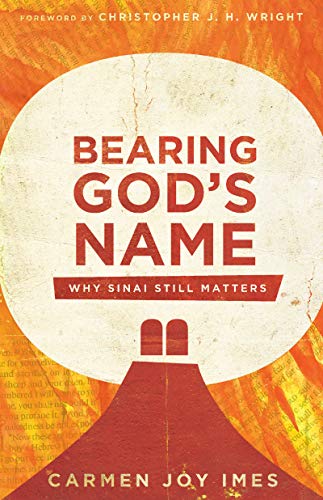
The book, Being God’s Image: Why Creation Still Matters, was recently published as a prequel to her previous book, Bearing God’s Name: Why Sinai Still Matters. The previous book on bearing God’s name, in turn, was distilled from Imes’ doctoral dissertation.

Her observations are profound in my book! (Which I don’t have because I am speaking figuratively now.) Having summarized her view on human beings being made in God’s image, I am turning now to the significance of bearing God’s name and not taking His name in vain.

Imes says we don’t bear (take on) God’s image because we are (already made in) God’s image, but we do take on (bear) God’s name if we are His covenant people. The significance of taking on God’s name is what is implicated in the third commandment: thou shalt not take the Lord’s name in vain.

In Carmen Imes’ first book, Bearing God’s name: Why Sinai Still Matters, she explores the commandment not to take the Lord’s name in vain. She argues for what she calls “missional reading”. Thus, she says we should not understand this command simply as a rule to be applied to our speech and how we refer to God verbally. She says the meaning is much broader, deeper and more fundamental than that.


This commandment implicates our whole lives! We who take God’s name are His representatives in the world. We bear or carry His name, so what we do, and who we are, and how we represent God, who’s name we carry, matters deeply!

Every human being is made in image of God, but only God’s covenant people bear His name. Every member of the human race is invited to join the covenant community, but until people join themselves to God’s covenant community, they do not take His name.

Thus, Imes says, “It’s impossible for a nonbeliever to take God’s name in vain.” They haven’t taken His name at all, so they cannot violate the command not to take God’s name in vain. If a person doesn’t take God’s name in the first place, he/she cannot take His name in vain.

Remember that God revealed His proper name, Yahweh, only to His covenant people. Yahweh was not revealed to all people at the time the commandments were given to Moses. The name of God, Yahweh, was only revealed to Israel in the context of the covenant God made with them.

In New Testament verbiage, we are ambassadors of Christ if we have been born again and accepted Christ as our Lord. When we are born again, we take on the “heredity” of God as His children. When we accept Jesus as Lord, we “take his name”: we become identified as Christ followers, traditionally known as Christians.

Because we are followers of Christ who bear his name, everything we do and say is a reflection of Him. We are representatives of the kingdom of God. We carry His flag as we live our lives in the world. (If, indeed, we are not ashamed to be called by His name.)

Continue reading “What It Means to Bear God’s Name and the Significance of Not Taking God’s Name in Vain”