Evidence of a Beautiful Mind

Beauty is hard to explain on the basis of naturalism.

Sunrise over Hawaii by Miriam Higgs

Everyone recognizes beauty. That is undeniable. Everyone recognizes beauty in nature. Nature is virtually saturated in beauty from mountain peaks, to ocean shores, to barren Antarctica and the desert landscapes, to the starry host and the living cell. We recognize beauty in things we see, in things we hear, words that are spoken and in the personalities of exceptional people.

We see beauty in human art, and that beauty is usually produced by effort and design. The beauty in art is rarely produced unintentionally. Art, itself, is an intentional activity. If “art imitates nature” (Aristotle), then our proclivity toward art suggests that nature is also the product of intentionality.

Just as human art reveals something of the personality and character of the artist, nature reveals something of the personality and character of its Creator.

Beauty has a certain objectivity to it. While people disagree may differ on whether certain things are beautiful, no one denies that beauty exists and that some things are beautiful. Further, there are some things that nearly all people agree are beautiful.

If beauty wasn’t, to some degree, objective it could not be taught by experts in universities. The study of beauty includes principles of symmetry and asymmetry, color palate, texture and many other things that these experts agree make good art. A principle that is not the least important is the meaning behind the art, not just for the artist, but for the viewer of the art.

Virtually no one disagrees that these are objective truths, self-evident in quality and character. The fact that people will disagree over what is beauty, or what is most beautiful, doesn’t negate the universality of the idea of beauty – beauty does exist, we can recognize it and we can replicate it.

Beauty is hard to explain on the basis of naturalism. What sort of function does beauty supply? And why does it persist? The more advanced human civilization becomes, the more we insist that beauty be incorporated into our world, the more we desire it and the more we seek to make things beautiful. The best explanation for the source of beauty is a Beautiful Mind of which we are but images.

Sinners and the Struggle Against Sin – The Resistance of Love

In our struggle against sin, we are to resist sin, not the sinners who trigger the pride that tends to well within us when we are wronged.


In Part I of Sinners and the Struggle against Sin – Taking Insult away from Injury, I highlight a connection between enduring hostility from sinners, as Jesus did on the cross, and our own struggle to resist sin, looking at Hebrews 12:3-4:

“Consider him who endured from sinners such hostility against himself, so that you may not grow weary or fainthearted. In your struggle against sin you have not yet resisted to the point of shedding your blood.”

We might think of our struggle against sin as a completely internal affair. Hebrews 12:3-4 suggests that there is an external component to it. The hostility we endure from sinners is part of our own struggle against sin. It isn’t hard to see why: the hostility from sinners triggers a guttural, visceral pride response in us, and pride is the root of all sin.

Think of any time you were slighted and how you responded to it. This is what the hostility of sinners triggers within us. We want to fight back. We want to return insult for insult. We want to defend our honor. We want vindication. We might even want vengeance.

In this passage, though, we are exhorted to look to Jesus who resisted sin to the point of actually shedding his own blood. We are reminded by the that we have not yet resisted to the point of shutting our own blood. It isn’t resisting sinners, but resistong sin, that is the key point here.

Continue reading “Sinners and the Struggle Against Sin – The Resistance of Love” →

Sinners and the Struggle against Sin – Taking Insult away from Injury

When we are told that we have not yet resisted in our struggle against sin to the point of shedding blood, the writer of Hebrews may be getting at something much closer to our own experiences than we might think.


In Hebrews 12:3-4, the writer says, “Consider him who endured from sinners such hostility against himself, so that you may not grow weary or fainthearted. In your struggle against sin you have not resisted to the point of shedding your blood.”

When I read these words this morning, I saw for the first time the connection between these phrases: “endured from sinners such hostility” and “your struggle against sin”. There seems to be a link between enduring hostility from sinners and struggling against (resisting) sin.

When I think of sin, I think of my own sin that is within me. I don’t think of struggling to endure hostility from sinners as struggling against sin, but that seems to be what this passage is suggesting. The last phrase sheds some light on this connection: “You have not resisted to the point of shedding your blood.”

I have been thinking about the strong encouragement to resist sin in these verses for many days now. I have been thinking of the metaphorical point of resisting sin to the point of shedding blood. But I had not seen the more direct connection between the hostility of sinners and my own struggle to resist sin.

Continue reading “Sinners and the Struggle against Sin – Taking Insult away from Injury” →

The Dissatisfaction of Life

The substances that correspond to our natural desires satisfy them only temporarily. We thirst, and drink, and we thirst again. We hunger, we eat, and we hunger again. What’s the point?


“I reached the pinnacle of success in the business world. In others’ eyes my life is an epitome of success.
However, aside from work, I have little joy. In the end, wealth is only a fact of life that I am accustomed to.
At this moment, lying on the sick bed and recalling my whole life, I realize that all the recognition and
wealth that I took so much pride in, have paled and become meaningless in the face of impending death.
You can employ someone to drive the car for you, make money for you but you cannot have someone to bear the sickness for you.
Material things lost can be found. But there is one thing that can never be found when it is lost – ‘Life’.
….
Whichever stage in life we are at right now, with time, we will face the day when the curtain comes down.
….
As we grow older, and hence wiser, we slowly realize that wearing a $300 or $30 watch – they both tell the same time…
Whether we carry a $300 or $30 wallet/handbag – the amount of money inside is the same;
Whether we drive a $150,000 car or a $30,000 car, the road and distance is the same, and we get to the same destination.
Whether we drink a bottle of $300 or $10 wine – the hangover is the same;
Whether the house we live in is 300 or 3000 sq. ft. – loneliness is the same.
You will realize, your true inner happiness does not come from the material things of this world.
Whether you fly first or economy class, if the plane goes down – you go down with it….”

These are the last words from Steve Jobs, reportedly.

I return to this same theme often in my thinking and writing: this life is short. We put so much energy into it, and we act often as if our time on this Earth will continue indefinitely, but it won’t. It doesn’t matter how accomplished, wealthy or powerful a person is, death is inevitable.

The recent suicides of Anthony Bourdain, the famous cook, food connoisseur and TV personality, and fashion designer, Kate Spade, are reminders that health, wealth, fame and influence do not satisfy our deepest longings and do not provide sufficient meaning or purpose in life to overcome depression. Many very wealthy and influential people have taken their own lives, suggesting that having everything a person might desire in the material world still leaves us lacking. So what is the point of life?

Continue reading “The Dissatisfaction of Life” →

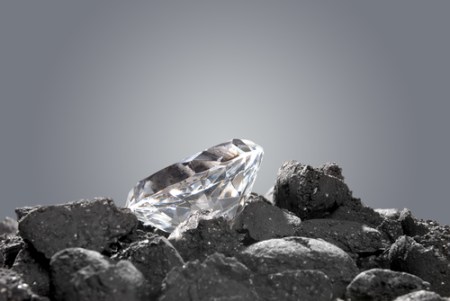
Diamonds and Coal and the Pressures of Life that Shape Us by Our Reactions to Them

We don’t choose our circumstances, but we can choose how we respond to them.


Diamonds and coal are made from the same substance, carbon.[1] They are both formed by heat and pressure, but the results are very, very different. We can learn some very poignant things from diamonds and coal that I will explore in this piece.

The properties of the two substances are interesting, and very different, though they form from the same substance. Coal is relatively soft. Coal burns and provides a source of energy, but it is not a very clean source of energy because coal is full of impurities.

Diamonds, on the other hand, are relatively hard – one of the hardest substance that exist. Diamonds have few impurities, and diamonds won’t burn. Diamonds can be used for cutting hard metals and similar uses because they are so hard and immutable.

Coal is readily available. It is soft and combustible. Coal is dirty and rubs off everywhere. Coal is really only useful for burning. Appropriately, a coal in the stocking has become cliché for an unwanted “gift”.

Diamonds are clean, translucent, rare and beautiful. Diamonds are highly valued for their own sake. So much, that we wear them on our fingers and around our necks as adornment for special occasions. They are also highly useful in all kinds of industrial applications.

Interestingly, diamonds and coal are both formed by heat and pressure. The difference is only in degree and location.

Coal is formed relatively near to the surface of the Earth, while diamonds are formed deep within the Earth. Diamonds are formed under tremendous heat and pressure over a long period of time. Coal forms relatively quickly under less heat and less pressure.

The result is that coal is full of impurities. Coal is still combustible, though it is formed under heat. Diamonds, on the other hand, undergo so much heat and so much pressure, that they are no longer combustible. All the impurities have been burned away.

I have heard that diamonds form from coal, but they don’t. Though diamonds and coal do form from the same substance – carbon – one doesn’t form from the other.

Carbon can be formed into diamonds, or it can be formed into coal. It’s one or the other. Coal never forms into diamonds, and diamonds never form into coal. The paths for the two elements are completely different, and the difference in the process under which they form results in two completely different elements – though they form from the same basic substance.

These facts that I have taken some time to gather in relation to diamonds and coal prompt some very poignant thoughts, beginning with the question: Would you rather be a diamond or a lump of coal? How do the processes of the formation of diamonds and coal, and nature of diamonds and coal, instruct us?

Continue reading “Diamonds and Coal and the Pressures of Life that Shape Us by Our Reactions to Them” →