What Was the Sin of Sodom and Gomorrah?

A clue is that people cried out in distress

It is probably not exactly what you think


I have wanted to dig into the story of Sodom and Gomorrah for a while now, ever since someone suggested to me that the story isn’t what I think it is. Everyone knows the reference to Sodom and Gomorrah, right? God smote those villages with fire and brimstone because of homosexuality.

That’s what I was taught. At least, that is what I always believed, but I have learned there may be more to the story. The truth is right where we should expect to find it: in the Bible. If you are intrigued as I was, then read on.

First, let’s review the story in Genesis 13. Abram and Lot flourished, and their clans and flocks grew in size in the land God promised Abram. As their estates grew, tensions arose among their entourages, and they decided to separate and spread out. (Gen. 13:5-9)

“Lot looked around and saw that the whole plain of the Jordan toward Zoar was well watered, like the garden of the Lord, like the land of Egypt.” (Gen. 13:10) The desirability of the land prompted Lot to choose Sodom and Gomorrah in the plain of Jordon, while Abram remained in Canaan.

Although the land was desirable, the story ends with this ominous statement: “The people of Sodom were wicked and were sinning greatly against the Lord.” (Gen. 13:13) Did Lot know what he was getting into?

That statement is there for a reason. We should take note. The land was inhabited with “wicked” people, yet Lot moved there anyway. Perhaps, the allure of a well watered garden – like the garden of Eden and like Egypt – was so great that Lot ignored the fact that wicked people lived there.

The mention of similarity to Egypt should also recall the desire of the people in the wilderness to go back to Egypt. Though they were enslaved there, the land was lush, and they had food and comfort. It seems that these allurements caused Lot to overlook the obvious problem with choosing to live there.


The comment also may provide an explanation for why Lot’s wife looked back in defiance of the angel’s warning. She may have regretted leaving such a desirable place to live, despite the wickedness of the people there.


She may have wanted to return to the abundance and comfort that drew them there, and that desire to hold on to abundance and comfort in the face of the abject wickedness of the people may have been her undoing.

We should also understand the backstory in Genesis 18 before we get to the story of Sodom and Gomorrah Genesis 19. Before the angels visited Sodom, they visited Abram.

Abram saw the three “angels of the Lord” from his tent. He went out to meet them, bowed in respect, and insisted they come to his tent to be refreshed. Abram and Sarai spared no expense to show them hospitality, and the angels returned the favor by affirming God’s promise to the elderly couple: promising that Sarai would bear a child within a year. (Gen. 18:1-15)

Before the angels left, the angels told Abram the reason they came: to investigate Sodom and Gomorrah because “the outcry against Sodom and Gomorrah [was] so great and their sin [was] so grievous.” (Gen. 18:20) This “outcry” that reached the LORD is the first clue to what was going on there. (Gen. 18:21)

The Hebrew word that is translated “outcry” in this verse is za’aq. It mean a shriek, cry for help, cry of distress, lamentation. The outcry means something was going on in Sodom and Gomorrah that was causing people to cry out for help in distress.

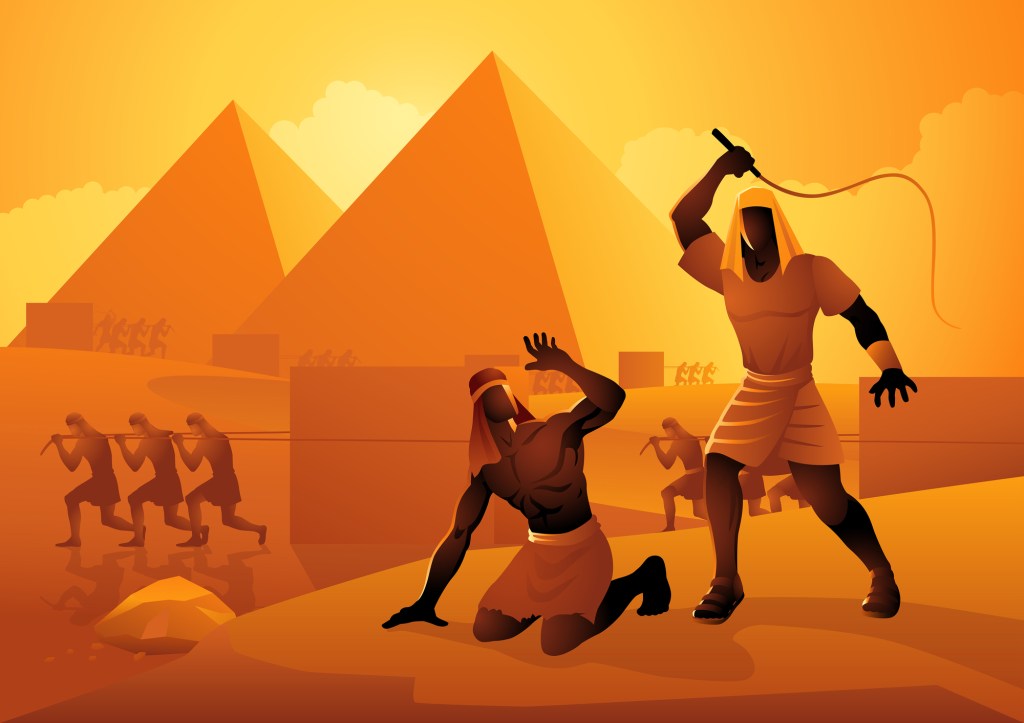
The word, outcry, in Genesis 18 should bring to mind Exodus 2:23 where God heard the Israelites cry out in distress over their oppressive treatment by the Egyptians. In both cases, in Egypt and in Sodom & Gomorrah, God responds to an outcry of the people living there.

They same word, za’aq, is used in both passages. God responded to the Hebrews cry for deliverance by sending Moses, and God miraculously rescued them from the land of Egypt. In Genesis 18, God similarly responded to a cry for deliverance from Sodom by sending His angels to investigate.

The parallel nature of these stories is important to recognize. The people cried out in distress, and God responded. Parallel stories and themes run throughout the Bible, and we should pay attention to them when they appear. They usually mean something.


We know why the people cried out in Egypt – because Pharaoh enslaved and mistreated them. The Bible is relatively silent, however, on the circumstances in Sodom and Gomorrah. If we pay close attention, though, we can find some clues!

Back to the story: In Genesis 19, Lot repeats the pattern of Abram’s hospitality. Lot saw two angels at the city gate, and he went out to meet them, like Abram did. Lot greeted them with respect the same way Abram did, and Lot insisted they come to his home where he prepared a feast for them, just as Abram did. (Gen. 19:1-3) These stories appear one after the other in the biblical narrative, and the parallel symmetry signals that we should pay attention.

Abram and Sarai, by the way, are known for generous hospitality. The generous hospitality of Abram is legendary in Jewish and even Muslim lore. Generous hospitality was a key distinctive of Abraham, God’s man of faith.

Lot, who was Abram’s kin, demonstrated the same kind of generous hospitality, but the story takes a bad turn. Everything seems great until the men of Sodom surround Lot’s house and demand that Lot bring the angels out to them, “So that we can have sex with them.” (Gen. 19-4-5) When Lot refused, they turned on Lot, This is what they said:

“This fellow [Lot] came here as a foreigner, and now he wants to play the judge! We’ll treat you worse than them.”

genesis 19:9

Most of us, I think, assume the sin of Sodom was primarily sexual in nature. The story certainly seems to suggest that if we miss the clues to what was really going on. The symmetry of the parallel stories leading up to the story of Sodom and Gomorrah suggest that something else is going on. The people crying out in distress, like the Jews in Egypt is another clue, and what the townspeople say to Lot is still another clue.

The clues are in the context and the contrast between the way Abram and Lot treated the foreigners/angels and the way the townspeople in Sodom & Gomorrah treated them. Abram and Lot go out of their way to greet the angels, bow to them in respect, make them feel welcome, and show them generous hospitality. The men of Sodom react the opposite way: they respond with hostility. They are angry that the foreigner in their midst (Lot) invited foreign guests into his home, and they came to punish and humiliate those guests by violating them sexually.

I never noticed these clues in the text before. They cast a different light on the story. It seems that the story is less about men wanting to have sex with men than it is about brutish inhospitality the strangers/foreigners.


This was a lynch mob. They came to run the foreign guests out of town and to demonstrate their extreme displeasure with Lot for inviting them in to his home. The men wanted to humiliate, violate, and punish Lot’s foreign guests in the worst possible way, and they wanted Lot to understand why: because Lot was a foreigner, and these men were foreigners, and they were not welcome in their town.


As side note, I would not likely have noticed this but for the book I am reading by James K. Hoffmeier, The Immigration Crisis: Immigrants, Aliens, and the Bible. He cites to the Sodom and Gomorrah story as an example of the way people in the Old Testament controlled their borders and their cities. (See also Judges 19-21 in which a similar scene plays out in Gibeah where the sons of Benjamin treat the Levites passing through in exactly the same way.)

I am reminded of the Parable of the Sheep and the Goats in which people did not realize the way they treated foreigners (and other vulnerable people) was like treating Jesus that way – good and bad. I am also reminded of Hebrews 13:2: “Do not forget to show hospitality to strangers, for by so doing some people have shown hospitality to angels without knowing it.” Mistreating strangers – similarly – might be nistreating angels!

This was the last straw for God. The angels returned the favor Lot showed them by protecting him and his family. The angels warned them to get out of town quick. As soon as Lot and his family were out of town, “the Lord rained down burning sulfur on Sodom and Gomorrah….” and reduced it to smoke and ash (Gen. 19:10-28)

Aside from some other details that do not seem directly relevant at the moment, that is the story of Sodom & Gomorrah. Most of the references to Sodom & Gomorrah in the rest of the Bible are used as warnings without much commentary, except for three passages. These passages tell fill in the rest of the story.

Continue reading “What Was the Sin of Sodom and Gomorrah?” →

Still Influenced By the Flesh: What’s Love Got to Do with It?

If we are Christ followers, we should not be content to remain as we are


“[Y]ou are still influenced by the flesh. For since there is still jealousy and dissension among you, are you not influenced by the flesh and behaving like unregenerate people?”

1 Corinthians 3:3 NET

I am inspired by Paul’s first letter to the Corinthians (of which we have record). The topic I want to write about is what Paul calls “the flesh”. We might just call it sin. The doctrine of sin is not popular today, but the Bible doesn’t pull any punches about it, and neither should we.

We do need to view it in the right context, though. The Bible is clear that all people have sinned, and all people do sin. John says that anyone who denies they have sinned is a liar, (1 John 1:8) but John adds that God is faithful and just to forgive us when we confess our sin to Him. (1 John 1:9)

Paul wrote this letter to “the church of God in Corinth, to those sanctified by Christ Jesus and called to be His holy people, together with all those everywhere who call on the name of our Lord Jesus Christ….” (1 Cor. 1:2) Thus, he is writing to Christians – Christians who are “still influenced by the flesh”.

Yes, Christians are influenced by the flesh, and Christians are susceptible to sin.

The notion of sin is disfavored and much maligned, but most people would agree that “to err is human”. The biblical notion of sin is not much different than this popular understanding of what it means to be human. It means in its various forms in the Greek to fail, to miss the mark, to do wrong, to misstep, etc. (See Biblehub)

The Greek word translated “flesh” in the New English Translation is σαρκικός, ή, όν (sarkikos). It means “pertaining to the flesh, carnal” (“behavior which is typical of human nature … with special focus upon more base physical desires” according to the HELPS word studies found at the Biblehub website).

Fleshiness is human tendency. Therefore, we might change the popular idea of what it means to be human by saying, “To sin is human.”

The Bible claims that only one human being in history was without sin, and that person was Jesus of Nazareth, who the Bible claims was actually God incarnate (God who became human). The Bible also claims that Jesus came to deliver humans from the limitations of sin (and from death). This was his purpose – to invite us into relationship with God as children to become who God always meant us to be – to be free of sin and death, to live in eternal relationship with God, having the same characteristics God has.

This is a process that starts with a commitment to God in Christ, and it culminates in our own victory over sin and death. The ultimate realization of this victory, however, only occurs after our resurrection:

“So will it be with the resurrection of the dead. The body that is sown is perishable, it is raised imperishable; it is sown in dishonor, it is raised in glory; it is sown in weakness, it is raised in power; it is sown a natural body, it is raised a spiritual body.”

1 Corinthians 15:42-43

“I declare to you, brothers and sisters, that flesh and blood cannot inherit the kingdom of God, nor does the perishable inherit the imperishable. Listen, I tell you a mystery: We will not all sleep, but we will all be changed—in a flash, in the twinkling of an eye, at the last trumpet. For the trumpet will sound, the dead will be raised imperishable, and we will be changed. For the perishable must clothe itself with the imperishable, and the mortal with immortality.”

1 Corinthians 15:50-53

Paul calls this transformation the perishable being clothed with the imperishable, and the mortal with immortality. (1 Cor. 15:54) Thus, we do not attain this perfection until we die and are resurrected, but we are called into relationship with God in this life where the process of change this begins the to happen

Paul’s purpose in writing this letter to the Christian Corinthians (and Christians everywhere and at all times) was to address their fleshiness – their sin. Though they had the “mind of Christ” (1 Cor. 2:16), they were still influenced by the flesh. (1 Cor. 3:3) Just as we are. So we should take note.

Continue reading “Still Influenced By the Flesh: What’s Love Got to Do with It?” →

How Do I Help My Brother with a Speck In His Eye When I Have a Log In My Own Eye? Judging Rightly

We cannot grow in maturity and holiness if our focus is on the sin of other people. We have a hard enough time recognizing and dealing with our own sin!


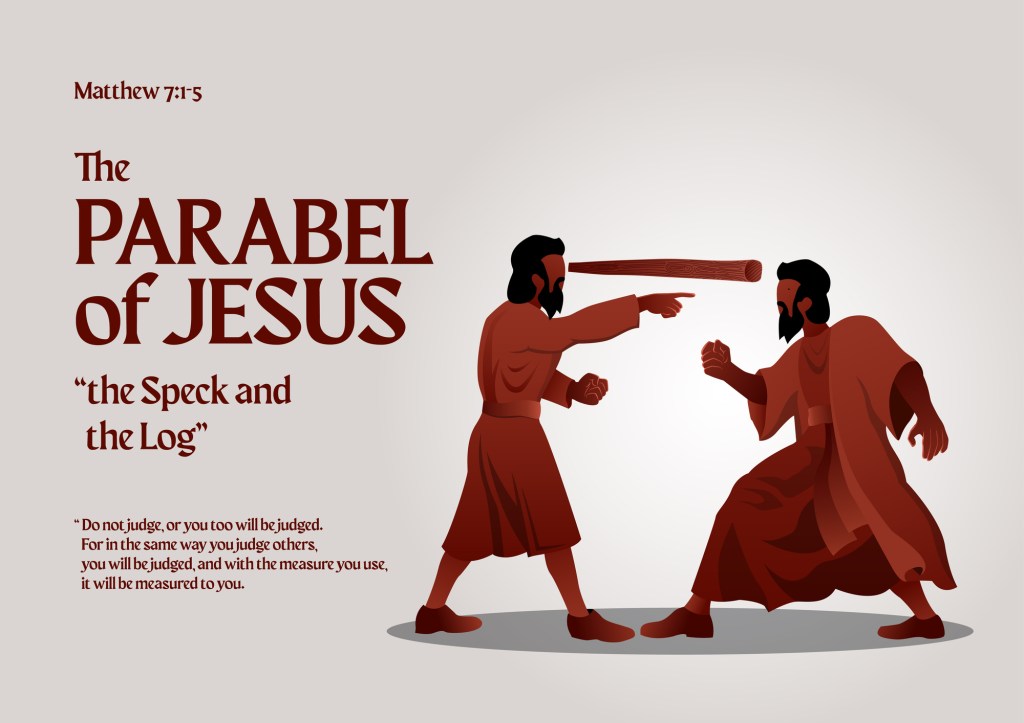
I have written previously about the parable of the log in a person’s eye who sees a speck of saw dust in another person’s eye. (See 8 Important Points about Judging and Judgment) Jesus says that we need to be careful about focusing on the specks in others’ eyes because of the logs in our own eyes. (Matthew 7:1-5)

Jesus is expressly talking about judging others, but the implications are much larger than that. They are about loving others, especially our brothers and sisters in the Lord. It is also about our posture to the world (those who do not know God in Christ, who gave Himself up for us).

We might be tempted to read what Jesus said and walk away thinking that we should not judge other people. That isn’t quite what Jesus says. Jesus says be careful in the way you judge others because the way you judge others is the way you will be judged. (Matt. 7:1-12)

We can’t get away from making judgments, which is nothing more, really, than the conclusions we reach based on what we know. We make judgments about innumerable things every day.

This is also not about Judgment (capital J). Only God has the authority to judge people, and God alone is a true Judge who can weigh all the facts accurately and completely. God alone knows our thoughts and our hearts. We can only judge by appearances, and we judge only from ground level.

When we see a speck in our brother’s eye, the parable should cause us to consider the logs in our own eyes, first. It’s a matter of perspective. What seems like a speck in someone else’s eye appears like a log when that speck is in my eye. Even so, humans have an unusual capacity to get used to those “logs” and forget they even exist.

One point of this parable is that we need to be dealing with our own sin as a matter of first priority. If sin is discovered in our brother, that discovery should cause us to consider first our own sin. I believe this is a fair reading of what Jesus is saying.

Jesus also does not tell us to leave our brother alone with a speck in his eye. Rather, he tells us to be considerate as we determine what to do about. We need to start by considering our own sin sinned (missing the mark) in our own lives. Then we need to approach our brother in the right attitude of heart, with empathy, realizing that we are not any better then our brother who’s speck we have observed.

Today, I have read what Paul says in Galatians 6:1-2 in my daily reading, and the parable about the log and the speck comes rushing back to me. I realize that Paul’s admonition in Galatians 6:1-2 harmonizes with what Jesus was taught his disciples in this parable:

“Brothers and sisters, if a person is discovered in some sin, you who are spiritual restore such a person in a spirit of gentleness. Pay close attention to yourselves, so that you are not tempted too. Carry one another’s burdens, and in this way you will fulfill the law of Christ.”

Galatians 6:1-2 NET (Emphasis added)

I previously observed that we must be in relationship with others to do what Jesus has said (judge rightly). We should not be approaching anyone about a speck in their eye if we do not do it from the perspective of loving relationship (as brothers and sisters). We have to do this in the right relationship, or we will not do it right.


Continue reading “How Do I Help My Brother with a Speck In His Eye When I Have a Log In My Own Eye? Judging Rightly” →

The Way of Righteousness and the Holy Command: an Introduction

We escape the corruption of the world by the way of righteousness and the sacred command. But, what if we lose the way and don’t know the sacred commandment?


Have you ever read a passage in the Bible that weighed heavily on you? A verse that caught you up short?  A verse that gave you great concern? A verse that made you question your own salvation?

I assume we all (who take the Bible seriously) have experienced that. I believe the Holy Spirit interacts with us as we read the Bible (which the writer of Hebrews says is “living and active”). Sometimes we are encouraged, and sometimes the light of scripture shines into the recesses of our hearts and exposes things that bother us. (And so they should!)

Indeed, I believe that this is one of the great benefits of reading Scripture on a regular basis. God talks to us through His revealed Word. He interacts with us in ways that get to the core of our being … if we let Him … to teach us, to convict us, to correct us, and to instruct us in righteousness. (2 Timothy 3:16)

I recently read the following verses in my daily Bible reading:

If they have escaped the corruption of the world by knowing our Lord and Savior Jesus Christ and are again entangled in it and are overcome, they are worse off at the end than they were at the beginning. It would have been better for them not to have known the way of righteousness, than to have known it and then to turn their backs on the sacred command that was passed on to them.

2 Peter 2:20-21

Peter goes on to quote two “proverbs” about: 1) a dog that returns to its vomit (quoting Proverbs 26:11); and 2) a sow that is washed that returns to wallowing in the mud.

These examples seem to be clear illustrations of people who, having been cleansed from sin, return to their sin. If you have ever returned to the sin you have walked away from, you know the angst that reading this verse can bring.

Peter says it is better that we never know Jesus than to have known him and walked away! People are worse off not to have known the “way of righteousness” than to have known it and turned their backs on the “sacred command” (or holy commandment).

I am convicted when I read these things. I sometimes despair of the sin I tend to repeat. I have often felt like a slave to certain sin, and I been anxious for my own salvation when I read a verse like this.

I think we should feel the full weight of verses like this. God is clearly interested in the fruit of our lives. A bad tree cannot produce good fruit. If we are tapping into the wrong tree, nothing we do can produce good fruit. The problem isn’t in the fruit; the problem is the source.

Continue reading “The Way of Righteousness and the Holy Command: an Introduction” →

The Way of Righteousness and the Holy Command: The Way

We escape the corruption of the world by the way of righteousness and the sacred command. But, what if we lose the way and don’t know the sacred commandment?


I started this short series focusing on the second epistle of Peter where Peter warns his readers about false prophets with “eyes full of adultery”, greed, and depravity who are slaves to their own sin. These people seduce the unstable and entice others by appealing to the lustful desires of the flesh. Peter says,

It would have been better for them not to have known the way of righteousness, than to have known it and then to turn their backs on the sacred command that was passed on to them.

These are fearful words of warning. Anyone who might feel enslaved to sin has likely felt angst when reading this words.

In the previous article, I note that the actions Peter describes are the fruit of people who have “known the way of righteousness” and the “sacred [holy] command” and have turned their backs and walked away. The fruits are the symptoms, not the cause.

The important thing for us, therefore, is to know the way of righteousness and the holy commandment, and not to turn our backs on them! In this follow up to that introductory article, I will focus on the way of righteousness.

Continue reading “The Way of Righteousness and the Holy Command: The Way” →