The Story of Abraham and Isaac Revisited: Introduction

God tests Abraham’s faith by asking him to sacrifice his son. Abraham in faith goes ahead but God intervenes to provide a ram for sacrifice instead.
Genesis 22.

Everyone in the western world has heard of the story of Abraham and Isaac. It is iconic. Even people who didn’t hear the story in Sunday school as a child have heard the story somewhere along the way in their lives. The story is a commonly referenced in literature and art, and often with negative connotations in our modern world.

Dare I say that most people have a shallow understanding of the story – even Christians? I would include myself in that category for most of my life, though I had the fortune of hearing the story and considering it for the first time, not in Sunday school, but in a college World Religion class.

The “fortune” of hearing the story for the first time in the context of an academic environment is that that I approached it first intellectually with an open mind. I approached it critically – not as in being critical of it, but as in being thoughtful about it.

Those discussions have stuck with me. We learned about the Mesopotamian world in which the story arose, including the theory that monotheism was born in that time and region (not necessarily of Hebrew origin).

I have since spent many hours thinking and writing about those things I first learned in that class about the Ancient Near Eastern world in which Abraham would have lived. I have learned other things as well, such as the apparently universal practice of child sacrifice to the gods that dominated the religious thought in that culture.

The story of Abraham and Isaac must be read in that context to understand how it fits in. We learn through the story that the God of Abraham was radically different from the gods of the Ancient Near East culture in which Abraham lived.

In Abraham’s world, every people group and community had their own gods. While each community of people had their own gods, and each god was different from the next, one thing those gods all had in common: they were unpredictable, arbitrary and capricious.

Everyone Abraham knew assumed that the gods had to be appeased, and appeasing the gods often meant sacrificing your own children to them if necessary. Abraham would not have recoiled in moral horror at the thought that God was insisting he sacrifice his son. As difficult as it might be, you didn’t argue with the gods.

We tend to focus only on Abraham’s faith, as if that is the sum and substance of the story. Faith is the Sunday school lesson, but it’s only a shallow understanding if we see nothing else in the story. Faith is merely the beginning of understanding:

“And without faith it is impossible to please him, for whoever would draw near to God must believe that he exists and that he rewards those who seek him.”

Hebrews 11:6

Without Abraham’s faith in God, he would not have learned that God was different than other gods. Abraham’s faith was the key to learning that God was different, and Abraham’s discovery of the unique character of God is the real gem of this story – that He is not unpredictable, arbitrary and capricious like the other gods.

Abraham was a man of faith. He believed God exists, and he believed that his God was the God of gods. He believed that God could be approached; God could be trusted; and God rewards those who seek Him. Abraham was a man who sought to draw near to God, but that is only the beginning.

In the story, we see that Abraham expected God to be like the other gods he knew, but we also see that Abraham sensed something different about God. God used Abraham’s cultural understanding of the gods to show Abraham that He was different.

God is not arbitrary and capricious. He has plans for His creation. He desires to bless His creation. He desires relationship with His creation, and we (like Abraham) can engage God in that purpose by faith – by trust in God’s benevolence and good intentions toward us.

This understanding of the story will become more evident as we dig deeper in the next article: The Story of Abraham and Isaac Revisited: Here I Am. While the Sunday School version is all about Abraham’s faith, and the secular, cynical version fixates of the savage notion that a god might demand child sacrifice, the real gem of the story is that God is not like the other gods Abraham knew.


How Will the World Know You?

How will the world know you?

Will the world know you by your family, your ancestors and the legacy that comes after you?

Will the world know you by your wealth, your fiscal responsibility and ability to turn a profit?

Will the world know you by your great intellect, by the diplomas on your wall, the articles you have written? and the collection of books on your shelf you have read?

Will the world know you by your creativity, your command of a color palette, graceful and unique strokes of the brush and eye for design?

Will the world know you by your fame, by the number of people who know your name?

Will the world know you by your physical prowess, your ability to come through in the clutch, and your wins?

Will the world know you by your command of the English language, your artful turn of a phrase and your ability to move people with the written word?

Will the world know you by the instrument you play, the finesse of notes and rhythms, and the virtuosity with which you play your instrument?

Will the world know you by your professionalism, by your reputation for excellence in your field, and the accomplishments you have achieved?

Will the world know you by your stunning good looks, your impeccable fashion taste, and the company of beautiful people you keep?

Will the world know you by your eloquence, the depth and richness of your voice and your ability to command the attention of a crowd?

Will the world know you by your scientific mind, your understanding of technical details, and ability to apply scientific method and sound logic?

Will the world know you by your leadership, the number of people who follow you and your influence?

Will the world know you by the music you compose, the divine harmonies and intricate melodies you weave together in symphonic wonder?

Will the world know you by your politics, the platforms you have championed, and the dedication to your party allegiances?

Will the world know you by the roles you have played, the tears you have coaxed from fawning audiences, and the adoring fans you have?

Will the world know you by your architecture, by your complex end subtle designs, by the magnificence of the structures created from your drawings?

Will the world know you by your dedication, reliability and number of sick days you did not take?

How will the world know you?

In the end, we all go down to the grave, and the world is passing away. When an Ode to a Grecian Urn fades from collective memory, Jesus said we will be known as his disciples simply by our love for each other.

“Love one another. As I have loved you, so you must love one another. By this everyone will know that you are my disciples, if you love one another.

John 13:34-35

“We know that we have passed from death to life,  because we love each other.  Anyone who does not love remains in death.”

1 John 3:14

“Be devoted to one another in brotherly love.  Outdo yourselves in honoring one another.”

Romans 12:10

“Love never fails. But where there are prophecies, they will cease; where there are tongues, they will be stilled; where there is knowledge, it will pass away….” And now these three remain: faith, hope and love. But the greatest of these is love. “

1 Corinthians 13:8,13

Who Is God? How Can We Approach Him? What Do the Answers Mean for Us Today?

Many things to which we devote our energies are good, but they become idols when they become our “ultimate things”.

Who will approach God? Who is the King of Glory? These are questions David poses in Psalm 24, one of the Messianic Psalms.

He begins with recognizing who God is. God is the creator of everything there is, and He possesses and has authority over all that He created.

The earth is the Lord’s, and everything in it,
    the world, and all who live in it;
for he founded it on the seas
    and established it on the waters.

Psalm 24:1-2

Though the nations all around David had their own gods in various images and likenesses, David recognizes that there is only one, creator God. One God made the heavens and the earth, and there is no god like Him. In that context he asks the question:

Who may ascend the mountain of the Lord?
    Who may stand in his holy place?

Psalm 24:3

How does one approach a God like that? How do created beings, such as ourselves, approach the God who created us? David understands that we can only approach such a God on His own terms:

The one who has clean hands and a pure heart,
    who does not trust in an idol
    or swear by a false god.

Psalm 24:4

Only a person with clean hands and a pure heart can approach a God like that. Only a person who trusts in such a God, alone, can approach Him. Only a person who understands truth and is free of deceit.

Can any of us say that we meet these conditions?

If we think honestly on these things, we have to realize that we don’t. The truth is that no one is righteous, not even one person. (Psalm 14:3; Psalm 53:3; and Romans 3:10)

Think of David, the very person who wrote this Psalm. He didn’t meet those conditions, and he certainly knew it. He is one of the most flawed people of all the people of faith in the Bible. He knew where he stood with God.

The problem: we want clean hands and a pure hear; we want to trust in God alone, and we want to hold to nothing but the truth. The truth is, though, that no one meets these conditions. No one can approach a holy God!


Yet, this Psalm exalts in the anticipation of connecting with such a God – a God who made and possesses the universe, a God who can only be approached with cleans hands, a pure heart, with singleness of devotion and in the fullness of truth. This is because David anticipates something. And this is where the Psalm shifts:

They will receive blessing from the Lord
    and vindication from God their Savior.
Such is the generation of those who seek him,
    who seek your face, God of Jacob.

Psalm 24:5-6

The resolution to the problem is that we do not approach God: He approaches us. We must receive from God his blessing and vindication. It is nothing we can ascend to, nothing we can achieve.

God knows this well, and He provided a way. As with Abraham for whom God provided a ram caught in the thicket to sacrifice in place of his son, Isaac, God has provided for us what is necessary to clear the way for us to receive Him. Through Christ, we are made holy, clean and new.[i]

The Psalm is considered “Messianic” because David anticipates our need for God to come to us, to provide for us. He says:

Lift up your heads, you gates;
    be lifted up, you ancient doors,
    that the King of glory may come in.

Psalm 24:7

Thus, David exalts not in the prospect that someone might ascend to heaven, but in the anticipation that God will descend to us. God meets us where we are. But there is more to this than God simply meeting us where we are: we need to be ready to receive Him.

Before the church service that inspires this article this morning, I read an article in my newsfeed: How the Capitol attacks helped spread Christian nationalism in the extreme right, from the Religious News Service. It may seem like a strange tie in to Psalm 24, but I hope you will stick with me to see the connection.

Continue reading “Who Is God? How Can We Approach Him? What Do the Answers Mean for Us Today?”

What It Means to Follow Jesus in Babylon

Live your lives, Increase and multiply. Seek the welfare of this world, BUT ALWAYS REMEMBER that this world is passing away

I tried to set the stage for what it means to follow Jesus in Babylon with a prior post: God’s Ways: a Primer for What It Means to Follow Jesus in Babylon. It is a kind of running start – a view from 40,000 feet. The purposes of God establish the context for understanding how we follow Jesus in Babylon.

Jesus, of course, did not live in Babylon during the 30-some years he walked the earth. I am speaking figuratively here. Jesus urged people to follow him, to live as he did and to “walk” as he walked – to be imitators of Jesus as he was an imitator of God the Father. We follow Jesus wherever we are.

Most people reading this blog don’t live in Babylon either, as in the ancient city. Rather, Babylon is symbolic of our lives in this world. Just as the exiles found themselves living as foreign people in a foreign land filled with foreign gods, followers of Jesus today are aliens and strangers in this world living among people who do not bow down to our God.

When Jeremiah wrote to the Jewish exiles in Babylon right after they were taken captive, right after they lost everything (their homes, their lives as they knew them, the Temple around which their community was organized), his words would have been difficult to receive.

“Thus says the Lord of hosts, the God of Israel, to all the exiles whom I have sent into exile from Jerusalem to Babylon….”

Jer. 29:4

That God “sent” them into exile would have been a painful reminder of all the warnings of the prophets leading up to the final siege of Jerusalem, captivity, and long march to Babylon. Jeremiah had their attention, though. The unthinkable that Jeremiah had long been predicting actually happened.

In that context, this is what he said:

“Build houses and live in them; plant gardens and eat their produce. Take wives and have sons and daughters; take wives for your sons, and give your daughters in marriage, that they may bear sons and daughters; multiply there, and do not decrease. But seek the welfare of the city where I have sent you into exile, and pray to the Lord on its behalf, for in its welfare you will find your welfare.”

eremiah 29:5-10

I don’t think we can emphasize enough the timing of these words: this was the very beginning of the exile. They just lost everything. They just got there. Their future was uncertain. Though they had some hope of returning to their homeland (because the prophets who warned them of the exile also predicted their return), their hope was faint at this point. 

I assume that most of the people reading this blog are not exiles, though many hundreds of thousands of people are refugees in this modern world. Even those of us who are not refugees are not “of this world” if we belong

In the rest of this blog, I will relate those words Jeremiah wrote to the exiled Jews in ancient Babylon to our lives in our modern “Babylon” today, and I will add in the warning, and the encouragement, that Jeremiah gave in the letter that are also instructive to us today. I believe Jeremiah’s words of instruction are how we should follow Jesus in Babylon.

Continue reading “What It Means to Follow Jesus in Babylon”

Clearing the Rubble of Hume in the Making of an “Unapologetic” Argument for God

Hume’s argument against miracles seems to be more of an exercise in satire than a sincere exercise in reasoning.

I have been trying to clear the way for an “unapologetic” argument for God. I am four articles in, and still making me way to the beginning. Standing in the way as I move forward is Hume’s standard of proof for miracles.

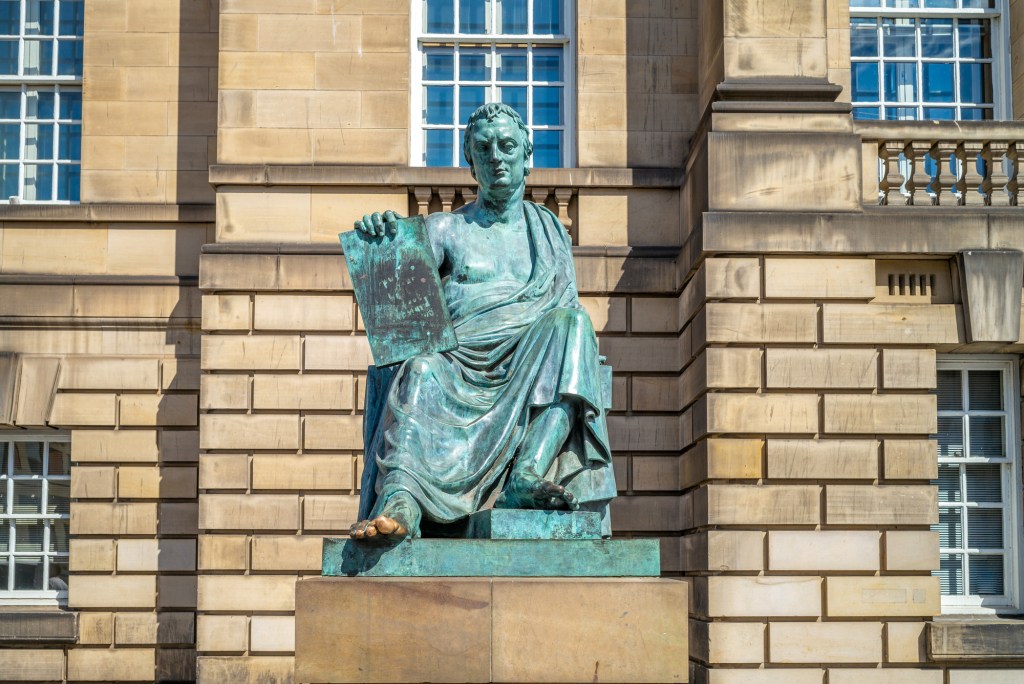
David Hume has had a profound influence on Western thought in the promotion of the Enlightenment view, which values human reason as the supreme measuring stick. Hume’s argument against miracles has been viewed as a gold standard among proofs that Christianity is not credible, especially to the extent that Christianity stands on the foundation of a miraculous event – the resurrection of Jesus.

Hume does not hide his antipathy for Christianity.[1] He calls the “Christian religion” a doctrine “so little worthy of a serious refutation … founded merely in the testimony of the apostles”. He labels belief in Christianity “arrogant bigotry and superstition”.

Hume speaks of the “greediness” with which “miraculous accounts” are received. He characterizes the “religionist” as “an enthusiast who sees no reality”, whose vanity is excited by strong temptations and self-interest to promote narratives he knows to be false for what he deems to be a “holy cause”. Hume accuses religionists of renouncing judgment by principle and losing grip on judgment by “passion and a heated imagination”.

Hume blames the popularity of religion on a “strong propensity of mankind to the extraordinary and the marvellous”. Hume’s disdain carries over from his view of “the generality of mankind” emerging from “ignorant and barbarous nations” who he says are fools … industrious in propagating the imposture” of the “supernatural and marvellous”, the “grossest delusions”, and “delusive prophecies”.

Hume rails on the religions “of ancient Rome, of Turkey, of Siam, and of China” equally. He lumps together the testimony of “a few barbarous Arabians” about Mahomet with “Titus Livius, Plutarch, Tacitus, and… all the authors and witnesses, Grecian, Chinese, and Roman Catholic, who have related any miracle in their particular religion”.

Me thinks he doth protest too much.

The standard Hume created to determine the veracity and credibility of a miraculous account contains the poison of his passionate convictions – a passion that smacks of the same kind of bias he accuses the “religionist” of committing. Yet, that standard has adherents today, perhaps because he reduces it to mathematical proportions that have the appearance of sacred science. Hume says,

“A hundred instances or experiments on one side, and fifty on another, afford a doubtful expectation of any event; though a hundred uniform experiments, with only one that is contradictory, reasonably beget a pretty strong degree of assurance. In all cases, we must balance the opposite experiments, where they are opposite, and deduct the smaller number from the greater, in order to know the exact force of the superior evidence.”

He acknowledges the importance of eyewitness testimony, but he imposes a standard on it that diminishes the value of any eyewitness testimony that contradicts widely established human experience. This seems reasonable on its face. “Marvelous” assertions are suspect; miraculous ones are even more suspect.

I think most of us can “go there” with him. On miracles, Hume says.

“A miracle is a violation of the laws of nature; and as a firm and unalterable experience has established these laws, the proof against a miracle, from the very nature of the fact, is as entire as any argument from experience can possibly be imagined.”

In one sense, Hume is merely acknowledging the nature of a miracle: it is a miracle that goes against (or seems to go against) the laws of nature that are commonly recognized and the weight of common experience. Nothing would be considered a miracle that was common to the experience of people, even if that experience is relatively uncommon among human experience. He reasonably says,

“There must, therefore, be a uniform experience against every miraculous event, otherwise the event would not merit that appellation.”

Hume, though, is not content to relegate miracles to the rarity they are by definition. He proceeds to define them out of the realm of possibility:  

“And as an uniform experience amounts to a proof, there is here a direct and full proof, from the nature of the fact, against the existence of any miracle; nor can such a proof be destroyed, or the miracle rendered credible, but by an opposite proof, which is superior.”

Perhaps, wanting to appear open-minded, Hume allows for some proof that might establish a miracle. The proof of a miracle, Hume says, must so weighty “that its falsehood would be more miraculous, than the fact, which it endeavours [sic] to establish”.

Even then, Hume says, such counter-balancing evidence only levels the scales; it doesn’t make the factual assertion of the miracle more likely than not (and rejection of the assertion of a miracle would be justified either way).


Hume says, the mere testimony that a miracle occurred should be dismissed out of hand unless the falsehood of the assertion would require believing the miraculous, itself.

Hume seems to assume the possibility of such corroborative evidence, but a simple application of math belies the lack of substance he saw in anything miraculous. Nil plus nil equals nil.

As Hume’s approach is a mathematical one, we can see by the application of math and the value Hume has given to the miraculous the impossibility of establishing proof of a miracle on Hume’s position. The likelihood of proof is nil.

Indeed, he sets his bar so high and makes the requisite proof so onerous that a miracle would be required to prove a miracle. Lest there be any doubt about the meaninglessness of Hume’s standard, he admits:

“I beg the limitations here made may be remarked, when I say, that a miracle can never be proved….”

Hume is saying that miracles cannot be proven by any amount or kind of evidence.

For this reason, Hume’s argument against miracles seems (to me) to be more of an exercise in satire than a sincere exercise in reasoning. I am surprised, therefore, that we take him at all seriously. To give further illustration and to remove all doubt about his pretense, Hume seems to beg the question in the following example:

“But suppose, that all the historians who treat of England, should agree, that, on the first of January 1600, Queen Elizabeth died; that both before and after her death she was seen by her physicians and the whole court, as is usual with persons of her rank; that her successor was acknowledged and proclaimed by the parliament; and that, after being interred a month, she again appeared, resumed the throne, and governed England for three years: I must confess that I should be surprized [sic] at the concurrence of so many odd circumstances, but should not have the least inclination to believe so miraculous an event.”

The fact that people still take him seriously, though the blunt force of his conviction seems stronger than his argument, is one reason I address him here.

Continue reading “Clearing the Rubble of Hume in the Making of an “Unapologetic” Argument for God”