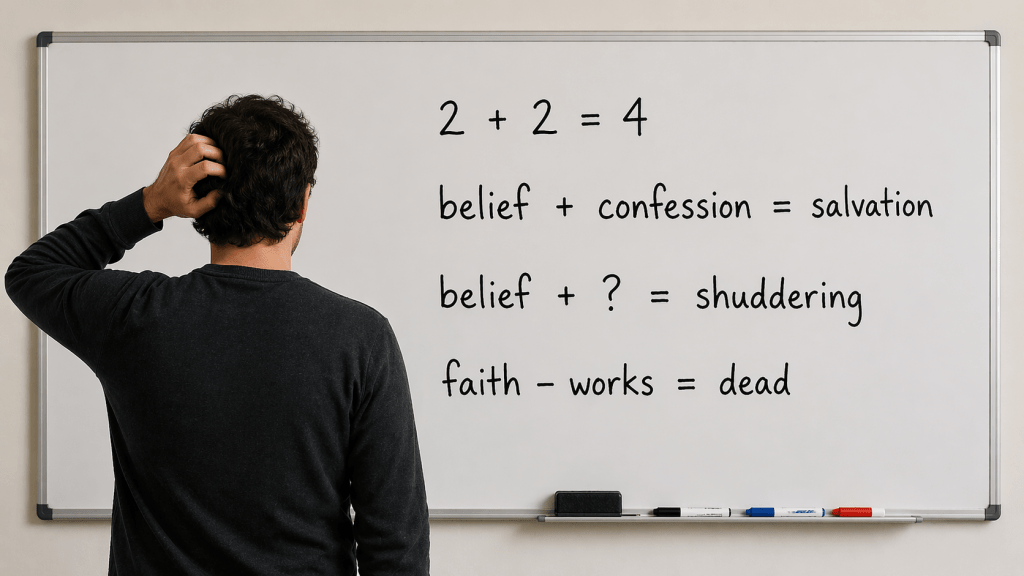
Is Merely Believing In Jesus Enough?

Jesus said that many people will say to him on the day of judgment, “Lord, Lord”, but he will tell them that he never knew them.


I follow a daily Bible reading plan every year. In most years I read through the Bible from beginning to end, but this year I am focusing on the New Testament only. Today, I came across this rather innocuous verse that prompts my thoughts:

Now when he was in Jerusalem at the Passover Feast, many believed in his name when they saw the signs that he was doing. But Jesus on his part did not entrust himself to them, because he knew all people. 

John 2:23-24 ESV‬

Though I was raised Catholic, a combination of evangelical people who shared the Gospel with me led me to a real, authentic belief in God and surrender to Jesus “as my Lord and Savior” (as the saying goes). I can’t say that I didn’t believe in God before that time (intellectually), but God didn’t mean anything to me before then. I had no relationship to God, and the existence of God carried no relevance in my life.

As a young Christian, I put great weight on simply believing in Jesus, which was what was emphasized to me. It seemed to me that believing in Jesus was all a person needed to do to be saved, and everyone who believed in Jesus was OK. I think that is still fundamentally true, but it is not the whole truth.

I was grateful, of course. Belief in Jesus changed my life! I recognized the changes deep within me, which I believe is indicative of being born again. My eyes were opened, and now I could see!

Many years later, however, it doesn’t seem quite so simple. Examples of people who go to church, and claim to be Christian, but who don’t act anything like Jesus, are legion. This hypocrisy among the people who call themselves Christian is a common reason why people say they don’t go to church any more. Many people don’t live what they believe.

Of course, we are all hypocrites to some extent. None of us live up to God’s standard. (Nor do we even live up to our own, lower standards, if we are being completely honest.)

There are differences in degrees. Some people are more like Jesus than others. The Bible acknowledges that we must all grow in our knowledge of God, and the Bible recognizes that sanctification is a process.

In my own life, I experienced some relatively instantaneous changes in me, especially in my attitudes, in what I was drawn to, and in my understanding (like a light bulb turning on). I also continued to struggle with habits of thought and action, some of which dog me still to this day.

We want simple formulas. Romans 10:9 says, “[I]f you confess with your mouth that Jesus is Lord and believe in your heart that God raised him from the dead, you will be saved.” ( ESV) This literally says that believing in our hearts and confessing with our mouths that Jesus is Lord is all that is necessary for salvation.

I believe in that “formula” with all my heart. BUT – at the same time – it is is not quite so simple. Jesus said, “Many will say to me, “Lord! Lord!”

We might have a tendency to view the “Romans Road” as a kind of magic formula that makes a person a Christian, but it doesn’t exactly work like that. Anyone can mouth those words with no change in their inner reality. It’s not enough to confess with your mouth, a person must believe in his/her heart.

Anyone can confess that “Jesus is Lord”. The confession must come from a real and authentic belief in the heart that results in a change to be assured it has real substance.

This change is not something we can manufacture. It occurs organically from the inside out. The change may not even be immediately noticeable. This is because the change results from God working inside us, not by our efforts to conform, but by His regenerative work in us. It may take a while to bear fruit on the outside.

People look at the outward appearance (confession), but God judges the heart. (1 Samuel 16:7) People may claim to be Christian, especially in the United States where being Christian can provide social, political, or other capital, but that doesn’t mean everyone who claims to be a Christian is an authentic believer and follower of Jesus.

Jesus said that many people will say to him on the day of judgment, “Lord, Lord”, but he will tell them that he never knew them. (Matt. 7:22) Jesus said that some of these people will even prophesy, cast out demons, and perform miracles in his name, but, they are not true believers. (Matt. 7:23) (If you want to hear the personal stories of people who recognize that they were once “false converts”, I am providing a link to their stories here.)

Continue reading “Is Merely Believing In Jesus Enough?”

Fruit, Love and False Prophets

It’s a sad state of affairs that Christians today may be more well known for their fighting with each other than for their love for each other. 


Someone commented recently on Facebook that some of the harshest critics of Christians on social media are Christians. (Assuming that anyone who self-identifies as a Christian is a Christian.) This reminded me of what Jesus said to his disciples after Judas left the last supper to betray him.

When he was gone, Jesus said, “Now the Son of Man is glorified and God is glorified in him. If God is glorified in him, God will glorify the Son in himself, and will glorify him at once.
“My children, I will be with you only a little longer. You will look for me, and just as I told the Jews, so I tell you now: Where I am going, you cannot come.
A new command I give you: Love one another. As I have loved you, so you must love one another. By this everyone will know that you are my disciples, if you love one another.”

John 13:31-35

“Now” the Son of Man is glorified, Jesus said. He was lifted up, but it wasn’t the kind of “glory” anyone expected. It was the glory of Jesus being obedient to the Father and accomplishing all that intended.

Jesus knew he was leaving, and (if we read between the lines), he knew the disciples left in front of him would struggle at first. What was the key instruction in this time? What was the one thing he gave them to hold onto?

Love one another. As I have loved you, so you must love one another. By this everyone will know that you are my disciples, if you love one another.”

It’s a sad state of affairs that Christians today may be more well known for their fighting with each other than for their love for each other. 

People will say that the doctrine is important and that Paul and the early church were also concerned about doctrine. This is true, of course.

It also occurs to me that the 1st century Christians lived in a world that was predominantly non-Christian. They were a very small minority. The disagreements among Christians likely went completely unnoticed by the world at large.

Christians are in the majority in the United States today, so negativity from Christians toward Christians in the United states is highly noticeable. With so many people who call themselves Christian, the fighting is going to get noticed.

A person might say further that love is tempered by truth. Love that does not recognize and confirm to truth is not love. Right? I cannot help but thinking, however, that such a statement sounds particularly like something a Pharisee may have said in the 1st century.

Isn’t it a shame that, with so many Christians in this country, we do not shine like that proverbial city on a hill? And, by shine, I mean with the love of God for each other (and for others – and even for our enemies).

Looking back at the first Christian leaders who had disagreements, I see that they spent time in prayer – together with each other. They worked to find common ground, and they agreed to disagree on peripheral things. They did not bicker publicly among themselves.

We see many examples of this in the Book of Acts and the epistles that make up the New Testament. Early Christians did not agree on everything, but they agreed on essentials, and they allowed room for disagreement.

Early Christians did take a strong stand against heresy, but we can’t just everything on which we disagree matters of heresy. Heretical doctrines in the 1st Century, like Gnosticism, have their 21st Century counterparts. We call certain clear departures from orthodox Christianity heretical, like the Jehovah Witnesses and Mormons, but the fighting my friend on Facebook was sad about is fighting among Christians who are somewhere in the range of Christian “orthodoxy”.

That is the rub.

Continue reading “Fruit, Love and False Prophets”

Why Should We Not Want to Make a Deal With God?

If you are bargaining with God for some immediate relief in your life, your view of God is too small.

Photo by Peter Avildsen

I have been reading through parts of Exodus. Today, I continued reading about Moses and Pharaoh. Pharaoh hardened his heart to the plea of Moses to let the Israelites travel three days into the wilderness to meet with God, and Pharaoh did not take the signs Moses performed to heart.

Up to this point, Pharaoh’s magicians matched all the signs Moses and Aaron performed, so apparently didn’t take those signs seriously. Aaron threw his staff to the ground, and the magicians did the same. It didn’t matter that Aaron’s staff swallowed up the magicians’ staffs. The magicians matched Moses and Aaron sign for sign, and Pharaoh paid no heed to them.

Moses turned the water of the Nile to blood. Pharaoh’s magicians did the same, “and Pharaoh’s heart became hard”, it says. (Ex. 7:22) He turned and walked away into his palace, and he didn’t take it to heart.

Aaron stretched out his arm with his staff and caused frogs to emerge all over the land. The magicians did the same, and Pharaoh was not moved, at least not right away.

Later, Pharaoh asked Moses and Aaron to “Pray to the Lord to take the frogs away…, and I will let your people go….” (Ex 8:8) Moses did it, “But when Pharaoh saw that there was relief, he hardened his heart and would not listen….” (Ex. 8:15)

Moses responded by having Aaron summon a plague of gnats. This time the magicians could not duplicate what Moses did, and they said to Pharaoh, “This is the finger of God.” But, “Pharaoh’s heart was hard….” (Ex. 19)

Notably, the Pharaoh’s heart became hard, or he hardened his heart, after the previous displays. After the plague of flies, however, the Pharaoh’s heart was hard.

Pharaoh’s heart was already hard at this point. He had been hardening his heart all along, but Pharaoh’s heart was already hard by the time Moses and Aaron summoned the plague of flies and the plague of flies “ruined the land”.


Even though Pharaoh’s heart was hard at that point, “Pharaoh summoned Moses and Aaron and said, ‘Go, sacrifice to your God here in the land.'” (Ex. 8:25)

Sometimes even people with hard hearts toward God will have moments in which they seem to believe, or seem to repent, but there is no heart change. They desire to be delivered from their dire circumstances, but nothing more. It isn’t really a true change of heart, and it doesn’t last.

Moses insisted that the people be allowed to leave the land and go into the wilderness, but “Pharaoh said, ‘I will let you go to offer sacrifices to the Lord your God in the wilderness, but you must not go very far. Now pray for me.”’ (Ex. 8:28)

People often make deals with God. People bargain for relief from the pain or difficulty that brings them finally to God as a last resort, but they turn to God out of desperation, and they don’t really mean to keep their part of the bargain. When people are “forced” to the point of praying to God as a last resort, they may not come willingly, and their hearts many not be changed if relief is all they want.

This was the case with Pharaoh:

“Then Moses left Pharaoh and prayed to the Lord, and the Lord did what Moses asked. The flies left Pharaoh and his officials and his people; not a fly remained. But this time also Pharaoh hardened his heart and would not let the people go.” (Ex. 8:‬30‭-‬32)

Pharaoh didn’t understand that the God of Moses and Aaron is the God who gives all people life and breath. He saw “their” God as a means to an end: a possible solution to the immediate relief he desired. Pharaoh didn’t perceive God as his God too!

We are often tempted in the same way to view the Bible, church, and God Himself as a means to our owns temporary ends. We aren’t looking down the road. We don’t appreciate that the universe, this earth, our world and our very beings are wholly dependent on God!

Once we get the relief we want from the immediate difficulty we are facing, it’s easy for us to harden our hearts again. Once we are out of trouble, we resort back to a hard heart and a stiff neck. There is no lasting change.

This is a human tendency we all have. All people can be “religious” at times. Many people go to church on Sunday, or once in a while, maybe on special holidays, but they live in Egypt the rest of the time.

We can be religious in the same way that we might carry a lucky rabbit’s foot or consult a medium. We want something. We want good fortune and good health, but we don’t want to change.

God should not have to make a deal with you. If you are bargaining with God for some immediate relief in your life, your view of God is too small, and you are missing the mark!

Continue reading “Why Should We Not Want to Make a Deal With God?”

The Critical Difference between the Gifts of the Holy Spirit and the Fruit of the Holy Spirit

The Corinthians had spiritual gifts and were using them, but they were not exhibiting the fruit of the Holy Spirit.


I wrote recently about the way Paul dealt with the messiness of the church in Corinth – Why did Paul Go to Corinth with a Demonstration of the Spirit’s Power? Paul observed that some people want signs before they will believe, and other people want “wisdom” (to be persuaded by intellectual argument). The Greeks fell into the second camp.

I have been reading 1 Corinthians in light of the recent happenings at Asbury University. Some people call it a revival, and other people question whether God was even involved. Perhaps, both ends of the spectrum are not quite right. Some people are quick to think that signs are evidence of God’s stamp of approval, and other people are quick to box God out of anything that doesn’t fit their theology.

In a previous article, I shared what I see in 1 Corinthians that is relevant to the subject. Because Greeks desired to be persuaded by argumentation, Paul came to them with nothing more than the simplest Christian doctrine (“Christ and him crucified”) in order to rely on a “demonstration of the Spirit’s power”.

If Greeks demanded wisdom, and Jews demanded signs, I am left to conclude that God doesn’t give us what we demand. (Though, He actually gives us both and much more if we are willing to acknowledge Him.) He just doesn’t dance to our music:

“To what can I compare this generation? They are like children sitting in the marketplaces and calling out to others:

“‘We played the pipe for you,
    and you did not dance;
we sang a dirge,
    and you did not mourn.’

Matthew 11:16-17

The Pharisees completely missed God incarnate standing before them because He didn’t meet their expectations. He healed people on the Sabbath; He hung out with sinners; He didn’t come from Bethlehem (or so they thought); He challenged them, instead of affirming them, and their theology was too rigid to accept Him.

Some people observing the Asbury phenomenon concluded it couldn’t be a move of God because: there was no preaching (though there was); it happened outside of church; the denomination of the University ordains women; LGBTQ students may have led worship; and people laughed and spoke in tongues.

I heard/read people say all these things, but the lack of preaching was one of the most common critiques. Protestants in particular put the emphasis on preaching. Worship services focus on the preaching.

I even hear people describe the Great Commission as a command to preach the Gospel to the ends of the earth. I have caught myself saying that also, but the Great Commission doesn’t focus on preaching.

“All authority in heaven and on earth has been given to me. Therefore go and make disciples of all nations, baptizing them in the name of the Father and of the Son and of the Holy Spirit, and teaching them to obey everything I have commanded you.”

Matthew 28:16-20

(Emphasis added) Teaching (not preaching) is an element of the Great Commission, but the emphasis is on making disciples. Preaching can include teaching, but teaching is not done only from a pulpit. Making disciples involves mentorship, doing life together in community, and much more than sermonizing.

The Greeks put so much emphasis on wisdom, oratory, argumentation, and eloquent speech that Paul deemphasized it. Even good things can become issues (even idols) for us when we overemphasize them, especially to the detriment of other important things.

In Paul’s first letter to the Corinthians, he says he went to Corinth with the strategy to refrain from preaching anything other than Christ and him crucified – the most fundamental of all Christian doctrines. Instead of relying on great preaching, he came to them with a “demonstration of the Spirit’s power” so that their faith would not rest in the persuasive powers of speech. (See the article linked above.)

It’s not that Paul came to them with no message. In the same way, it’s not like no message was preached at Asbury. In fact, the Asbury “revival” began with a message in the chapel on a Wednesday morning. Students and faculty got up front throughout the more than two week continuous “chapel” to read from scripture and give short messages, but the messages (the preaching) was light – just like when Paul went to Corinth.

The issue at Corinth wasn’t that the Greeks were demanding signs of God’s presence. They had the spiritual gifts and were using them (though not very well). Their primary issue was their lack of unity, quarreling, boasting and disagreement about who they followed. They were divided, contentious, and argumentative.

After identifying the problem of their lack of unity and two potential errors (a demand for “signs” and a demand for “wisdom”), Paul diagnosed the core problem with the Greek Corinthians – their desire to be persuaded with speech. Thus, he concluded that more speech wasn’t going to solve the problem. He needed a demonstration of the Spirit’s power so that their faith would not rest in the persuasive words of men (as they desired).

This is what I addressed in the last article, but I want to move on to the second error, now. Different expressions of the body of Christ tend toward different errors. If the Corinthians erred in relying too much on persuasion, the Jews (Paul admitted) erred in relying too much on signs – demonstrations of God’s power. (Ironically, the miracles performed right in front of the Pharisees were explained away!)

I find it instructive that Paul did not exhort the Corinthians to abandon the spiritual gifts. No, he encouraged them to desire the spiritual gifts! At the same time, he instructed them to put the spiritual gifts in perspective and use them for the mutual benefit of the whole body – something they weren’t doing.

The Corinthians lack of unity and order was evidenced not only in their argumentation; it was also evidenced in the haphazard and self-centered ways they used the spiritual gifts. Paul doesn’t tell them to stop using the spiritual gifts, just as he doesn’t tell them to stop preaching. Instead, he urges them to follow the “most excellent way” – emphasizing faith, hope and love, but above all love

I imagine that Pentecostal Christians would say of the Corinthian church in those days that they were experiencing an “outpouring” and “moving” of the Holy Spirit because of the way they “operated” in the spiritual gifts (to use a modern term). Not only were they “operating” in the spiritual gifts, but Paul came to them with his own demonstration of the Spirit’s power.

Some segments of the modern church would say the Holy Spirit was really moving in that church. Maybe they would have even called Paul’s visit a revival, an outpouring, or an awakening.

Here is the thing that strikes me, though, as I read Paul’s letter in light of the Asbury “revival”. While it may have seemed like the Holy Spirit was “moving” in their midst, the Corinthian church was being torn apart by quarreling, factions, sexual sin, broken relationships, and strife. Though they were moving freely in the gifts of the Holy Spirit, they were lacking in the fruits of the Holy Spirit.


What does that mean for us?

Continue reading “The Critical Difference between the Gifts of the Holy Spirit and the Fruit of the Holy Spirit”

People Are Enslaved to Whatever Defeats Them

God saves us to set us free from sin. We are meant for a freedom that empowers us to be good, knowledgeable, self-controlled, enduring, godly, filled with brotherly affection and with love.

The words that have become the title of this blog piece struck me in my daily Bible reading this morning. They are pulled from 2 Peter 2:19. I highlighted them in my digital Bible app.

We may tend to focus on the more encouraging provisions of the Bible and gloss over provisions like the one I am quoting here, but the Bible is a double-edged sword. It sometimes cuts to the marrow. It discerns and reveals the thoughts and intents of the heart. It is living and active… if we let it in to our hearts to do its job.

I am convicted today, as I should be, and I am encouraged, because God, the Father, disciplines His children whom He loves. God watches out for the ones He loves. He warns us when we are straying into dangerous territory.

If we are paying attention and willing to respond, these warnings will protect us. If we rush headlong ahead, not heeding the warnings, as we are apt to do, we find ourselves entangled in difficulties that can threaten to undo us if we fail to repent and turn around.

Even then, the going can be difficult. Bad habits are easy to form and very difficult to break. If we go too far down the road with them, we find reversing course to be very difficult, indeed. Forming new, good habits is many times more difficult than the path we followed into those bad habits.

Bad habits are easy to form because they come from a place that is instinctual. They are outgrowths of natural tendencies of people who simply do “what feels good”.

Bad habits form from desires that are common to people – not necessarily bad desires. Evil isn’t a thing in itself. Evil is the corruption of good. Bad habits for when we seek to satisfy our desires in the easiest, most accessible, self-centered and least beneficial ways.

For instance, loving God and loving our neighbors – the two greatest commandments of God – are wrapped up in loving ourselves. If we don’t love ourselves, we have a hard time loving others. If we love others, we usually have an easy time loving ourselves. Loving God and loving people are intimately related to loving ourselves.

The popular idea of “self love”, getting some “me time”, and “focusing on myself”, however, can be a corruption of what is basically good. We are naturally self-centered. We naturally love ourselves more than others. When Jesus told us that we should love our neighbors as ourselves, he was implicitly acknowledging the fact that we are naturally focused on ourselves and our needs.

We instinctually love ourselves and seek what is best for us. We have to be purposeful, intentional and self-sacrificing to consider others, and especially to consider others ahead of ourselves. It isn’t natural, and, therefore, it isn’t easy.

Loving others isn’t hating ourselves; it’s learning to love others on the same level as we love ourselves. It is thinking of others on the same level as we think of ourselves.

Many people today are self-loathing, which is also a corruption of what is good. People who loath themselves are equally as self-absorbed as people who are corrupted in self-love.

We are made in God’s image, so to loathe ourselves is to loathe the very image of God. We shouldn’t confuse loving our neighbors as ourselves with loathing ourselves.

Self-loathing is a kind of self-centeredness. People who are self-loathing are self-absorbed in a negative way. Self-absorption and self-focus are a corruption of what is good, regardless of whether the result is pleasurable or painful.

The words of Jesus are transcendent. They direct our eyes away from ourselves to God and to others. When Jesus says, “My yoke is easy and my burden is light”, he is speaking to the reality that our self-focus (the burden of the self) traps us into unhealthy and ultimately destructive behaviors that are more of a burden than a help to us.

Such is the burden of sin. When we are unable to overcome sin, we are enslaved to it. As Peter says, “We are enslaved to whatever defeats us.” And so, I have come back to the focus of this blog piece: these words in 2 Peter 2:19.

Continue reading “People Are Enslaved to Whatever Defeats Them”