The Story of Abraham and God’s Redemption of Mankind – Part 2

God works out His purposes through the messiness of human history.

The story of God’s redemption of mankind in the Bible funnels through one man, Abraham from Mesopotamia. I introduced Abraham (known as Abram then) and his family in Part 1 of this series of articles.

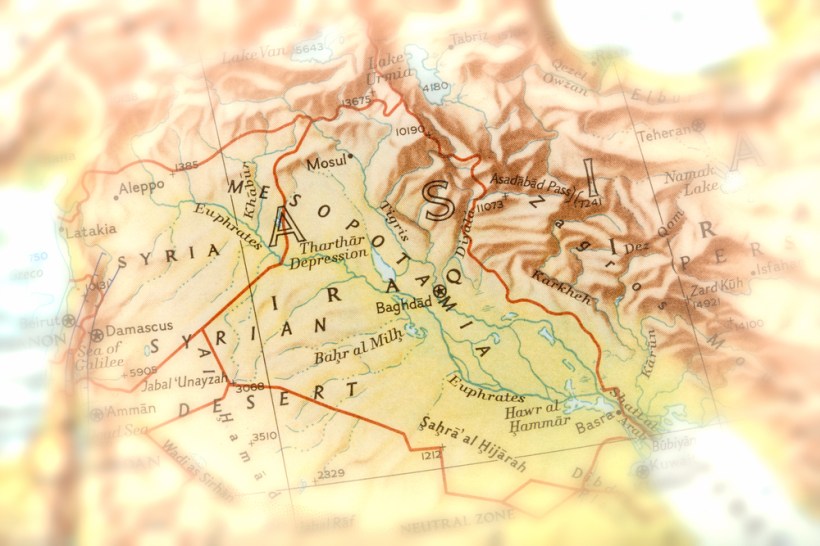
Abram’s sister, Sarai, became his wife. Both of them were children of their father, Terah, by different mothers. Terah’s son, Haran, died in their homeland (Ur). The family with Lot, Haran’s son, left Ur and and traveled to a place they called Haran in southern Turkey, just north of Aleppo Syria.

Terah and Nahor remained in Haran, but God gave Abram the direction, “Go to the land that I will show you”, and the promise, “I will make you a great nation….”, and “Through you every family on earth will be blessed”. (Gen. 12:1-3) Thus, at the age of 75, Abram and Sarah left Haran and continued on to Canaan, and Lot went with them.

When they arrived at Shechem in Canaan, God renewed the promise as Abram looked out over the land: “I’m going to give this land to your descendants.” Abram built an altar there, Then, he continued on to the high country in Canaan, between Bethel and Ai, where he also built an altar and worshiped God. (Gen. 12:7-8)

Though God had promised him twice at this point to give Abram this land, Abram continued on. They traveled south out of Canaan, into the Negev desert, and they kept going further south to Egypt because of famine. (Gen 12:9-10)

Abram remained in Egypt long enough to accumulate some wealth before he started moving again. (Gen. 13:2) It is written that Abram “traveled from place to place” when he left Egypt. He seemed to be wandering.

He traveled north again, back to the Negev and eventually back to Bethel and Ai, where he settled down. (Gen. 13:3-4) It must have been some time, as he and Lot had accumulated so many animals their herds and servants couldn’t coexist peacefully. Thus, they parted ways. (Gen 13:5-13)

Lot settled south of Canaan in the Jordan Valley. Abram remained in Canaan, and God gave him the same promise a third time: “Look north, south, east, and west of where you are. I will give all the land you see to you and to your descendants….”; and “I will also give you as many descendants as the dust of the earth.” (Gen. 13:15-16)

Still, Abram moves again, this time south about 35 miles to another part of Canaan known as Hebron. Many years pass. Abram seems to be waiting for God to do what he said, and, for the first time, Abram begins to show signs of doubt that God’s promises would come to pass, . Perhaps, this is why God promises him a fourth time: “Your own son will be your heir” (Gen. 15:4); and “I will give this land to your descendants.” (Gen. 15:18)

When Abram was 86, however, Sarai takes matters into her own hands and offers her Egyptian servant, Hagar, to Abram. Abram agrees, Hagar conceives, but all is not well in the Abram household. Hagar disrespects the barren Sarai, and Sarai mistreats Hagar so badly that she runs away. (Gen 16)

God comforts Hagar in her distress and says of Ishmael, “He will be free and wild”, but “[h]e will fight with everyone, and everyone will fight with him….,” and “[h]e will have conflicts with all his relatives.” (Gen. 16:12)

It seems that nothing is going right for Abram, and God promise takes on a sour taste. Is this the son through whom God will bless all the nations? This wild and contentious boy? Is the son of Sarai’s now despised Egyptian servant Abram’s heritage?

Continue reading “The Story of Abraham and God’s Redemption of Mankind – Part 2”

The Story of Abraham and God’s Redemption of Mankind – Part 1

As I start my third journey through Scripture from beginning to end in as many years, I am picking up on things I didn’t see the first two times through. In this series of articles I am tracing some stories in the great theme of God’s redemption of mankind through the descendants of Abraham.

Scripture is multi-layered and contains many themes large and small. I expect a person can study Scripture for a lifetime and always be seeing new things. Today I am seeing something in the line of Abraham that I kind of knew already, but I am digging into it in more detail.

The intricate tapestry that is the 60-some writings of the Bible authored by 40 some different people over 1500 or so years always amazes me. That tapestry is often veiled to us, as if we were seeing it from the wrong side. Unless we see it from the side from which it was meant to be viewed, the picture won’t be clear to us.

When we read the stories of ancient people, they feel foreign to us today. For instance, Sarai (later known as Sarah) is the wife of Abram (later known as Abraham), and she is also his half-sister. (Gen. 20:12) They shared the same father, but they had different mothers.

We shudder at the thought today of a person marrying a close, blood relative like that – a sister to boot! (Such close relations were later explicitly banned in Leviticus 18:9.) It was common a couple of thousand years before Christ, though. Perhaps this was due to limited spousal options and the greater distances people lived from each other.

We also need to understand that large segments of the Bible read like a narrative of things that simply happened, often without commentary. A recitation of the facts does not necessarily mean an “endorsement” of them. They simply are what they are, and we are often left to draw our own conclusions.

What we see throughout Scripture is that all people are deeply flawed, even the people with whom God found an audience. Ethical shortcomings have existed throughout every era of recorded human history. The Bible is nothing if not candid about the human condition.

I am setting the stage, here, for the point I eventually want to make about God’s plan to redeem all of mankind that weaves through the tapestry of the biblical narrative. I will have to lay this out over a number of articles.

In this article, I want to focus on Sarai and Abram and their origins. In Abram, who God renamed Abraham, God found a willing ear, and so God made His covenant with Abraham and gave Abraham a promise to bless not only him and his descendants, but all the nations.

This covenant and promise becomes the central story of all Scripture and needs to be recognized to make sense of it. It is one of the biggest themes in the biblical narrative tapestry.

Continue reading “The Story of Abraham and God’s Redemption of Mankind – Part 1”

Why Would God Harden Pharaoh’s Heart? And How Did He Do It?

We are not programmed to obey God so that we are able to love Him.

The Bible is a complex and rich tapestry, but we often fail to see the patterns, let alone the overarching pattern, of it. For me at one time, it was like looking at a tapestry from the wrong side – just a jumble of threads going seemingly everywhere and nowhere, without any discernible design.

At the same time, the Bible is not safe. I found it to be a harsh reflection of me when I read it for the first time. It was dangerous.

It commanded itself to me, but I didn’t always like what I saw or felt. Primarily, I didn’t like what reflected back at me about myself.

I will never forget the day in a world religion class as a college freshman that I read these words:

“For the word of God is alive and active. Sharper than any double-edged sword, it penetrates even to dividing soul and spirit, joints and marrow; it judges the thoughts and attitudes of the heart.”

Hebrews 4:12 NIV

I wasn’t a believer then, but I could see it, and it made me feel uncomfortable. Even though the rich meaning of Scripture was veiled to me at the time it reflected back to me and probed my heart to expose the worst aspects of me.

I read in the words of David today in my reading from the Psalms:

“With the merciful you show yourself merciful; with the blameless man you show yourself blameless; with the purified you show yourself pure; and with the crooked you make yourself seem tortuous. For you save a humble people, but the haughty eyes you bring down.”

Psalm 18:25-27 ESV

God deals with each of us according to our own hearts. We see Him presently “as in a mirror dimly”, Paul says, “but then we shall see Him face to face!” (I Corinthians 13:12 ESV) We see God in this life through our own reflection, which may not always be clear.

We see in Scripture our own hearts mirrored back at us, and we see God as if He were standing over our shoulders looking on. How we respond to what we see and to determines how He reveals Himself to us.

As I read through Exodus in my daily reading, I read the passage in which God told Moses he would harden Pharaoh’s heart. Moses would do miraculous things in front of Pharaoh, but Pharaoh would not be moved by them. (Exodus 4:21)

This seems odd at first blush that God would do that. How can we blame Pharaoh for his hard heart if God hardened it? Why would God even do that?

Continue reading “Why Would God Harden Pharaoh’s Heart? And How Did He Do It?”

God’s Order for Living Beings, Human Beings and His Grand Design

“Then God said, ‘Let the earth bring forth living creatures after their kind….'”


I am starting a new Bible reading plan for the year, beginning in the beginning: in Genesis. Reading through the rich text of Genesis again I am seeing some things I hadn’t noticed before. Consider the following (with my emphasis added):

“Then God said, ‘Let the earth sprout vegetation, plants yielding seed, and fruit trees on the earth bearing fruit after their kind with seed in them‘; and it was so. The earth brought forth vegetation, plants yielding seed after their kind, and trees bearing fruit with seed in them, after their kind; and God saw that it was good.

Genesis 1:11-12

“God created the great sea monsters and every living creature that moves, with which the waters swarmed after their kind, and every winged bird after its kind; and God saw that it was good. And God blessed them, saying, “Be fruitful and multiply and fill the waters in the seas, and let birds multiply on the earth.’

Genesis 1:21-22

“Then God said, ‘Let the earth bring forth living creatures after their kind: cattle and creeping things and beasts of the earth after their kind‘; and it was so. God made the beasts of the earth after their kind, and the cattle after their kind, and everything that creeps on the ground after its kind; and God saw that it was good.”

Genesis 1:24-25

Then God said, ‘Let us make man in our image, after our likeness. And let them have dominion over the fish of the sea and over the birds of the heavens and over the livestock and over all the earth and over every creeping thing that creeps on the earth.’ So God created man in his own image, in the image of God he created him; male and female he created them. And God blessed them. And God said to them, ‘Be fruitful and multiply and fill the earth and subdue it….'”

I color-coded the various provisions that form the pattern that informs my thinking today. The provisions in each color correspond with the other provisions of the same color.

Now, let me see if I can put all my thoughts together in a coherent whole.

First of all, God ordered (in the sense of designed) all living beings to multiply after they own kind. We see this everywhere in nature: apple trees produce seeds that grow into new apple trees; asparagus plants produce seeds that grow into new asparagus plants; lions beget lions; polar bears beget polar bears; yellow polka dotted salamanders beget yellow polka dotted salamanders; bluefin tuna beget bluefin tuna; and purple finches beget purple finches.

This is the order of living things. Not only that, but we now know that something (call it evolution or something else) works powerfully within living beings to reproduce and even to adapt with changes over time.

Every living thing bears seed or otherwise reproduces more of its kind. Human beings included, but only humans are made in the image of God. (Hold that thought.)

God “blessed” the living things He created, saying, “Be fruitful and multiply” and fill the earth. (Gen. 1:22) He also blessed man who God made in His own image, and gave similar blessing/order: “Be fruitful and multiply and fill the earth and subdue it….” (Gen. 1:28)

Note that God “ordered” (as in designed) the living things He created to reproduce after their kinds and to be fruitful and multiply, but God ordered – as in not only designed, but commanded – man to do the same. The difference is an important key to understanding what God is doing.

Unlike the other living creatures that are designed to reproduce and multiply after their kinds, humans have some agency in the matter. God designed them for the same purpose, but He also commanded them to do it – and gave them agency in doing it – because humans are created in the image of God who has agency – the ability to exercise will and to do (or not do) things.

Humans, of course, had no choice in their creation, but they do have choice in whether to “participate in God’s design” and how they would participate in God’s design. This choice was demonstrated in the one tree in the garden that was forbidden to them.

It was a real choice, and it had real consequences. It had to have real consequences or it wouldn’t have been a real choice. That choice was part of what it meant to be made in the image of God. Without the ability to choose, humans would have been just like the other living things God created. The ability to choose set humans apart.


As the story goes, humans ate the fruit of the one tree that was forbidden.

They exercised the choice God gave them. In eating the fruit of the tree of the knowledge of good and evil, humans opened up their world to all the ways they might choose to go against the order of creation.


Throughout Genesis 1, we read over and over again that what God did “was good” (Gen. 1:4, 10, 12, 18, 21, 25, 31). If what God designed was good, choosing to operate counter to that design would be evil (the opposite of good).

None of this is very revelatory so far, but I am getting there.

Genesis 1 reminds me of 1 Corinthians 15 where Paul says:

God gives [all living things] a body as he has chosen, and to each kind of seed its own body. For not all flesh is the same, but there is one kind for humans, another for animals, another for birds, and another for fish.

1 Corinthians 15:38-39

The order/design of life – of reality – is immutable. Life is ordered the way God created it, though humans have some choice (within limits) of whether to align with God’s design or to buck against it. Indeed, the story of the fall is the story of humans exercising that choice, God built into His design an adaptation (if you will) to accomplish His ultimate plan.

Continue reading “God’s Order for Living Beings, Human Beings and His Grand Design”

On Working to Establish a Biblical Orientation on Issues of Race

Christianity transcends all the natural barriers to human relationships.

Although the dust has settled (somewhat) on racial tensions since the maelstrom that was kicked up in the wake of the George Floyd killing in Minnesota, no one should think that the issue has been settled or will go away without some resolution. The country, including the church community, is divided on the facts, and issues, and measures that should be employed to resolve the racial tension. Even people of good will are uncertain on how to move forward.

A predominant worldview has emerged in academia that is filtering down into local communities that frames the issue and potential resolution in terms of oppression. This worldview divides the world into the oppressed and their oppressors. The people who hold to that narrative are aggressively pushing for change.

They push the people they are define as the oppressors in the racial tension. The people defined as the oppressors are white and predominantly “Christian” in name (at least). As with the laws of nature, so with the laws of natural human tendencies: when someone pushes, people being pushed naturally push back.

So it is today that the predominantly white, Evangelical Church in the United States is feeling the pressure of the desire and demand for change to address the racial disparities and tensions in our world, and we are tempted to reflexively push back against that pressure.

But how should we respond?

I have written on the differences between Critical Race Theory and biblical justice. We should recognize that the worldview based on the CRT framework is not biblical, though many of our brethren of color and more progressive white Christians have embraced it.

I submit, though, that CRT has come to prominence in the African American churches and among progressive white churches because the Church, generally, has left a vacuum, and “nature abhors a vacuum”. We have failed to recognize and address in a biblical way the deep and lasting pain of racism that continues to exist in a society that only recognized equal rights for African Americans in my lifetime.

The failure of the Church to address racial issues left room for a completely secular and unbiblical approach to sweep in. So, other than acknowledge our failure, what do we do now?

Continue reading “On Working to Establish a Biblical Orientation on Issues of Race”