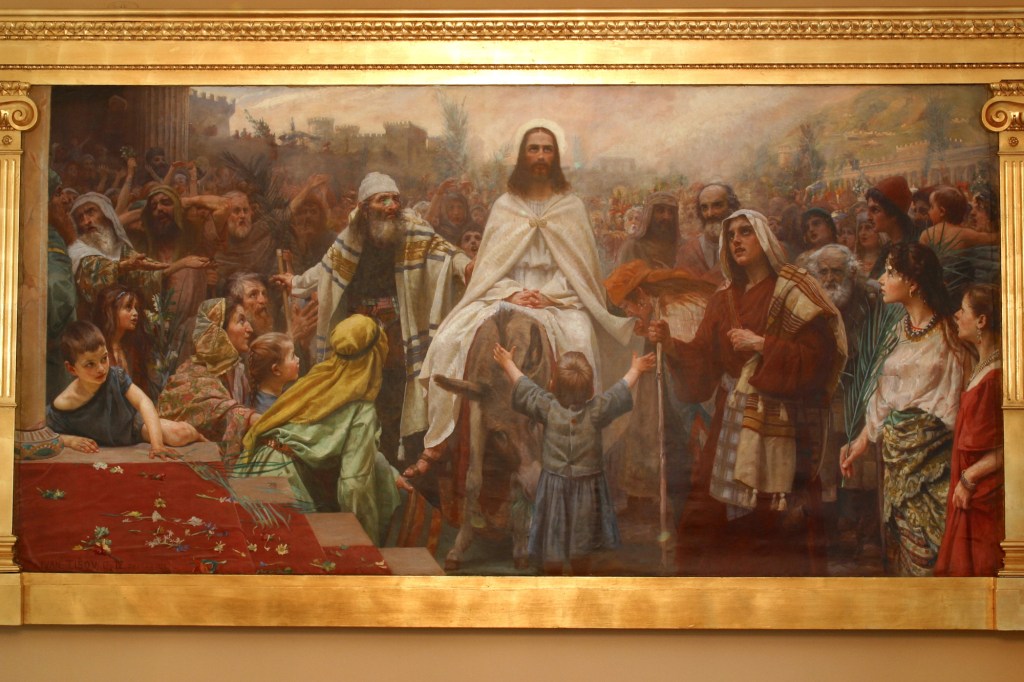
We escape the corruption of the world by the way of righteousness and the sacred command. But, what if we lose the way and don’t know the sacred commandment?
I started this short series focusing on the second epistle of Peter where Peter warns his readers about false prophets with “eyes full of adultery”, greed, and depravity who are slaves to their own sin. These people seduce the unstable and entice others by appealing to the lustful desires of the flesh. Peter says,
It would have been better for them not to have known the way of righteousness, than to have known it and then to turn their backs on the sacred command that was passed on to them.
These are fearful words of warning. Anyone who might feel enslaved to sin has likely felt angst when reading this words.
In the previous article, I note that the actions Peter describes are the fruit of people who have “known the way of righteousness” and the “sacred [holy] command” and have turned their backs and walked away. The fruits are the symptoms, not the cause.
The important thing for us, therefore, is to know the way of righteousness and the holy commandment, and not to turn our backs on them! In this follow up to that introductory article, I will focus on the way of righteousness.
We escape the corruption of the world by the way of righteousness and the sacred command. But, what if we lose the way and don’t know the sacred commandment?
I started this short series with a passage from 2 Peter 2:20-21:
If they have escaped the corruption of the world by knowing our Lord and Savior Jesus Christ and are again entangled in it and are overcome, they are worse off at the end than they were at the beginning. It would have been better for them not to have known the way of righteousness, than to have known it and then to turn their backs on the sacred command that was passed on to them.
They “they” who escaped the corruption of the world only to be entangled in it again are the false prophets Peter accuses at the beginning of the chapter of introducing “destructive heresies” and “denying the sovereign Lord who bought them.” (2 Pet. 2:1) Peter says these false prophets are like dogs returning to their vomit. (v. 22) Seducing the unstable (v. 14) and appealing to the lustful desires of the flesh, they entice “people who are just escaping from those who live in error.” (v. 18)
In the introductory article, I note that the words of judgment Peter unleashes on these false prophets might lead to a concern that we could one of those unstable ones who are enticed and entrapped. Those who struggle with sins that so easily entangle us might easily feel condemned in this tirade.
The solemn warning that such ones are better off not knowing Jesus. than knowing the way of righteousness and turning their back on the sacred command is enough to send a shiver down the spine. The actions Peter describes, however, are the fruits of turning away from the sacred command. These fruits are not the problems in themselves, but the symptoms of disconnecting from the way of righteousness and the sacred command.
In the second article, I explored the way of righteousness. The way of righteousness is the way of Jesus, who is the Way! Knowing Jesus and knowing the way of righteousness is the same thing.
The way of righteousness means embracing and walking in light of his sacrifice on the cross by which we are justified and we are considered righteous before God the Father. It means trusting in Jesus and the grace of God the Father. It means ceasing from our striving to earn the way and the pride that goes with our achievement.
The way of righteousness means following Jesus and maintaining relationship with Jesus, who is our Living Water, our Bread of Life, and the Vine in which we have become the branches (extensions of him). Knowing the way of righteousness and turning from the sacred command is to disconnect and to go our own way.
But what is the sacred command? This was my big question as I read through this passage recently, and this question is ultimately what motives me to write this short series.
I admit, that I wasn’t sure as I read through this passage. I should have known, because Jesus was pretty clear about it. But, I didn’t. I had lost sight of it. It’s so easy to lose sight of what’s important in the turmoil in the world that often spills over into my own heart.
I am reminded again in my daily reading of Scripture of the prominence of women in the life and ministry of Jesus. Every time I read through the Gospels, I see it. As I read through the Old Testament with eyes sensitized by the Gospels, I see the theme there also. This theme is somewhat, hidden, however.
We have only committed to the idea that women should be equals of men in very modern times, and that idea is still not universal around the world. A cultural revolution was required in the western world to change ancient paradigms. The change has been slow, difficult, and filled with tension.
Christianity was influential in bringing about that change, but many Christians have also resisted it. This is true even while the roots of that cultural revolution are embedded in Judeo-Christian Scripture.
Tom Holland, in his epic book, Dominion, traced modern, secular humanist values back to a surprising root. He had no idea where the values he took for granted came from: gender equality, racial equality, individual freedoms, civil rights, etc. When he searched for them, he for found them in Genesis, in the Gospel accounts of Jesus, and in the letters of Paul, the apostle.
Rebecca McLaughlin writes about the prominence of women in the Gospel accounts of Jesus in her 2021 article, Jesus Changed Everything for Women. She quotes Holland to remind us of the cultural context in which those accounts were written:
In Greco–Roman thinking, men were superior to women and sex was a way to prove it. “As captured cities were to the swords of the legions, so the bodies of those used sexually were to the Roman man,” Holland wrote. “To be penetrated, male or female, was to be branded as inferior.”
In Rome, “men no more hesitated to use slaves and prostitutes to relieve themselves of their sexual needs than they did to use the side of a road as a toilet.” The idea that every woman had the right to choose what happened to her body was laughable.
Jesus chantged Everything
Jesus didn’t introduce the these radical notions, however. They go all the way back to Genesis, where we read that God made men and women, together, in His image. (More on that below)
Modern westerners have learned to reject and even to despise the paternalism of most of the history of mankind (pun intended), so it’s easy to miss the way the Bible elevates women. After all, the Bible was written by many men many centuries ago, before anyone in the west (or anywhere else) got the notion that women should be treated as equals.
Let that sink in a moment: the Bible was written by men.
As much as modern westerners like to recoil from the idea of men treating women as second class citizens, the 1st Century Roman world thought nothing of it. Aristotle taught that women are “defective men”. He believed that “women were fit only to be the subjects of male rule“, and “they are born to be ruled by men”. Aristotle and most men for millennia thought that the inferiority of women was obvious, stemming from their nature as the “weaker gender”.
Given that context, the “clues” we find “hidden” in the Bible of a different narrative about women is remarkable. Though the Bible was written, literally, by men, Christians like myself maintain that it was inspired by God, and a divinely inspired narrative shines through it. This is true despite the obvious cultural influences we see on the face of it.
The Bible was written by men during times in which men dominated thought and culture. it is no wonder that the Bible is often criticized for being backward and paternalistic, but that view can only be sustained on a cursory, shallow reading of the Bible. A closer reading belies a very different narrative!
[29] “Woe to you, experts in the law and you Pharisees, hypocrites! You build tombs for the prophets and decorate the graves of the righteous. [30] And you say, ‘If we had lived in the days of our ancestors, we would not have participated with them in shedding the blood of the prophets.’
Matthew 23:29-30
Reading this passage in Matthew today reminded of the old bit by the comic, Jeff Foxworthy. If Jeff Foxworthy was a comic in 1st Century Judea, he might have said, “You might be a Pharisee if ____________________ (fill in the blank).”
In a similar vein, we could say, “You might be a Pharisee if you think you would not have opposed Jesus if you lived in Judea in the 1st Century.”
Of course, Jesus wasn’t being funny when he confronted the Pharisees, and this wouldn’t be a comedic schtick.
I don’t think Jesus was saying it was wrong for people to build tombs to the prophets or decorate them with flowers. Jesus was saying it was wrong to say (and think) they would have treated the prophets any differently.
The Pharisees are to us what the prophets were to the Pharisees. We may be tempted to think that we would embraced Jesus if we lived in 1st Century Judea, and would not have opposed him or called for his crucifixion if we we were in the crowd that shouted, “Crucify him!”.
But, that is no different than how the Pharisees thought and what the Pharisees claimed about the prophets that were resisted, derided, and sometimes killed by the “religious” people of their day. Jesus was clearly implying that the religious people of his day (the Pharisees), were no different than the religious people in the days of the prophets.
Can we say, then, that we are different than they?
Only if we adopt the same thinking as the Pharisees! (If I am understanding Jesus accurately.)
The Pharisees thought of themselves more highly than they should have. John came preaching repentance, for the Kingdom of God is near! But, the Pharisees didn’t repent. They didn’t think they needed to repent.
When Jesus – who was God in the flesh – came into the world, the Pharisees didn’t recognize Him or receive Him. (John 1:9-11) They did not prepare themselves for his coming by repenting, as John the Baptist exhorted. They adopted the wrong attitude about what God was doing in their time, and they didn’t hear and respond to what God God’s messenger was saying.
Pharisees say the right things, and they do the right things, but they fool themselves. What the Pharisees said and did was a façade. Their hearts were not aligned with their actions. They claimed to be experts in the Law, but Jesus called them blind guides leading blind followers. (Matt. 15:14)
Pharisees were concerned with appearances and the way people saw them. Pharisees were not as concerned with their heart attitudes. Jesus called them “white-washed tombs” that were empty inside (full of dead people’s bones and uncleanness). (Matt. 23:27-28) We need to be careful that we do become like the Pharisees.
I am reading in Mathew right now in my year long reading plan, focusing this year on the New Testament. I have read the whole sweep of the Bible, from the Old Testament through the New Testament, each year for a number of years. I am not sure how many, because I have not kept track.
The words, “be wise as serpents and innocent as doves”, came up in conversation with my son a few days ago, so these words caught my attention in my daily reading this morning. I had not paid much attention to the context in which Jesus spoke these words before:
“I am sending you out like sheep surrounded by wolves, so be wise as serpents and innocent as doves. Beware of people, because they will hand you over to councils and flog you in their synagogues.”
Matthew 10:16-17 NET
These are the instructions Jesus gave the disciples when he sent them to “the lost sheep of the house of Israel”. Jesus was very specific in his instructions, telling them what to do and what not to do, what to wear, how to conduct themselves, and Jesus pointedly included the following instructions:
“Do not go among the Gentiles or enter any town of the Samaritans. Go rather to the lost sheep of Israel.”
Matthew 10:5-6
I realized this morning for the first time the significance of the warning that Jesus was giving to his disciples when he sent them “out like sheep surrounded by wolves”. (Matt. 10:16) That instruction takes on a different color for me, now, considering that the “wolves” surrounding the disciples would be the religious people in their world – their fellow Jews.
Jesus was not sending the disciples among the Romans, or the Greeks, or even the Samaritans. Jesus was sending his disciples to the lost sheep of the house of Israel.
Jesus told the disciples to go only to the lost sheep of the house of Israel, and Jesus warned them they would be surrounded by wolves. This means Jesus was sending the disciples to the sheep in the house of Israel, and the disciples would be surrounded by wolves in the house of Israel.
The conclusion seems clear that the sheep in the house of Israel to whom Jesus was sending his disciples were going to be among wolves, who were also in the house of Israel.
These words of Jesus provide us the time worn adages about wolves among the sheep and wolves in sheep’s clothing. Jesus repeats this theme of the lostness of religious people and the wolfishness of religious leaders over and over again throughout the Gospels. So much, that this theme has stuck out like a sore thumb to me in recent years. (I have written about it in articles like, Why Did Jesus Pick on the Pharisees so Much?)
I have been recently pondering about the many criticisms Jesus leveled against the religious leaders of his day. Do these criticisms have any warrant today? How should we view what Jesus said to the religious leaders of his day? Is the significance historical, only? Or does it have application today in our Christian world?