A Call for Changing Priorities: Taking Hold of God’s Promise


In these present times, the corona virus threat looms large. Every day the number of cases and deaths rise, but we will get through this. We may not be able to see the end of it yet, and it might last longer than any of us hope, but we will get through it.

We might long, now, for life to return to normal, but I really hope it doesn’t.

The corona virus is a wake up call for everyone – for those who are vulnerable, and those who aren’t – because what we do doesn’t just affect ourselves. Our actions affect those around us. We are learning that lesson collectively.

The Bible puts it this way: if we sow the wind, we reap the whirlwind. (Hosea 8:7) We see the way it works out with the virus: one person can infect three, and three people can infect nine, and the spread of the virus spreads exponentially if we don’t take measures to arrest the unseen enemy of our bodies.

The same principles apply to sin. Our selfish, self-centered, self-absorbed, proud and arrogant sinful proclivities affect (infect) others, and the influence spreads.

It spreads to our children. It spreads to our spouses. It spreads to our co-workers, neighbors and people we contact inadvertently every day. What we do and what we say and the attitudes of our hearts, if they are informed, motivated and inhabited by the sinful nature within us, has unintended consequences … for ourselves and for others around us.

What we can’t see can and does hurt us and hurts others.

Continue reading “A Call for Changing Priorities: Taking Hold of God’s Promise”

God’s Caring and Purpose in the Midst of Pain and Suffering

God is not cold or uncaring or unaware of our pain and suffering. Yet, He has a plan, and He intends to carry it out.


“No one has ever seen God, but the one and only Son, who is himself God and is in closest relationship with the Father, has made him known.” (John 1:18 NIV)

John is talking about Jesus, of course. The progression in the beginning of John’s Gospel goes like this: In the beginning was the Word; the Word was with God; the Word was God; all things were made through the Word; in Him was life; and the Word became flesh and dwelt among us. (John 1:1-4, 9, 14) Then, John makes the statement I have recited above. No one has ever seen God but the one and only Son, who is God.

The Greek word that is translated “one and only Son” in the New International Version of the Bible is monogenés, derived from the world monos, meaning one of a class (one of a kind) and genos, meaning only of its kind. A more literal translation of the word would be “only begotten”.

The beginning of the Nicene Creed[1] captures the idea as follows:

We believe in one God,
      the Father almighty,
      maker of heaven and earth,
      of all things visible and invisible.
And in one Lord Jesus Christ,
      the only Son of God,
      begotten from the Father before all ages,
           God from God,
           Light from Light,
           true God from true God,
      begotten, not made;
      of the same essence as the Father.
      Through him all things were made.
      For us and for our salvation
           he came down from heaven….

These thoughts arise today in the context of a discussion between the great Anglican scholar, Tom (N.T.) Wright[2], and Justin Brierley[3], the Unbelievable? Podcast and Ask NT Wright Anything host out of the UK. They were talking about the corona virus threat that is plaguing the world.

Among other things, Tom Wright (who is an historian) observed that a pandemic like the corona virus is not unique in the history of the world. The Justinian plague is believed to have killed as many as 25 million people (6th century), the Black Death killed probably double that in the 14th century. The Italian Plague (1629-31), Great Plague of London (1665-66) and Great Plague of Marseilles (1720-22) took millions of lives in Europe, and the Third Plague Pandemic killed about 15 million people, hitting China and India the hardest.[4]

After a discussion of how Christians should respond to the threat (in the same manner as they always have – with compassion and self-sacrifice, helping those in need), Justin prompted Tom by asking him for a five minute response to the hard question: why does God let things like plagues happen?

Tom Wright’s response recalls articles I wrote on March 22, 2020 (Change of Perspective: From the God of Moses to Jesus) and on March 28, 2020 (Perspective in the Reminder of Our Own Mortality). In the first article, I addressed the seeming incongruity between the picture of God we see in the Old Testament compared to the person of Jesus we meet in the New Testament. In the second article, I sought some perspective on the bad things that are happening in light of God’s revealed purpose in creating us and the world in which we live.

Tom Wright’s brief response (focusing on the raising of Lazarus from the dead) sits right in the middle. Right where we live. Let me explain.

Continue reading “God’s Caring and Purpose in the Midst of Pain and Suffering”

On Being Salt (and Light) in the World


This blog post is inspired by today’s sermon where I go to church. The sermon was the last in a series about how followers of Christ are called to have an impact on the world. The text is out of Matthew, known as the Sermon on the Mount:

“You are the salt of the earth, but if salt has lost its taste, how shall its saltiness be restored? It is no longer good for anything except to be thrown out and trampled under people’s feet.  You are the light of the world. A city set on a hill cannot be hidden.” Matthew 5:13-14 ESV

The themes here are salt and light. God calls His people to be salt and light in the world. These should be familiar concepts, but it always helps to dive a little deeper into the things we think we already know, and it doesn’t hurt to be reminded and encouraged to live them out.

I will preface my thoughts with a personal story I have told before. In high school and college, I found in myself a yearning to go off in the woods and retreat from society. That feeling might have been originally inspired by reading My Side of the Mountain when I was in grade school.

My Side of the Mountain was about a young boy who left his home for the woods of the Catskill Mountains where he took up residence in a hollow tree. He fended for himself in the quiet and solitude of nature, taming a peregrine falcon in the process, in a very idealistic depiction of life alone in the Eden of nature.

You probably won’t be surprised to know that I was very drawn to Henry David Thoreau. That kind of contemplative life lived alone in the peace and abundance of the outdoors was alluring to me. Even after I became a believer in college, my personal dream included peace, quiet, solitude and nature.

I am still drawn to that, but God took me through a college class in which I realized that God was calling me to the noise, bustle and busyness of society – despite my reluctance. It seemed like a personal paradigm shift to me, and it was; but it really wasn’t as profound a revelation (or shouldn’t have been) as it seemed at the time.

I won’t bore you with the details here, but I realized that I couldn’t (and shouldn’t) run from the encroachment of “civilized” society on that idyllic vision of personal utopia. I needed to turn and face it. I realized God was calling me to engage the world and not run from it.

Throughout history, religious believers of various kinds formed groups that cloistered themselves from the world. From monasteries to modern communes, the tendency to want to run from the grit and grime and dirt of humanity and human institutions is a strong idealist and religious theme, but not one, it seems, God wants most of us to pursue.

That is because He calls us to be salt and light.

As I listened to the sermon today, it dawned on me that salt is only effective when it comes in contact with food. It’s purpose in drawing out the flavor of food and in preserving it can only be realized when salt is in close contact with it. Salt can’t flavor or preserve food it doesn’t touch. Continue reading “On Being Salt (and Light) in the World”

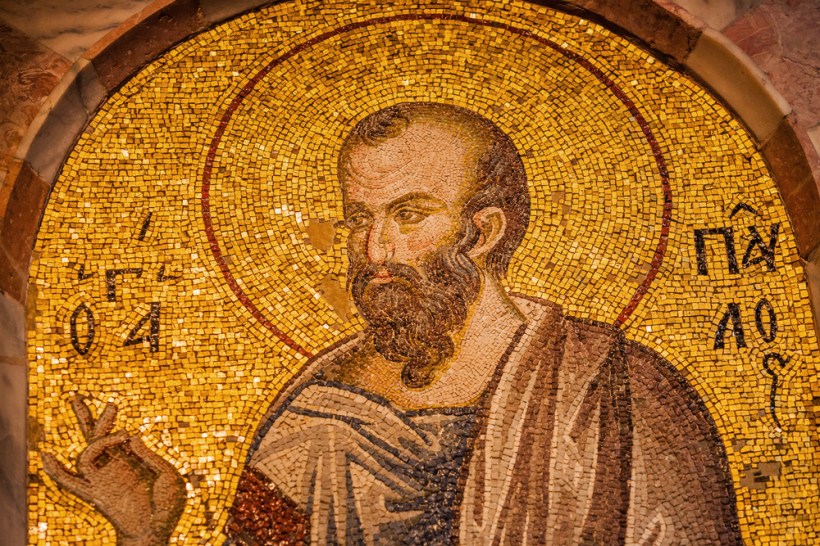
Paul… the Radical Countercultural?

In one sentence, Paul leveled all the traditions and paradigms that characterized the Greco-Roman world

Paul Mosaic at Chora Church in Istanbul

People today don’t give Paul (or Jesus or the Bible) enough credit for “forward thinking”. We like to think that modern man has pulled himself (and herself) up by the bootstraps, a notion that emerges from our modern view of ourselves, of beings that have made ourselves after a long, doggedly determined climb out of the primordial slime.

Paul is often called patriarchal and even misogynist. He is blamed for the “backward thinking” that prevails in some areas of the church. Bronze age ideas and norms, they say, enslave the church in primitive thinking that quashes the rights of more sophisticated modern people.

There are dozens of examples in Scripture that this isn’t true. When we read the Scripture through a modern lens and don’t understand or appreciate the context of the time when it was written, we fail to appreciate the radical nature of Scripture.

I have written on these things many times in the past, but my attention is drawn to one example today. In his letter to the Galatians, Paul wrote:

“[I]n Christ Jesus you are all sons of God, through faith. For as many of you as were baptized into Christ have put on Christ. There is neither Jew nor Greek, there is neither slave nor free, there is no male and female, for you are all one in Christ Jesus. And if you are Christ’s, then you are Abraham’s offspring, heirs according to promise.

“I mean that the heir, as long as he is a child, is no different from a slave, though he is the owner of everything, but he is under guardians and managers until the date set by his father. In the same way we also, when we were children, were enslaved to the elementary principles of the world. But when the fullness of time had come, God sent forth his Son, born of woman, born under the law, to redeem those who were under the law, so that we might receive adoption as sons And because you are sons, God has sent the Spirit of his Son into our hearts, crying, ‘Abba! Father!’ So you are no longer a slave, but a son, and if a son, then an heir through God.” (Galatians 3:26-4:7)

Let’s unpack this a bit, and I think you will see what I am talking about. First, we need to consider the context of the time in which this letter was written. Then we need to look closely at what Paul is saying.

Continue reading “Paul… the Radical Countercultural?”

Herod, Mikvehs and the Religion Disconnect

Religion is often disconnected from the spiritual reality of the existence of God and who God is as revealed in Scripture.

Ruins of King Herod’s fortified palace Machaeros, Jordan, Middle East.

A recent article on the discovery in 2016 of the mikveh uncovered at the site of King Herod’s palace at Machaerus on the eastern shore of the Dead Sea in modern Jordan got me thinking about a theme I have been contemplating for some time.[1] That theme is the disconnection between religious ritual and spiritual reality.

21st Century people might call that “disconnect” hypocrisy in the process of dismissing all religions and spiritual truth. That modern tendency to discount all religion in that way, and especially Christianity, reflects a lack of understanding that bothers me when I hear it. The recent discovery reminds why I feel this way.

Digging into the history of King Herod, the palace at Machaerus and the mikveh that was recently discovered there sheds some light on the subject and reminds me that there is much more than meets the modern eye. And, in some fundamental ways, nothing has really changed from then to now, and yet everything has changed at the same time.

Before we get into the meat of the matter, I should explain that a mikveh is a small pool or bath used in ritual purification. Thus, the discovery of a mikveh in King Herod’s palace indicates that the royal inhabitants engaged in the Hebrew purification ritual that was instructed in the Old Testament (the Torah).[2]

Of course, the instructions in the Torah were traditionally understood as religious in nature, though the ritual cleansing in mivka’ot (plural of mikveh) might be seen through the lens of modern science as good hygiene. The purification rite that were instructed would have inhibited the spread of contagious diseases and infection. But for them, with no understanding of modern hygiene, health and medicine, these practices were purely religious in nature.

With that in mind, what then is the significance of the discovery? How does it shed light on the disconnect between religious practice and spiritual reality? What is the nuance that modern people often miss in discounting everything they lump together as “religion”?

Continue reading “Herod, Mikvehs and the Religion Disconnect”