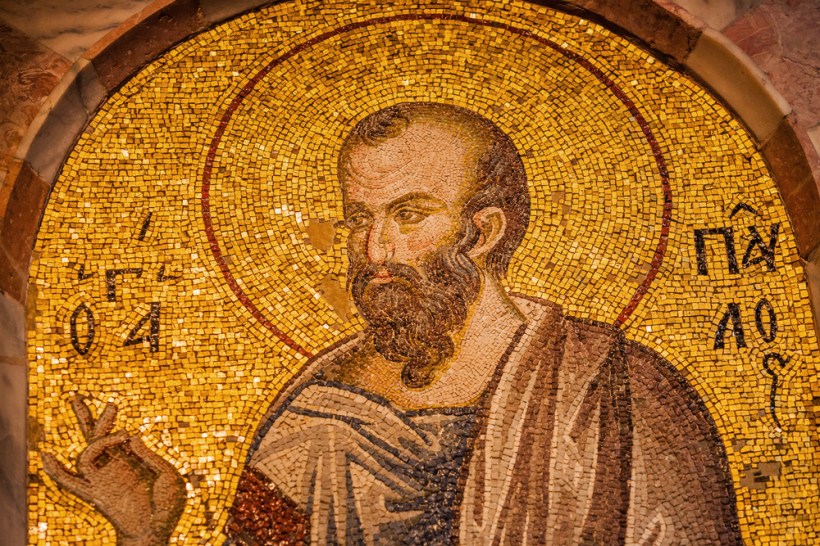
Paul… the Radical Countercultural?

In one sentence, Paul leveled all the traditions and paradigms that characterized the Greco-Roman world

Paul Mosaic at Chora Church in Istanbul

People today don’t give Paul (or Jesus or the Bible) enough credit for “forward thinking”. We like to think that modern man has pulled himself (and herself) up by the bootstraps, a notion that emerges from our modern view of ourselves, of beings that have made ourselves after a long, doggedly determined climb out of the primordial slime.

Paul is often called patriarchal and even misogynist. He is blamed for the “backward thinking” that prevails in some areas of the church. Bronze age ideas and norms, they say, enslave the church in primitive thinking that quashes the rights of more sophisticated modern people.

There are dozens of examples in Scripture that this isn’t true. When we read the Scripture through a modern lens and don’t understand or appreciate the context of the time when it was written, we fail to appreciate the radical nature of Scripture.

I have written on these things many times in the past, but my attention is drawn to one example today. In his letter to the Galatians, Paul wrote:

“[I]n Christ Jesus you are all sons of God, through faith. For as many of you as were baptized into Christ have put on Christ. There is neither Jew nor Greek, there is neither slave nor free, there is no male and female, for you are all one in Christ Jesus. And if you are Christ’s, then you are Abraham’s offspring, heirs according to promise.

“I mean that the heir, as long as he is a child, is no different from a slave, though he is the owner of everything, but he is under guardians and managers until the date set by his father. In the same way we also, when we were children, were enslaved to the elementary principles of the world. But when the fullness of time had come, God sent forth his Son, born of woman, born under the law, to redeem those who were under the law, so that we might receive adoption as sons And because you are sons, God has sent the Spirit of his Son into our hearts, crying, ‘Abba! Father!’ So you are no longer a slave, but a son, and if a son, then an heir through God.” (Galatians 3:26-4:7)

Let’s unpack this a bit, and I think you will see what I am talking about. First, we need to consider the context of the time in which this letter was written. Then we need to look closely at what Paul is saying.

Continue reading “Paul… the Radical Countercultural?”

Lay Your Weapons Down

Our battle is not against flesh and blood. (Ephesians 6:12)


Os Guinness says, “It’s no secret that the world doesn’t know how to handle our differences.” Just consider countries like China, Iran and others in which dissidents are treated as enemies of the state, rounded up and imprisoned or even killed.

In the West, we have handled our differences better than most in the last couple of hundred years, but we have had our issues as well. Guinness addressed religious matters, in particular, and notes that we have different views for how to address differences. There are those who advocate for the “sacred public square” where religion is king, while others urge a “naked public square” that is wiped clean of religious and faith expression.

He advocates for a third way of dealing with religious differences: “the civil public square”. In the civil public square, all people are given freedom of conscience to speak from their own faith tradition, or no faith tradition at all (which is also a kind of faith).

Guinness criticized the last 50 years in the United States during which culture wars have been battled out in the public square. The result is that differences have become more entrenched, and they are getting deeper and wider as time goes on.

As a Christian, Guinness is concerned about the state of the church in these times. He observes that millions of people are dropping out of religion altogether because of “the ugliness of Christian extremism in public life”.

He is quick to say that the secular extreme is just as bad, but I agree with him that we (Christians) should be concerned for our own influence in the world.

Continue reading “Lay Your Weapons Down”

Climate Change and the Gospel


Many Christians deny that climate change is happening, perhaps because many Christians distrust science. More accurately, perhaps, they distrust scientists, as a large number of scientists are atheists, especially some extremely vocal scientists who “preach” a form of scientism[1].

As Christians, though, we need to be careful here. We need to respect truth wherever we find it and wherever it leads. Without letting go of the revealed truth of God in Scripture, we need to recognize and acknowledge truth that science reveals – the truth of God’s creation.

We also need to recognize and understand the difference between science and scientists. Science, done right, reveals the truth of God’s creation. The scientists who do science are influenced by their own biases, assumptions and preconceptions, worldviews and individual perspectives, but that doesn’t mean that the results of the science they do can’t be trusted.

We have to separate out the science and the conclusions drawn by scientists from the science. Even there, those conclusions shouldn’t be discarded without consideration. Scientific conclusions (conclusions that naturally and inevitably follow from proven premises) should be distinguished from philosophical conclusions (extrapolations from the scientific conclusions that go beyond the bare facts and enter into philosophical territory).

What does that mean? A very extreme example might be the assertion by Neil deGrasse Tyson that science has replaced philosophy and made it irrelevant. He maintains that science tells us everything we need to know about reality. This very statement is a philosophical statement. (Hint: it’s not science.) Just because a scientist says something doesn’t make it true.

We also have to keep in mind that science has been reduced over the decades and centuries to mean something more limited than what it once meant. (Theology was once known as the Queen of the Sciences). Science is now limited in its definition to mean the study of the natural world and its material components and processes. Scientific method is limited to what can be proven by observation of the material world and its processes.

Science is a species of knowledge, but we sometimes conflate science with knowledge, thinking that science is the end-all and be-all of knowledge and that knowledge is only that which science reveals to us. As Christians, we don’t believe this. Philosophers don’t believe this. Artists, and poets and musicians don’t believe this. Many scientists don’t believe this as well.

But, I digress. I believe that the science for climate change is accurate – at least to some extent. To what extent, I am unable to conclude, as I don’t know the science well enough. But that the climate is changing is fact. It is changing, and we shouldn’t be ignorant of that fact.

It is also fact that we are contributing to that change. CO2 emissions, for example, have gone up dramatically since the industrial revolution. That is science that can’t (shouldn’t) be denied. It’s been substantially demonstrated in a multitude of ways.

To what extent has our activity contributed to the change? To what extent is our activity driving the change? To what extent can we reverse the change? Can we reverse climate change by our efforts? I think these are all open questions as I understand the state of the science.

As Christians, I think we need to be careful to respect the truth of science; otherwise we are guilty of denying and misrepresenting truth. We need to respect truth wherever it is found because our God is true, Jesus was truth personified. For that reason, also, we have no reason to be afraid of the truth.

Our approach should be appropriately nuanced on issues like climate change. How we deal with the truth and respond to it must be placed into context. There is a higher truth than climate change: God and His purposes that we learn from revealed truth found in Scripture.

For the Christian, the prospect of climate change does not appear as the ominous a threat it is for the non-believer. This is because we understand that the earth is passing away;[2] and God has promised a new heavens and a new earth.[3] In fact, Jesus warns us not to store up our treasures on earth where they are subject to rot, decay and destruction (sounds like the second law of thermodynamics), but to store them up in heaven.[4]

But we also need to be mindful that God made us stewards of the earth, and He expects us to be good stewards. Continue reading “Climate Change and the Gospel”

Ceding Earthly Kingdoms and Seeding the Kingdom

Entry into the kingdom of God is by way of the cross, and followers in that way are cross-bearers who walk in the way of Jesus and invite their enemies to join them.

Tower of David in Jerusalem, Israel.

In a discussion with Canadians, Krish Kandiah and Tom Newman, on the unbelievable Podcast with Justin Brierley (Agnostic ‘trying on’ church talks to a Christian – Tom Newman & Krish Kandiah), the conversation turned to the fact that Christians are a minority in Canadian and British society. The agnostic, Tom Newman, discussed his “experiment” with Christianity that was the subject of his own podcast. He found that Christians bring value to society, because Christians are particularly motivated to do good things. This led to an interesting dialogue.

Krish Kandiah, a pastor, observed that the temptation of Christians as minorities in society is to go private, turn inward, and become cloistered. Doing that, however, is not How Jesus instructed Christians to act.  Jesus says you don’t light a candle to put it under a bushel. So, Krish Kandiah says,

“It becomes the obligation of the Christian minority to serve and bless the majority.”

What a difficult statement for an American Christian to hear! It almost doesn’t register. Did he really just say that? (I note that the interviewees ware both Canadian, and the host is British. Canada and Great Britain are decidedly post-Christian.)

The United States is heading that way too, though we don’t like to admit it.

Interestingly, Christianity is growing in other parts of the world like Africa, Asia, Latin America, the Muslim world, and Oceania. Christianity is noticeably declining in the United States, Europe, and the rest of the “western” world.

I think about these things in the context of the cultural wars that are raging in the United States. Christians are desperately fighting to hold on to a Christian consensus that was once called the “Moral Majority”, but Christians have been losing ground. American society is incrementally moving the other way, and the movement is gaining momentum despite the efforts of the most ardent culture warriors.

How do we deal with that? In a classic American Christian way, I wonder, “What would Jesus do?” More poignantly, I wonder what God is saying to us (American Christians) in this day and age?

Continue reading “Ceding Earthly Kingdoms and Seeding the Kingdom”

Lamentations of a Recovering Christian Patriot

The views of Christians around the world provide a counterbalance to the unique bent of American Christianity.


I became a Christian in college, despite the progressive, skeptical atmosphere in the Iowa liberal arts college I attended. One that had roots in the Methodist Church, but the current tree had all but separated from those roots in favor of more modern fertilizer. I learned to put into perspective the tensions I saw between what I read in Scripture and what I was learning in college.

I compartmentalized some of the differences. I was able to synthesize many of them, but some of the tensions I learned to “shelve” for later consideration.

I wasn’t very career minded when I graduated from college. I only wanted to follow and serve Jesus. I ended up packing my bags to go to Alton Bay, NH for a summer job, believing that I was going, like Abraham, to a place God was calling me. I didn’t know exactly what I was in for. I only had a summer job, but I didn’t think I was coming back to the Midwest.

I got deeply involved in the local church in Laconia, NH after the summer job ran its course. It was a dynamic church, growing out of the Jesus People movement in the 60’s, and still going strong.

During my time there, the Moral Majority was on the rise and gaining influence. Pat Robertson ran for President while I lived in the Granite State. Live Free or Die was the NH motto, and people were proud of it.

Politics crept into my faith and into the church. I rubbed shoulders with sometime churchgoers who were members of the John Birch Society. As I look back, though, they were infrequent participants, but they left their mark.

I didn’t know it at the time, but this dynamic church with a storied local history was about to implode. I was there about six years, got married there and had two children. I left in 1988 to go to law school and pursue a new path. (Not long after I left NH, the church splintered into many pieces and is, now, only a distant memory.)

That path brought my back to the Midwest where I have remained ever since. I have wandered through much wilderness and have been challenged in my faith since then. Law school sharpened my thinking, but it dulled my spiritual edge.

I compartmentalized my faith once again, as I had done in college. I set things “on the shelf” as I devoted myself to learning the law.

It turns out I was pretty adept at understanding the law, leaving law school with a diploma and the academic standing of second in my graduating class. This was in keeping with a vision a wise and spiritual woman had for me that was part of the confirmation from God that I should go.

The certainty with which I left to go, similar to the certainty I had when I left for New Hampshire, gave way to uncertainty in how I should reconcile the political and cultural influences that bore down on me under the scrutiny of the jealous mistress of the law.

I kept that jealous mistress at bay, but it would be years before I reached a point of resolution.  My faith survived, but the political and cultural baggage I brought with me from New Hampshire did not.

The dynamic church I attended there a long ago now disintegrated into myriad pieces of broken relationships, broken dreams and broken promises during my sojourn away. The way was difficult, but I think I am a better Christian because of it, and this is what I believe I have learned.

Continue reading “Lamentations of a Recovering Christian Patriot”