Don’t Let Fear Win: Keep the Conversation Going


“When two enemies are talking, they aren’t fighting. It’s when the talking stops that the violence starts. Keep the conversation going.”

This is how Daryl Davis concludes his Ted X Talk, Why I, as a black man, attend KKK rallies, December 8, 2017. Yes, that’s right, a black man who attends KKK rallies!

Let that sink in a little bit.

It’s not that Daryl Davis has any affinity for the KKK. He certainly doesn’t, but he is an outside-the-box thinker. When he came to the realization that racial prejudice exists as a young boy, and that it was aimed at him (it took some time for that to sink in at 10 years old), he began to ask questions. In his boyish curiosity, he wondered, “How people could hate me if they didn’t even now me?”

That question led him to read books on white supremacy, black supremacy, and similar topics, but he couldn’t find a good answer. He figured, then, that the best way to get an answer would be to go to the source. By that time, he was an adult.

His curiosity led him to invite the Imperial Wizard, the national leader, of the Ku Klux Klan, to meet with him. He was warned, “Don’t fool with Mr. Kelly. He will kill you!” Daryl Davis, though, is no ordinary person. His curiosity was stronger than his fear.

His secretary set up the meeting, as requested, in a local hotel room. His imperial guest knew only that the interview was to about his involvement in Klan. No one told the Imperial Wizard that his interviewee was black.

Kelly showed up to the hotel room right on time with his armed body guard. They froze when they saw their host, but they entered anyway as Daryl Davis invited them to sit down.

The meeting was tense. About an hour into the meeting there was a strange noise that Davis thought came from his guest. He was instantly ready to lunge from his seat to take down his guest and his bodyguard as those previous words of warning rushed like lava ready to erupt to the surface. (“He will kill you!)

Daryl glared into the eyes of Mr. Kelly with the intensity of a man demanding to know what caused that noise! The Imperial Wizard glared back at him with the same urgent intensity as the body guard looked from one man, then to the other with his hand on his gun. Anything could have happened.

In a moment, Daryl’s secretary, Mary, realized what happened and began to laugh. She had filled a cooler with ice and cans of soda pop for the meeting. She knew immediately that the sudden noise was merely the cans falling as the ice melted and shifted underneath.

They all laughed in relief. It was a literal and figurative ice breaker.

The story gets better, and the lessons to be drawn from it are especially poignant in this time of increasing political, racial and religious polarization in the United States. This is the rest of the story of the black musician who invited the Imperial Wizard of the KKK to meet him in a hotel room.

Continue reading “Don’t Let Fear Win: Keep the Conversation Going”

Putting the American Church into Perspective

Our perspective should be colored by God’s global and eternal purposes, not by the smaller, immediate “world” that we know.


A recent article in Relevant Magazine online, Report: 8 in 10 Evangelicals Live in Asia, Africa and South America, was there to greet me this morning when I opened Facebook. The article title, and the concluding statement put things into perspective:

“[T]hese figures … underline an important point about the vast racial and ethnic diversity of the evangelical strain of Christianity — a diversity often neglected in American conversations about faith.”

Evangelicals make up a little over 25% of the Christians in the world, and only 14% of the Evangelicals in the world live in the United States. Let that sink in.

Let’s take another step back. Let’s gain a little perspective. Let’s look at American Evangelical Christianity for a moment from the larger perspective of the world.

Continue reading “Putting the American Church into Perspective”

The End of White Christian America?


The headline reads: White Christian America ended in the 2010s.[1] As a white evangelical (and male), the first reaction to such a headline, I admit, is to cringe. We hear so much about the white privilege, white evangelicals and white Christians, generally, and none of it with “white” in the description is positive.

It gets old for me, if I am being honest. I am human after all. But, if this time really spells the end of “white Christian America”, however that might actually be defined, then so be it.  Truth is truth. Reality is reality.

Of course, the headline in the NY Times in 1966 reading that God is Dead[2] proved to be a bit exaggerated. Thus, I don’t necessarily concede that white Christian America ended in the 2010s. I am skeptical of statistics and statisticians. I am skeptical of sweeping statements. I am skeptical of the biases that inform the conclusions we reach.

Further, the statement implies that we can identify white Christian America (and agree on a definition). I don’t identify with the stereotypes that appear to be informing the article. As an example, my wife and I decided to live in a city and allow our children to go to public school in which white folks like us are minorities. We made that decision for the sake of giving them the experience of diversity. We embrace diversity.

That’s the problem with broad, sweeping generalizations. I feel that most of the white Christians I know view the world more like me than the article suggests. Maybe I’m wrong, but some significant segment, at least, of the white Christian population is mischaracterized in the assumptions.

I don’t associate white with Christian. No educated person could (or should) associate Christian with white (European) people globally. Not anymore.

“White Christian” Europe is a ghost of what it was. Europe and Canada are decidedly “post-Christian”, and the United States is following. Meanwhile, Christianity in Latin and South America is growing at a record pace, as is Christianity in China and Iran, even amidst increasing oppression and persecution. Jesus was a Middle Eastern “man of color”, and most Christians in the world are non-white.

Still, the numbers in the United States tell a story. I am just not sure we are very good at reading and understanding the story they tell. I would argue that the story these numbers tell is more about a seismic shift in the predominant worldviews that drive societal change in the United States than a racial divide – not that there is no racial divide.

Though I am skeptical about the story this article tells, the numbers suggest that something is going on. Some shift has occurred over the last decade or two that is revealed in these numbers, and it is a shift away from a politically conservative, Christian position (white, black, brown or other).

The predominantly white, evangelical movement that has rallied around Trump as a political savior is a last ditch, desperate and ill-conceived attempt (in my opinion) at clinging to a position of societal influence. It’s an attempt to exert human wisdom and strength into a flawed human system. I am not sure how much of that effort is inspired by faith in the sovereignty of God and how much of it is inspired by “the will of man”.

Yes, God establishes authorities, like Donald Trump, and that means God establishes the authority of other leaders, like Barack Obama (or any other leader, for that matter).[3] If we believe God establishes any authority, we have to believe He establishes all of them (even the ones we don’t like, the ones that we feel are a threat to us). We can’t say with any degree of integrity that God only establishes certain authorities that we favor, and not others.

Frankly, we need to reconsider how to interpret Romans 13 on that score, starting with the fact that Paul spoke those words to the Romans who suffered greatly under a harsh and hostile Roman world that worshiped Caesar and put to death those who would not bow down to him. It can’t mean what we popularly think it means in the United States.

We also need to be careful about putting our confidence in kings. Our confidence should be grounded in God, alone. God established Saul as king when the people wanted a king (like the other nations), but that wasn’t actually a blessing; it was actually a rejection of reliance on God.[4]

God gave the people what they wanted, though they were rejecting God in the process. God used that circumstance, as He uses all things, to accomplish His purposes, of course. But that doesn’t mean that the people who championed a king were on the right side of that equation.

We have to remember that our ultimate destiny isn’t in this world, but in the life to come. If the numbers and the trends they reveal suggest anything, they suggest that we will need an eternal perspective all the more as we lose hold of our significance among the powers and influences of this modern world. This is no less true in the United States.

And if the world hates us (for the right reasons – because we are God’s people, not because we have power or privilege), we shouldn’t be surprised. The world hated Jesus too. Our best response isn’t to cling to worldly power, but to die on the cross that God has shaped for us.

God is strong in our weakness. In this time in which Christians seem to be losing our foothold in the national power structure, we need to look to God for our strength. That isn’t a bad thing, in my opinion. That’s where we should be looking for our strength in all circumstances. It’s easier, though, to lean on God’s strength when we are weak.

And, assuming that is the case, it’s going to be easier for us to lean on God as time goes on. Not necessarily because we want to, or because that is our natural inclination (because it isn’t), but because we will have no other choice. And if that is the case, then so be it.

I won’t rue the end of white America, though I would gladly trade the white part for the Christian part. The white part will continue to color. It’s inevitable, and frankly I think for the best in a world that is increasingly global and diverse. Every tribe and tongue is represented in Revelations, so why would Christians do anything but applaud the increasing diversity of the United States?

As for Christianity, I would gladly lose cultural (American) Christianity for real spiritual renewal.  Maybe God is stripping away the impurities to expose the gold. If that is the case, we have a long way to go, and the fire is going to get hotter.

~~~~~~~~~~~~~~

[1] White Christian America ended in the 2010s, by Robert P. Jones, the CEO and founder of PRRI (Public Religion Research Institute) and the author of “The End of White Christian America,” which won the 2019 Grawemeyer Award in Religion. His forthcoming book is “White Too Long: The Legacy of White Supremacy in American Christianity”, published at NBCnews.com Dec. 27, 2019.

[2] God is dead, and religion dying, remembered by James Finn in the New York Times April 19, 1970

[3] For an excellent expose on the way we cite Romans 13 to support our own bias, see Misusing Romans 13 To Embrace Theocracy, by Stephen Mattson at sojo.net December 10, 2019.

[4] See Is Donald Trump the King We Wanted? at Navigatingbyfaith.com November 17, 2019.

A Discussion about the Influence of Christianity on Western Civilization by Two Non-Believers

What is the the impact of Christianity on the values and assumptions of western civilization?

Dionysus Bacchus Wine statue portrait

In my college English classes, I recall the attitude that Tom Holland conveys in a recent interview of he and AC Grayling by Justin Brierley on the Unbelievable? podcast: Did Christianity give us our human values? Neither Holland nor Grayling are believing Christians, so I was intrigued to listen to what they had to say.

Holland explained that he was raised in the Anglican church, but he found Christianity to be “dull” at an early age. He was much more drawn to the ancient, classical world in the same way he was drawn to dinosaurs when he was younger. “It was big; it was fierce; and it was extinct. To be honest, I was very much on the side of Pontius Pilate: the eagles, the togas, the glamour of it. Jesus becomes slightly dull in comparison. He was a loser, really.”

Tom Holland says there wasn’t a dramatic moment in which he lost his faith. It was more like his faith was a dimmer switch dialing down. He says, “My faith was essentially blotted out by the sun of my fascination with the classical world.”

This was more or less the attitude I remember in the education of my youth. In my high school Latin class, we celebrated Roman society, even dressing in togas one day for some kind of classroom party. In 1978, just before I set off for college, the movie, Animal House, practically turned the toga party into a curricular activity.

I remember distinctly a professor explaining through an entire class on Milton’s Paradise Lost why Satan is the most appealing character in that classical work. The theme of naïve innocence and initiation into the world of knowledge that brings with it the thrill of discovery and loss of innocence runs through all of English literature.

The loss of innocence is a rite of passage. The world of knowledge, being equated with that loss of innocence, is more fun, interesting and downright exciting than the pious world that is inevitably left behind. “Religion” (Christianity) was viewed as a desperate attempt to hold on to that naiveté, even as the proverbial horses of lust, titillation and wonder about the forbidden world are escaping the barn.

Tom Holland, like my worldly professors in college, gladly left the “dull” world of Christianity behind.  When he set out to write history, he was drawn to write about the Greeks and Romans of his youthful fascination. This journey, though, eventually led him to a surprising conclusion. He says,

“I found the experience of living in the minds of people like Caesar, … people I had deeply admired as a child, almost hero worshiped … increasingly unsettling.”

The disconnect increased the more he dug into it. If the values of the ancient Greco-Roman world are foreign to modern, western values, what was the source of his modern, western values?  What were the real roots of his western values if they are not Greco Roman?

Through the process of researching and writing history, Holland came to realize that the present values of humanism, secularism and liberalism that are prized in western society find their roots in Christianity. The realization of the impact of Christianity on the values and assumptions of Western civilization was “sharpened” for him in the process of writing a book on the history of Islam.

Holland recalls that he found himself coming to the conclusion that “[much of what] Muslims believe about the origins of Islam are actually mythic, are back projections”. Muslim critics repeatedly complained of the book he wrote on the Islam, challenging him that he wouldn’t dream of subjecting his own beliefs and values to the same critical review. Thus, Holland says, the book he wrote most recently, Dominion: How the Christian Revolution Remade the World, began as an attempt to subject the origins of his own cultural values to the same standard of critical review.

He says that the book was his effort to take the criticism to heart and to trace the thread of his own humanist, liberal values back to see “where it leads through the labyrinth”.  Speaking of that effort, the culmination of which is now in print, he says,

“Ultimately, it leads back to Christianity, and I’ve come to the conclusion that, in almost all of the essentials, myself, my friends, the society in which I live, the whole of the west is so saturated in Christian assumptions that it is almost impossible to remove ourselves from them.”

This is not the post-modern, post-Christian narrative that I have heard elsewhere. Indeed, AC Grayling, the other guest on the podcast that inspires this blog today, takes a different view. That is the subject of the interview. The interview is worth a listen, whether you might side with Grayling or with Holland. The fact that Holland comes out of the atheist camp to announce what he has determined from his research is noteworthy. Therefore, I publish this short blog post and invite you to listen along to this interesting discussion.

21st Century Reflections on 2nd Century Description of Christians

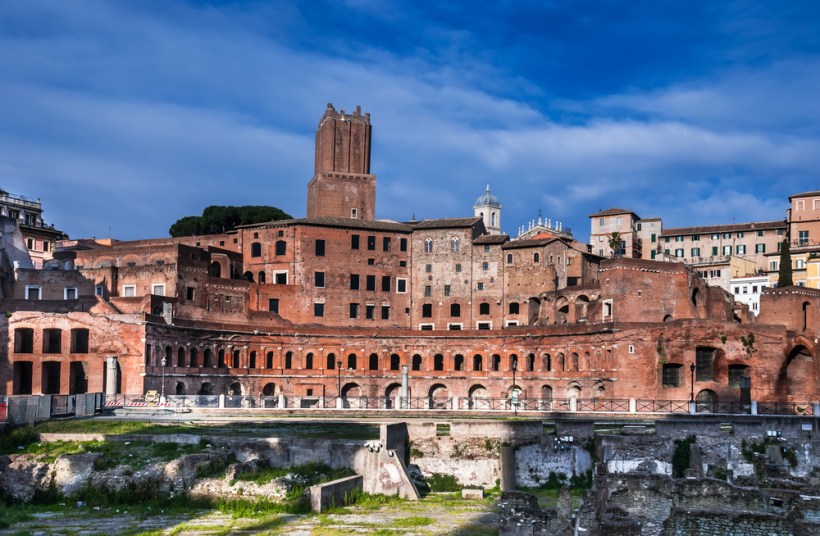
Rome, Italy. Trajan Markets, built in 2nd century AD by Apollodorus of Damascus in the time of Emperor Trajan

The following descriptions of Jews contrasted with Christians in the Roman Empire inspire my thoughts today:

“Rome respected Judaism because the religion was ancient and enduring. Jews had survived opposition for over a thousand years and, in spite of that opposition, had spread throughout the Roman Empire and beyond.… Roman authorities did not require Jews to venerate the gods (say, through sacrificial offerings in local temples) or to serve in the military, and Romans viewed and used at least some local synagogues as civic centers, which implies that Judaism served the larger Roman public, however modestly. Jews were far more integrated into Roman society than it might at first appear.

“…. Jews worshiped one God, Yahweh, to whom they were exclusively devoted; followed a rigorous set of ethical and religious practices; and refused to participate in pagan rituals and festivals. They observed a way of life that set them culturally apart. The Jewish rite of circumcision kept Romans who were attracted to Judaism from wholesale conversion. Jewish kosher laws required that Jews shop in their own stores, their dress codes made them noticeable, and their commitment to marry only fellow Jews prevented them from assimilating into Roman culture.”


“Christians appeared to live like everyone else. They spoke the local language, lived in local neighborhoods, wore local styles of clothing, ate local food, shopped in local markets, and followed local customs. ‘For Christians cannot be distinguished from the rest of the human race by country or language or custom. They do not live in cities of their own; they do not use a peculiar form of speech; they do not follow an eccentric manner of life.’ At a surface level Christians appeared to blend in to Roman society quite seamlessly.

“Yet they were different, too, embodying not simply a different religion but a different—and new—way of life. ‘They live in their own countries, but only as aliens. They have a share in everything as citizens, and endure everything as foreigners. Every foreign land is their fatherland, and yet for them every fatherland is a foreign land.’ They functioned as if they were a nation within a nation, culturally assimilated yet distinct at the same time. ‘Yet, although they live in Greek and barbarian cities alike, as each man’s lot has been cast, and follow the customs of the country in clothing and food and other matters of daily living, at the same time they give proof of the remarkable and admittedly extraordinary constitution of their own commonwealth.’”[1]

This is the fascinating description of Christians from an anonymous letter writer in the Second Century to Diognetus, a Roman official, which the writer of the book from which the excerpt is taken compares to the Roman view of the Jews in the same time period. The comparison inspires a number of thoughts that are worth exploring.

Continue reading “21st Century Reflections on 2nd Century Description of Christians”