Heavenly Citizens In These Modern Times

What deserves our ultimate allegiance?

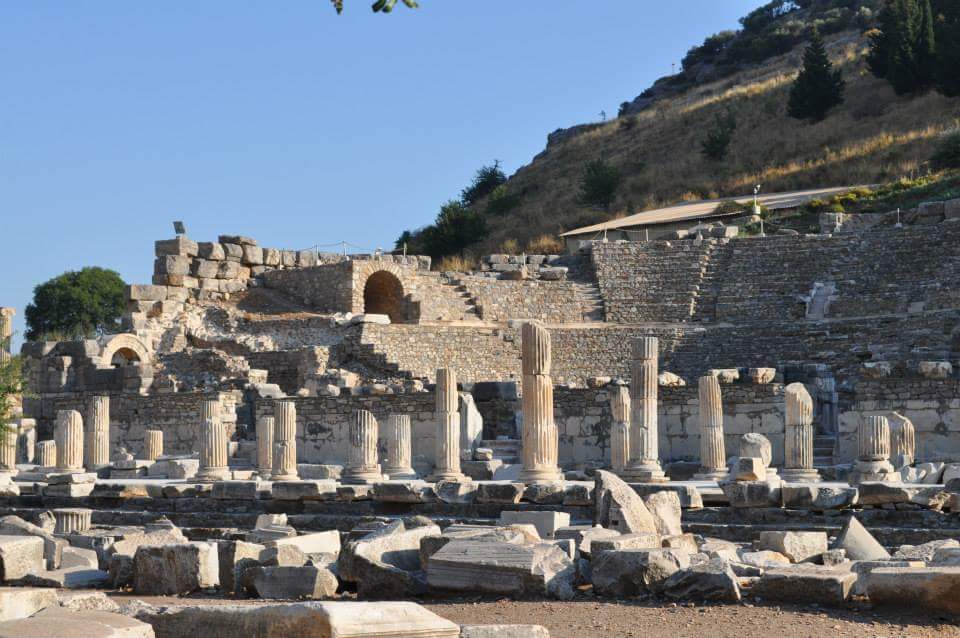
City Hall at Ephesus by Brooke Miller

Peter and Paul, the pillars of the Church, were clear that the only citizenship that counts is our citizenship in heaven. (Phil. 3:20) W are only “sojourners and exiles” in this world. (1 Peter 2:11)

Paul submitted to earthly authorities as though they had been established by God. (Rom. 13:1) He submitted to lashing by Jewish authorities five times! He appealed to his Roman citizenship, but, he clearly saw himself not as a citizen of this world. He was a citizen of the kingdom of heaven that is to come.

He used his Roman citizenship to gain an audience for the gospel among the Romans, to be an ambassador for Christ as he spoke to people in the public squares. He used his credentials as a Hebrew scholar to gain an audience for the Gospel in the synagogues.

Paul submitted to the processes and protocols of Roman and Jewish authorities. He recognized their earthly authority over him. He appealed to that same authority, not for his own advantage, but for the purpose of advancing the kingdom of God.

When we get involved in politics in the 21st century, do we submit to the authorities established by God as Paul did? Paul boasted of his lashings. Paul used his Roman citizenship, not to get out of prison, but to get to Rome to support the followers of Christ there.

Do we count ourselves, first, as citizens of heaven? Paul longed to be with Christ. He used his time on this earth to advance the kingdom of God while he longed for the day when he would put off his perishable body and put on immortality.

Do we use our earthly citizenship not for our own advantage, but to advance the Kingdom of God? When we fight for tougher laws and tighter borders and the right to walk around without masks, are we fighting for the kingdom of God?

Paul said what needed to be said for the sake of the Gospel, but he accepted the earthly consequences of his focus on heavenly things. Paul lived in an earthly world that was hostile to him and everything that he stood for. He submitted to the world’s authority, but he did it in obedience to the authority of God for the advancement of the Gospel, the good news of the coming of the kingdom of God.

Sometimes, I wonder whether we resist authorities that to advance our earthly objectives and appeal to political power and influence to secure our earthly advantage. I wonder how often we have it all wrong.

What are our priorities? To whom do we owe our ultimate allegiance? What are our ultimate goals? Are we seeking to advance the kingdom of God at all costs, including the cost to ourselves and our own position in the world?

Paul used his station in life as a Jewish scholar and a Roman citizen not for his own benefit, but for the benefit of the kingdom of God, to gain audience in front of people, and to spread the gospel. How do we use our station in life, our political power and religious knowledge? To whose benefit are our actions accumulating?

Are we fighting to protect and preserve our own families, communities and country in this world only to lose sight of our citizenship in heaven? Are we striving to save our lives only to lose our souls?

These are questions, not accusations. God knows the heart. I pose these questions in my own heart as write them.


There Is Now No Condemnation, but Go and Sin No More.

When Jesus said, “Neither do I condemn you,” it isn’t the end of the story.

I have been thinking lately about the phrase, “Do not go on sinning.” These were the words Jesus spoke to the woman caught in adultery after he rescued her from her accusers. We forget about them, perhaps, because of the force of the rest of the story.

The Pharisees brought her to Jesus one day and challenged him: “’Teacher,’ they said to Jesus [with a hint of affected deference, I imagine], ‘this woman was caught in the act of adultery. The law of Moses says to stone her. What do you say?’”

They were trying to trap Jesus into saying something they could use against him, but Jesus was not shaken or disturbed by the dilemma they posed him. He stooped to write in the dust with his finger.

The awkward silence was broken finally by a demand for an answer. Jesus obliged,

“Alright, but let the one who has never sinned throw the first stone!”

John 8:7

Significantly, Jesus didn’t deny what the Law says. His answer implied agreement with the judgment of the Law, but his answer turned the table on the accusers and focused attention on them.

His answer is reminiscent of apportion of the prayer that Jesus taught his followers to pray and of a segment of the Sermon on the Mount:

“And forgive us as we forgive those who trespass against us.”

Matt. 6:12

“[I]n the same way you judge others, you will be judged….”

Matt. 7:2

The pregnant silence continued again, as Jesus returned to writing in the dust with this finger. This time, the demands for an answer slipped away with the accusers, one by one, leaving alone with the accused woman.

The focus of the encounter had shifted dramatically from the adulterous woman to her accusers. Their self-righteous smugness turned to bitter disappointment and shame as Jesus put them in their place.

Now alone with the woman, Jesus asked her, “Where are your accusers? Didn’t even one of them condemn you?”; “No, Lord,” she replied. “Then, “Neither do I,” Jesus said.

This seems to be the perfect way for Jesus to end the story. The accusers of the adulterous woman were sinners too. When Jesus said, “Let the one who is without sin cast the first stone”, none of them could do it. They knew they would be condemning themselves. What Jesus wrote in the sand must have hit home with them.

The story would be perfect if it ended there, right? Jesus, the Lord and Savior of the world, says he doesn’t condemn the adulteress woman either!

But that isn’t the end of the story. The story ends with Jesus adding, “Go and sin no more.” (John 8:11)

Those words hang there now for me, as I imagine they did for the woman.

What wisdom and command of the situation Jesus had shown! The pompous self-righteousness of the religious leaders who used this poor woman as a ploy to back Jesus into a corner was deflated. The public humiliation and shame she must have felt was heaped back on her accusers in divine vindication. The gentleness with which he treated her and affirmed her value is beautiful.

But, when the men had left, and she was alone with Jesus, he left her with the instruction, “Go and sin no more.”

Jesus didn’t condemn her, but Jesus didn’t release her to go back to the lifestyle and choices she had made to that point. Why not?

The words, “go and sin no more”, haunt me as I think about myself and how easily I fall into sinful attitudes and stumble. It would so much easier if Jesus hadn’t tagged those five words on to the end of this story!

Continue reading “There Is Now No Condemnation, but Go and Sin No More.”

Don’t Wonder at the Saying, “You Must Be Born Again”

Being born of the Spirit is being awakened to a reality that is greater than the physical reality we presently know

A couple of stories in the Gospel of John illustrate the dichotomy of the natural world and the spiritual world. These are two of the most iconic stories in the New Testament, and they happened in close proximity in time to each other: the story of the Samaritan woman at the well, and the story of Nicodemus.

In this blog post, I want to focus on the encounter of Jesus with and Nicodemus, the Pharisee. Nicodemus was a religious leader of some prominence in the community. Many religious leaders of the time felt threatened by Jesus, but not Nicodemus.

He sought Jesus out to ask him some questions, going to Jesus at night, which suggests that his visit might not have been viewed favorably by his fellow Pharisees. He acknowledged the “credentials” Jesus demonstrated, the miracles that he had done, indicating an openness to what Jesus would say. Without waiting for a question, Jesus initiated the following dialogue:

“Jesus answered him, ‘Truly, truly, I say to you, unless one is born again he cannot see the kingdom of God.’  Nicodemus said to him, ‘How can a man be born when he is old? Can he enter a second time into his mother’s womb and be born?'”

(John 3:1‭-‬4 ESV)

I think was an honest question. The context suggests that Nicodemus wasn’t challenging what Jesus said. He just wasn’t following.

We see by his approach to Jesus that he was open, but he didn’t understand what Jesus was getting at. “What was Jesus trying to say?”

It’s ironic, perhaps, that some Christians who say they take the Bible literally, don’t recognize the ubiquitous use of figurative (non-literal) language and ideas in the Bible. We can’t approach Scripture in a wooden way and hope to understand the depth of it.

If you have wondered what it means to be born again, let’s take a look at what Jesus said to Nicodemus and how Paul applies those concepts after the death and resurrection of Jesus. But first, Jesus continued:

“[U]nless one is born of water and the Spirit, he cannot enter the kingdom of God. That which is born of the flesh is flesh, and that which is born of the Spirit is spirit.'”

John 3:5-6

Jesus obviously didn’t mean that a man must re-enter his mother’s womb and be physically born again. He also doesn’t literally mean that man must be born of water, like out of a lake or something. He does seem to be saying literally, though, that man must be born (again) of Spirit or he cannot enter the kingdom of God, so let’s dig into it and try to flesh out what he means.

Continue reading “Don’t Wonder at the Saying, “You Must Be Born Again””

Reflection on the Unity for which Jesus Prayed: Peter & Cornelius

Sometimes we need to hesitate, suspend judgment and be open to the prompting and move of the Holy Spirit who comes along side us to achieve the unity for which Jesus prayed.


The message I listened to today in the online Chapel Street Church service was about the prayer Jesus prayed for us in John 17:20-23:

“I pray also for those who will believe in me through their message, that all of them may be one, Father, just as you are in me and I am in you. May they also be in us so that the world may believe that you have sent me. I have given them the glory that you gave me, that they may be one as we are one—I in them and you in me—so that they may be brought to complete unity. Then the world will know that you sent me and have loved them even as you have loved me.”

It got me thinking about what I see in my social media platforms: the polarization, division and disunity among the people with whom I am connected. Our nation is as divided as it ever has been in every possibly way.

When we look at the church, do we see a contrast to what we see in the world? Or do we see the same kind of division and disunity in the church?

I know my initial reaction to those questions, but let’s not jump to conclusions yet. God’s word doesn’t go out and come back void. If Jesus prayed for unity, can’t God accomplish it?

When I look out on the Church and think about Church history, I see a lot of division and disunity. Our history books focus on the disagreements, rather than the agreements. In fact, we see disagreement right from the beginning: Paul disagreed with the Gnostics; the Corinthians were fighting over following Paul or Apollos; and even Peter and Paul disagreed over whether to continue to follow Jewish laws on foods and religious rituals.

Disunity seemed to spring up immediately. Or did it?

Paul would say the Gnostics were not true believers. They denied the deity of Jesus and the reality of the resurrection, among other things. Paul urged the Corinthians not to identify either as followers of himself or Apollos, but to identify as followers of Jesus only. The Holy Spirit settled the disagreement over the eating of foods and Jewish rituals when He gave Peter a vision that was repeated three times followed by a “divine appointment” with Cornelius, a Gentile (though Paul would have to confront Peter before Peter finally go it).

In the rest of this blog post I will explore Peter’s story, and what it might mean for us, and maybe I will come back to the other examples in future posts. Continue reading “Reflection on the Unity for which Jesus Prayed: Peter & Cornelius”

Toward an Understanding of the Wrath of a Loving God

If there is no God whose wrath will produce ultimate justice, we who are justice-minded have no recourse other than to respond in kind


I am currently reading, A Gentle Answer: Our “Secret Weapon” in an Age of Us Against Them, by Scott Sauls. The following statement in the book reminded me of similar observations made by Miraslav Volf:

“Some [people] object [to the idea of God’s anger] strongly: ‘…. If there is a God at all for me, it’s not an angry God. My God is loving. My God would never lash out or punish or judge or get angry at people.’ When I hear someone discount or downplay the biblical idea of God as a judge, whose holiness sometimes includes expressions of anger, I wonder if they have ever been the bullied kid, or the abused woman, or the oppressed slave, or the assault victim? I wonder if they have sat down and listened to the story of a holocaust victim, or of someone whose child was kidnapped, or of a woman whose husband abandoned her for a younger mistress?’”

I have heard Tim Keller talk on the subject, and the most poignant source of his ideas that he quoted was writings by Miraslov Volf, the Croatian theologian, professor of Theology and Director of the Yale Center for Faith and Culture at Yale University.

Volf was influenced by his own experience with the Yugoslav Wars, characterized by the ethnic cleansing that raged in what is now known as Croatia in what is, perhaps, his most influential writing: Exclusion and Embrace: A Theological Exploration of Identity, Otherness, and Reconciliation (1996). According to Wikipedia, “Exclusion and Embrace deals with the challenges of reconciliation in contexts of persisting enmity in which no clear line can be drawn between victims and perpetrators and in which today’s victims become tomorrow’s perpetrators—conditions that arguably describe the majority of the world’s conflicts.”

That context might represent a large portion of the world we live in at various times and places. Think Hatfields and McCoys, for instance. In a later work, Volf reflected:

“I used to think that wrath was unworthy of God. Isn’t God love? Shouldn’t divine love be beyond wrath? God is love, and God loves every person and every creature. That’s exactly why God is wrathful against some of them. My last resistance to the idea of God’s wrath was a casualty of the war in former Yugoslavia, the region from which I come. According to some estimates, 200,000 people were killed and over 3,000,000 were displaced. My villages and cities were destroyed, my people shelled day in and day out, some of them brutalized beyond imagination, and I could not imagine God not being angry. Or think of Rwanda in the last decade of the past century, where 800,000 people were hacked to death in one hundred days! How did God react to the carnage? By doting on the perpetrators in a grandparently fashion? By refusing to condemn the bloodbath but instead affirming the perpetrators basic goodness? Wasn’t God fiercely angry with them? Though I used to complain about the indecency of the idea of God’s wrath, I came to think that I would have to rebel against a God who wasn’t wrathful at the sight of the world’s evil. God isn’t wrathful in spite of being love. God is wrathful because God is love.

“Once we accept the appropriateness of God’s wrath, condemnation, and judgment, there is no way of keeping it out there, reserved for others. We have to bring it home as well. I originally resisted the notion of a wrathful God because I dreaded being that wrath’s target; I still do. I knew I couldn’t just direct God’s wrath against others, as if it were a weapon I could aim at targets I particularly detested. It’s God’s wrath, not mine, the wrath of the one and impartial God, lover of all humanity. If I want it to fall on evildoers, I must let it fall on myself – when I deserve it.

“Also, once we affirm that God’s condemnation of wrongdoing is appropriate, we cannot reserve God’s condemnation for heinous crimes. Where would the line be drawn? On what grounds could it be drawn? Everything that deserves to be condemned should be condemned in proportion to its weight as an offense – from a single slight to a murder, from indolence to idolatry, from lust to rape. To condemn heinous offenses but not light ones would be manifestly unfair. An offense is an offense and deserves condemnation…” (From Free of Charge: Giving and Forgiving in a Culture Stripped of Grace pp. 138-139)

These poignant reflections work toward the “appeal”, or at least makes some sense of, the idea of a wrathful, but loving God. I sense, though, that people of modern sensibilities may still be reluctant to credit the goodness of a wrathful God. This is where Miraslov Volf brilliantly exposes the faulty thinking of the western mind that has been largely untouched by evils that are reality in many other areas of the world: Continue reading “Toward an Understanding of the Wrath of a Loving God”