I just finished reading Judges 19-21, and I want to look away. I realize, though, that looking away is exactly the thing I should not do. This story is meant to offend modern and ancient sensibilities alike. We dare not look away and move on without understanding the poignance and significance of this passage in the Bible.
It’s a good time to state the obvious: not all passages in scripture are prescriptive. In fact, many of them are simply descriptive – a statement of what actually happened.
Further, we should recognize that Hebrew Scripture works by burying commentary subtly into the text in ways that require us to question, dig, and pull it out. Scripture is like the buried treasure and the pearl of great price that requires effort to obtain. We are not robots or data receivers. We are living beings contending with a living God and a loving revelation that requires interaction.
Scripture is also brutally candid about the human condition and the human heart. The often repeated phrase, “There is no one righteous, not even one,” is borne out over and over again to be true. All of the Bible testifies to that fact.
Hebrew scripture builds on itself. The patterns and themes we see early on are echoed in later passages. We need to pay attention to the repeated patterns, because that is where the text is signaling that we should dig.
Scripture often confronts us in ways that are highly uncomfortable. If we feel disoriented reading it, that is not a failure of interpretation. That is the point.
“The word of God is alive and active. Sharper than any double-edged sword, it penetrates even to dividing soul and spirit, joints and marrow; it judges the thoughts and attitudes of the heart.“
Hebrews 4:12
The closing chapters of Judges are not merely recounting Israel’s past; they are exposing what happens when a covenant people slowly, perhaps inevitably, detach themselves from the living reality of God while continuing to operate within the forms of religion. The religious structures are maintained, but the substance evaporates through spiritual neglect, idolatry (love of things more than God), and a failure to love others.
The Horror Is the Message
The brutality of Judges 19 is intentional. The narrative is crafted to unsettle us.
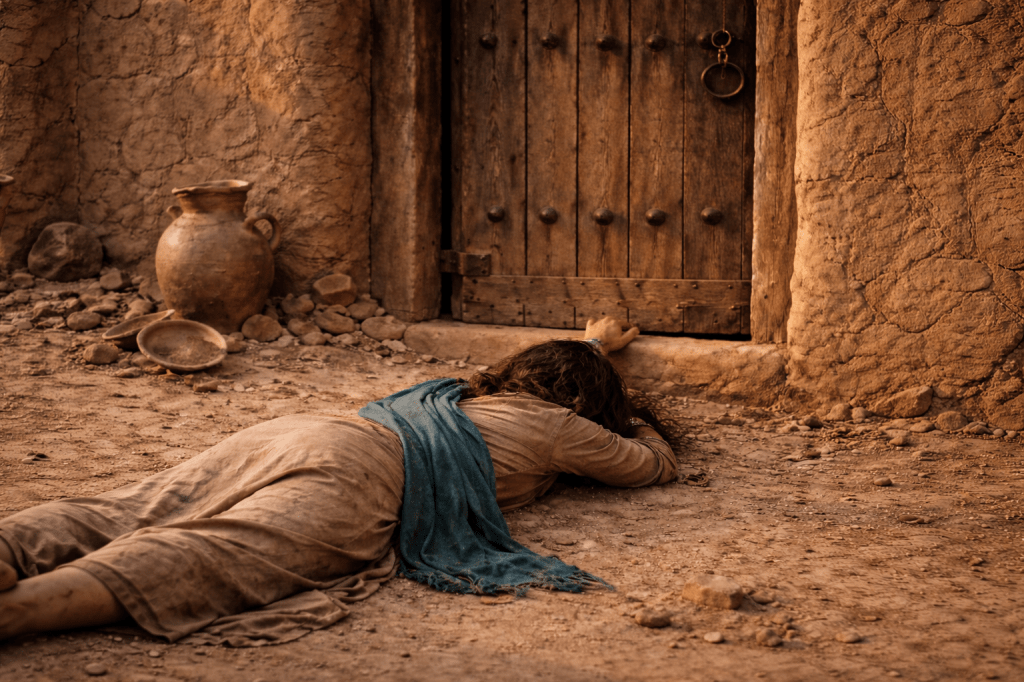
A Levite—one who should embody spiritual leadership—sacrifices the vulnerable to preserve himself. A town within Israel reenacts and surpasses the wickedness of Sodom. A woman is used, abused, and discarded,. And the response of the nation, though clothed in the language of justice, spirals into something equally disordered, brutal, and ungodly.
If we are tempted to distance ourselves from this story, we are already missing the purpose of the text. Scripture is not merely documenting their failure. It is revealing the potential trajectory of our own failings: the inclinations of the human heart untethered from right relation to God and people – the sin that is always crouching at the door, waiting to creep in, and ready to take hold … if we let it
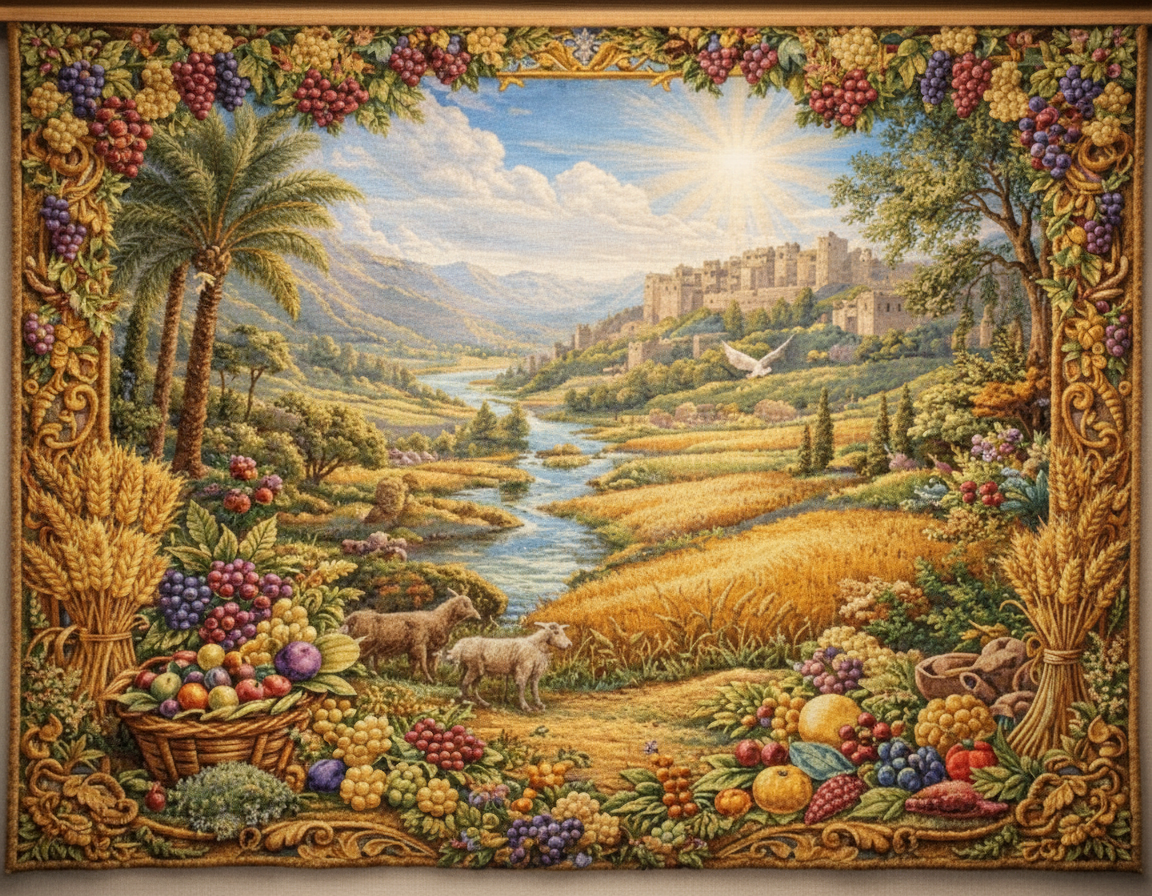
I am increasingly impressed by the importance of understanding the arc and sweep of Scripture from Genesis to Revelation. Though the Bible is a collection of many writings by many authors compiled over many centuries, it is a single, finely woven tapestry rich and brilliant in its nuance and theme.
Of course, a tapestry makes no sense if we do not view it from the right perspective. From the back side of the tapestry it appears like a jumbled mess of tangled threads.
The full beauty and design of the tapestry remains a mystery until it is viewed from the right perspective. Only then can we understand and appreciate it.
We would have no sense of the beauty or theme of the tapestry if we only saw it from the back side. Because the tapestry of thole Bible is so grand, we can also miss the big picture if we study it only as through a microscope or a magnifying glass.
We need to step back often and consider the trajectory, arc, and sweep of Scripture – from beginning to end – to make sense of the individual threads that may not appear to make sense in isolation.
From the time of Abraham, Isaac, and Jacob onward, the Bible seems to be all about these patriarchs and their descendants to whom God promised a land. For over 400 years Abraham’s descendants looked forward to taking possession of this land. That time was spent in captivity in Egypt, where the prospects of God’s promise grew dim and seemed unlikely until God sent Moses.
Led by Joshua, the people finally enter into the land after another 40 years of wandering in the wilderness with Moses. They drive out the inhabitants, settle in, and live there almost a millennia through cycles of judges and kings. It seems all about this land and its people. The theme of God’s covenant to give his people the promised land and the people’s covenant to keep God’s law dominates the portion of Scripture we call the Old Testament.
The land, the great leaders, the Law seem to define their destination. Again and again, however, those things prove to be provisional. The leaders fail. The Law fails because they seem wholly incapable of keeping it. The very land, itself, seems to fail them.
When we step back, we see that these things that seem to be the main point of the whole story actually point beyond themselves. They expose something deeper. They give way to something infinitely greater.
One of those themes that gets buried and lost in the jumble of threads is Jubilee. The Jubilee instructions are embedded in the middle of the Law in Leviticus 25. They are God’s specific instructions on how Israel was to live in the land into which God was leading them. That they never actually carried out the Jubilee instructions may account for us failing to recognize their importance in the tapestry of God’s Word.
The Radical Vision of Jubilee
In Leviticus 25, God established the Year of Jubilee—a societal reset unlike anything in the ancient world. The Year of Jubilee was to be observed after seven periods of seven years. In the 50th year, the Year of Jubilee, the land was to be returned to its original owners. Debts were to be released. Indentured servants were to be set free.
The Year of Jubilee was to be observed every 50 years. Every fifty years was to be a reset.These were God’s instructions and the reason for these instructions was clearly laid out:
“The land is mine” sayeth the LORD, “and you are strangers and sojourners in it.“
(Leviticus 25:23)
Let that sink in….. God never intended Israel to own the land.
Even today many people consider Israel to be the land God promised his people for eternity. Even today we think it is all about the land.
Jubilee appears to us to be an economic policy. A cringeworthy redistribution of wealth that might offend modern, conservative sensibilities. But underneath it lies a theological theme – God’s design – that reshapes everything when we see it:
God wanted them to live in the land, to work the land, to benefit from the land, but only and always as temporary dwellers – as foreigners. They were not to call the land home. They were never meant to treat the land as their own – as owners.
The write of Hebrews understood this, and commended Abraham for living in the land of promise “as in a foreign land, living in tents.” (Hebrews 11:9)
We can understand why, the writer of Hebrews commended the people of faith who “acknowledged that they were strangers and exiles on the earth.” (Heb. 11:13) They were “seeking a homeland … a better country … a heavenly one.” (Hebrews 11:15-16) Why? Because they understood the promised land wasn’t their final destination!
Jubilee is not about fairness, or economics, or socialism—it is about something much more transcendent. It is about God’s eternal plan for the heavens and the earth and all the people in it. It is a reminder to Israel (and us) of who they (we) are in relation to God. It is a reminder that to them (and to us) this world is not all there is. God has bigger plans!
A People Shaped by identity
Though God promised His covenant people a land, their identity as God’s people was the most important thing. God’s vision for them extends beyond land into identity as His people. The Israelites were not meant to identify with the land, but with God.
They were to identity as God’s people living temporarily in a land God gave them, and they were to be a light to the nations. From the days of Abraham, God planned “to bless all the nations” through his descendants. (Gen. 12:3; 18:18; 22:18; 26:4; & 28:14) They were to be a people God called out from among the nations to covenant with Him. These people were intended to identify with God’s greater purpose in the world – which was for all the nations.
Israel is commanded to care for the stranger, the poor, and the landless in the land of God’s promise—not merely as an act of generosity, but as an expression of memory and identity:
“You were strangers in Egypt.”
God wanted them to remember who (and whose) they were. God rescued and redeemed them for Himself and for His purposes. Their story was always meant to shape their community and society into what God wanted them to be. God wanted to establish His people in His land to carry out His eternal plans for all the nations – for all people in the world.
They were not to be a people defined by power, dominance or possession, but by dependence, deliverance, provision, and protection of others – just as God delivered them, provided for them, and protected them. God’s instructions were structured to prevent them from becoming the kind of nation under which they once suffered – a nation like all the other nations around them. They were to be different, holy, and set apart for God’s greater purpose
In Luke four, Jesus announced his public ministry in his hometown synagogue with these words:
“The spirit is on me because he has anointed me to proclaim good news to the poor. He has sent me to proclaim freedom for the prisoners and recovery of sight for the blind, to set the oppressed free, to proclaim the year of the Lord’s favor.”
Luke 4:18-19
Good news to the poor, freedom for prisoners, and freedom for the oppressed echoes Isaiah 61. “[T]he year of the Lord’s favor” echoes Leviticus 25, where Moses passed on the jubilee instructions given by the LORD to the LORD’s people.
Jesus was saying that these things foretold by Isaiah and the Jubilee instructions from Moses were fulfilled in him. Most of us are familiar with the way that many of the prophecies in Isaiah were fulfilled in Jesus, but we may not appreciate how Leviticus 25 takes on special significance – and controversy – in the life and ministry of Jesus.
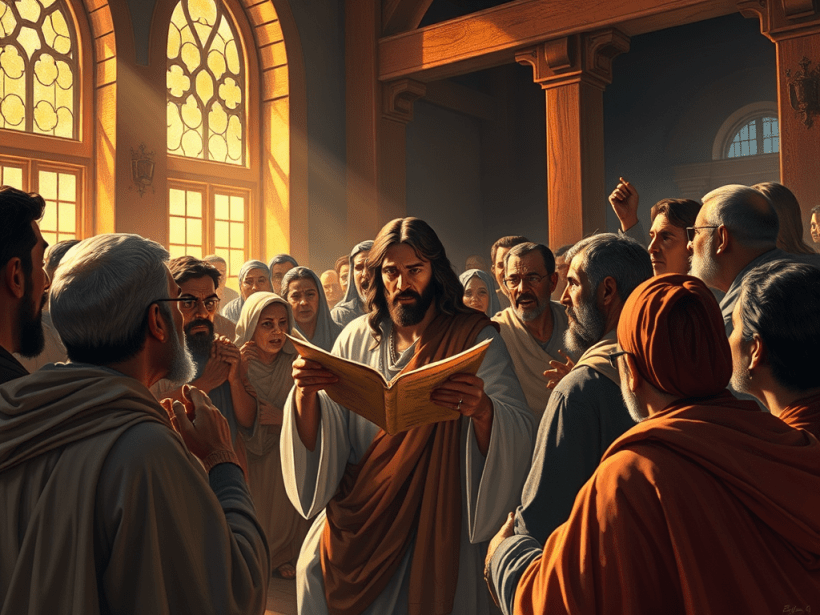
Jesus announced his public ministry in a dramatic way in his hometown synagogue when he asked for the Isaiah scroll, opened it, read the words quoted above, and sat down. The people in the synagogue were initially “amazed at the gracious words” Jesus spoke. (Luke 4:22) By the end of the short exchange that occurred after that, the people wanted to throw Jesus off a cliff. (Luke 4:28-29) What happened?
The words of Jesus that provoked his hometown people to anger were these:
“‘Truly I tell you,’ he continued, ‘No prophet is accepted in his hometown. I assure you that there were many widows in Israel in Elijah’s time, when the sky was shut for three and a half years and there was a severe famine throughout the land. Yet Elijah was not sent to any of them, but to a widow in Zarephath in the region of Sidon. And there were many in Israel with leprosy in the time of Elisha the prophet, yet not one of them was cleansed—only Naaman the Syrian.'”
Luke 4:24-27
Why did these two stories provoke the people to anger? Maybe the better question (the one we might not want to ask) is whether we are much different than they were?
The tension that played out in that Galilean synagogue when Jesus announced his ministry presages our modern reality 2000 years later. We still have a difficult time with the instructions, intentions and long-term plans that God announced when He told Abram that all the nations of the earth would be blessed through his descendants.
Today, I want to review some relevant provisions in Isaiah 61 and Leviticus 25 to explore why that reference did not sit well with God’s people. It wasn’t the references so much as the stories of Elijah and Elisha that he connected to them. Those stories – and what they suggest – may still not resonate well.
For at least 7 years, I have been drawn to the passage in Luke 4 where Jesus gives perhaps the earliest description of his public ministry. Jesus introduced his intentions by reading a select passage from the Isaiah scroll, rolled it up, sat down, and announced, “Today this scripture is fulfilled in your hearing.” (Luke 4:21) These were the words that he read:
The Spirit of the Lord is on me, because he has anointed me to proclaim good news to the poor. He has sent me to proclaim freedom for the prisoners and recovery of sight for the blind, to set the oppressed free, to proclaim the year of the Lord’s favor.
Luke 4:18-19
Immediately after this announcement, Jesus began demonstrating in Galilee what he came to do – teaching with authority (Luke 4:31-32); setting people free from demonic spirits (Luke 4:33-35); and healing the sick (Luke 4:36-40). At the end of this flurry of divine action, Jesus said, “I must proclaim the good news of the kingdom of God to the other towns also, because that is why I was sent.” (Luke 4:43) In this statement, he clarified that the good news he came to proclaim is the coming of the “kingdom of God.”
This short passage from Isaiah 61 that recalls the Year of the Lord’s Favor (Jubilee) focuses our attention back on Leviticus 25, which is the framework for the communal life God desired His people to embrace when they settled into the land of God’s promise.
The context of these words in Isaiah 61 remind of us the significance of these words that defined the ministry of Jesus and the Jubilee principles that characterized his life and message. When Jesus quoted from Isaiah 61 in the synagogue, he was incorporating God’s great plan and purpose into the announcement of his ministry.
Isaiah 61 cannot be understood apart from Isaiah 59, which recalls the iniquities of the people that separated them from God and the blood that was on their hands. (Is. 59:1-2) They abandoned the way of peace and justice. (Is 59:8-9) They walked in darkness. (Is. 59:10) No one was available to intervene. (Is. 59:15-16), so God said He would step in (Is. 59:17) with a Redeemer for those who would repent. (Is. 59:20)
Isaiah 60 announces God’s plan of redemption: “arise, shine, for your light has come.” It presages that “nations will come to your light.” (Is 60:1:3) Isaiah 60:4-16 announces God’s intention that all the nations will come to Israel “bringing your [Israel’s] children from afar” (v.9), and “foreigners will rebuild your walls” (v.10) , and “you will drink the milk of nations and be nursed….” (v.16) Isaiah 60:17-22 promises peace, no more violence, everlasting light, and righteousness.
In that context, Jesus read the opening verses of Isaiah 61 – announcing that the time had come for proclaiming good news to the poor, binding up the brokenhearted, proclaiming freedom to captives and release from darkness for prisoners, and proclaiming the year of the Lord’s favor.
Significantly, the Jesus left out the concluding words: “and the day of vengeance of our God….”
In doing that, Jesus signaled that he did not come for judgment. “For God did not send his Son into the world to condemn the world, but to save the world through him.” (John 3:17) Jesus came to proclaim the good news of the coming of the kingdom of God predicted in Isaiah 61 – healing, freedom, release, and blessing – because God’s people had failed to live into and live up to the plan God had for them.
The words Jesus read culminate with a proclamation of the “year of the Lord’s favor” from Leviticus 25. This is where it gets interesting to me. I have not focused on this part of what Jesus said before, so let’s dive in.
A very good friend and sister in Christ recently gave a devotional presentation to a faith-based non-profit Board of which I am a member. She reflected on her experience of being a minority as a Christian growing up in India, where less than two percent (2%) of the population is “Christian” (including Catholics, Jehovah Witnesses, and Mormons).
Her poignant story of personal struggle with minority status and finding blessing in it, hits home with me. I have never felt like a minority in the visceral way that she experienced it. The blessing she found through Scripture in embracing her minority status is a lesson for all believers.
Being a Christian in a Non-Christian World
My friend struggled with her minority status as a Christian in India. She was ridiculed, teased, and looked down upon. By God’s grace, she felt her divine calling as a child of God, but her identity as a Christian came with consequences.
The consequences proved even more difficult for her sister, who applied to medical school. The admissions officer said she must recant her faith to be approved for assignment to any med school. She refused, and she gave up her dream of becoming a physician. Minority status in a majority world as consequences.
Being a Foreigner in the United States
When she emigrated to the United States she felt the joy of being a part of the Christian majority. Over time, however, the struggle with minority status began to resurface again. She stood out because of her ethnicity, accent, and cultural differences. She realized, “I am a minority within my Christian majority realm.”
This was a very personal struggle for her because of her childhood experience in India. She thought that moving to American where Christians are in the majority would be different. Instead, she felt the sting of minority status. Though she was a Christian in an ostensibly Christian country, she was still an outsider and a foreigner because of her nationality, ethnicity, and cultural differences.
Being a Foreigner in the World
She shared that God met her in the struggle and confronted her with His Word. What she learned through this process was sobering for her, and it is a lesson for those of us who have always lived in majority status in a majority Christian nation.
She began to realize what a privilege it is to be a minority because we are called as believers out of the world where wide is the path that leads to destruction. We are set apart by God from the world, which means we are called to minority status in the world.
Narrow is the path that leads to life. Minority status is the Christian experience.
The Privilege of Minority Status
As she focused on these things God was showing her in His Word, she became grateful for her experience as a Christian in a majority non-Christian country. This experience gave her perspective that American Christians lack.