Francis Chan said in a recent interview that many people walk away [from Christianity, faith, religion] because they have never really had an encounter with God. They walk away from their belief system or their parent’s belief system because they have had no personal encounter with the divine.
“If you really encounter God”, he says, “You don’t do that.” Moses didn’t walk off Mount Sinai arguing about a belief system. Job didn’t return to his belief system or his parents’ belief system. They had real encounters with God, and those encounters changed them.
I have thought for several years about the odd fact that Job had a million questions for God until God appeared. When God showed up, He didn’t provide a single answer to any of Job’s questions, but Job no longer had any questions!
Job’s questions didn’t matter anymore after God showed up!
When Job demanded answers, he wasn’t looking for a belief system. He was desperately seeking an encounter with God, though he might not have known it at the time. If Job had settled for a belief system (or a systematic theology as we might call it), his questions may have been answered, but his doubts would have continued.
People will argue about belief systems, but we don’t argue about an encounter with God. You might not understand my encounter with God, but you can’t refute it. You might question my experience, but I know what I know.
Belief systems don’t change people. Encounters with God change people. A belief system is not the crux of Christianity. If we think it’s all about having a systematic theology, we are missing the forest for the trees; we are accepting a shadow of the real thing. The real thing is God, Himself!
Francis Chan ended his train of thought with the words of Isaiah in 29:13:
“[T]hese people draw near with their mouth and honor me with their lips, while their hearts are far from me, and their fear of me is a commandment taught by men….”
Christianity has no life or vitality if it is nothing more than a commandment taught by men. The essence of Christianity is Jesus. Jesus is God who became man. Jesus said,
“Whoever has seen me has seen the Father.” (John 14:0)
We do not know God if we have never encountered Him. Mental ascent is not the same thing as knowing God through encounter with Him!
Jesus urged people to seek God. He didn’t urge people to seek to know about God. He urged people to seek to know God, personally. He urged them to seek God, the Person!
Jesus said, “I am the way, the truth and the life.” He didn’t say, “I can show you the way”; or “I can teach you the truth”; or “I can give you the life”. He said, “I AM the way, the truth and the life!”
The way, the truth and the life resides in the person of Jesus Christ. Jesus is one with the Father, and He left behind the Holy Spirit, who is also one with God the Father and who accessible to us, that we might know God intimately and personally.
We settle far too often for mere knowledge and belief systems. What we need is encounter and relationship with the Living God. What we need is the Living Water and Living Bread, which is God, Himself.
Paul said, “What business is it of mine to judge those outside the church?” (1 Cor. 5:12) This is where my mind went when I watched An (Un)Civil War: The Evangelical Divide posted online recently by CBS News. In the next moment, I was asking question Joshua asked the commander of the army of the Lord: “Are you for us or for our enemies?” (Joshua 5:13)
If you know the Lord’s answer to Joshua’s question, think about it for a moment. The subject here is the modern form of evangelicalism that is highlighted in the CBS piece linked above: hyper patriotic, nationalistic and political. I will come back to the Lord’s response to Joshua before I conclude. (You can read the passage now if you are too curious to wait.)
I hardly watch the news anymore, and CBS is certainly not my “go to” news source. I don’t have one. The portions of the CBS piece that are ringing in my head are the clips of the evangelical leaders preaching and explaining themselves in their own words.
I do understand that these clips are selected and don’t represent all that these leaders stand for or all that they might say. What they reveal, though, is enough to move me to write.
The clips show various preachers unapologetically “speaking the truth” from the pulpit, which the commentator calls “sermonizing a brand of social conservatism defined by conspiracy and apocalyptic rhetoric”. The words of the commentator are not what catch my attention, but they should be noted for the way they are perceived.
The piece focuses on what is described as a “power struggle” in evangelical circles. That is how the world sees the difference in opinions by evangelicals: a power struggle inside Christianity “at war within itself”.
One firebrand pastor (Greg Locke) touts the amount of support for his position, seeming to affirm the perception that it’s all about power and influence. In the world of politics, the number of evangelical constituents (over 1 in 4 Americans) is a matter of power and influence to political pundits. Locke’s comment and the concern expressed in the media piece align on that basis.
(I question whether 1 in 4 Americans are really evangelicals in the way I and most people of genuine faith define evangelicals. The statistic is a political one, not a religious one, but that is a topic for another day.)
One pastor is heard saying, “But we shouldn’t talk politics in religion. Says who? Satan?! That’s the only way they control us!”, he says. “To get us to be silent.”
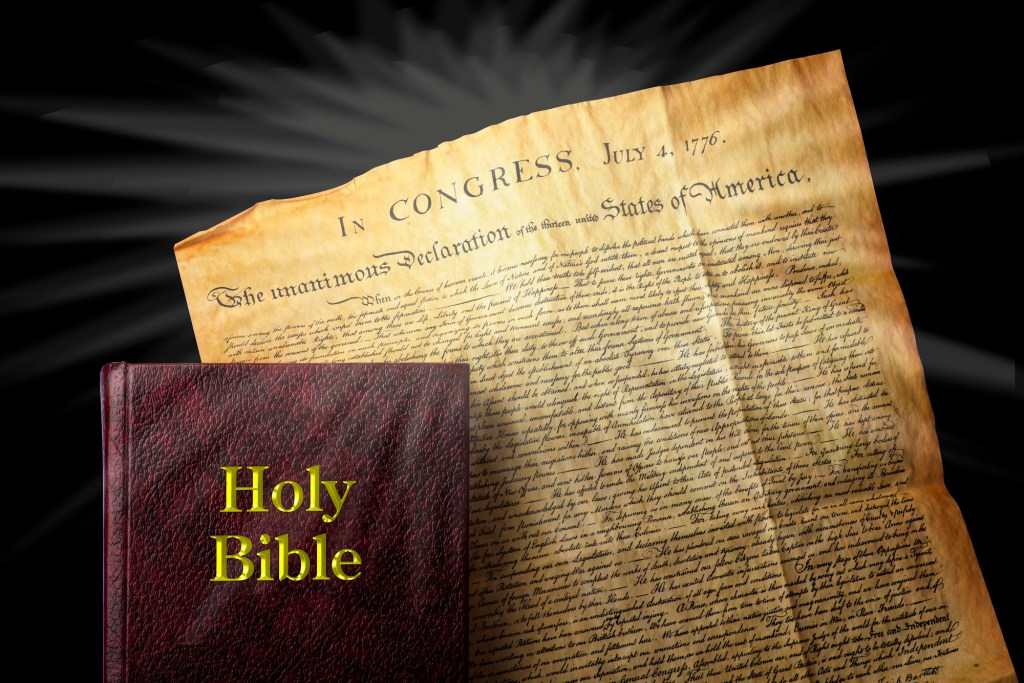
Indeed, power, influence, and control are at the center of this phenomenon. At the same time, Locke claims that the Bible is the issue, “Here is what the Bible says. Boom! We’re going to go with it!”
Locke views himself as fighting for the Bible, fighting for ‘God and country”, trying to wrestle the United States out of the grip of the left and Satan. But, is that really what is going on? What about the Bible?
Are they actually preaching what the Bible says?
There is so much to be said here, but I want to focus on just three things: 1) what the Bible says; 2) what the message of the Gospel is; and 3) whose side God is on in this struggle.
The creation of Adam – Vatican Sistine Chapel in Rome, Italy. Created by Michelangelo Buonarroti.
I took some interest in a Facebook post at Bible Archaeology[1] about the image of Tiberius Caesar on a Roman coin like the one Jesus referenced in Matthew 22:15-22.[2] Some scriptural references and back ground facts are the subject of my writing today.
The story is well-known. Some Jewish leaders challenged Jesus with the question, “Is it lawful to pay taxes to Caesar, or not?”
It was a ruse. They were trying put Jesus into the impossible position of aligning either with the Jews (against the Romans) or with the Romans (against the Jews) on the issue of paying taxes.
Jesus famously asked for a coin, and then he asked whose image was imprinted on the coin. It was Caesar’s image, of course. Then Jesus said, “Therefore render to Caesar the things that are Caesar’s, and to God the things that are God’s.”
Perhaps, my interest was piqued because I have written about the story before. I talk about rendering unto Caesar in the context of how Christians should respond to secular authority.[3] I wrote about Jordan Peterson’s comment, crediting the words of Jesus to the creation of the modern principal of the separation of church and state.[4] But I haven’t focused on what it is we are to “render” to God.
I am always excited to learn something new, and the Bible Archaeology post added some details I didn’t know. The first details provide the backstory to the story, which involves Judas the Galilean. The interrelationship of the two stories shows how intertwined, complex, nuanced and harmonious Scripture is within itself and with external facts discovered through historical and archaeological sources, among other things.
I appreciate the historians and archaeologists, like Bible Archaeology, that dig up corroborating details. In the Facebook post, they cite additional scriptural passages on Judas the Galilean that give us insight into why the Pharisees in Galilee challenged Jesus on the issue of paying taxes.
I have been busy of late (what else is new?), so I haven’t written much, though I always have thoughts swirling in my head that I would like to get “down on paper”. Today, I have just a short thread I want to get out of my head.
Paul speaks of the God Abraham believed in as the God “who gives life to the dead and calls into existence the things that do not exist.” (Romans 4:17 ESV)
Many are the gods that people have believed in since time immemorial. From gods made of wood and stone, to trees, mountains, the sun and other natural objects, to the pantheons of Greek and Roman gods, the number of gods people have believed in are legion.
Today, Hindus still have a panoply of gods, and pagans still worship objects of nature (or simply nature, itself). Christians and Muslims have whittled the legion down to one, and atheists believe in, simply, one less God than they. Other than the atheists of the world, most of humanity believes in something transcendent that is labeled divine.
The human drive is to attempt to discern the transcendent. Most agnostic believe that something transcends the natural worlds, though they won’t dare to divine what it is. Even some atheists hold out some form of believe in transcendence, even if they ultimately determine it is illusory. They acknowledge, like Stephen Hawking did, that it is helpful to believe it.
There is mystery in the transcendence we sense breaking into the world. There is intrigue. There is anticipation, and there is hope in the sense of transcendence that lingers often on the blurry edges of our mundane existence, sneaking into it at times leaving us breathless and wondering.
I often allude the curious statement in Ecclesiastes 3:11 that God put eternity in the hearts of men:
“He has made everything beautiful in its time. He has also set eternity in the human heart; yet no one can fathom what God has done from beginning to end.” (NIV)
If God didn’t put a yearning for transcendence into the human heart, where does it come from? I believe that is a rhetorical question.
For many, the idea of a transcendent being or reality is just too much to grasp. It is surrounded by too much uncertainty and requires too much strain and effort to attain even a dark understanding of it that they determine the simpler, easier and preferable course is to remain agnostic or to dismiss the idea of transcendence altogether.
Others have taken the leap to embrace one understanding or another and have committed themselves to that understanding. Thus, the legions of gods that have existed in the constructs of human thought. And that might just be what all or most of them are – constructs of human thought, attempts at putting a “face” on the transcendence we sense in he universe.
One man, Abraham, believed in a God “who gives life to the dead and calls into existence the things that do not exist.” This was a God above all gods. This was a God who spoke the universe into existence.
This was a God who Paul and other first century Judeans believed entered into the world He created in the form of a created being in whom He imprinted His own image. God could enter that being because He created room for Himself in that being. The writer of Hebrews says:
“[Jesus] is the radiance of the glory of God and the exact imprint of his nature…. (Heb. 1:3)
In very recent times, our best scientists have determined that the universe had a beginning. It came into existence a finite time ago. Stephen Hawking demonstrated the necessity of “singularity” (a beginning) mathematically.
The trio of Arvind Borde, Alan Guth and Alexander Vilenkin determined mathematically that any universe that is expanding had a beginning (a singularity) a finite time ago. Thus, a point of singularity, a beginning, would apply to any number of multiverses.
The fact that our universe, and any universe like ours that exists or could possibly exist, had a beginning a finite time ago raises the specter of the transcendent – a Beginner who initiated our universe into existence.
This is the God Abraham believed (a God who “calls into existence the things that do not exist”) in at a time when people were still making gods out of wood and stone. Though the entire world he knew thought they could conjure up and appease gods they made, Abraham believed in the kind of God that is utterly transcendent and which could create a universe out of nothing by speaking it into existence.
Abraham also believed in a God who could raise dead things to life. Paul in the first century, and all the followers of the man, Jesus, claimed that Jesus is the vindication of that belief. That Jesus was God who became man – emptying Himself (Phil. 2:7) to take on the form of a being (man) who God created in His image. (Thus, it was a good fit!)
That man demonstrated the character of God for us in the way he lived out his life. He reflected God’s love for us by his willingness to give his own life for us. He gave us the ultimate, transcendent hope by rising from the dead in that same body and inviting us to follow him.
Now, Paul says, we only have a partial understanding of that God who would stoop to come to us and demonstrate His love for us, but there will come a day when we shall know as we are fully known:
“For now we see only a reflection as in a mirror; then we shall see face to face. Now I know in part; then I shall know fully, even as I am fully known.” (1 Corinthians 13:12)
We yearn for Him because of the eternity that He set in our hearts, and we have some understanding of him because of His image that He placed in us. We can put a “face” to God in the life of Jesus, and we have hope that we will see Him “face to face” because of the resurrection of Jesus in human body he inhabited.
He holds out the promise to all of us that He made through Abraham thousands of years ago – a promise that Abraham could not even articulate other than to say that, through him and his descendants, God would bless all the people of the earth.
And Jesus left for us the Holy Spirit, which is God in the form of Spirit who is available to come into and reside in each one of us (John 14:15-21) who have invited Him in to reside with us to bear witness with our spirits that we are children of God. (Romans 8:16)
These things characterize the God of Abraham who was revealed more completely through the incarnation of Jesus. These things set one conception of God apart from all other conceptions of gods, and even the conceptions of one god that remains aloof. The hope of the God of Abraham is Christ in us!
The Son is the image of the invisible God, the firstborn over all creation.For in him all things were created: things in heaven and on earth, visible and invisible, whether thrones or powers or rulers or authorities; all things have been created through him and for him.He is before all things, and in him all things hold together…. [and he is] Christ in you, the hope of glory.” (Colossians 1:15-17, 26)
I spend a fair amount of time thinking about the Pharisees in Jesus’s day and who the Pharisees of our day might be. Jesus was pretty tough on them as a group. It seems that maybe we should pay attention.
They were religious leaders, of course. The Oxford online dictionary defines a Pharisee as “a member of an ancient Jewish sect, distinguished by strict observance of the traditional and written law, and commonly held to have pretensions to superior sanctity”. The word, Pharisee, has become synonymous with a self-righteous person or a hypocrite.
I think it’s easy to write them off as a particularly unenlightened, archaic clique of religious leaders who completely missed the boat when God became man and walked among them. I also think it’s dangerous for us to dismiss them so offhandedly.
Pharisees weren’t the only religious leaders in the First Century. The Sadducees were another “party” of religious leaders in that time. Like Democrats and Republicans today, the two groups were in conflict with each other over politics and theology. There were also Zealots and Essenes who were more on the fringes.
The Sadducees were more elite and upper class than the Pharisees. They were also more conservative, at least in the sense of recognizing only the written Torah, rejecting the “oral Torah” (along with the Prophets and the idea of resurrection of the dead).
The Pharisees were more trusted by common folks. While the Sadducees incorporated and settled into Greek culture and thought, the Pharisees opposed it, remaining more “pure”, emphasizing Mosaic Law alone.
The word, Pharisee, means “set apart, separated”. Though I am not aware of any Sadducees who followed Jesus, more than a few Pharisees were believers, including Nicodemus (John 3:2), Joseph of Arimathea (John 19:38), an unknown number of “those of the party of the Pharisees who believed” (Acts 15:5). Paul, of course, was also a Pharisee.
The Pharisees were the trusted religious leaders of the common people. They had the most interaction with Jesus, perhaps, because they interacted more with the common people than did the Sadducees. The Sadducees were more politically aligned with the Romans and enjoyed more privilege and position.
The Pharisees, as I have come to see them, are a lot like many of our religious leaders today. They were earnest in their effort to remain true to the Mosaic teachings, to honor God and to live lives devoted to God.
They were also misguided, of course. They missed the proverbial forest for the trees. God became man and walked among them, and most of them didn’t recognize Him. They clung too tightly to their ideas of who the Messiah would be and what he would be like – they clung too tightly to their doctrines – to recognize the Messiah when he showed up.
In this tendency to cling to traditional ideas, to be dogmatic about doctrine, to focus too much on particulars and, thereby, miss the big picture, I see possible parallels to the Christian world of today. I don’t claim to know exactly how that parallel applies, but I think we need to take seriously the idea that we have Pharisees among us (and have Pharisaic tendencies in all of us).
I think it’s dangerous to assume that we are not like the Pharisees today. The Pharisees are much more like us than we care to admit or consider. Most devout believers are more in danger of being a “Pharisee” than a heathen, for instance. If we are going to fall into error, it will likely be on the side of the Pharisees.
The Pharisees weren’t necessarily wrong (or weren’t all wrong) in their theology. It was more in the application. They focused on the letter of the Law, but they failed to understand its “spirit”. They focused more on how they appeared to others than how God saw them.
They knew their Scripture. They knew that the Messiah would come from Bethlehem and from the house of David, so they rejected Jesus because he appeared to be from Nazareth. They “knew” nothing good came from Nazareth (more of a cultural reality), but they failed to keep an open mind. If they had done a little research, they would have discovered that Jesus did come from David’s line and from Bethlehem.
Dogmatic thinking that “locks in” certain interpretations of Scripture and the expectations that grow out them is as much a danger for us today as it was for the Pharisees in the First Century.
The Pharisees were concerned about instructed people to behave in certain ways, and they were quick to denounce actions that were out of step. They tried hard to conform their own actions to those expectations. In doing this, however, they were focusing on outward appearances.
Jesus challenged them in their assumptions, their traditions, their dogmatic adherence to theology and doctrines they held, and in their practices:
“And the Lord said to him, ‘Now you Pharisees cleanse the outside of the cup and of the dish, but inside you are full of greed and wickedness. You fools! Did not he who made the outside make the inside also? But give as alms those things that are within, and behold, everything is clean for you. But woe to you Pharisees! For you tithe mint and rue and every herb, and neglect justice and the love of God. These you ought to have done, without neglecting the others.'”
Luke 11:39-42 ESV
This reminds me of the faith and works tension that we wrestle with as modern Christians. We should know better than the First Century Pharisees did that we are not saved by our outward actions. We are not saved by our merit or our own efforts. We are saved by grace alone, which we perceive and embrace by faith.
Yet, we have the tension that faith without works is dead. A tree is known by its fruit. We also care deeply how other people perceive us. We have no less pressure to conform our actions to expectations than they did. How, then, should we live?