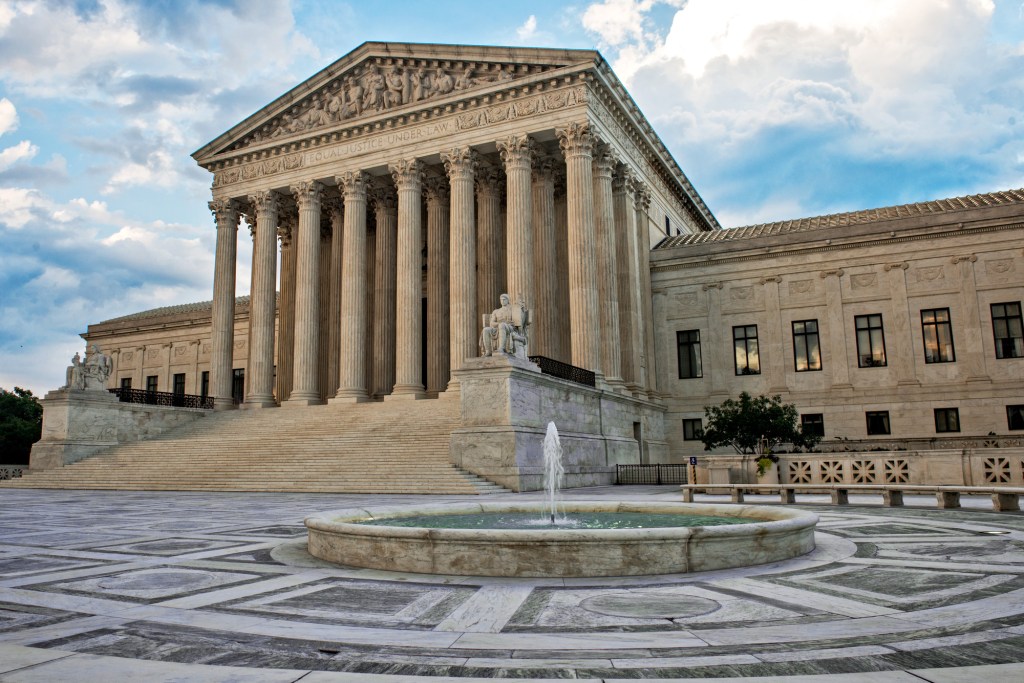
Davide French has expressed some of my own angst at the news that the Supreme Court overturned Roe v. Wade in a recent article, Roe Is Reversed, and the Right Isn’t Ready. Like him, I have championed the pro-life cause. My wife and I marched in Washington. We protested at an abortion clinic. We supported a crisis pregnancy center. I have largely been silent, however, for the past 30 some years.
In 1988, the year I entered law school with two children, financial difficulty, and a very uncertain future, my wife became pregnant. It was the most difficult year of our lives. She was severely sick, living in a strange place 1000 miles from her family under extreme pressure.
When the doctor told her the baby tested positive for spina bifida, and she should consider an abortion, she changed doctors. I supported her fully. We were committed to life.
My son who was born in 1989 is 33 years old now. He bears the scar tissue at the base of his spine where his spinal cord once looped outside his spinal column. He was born that way – with the scar tissue, healed over, fully formed and perfectly healthy.
He became a champion wrestler, All-State, many times All-American, many times national finalist, multi-time national champion. My wife might not have been born if abortion was legal in 1961, and my son would not have been born if we we listened to our doctor.
We were very fortunate, and we are very grateful, and I realize the story could very well have been different. Many people are not as fortunate.
There is a constitutional issue with abortion, a moral issue, and then there is the issue of how the body of Christ demonstrates God’s love in this broken world. I have some thoughts on each of these issues, and I feel compelled to weigh into these turbid waters despite my hesitation.
The constitutional issue has been settled… for now. As an attorney and having studied the Roe v. Wade decision in law school, I can say with some degree of confidence that it had thin precedential support. It’s foundations were shadowy and wispy as a matter of constitutional jurisprudence, relying on a medical understanding of the day, and not legal principles, to shore up a lack of solid, legal precedent.
In the David French article he quotes Justice Ruth Bader Ginsberg who seems to admit the same point. She once “declared Roe ‘breathtaking’ and warned that ‘Doctrinal limbs too swiftly shaped, experience teaches, may prove unstable.’” Her prescience was accurate. It stood for one year shy of 50, but those doctrinal limbs have given away under their own weight.
“The Court’s job is not to determine which rights we should possess but rather which rights we do possess,” says French. (Emphasis in the original) So, it should be. So, the Constitution is written. So, the jurisprudence informs us.
Lawmaking is the province of Congress, not the judicial branch. Ironically, though, the instability of that decision haunts not just the left today. Framed on the back of a politically motivated opinion for which little precedent existed for support, that one decision has greatly politicized the Supreme Court to our jeopardy.
That most people perceive the opinion that struck down Roe v. Wade as a political accomplishment is proof, and that should not be comforting news. A Supreme that can be lobbied and jockeyed and filibustered to do the majority’s bidding is a threat to freedom and sound government.
And, of course, the recent decision was just as political as the decision it overturned – maybe more so. The Court that decided such a progressive decision as Roe v. Wade was largely appointed by conservative presidents. Richard Nixon appointed Justice Blackmun, who write the majority opinion.
There was a day when Presidents made an attempt to appoint the most impressive legal minds to the high court. Confirmation hearings focused on their credentials and legal acumen. The justice appointees and the senators who vetted them knew well and respected the value of impartiality that is essential to true justice. In an odd way, Roe v. Wade, penned by a conservative appointee is proof.
For the last 40 or more years, however, most confirmation hearings on appointments to the high court have been political circuses. No question is off limits, including the direct question of how a justice will decide an issue that comes before him or her. It no longer matters that the Rules of Professional Responsibility that govern all judges forbids that very thing.
Pro-life champions are notching the recent decision as a win, but the battle rages on. This decision pushes the battle to the legislatures of the 50 states.
More fundamentally, though, pro-lifers may have won this battle, but the Republic may be losing the war. The more our Supreme operates by political fiat, the less stable we become.
As for morality, it seems that many people assume the pro-life position is a religious view. While many religious people are pro-life, many religious people are pro-choice also. I have seen many of my religious friends categorically criticize the decision in the last few days.
At the same time, the pro-life crowd includes non-religious people, including atheists, like Kelsey Hazzard, who says, “The abortion industry would have you believe that people like me do not exist.” Reducing the abortion issue to a religious category is scapegoating and insulting to people who claim not to be religious.
No other modern issue offers less common ground for compromise. A fetus is either human life with intrinsic value, or it isn’t. A women’s body is either an inviolable vessel subject to her self control, or it isn’t. A fetus in a woman’s womb is part of her body, or it’s an unborn baby with separate and distinct personage, value, and legal status.
I find the arguments for life to be compelling, but the arguments for choice are compelling also. The stories are real. The fact that women, alone, bear the burden of the consensual (or non consensual) act of sex is reality.
A man can and often does escape all responsibility, but a woman has nowhere to hide. The fact that man are not compelled by the state to bear their responsibility is criminal.
Yes, many states have laws on the books that allow a woman to prove paternity and make the man pay support, but that’s on her dime! Some local prosecutors will take those cases, but those positions are too few, too overworked, and have insufficient resources to take on all cases.
I have slowly come around to an uncomfortable angst on the morality of abortion.
Thirty four years ago, our conviction about what we should do when faced with the probability that we might have a physically deformed child was unwavering. We chose to protect the life God gave us. I still think abortion is morally wrong.
It doesn’t matter whether that life might be deformed or have down syndrome. It doesn’t matter what the economic, social, and other circumstances are. I am not saying there are no exceptions, but most exceptions do not justify taking a life.
This is the black and white, analytical position I believe in, but I know the challenge is not in the black and white, but in the grey. The exceptions to the rules are always where the difficulty lies. Life is complex, and complexity is nuanced.
I am not going to say much more about the morality. I know where I stand, but I know good people who share my faith – people I have prayed with – who do not share my position.
About 18 months go my view of things shifted through the unlikely coincidence of my annual Bible reading and a serendipitous sermon on Sanctity of life Sunday. (See Thoughts on the Sanctity of Human Life….” I hope you will take the time to read it, because it informs my questions to the body of Christ.
Does God hear the cries of unborn babies? Does God hear the cries of women who have been abused and misused? The answer is certainly, “Yes”.
There are people on both “sides” of the abortion story. I believe Scripture warns us about our focusing on the “sides” and urges us to consider the greater purposes of God. Do you remember what the angel of the Lord told Joshua, when Joshua asked which side he was on? Go ahead and check it out.
Do you think God rejects innocent babies who have not yet taken a breath? How you answer that question may well reveal how you perceive God.
How you answer that question likely influences how you respond to this issue. Read Exodus 2 and Exodus 3. Whose cries does God hear, and what cries prompt Him to respond?
I hope you don’t gloss over these questions. I hope you wrestle with the implications. Who is it that God is concerned about? And why?
Go back to the question about how God handles the death of an unborn baby who has yet to take a breath. Does He receive them? Or does He reject them?
I urge you not to gloss over these questions.
How we answer them informs how the Church should orientate itself on the issue of abortion. Our answers suggest the priority of our focus and how we should live out the Gospel on this issue.
How we do that individually is a matter of the gifting God has giving each of us, the burden He has put on our hearts, and the leading of the Holy Spirit. We will only make our way forward as the salt and light God intend us to be with much prayer and humility and trepidation.