How difficult it is for those who have wealth to enter the kingdom of God! For it is easier for a camel to go through the eye of a needle than for a rich person to enter the kingdom of God.
In reading through the Gospel of Luke, the doctor, historian and traveling companion of Paul, two dialogues appear in chapters 18 and 19 about men of wealth. They are the stories of the Rich Young Ruler and Zacchaeus, the tax collector.
Both men are rich and are tied into the local power structure. They both seek out Jesus and encounter Him, but one turns away, saddened because of his wealth, while the other receives Jesus joyfully. And, then there is the story of Ananias and Sapphira. They had become part of the early church, but wealth became their undoing.
All three stories deal with wealth and possessions and relationships with God. And more importantly, they deal with the heart. We will review each story in this three part series on wealth and relationship to God.
And he said to them, “Which of you who has a friend[1] will go to him at midnight and say to him, ‘Friend, lend me three loaves, for a friend of mine has arrived on a journey, and I have nothing to set before him’; and he will answer from within, ‘Do not bother me; the door is now shut, and my children are with me in bed. I cannot get up and give you anything’? I tell you, though he will not get up and give him anything because he is his friend, yet because of his persistence[2] he will rise and give him whatever he needs. And I tell you, ask, and it will be given to you; seek, and you will find; knock, and it will be opened to you. For everyone who asks receives, and the one who seeks finds, and to the one who knocks it will be opened. What father among you, if his son asks for a fish, will instead of a fish give him a serpent[3]; or if he asks for an egg, will give him a scorpion? If you then, who are evil, know how to give good gifts to your children, how much more will the heavenly Father give the Holy Spirit to those who ask him!” (Luke 11:5-13)
Reading through Luke recently this passage impressed me in a way that hadn’t occurred to me previously. We often remember things out of context, but context is important and provides insight, and sometimes even changes what we think we know of the verse, standing alone.
It seems that the ask, seek and knock passage is often remembered for the proposition that God, our heavenly Father, will give us the good things for which we ask, seek and knock[4] because a natural father doesn’t withhold good things for his children. But that isn’t the central point of the passage.
This passage is beautifully laid out in a progression of intimacy that I had not seen before.
Sacrifice began with Cain and Abel. Able gave an acceptable sacrifice, giving to God from the best of what he had. God accepted Abel’s sacrifice and Cain became jealous of Abel’s favor with God and took his life.
The sacrifices offered by Cain and Abel were outward expressions of their hearts toward God. Abel offered to God a sacrifice from among the best that he had; Can did not. Cain’s reaction of taking Abel’s life was also an expression of his heart, being self-absorbed and jealous and unable to countenance the favor Abel obtained from God. This only shows, however, there is more to the offering of a sacrifice than meets the eye.
Christians read the OT through the lens of the interpretation of Jesus. Jesus told the Pharisees, “You search the Scriptures because you think that in them you have eternal life; and it is they that bear witness about me, yet you refuse to come to me that you may have life.”[1] On the road to Emmaus, Jesus came along side two disciples after He had risen from the dead and interpreted the Scriptures for them, showing them “all the things concerning himself”.[2]
Jesus tells us that the OT is a precursor to the NT. The OT laid the groundwork for the NT and prepared the way for the revelation of Jesus. A Christian can’t read the OT divorced from the NT. It makes little sense by itself.
When it comes to sacrifice, the entirety of the OT points to the ultimate sacrifice that was to come – the sacrifice of God who became man and gave Himself up for us. God turned everything on its head in that culminating moment, and we learn (looking back) that this was the plan all along. God intended from the beginning to do this, and He prepared the stage for it through His working with Abraham and Abraham’s descendants, stubborn and rebellious though they were.
They were exactly like us. But that means there is hope for us!
And that is the problem. God can be nothing other than who He is. He is (in Himself) the standard to which all things are compared. If we want to have a relationship with God, it must be on God’s own terms because God is who is He is.[3]
God did create us in His own image[4], but that doesn’t mean that we are exactly like Him. He gave us agency, the ability to choose, including the ability to choose to reject Him and go our own ways.
If God is the standard of goodness, a choice to embrace anything other than the goodness of God is evil. Evil doesn’t exist without good. Good is the benchmark against which anything other than good is measured, and anything other than good is evil.
In giving us this choice, God gave us the gift of love, because love can’t exist without choice. If we have no choice but to reflect God’s character, we would not be able to know and reciprocate love, because love is a choice. Hold that thought.
When we think of the sacrifices in the OT, we think of the animal sacrifices that became the central activity in the Temple. Why did God require them? What was the purpose of the system of ritual sacrifices that God instructed?
The surrounding nations and religious activity from time immemorial to the present day included sacrifices to appease angry gods and gain favor with them. Was this simply more of the same?
Actually, no. This was a paradigm shift. For one thing the surrounding nations engaged in child sacrifice, but God forbid the practice by the Israelites.[5] When the Israelites engaged in the practice anyway, God judged them for it.[6] Instead, God instructed them to sacrifice animals.
In doing this, God began to condition His people for something other than what the rest of their known world did. God began to lead them in a different direction. The switch from child sacrifice to sacrifice of animals was only one step in the process, and it wasn’t the destination, but only part of the journey.
The sacrificial system God gave His people pointed beyond it to something else. When God gave the instruction to Moses in regard to the sacrificial system, He explained, “For the life of a creature is in the blood, and I have given it to you to make atonement for yourselves on the altar; it is the blood that makes atonement for one’s life.”[7]
The sacrifices were intended to provide the atonement for the sins of the people. God provided an “out” – a way for a sinful people to be restored to relationship with God. It is a necessary corollary to the ability to choose evil instead of God, but the animal sacrifices weren’t mean to be a permanent fix.
After many generations of failure to walk in the ways that God established for His people, continually returning to the gods of their neighbors and the evils that God warned them to leave behind, God began to send them prophets. At the height of their failings and continual wandering after the evils God warned them against, God spoke these words through the prophet Isaiah:
“11 What to me is the multitude of your sacrifices?
says the Lord;
I have had enough of burnt offerings of rams
and the fat of well-fed beasts;
I do not delight in the blood of bulls,
or of lambs, or of goats.
12 “When you come to appear before me,
who has required of you
this trampling of my courts? 13 Bring no more vain offerings;
incense is an abomination to me.
Likewise, God spoke through the prophet Hosea:
For I desire steadfast love[8] and not sacrifice,
the knowledge of God rather than burnt offerings.
It wasn’t the sacrifices that God wanted; it was relationship. The sacrifices God instructed His people to make were not the permanent fix, as stated above. It was only a temporal means to a more permanent end. The permanent fix was not to come from man, but from God.
As stated in Hebrews, the sacrificial system was only an illustration.[9] The sacrificial system was merely a temporal, external regulation pointing to an eternal, internal reality that was to be revealed in Christ.
“But when Christ came as high priest of the good things that are now already here, he went through the greater and more perfect tabernacle that is not made with human hands, that is to say, is not a part of this creation. He did not enter by means of the blood of goats and calves; but he entered the Most Holy Place once for all by his own blood, thus obtaining eternal redemption. The blood of goats and bulls and the ashes of a heifer sprinkled on those who are ceremonially unclean sanctify them so that they are outwardly clean. How much more, then, will the blood of Christ, who through the eternal Spirit offered himself unblemished to God, cleanse our consciences from acts that lead to death, so that we may serve the living God!
For this reason Christ is the mediator of a new covenant, that those who are called may receive the promised eternal inheritance—now that he has died as a ransom to set them free from the sins committed under the first covenant.”[10]
This is why, when Jesus was dying on the cross, as His death approached, He said, “It is finished!”[11] In that moment Jesus fulfilled the law and all that the law demanded. Just as Jesus told His followers when He was alive, He became the ransom for us all.[12] His sacrifice was once for all; it was the perfect sacrifice; it was the sacrifice that bought us eternal life. It was the ultimate sacrifice that God planned from the beginning.
When God made us in His image, giving us agency, He allowed us the gift of love, which we could not have obtained any other way. But it came with a huge risk – the risk that we could and would reject God. In fact, God knew we would reject Him and go our own way. But he provided a way out.
Just as God provided a way out for Abraham when Abraham dutifully went to sacrifice his so, Isaac, in the tradition all the surrounding nations, God provided a way out for all of us. For Abraham, God provided a goat to be sacrificed instead of his son. For Israel, God provided for animals to be sacrificed instead of their children.
But all of this was only a stop gap, a bridge to a different, new and ultimate reality in which God intended to provide the ultimate sacrifice, one for all. This is was a sacrifice to be made by God Himself, taking on the form of a man, and being found in human form, He proceeded to be obedient to the plan, even to the point of sacrificing Himself in death for our sake.
In doing this, God also showed us the way we should reflect His love:
“So if there is any encouragement in Christ, any comfort from love, any participation in the Spirit, any affection and sympathy, 2 complete my joy by being of the same mind, having the same love, being in full accord and of one mind. 3 Do nothing from selfish ambition or conceit, but in humility count others more significant than yourselves. 4 Let each of you look not only to his own interests, but also to the interests of others. 5 Have this mind among yourselves, which is yours in Christ Jesus,6 who, though he was in the form of God, did not count equality with God a thing to be grasped,7 but emptied himself, by taking the form of a servant,[c] being born in the likeness of men.8 And being found in human form, he humbled himself by becoming obedient to the point of death, even death on a cross. 9 Therefore God has highly exalted him and bestowed on him the name that is above every name….”[13]
~~~~~~~~~~~~~~~~
[1] John 5:39-47 (“You search the Scriptures because you think that in them you have eternal life; and it is they that bear witness about me, 40 yet you refuse to come to me that you may have life. 41 I do not receive glory from people. 42 But I know that you do not have the love of God within you. 43 I have come in my Father’s name, and you do not receive me. If another comes in his own name, you will receive him. 44 How can you believe, when you receive glory from one another and do not seek the glory that comes from the only God? 45 Do not think that I will accuse you to the Father. There is one who accuses you: Moses, on whom you have set your hope. 46 For if you believed Moses, you would believe me; for he wrote of me. 47 But if you do not believe his writings, how will you believe my words?”)
[2] Luke 24:27 (“And beginning with Moses and all the Prophets, he interpreted to them in all the Scriptures the things concerning himself.”)
[3] God told Moses, “I am who I am”. (Exodus 3:14)
[6] Jeremiah 32:35-36 (“They built the high places of Baal in the Valley of the Son of Hinnom, to offer up their sons and daughters to Molech, though I did not command them, nor did it enter into my mind, that they should do this abomination, to cause Judah to sin.‘Now therefore thus says the Lord, the God of Israel, concerning this city of which you say, ‘It is given into the hand of the king of Babylon by sword, by famine, and by pestilence.’’”)
[8]The Hebrew word, ese (etymology unknown), means covenant-loyalty. This term is used generally of loyalty to a friendship or agreement. Preeminently, it conveys the idea of God’s perfect loyalty to His own covenant. God desires His covenant to be reflected back by us; He desires His love for us to be reflected back by our love for Him.
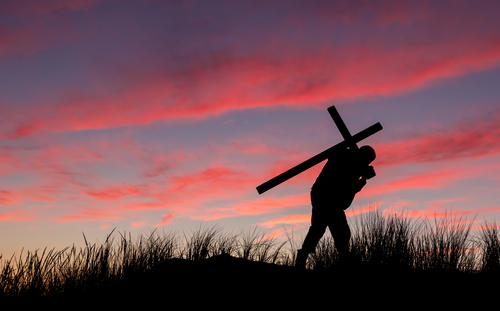
What does it mean to take up the cross and follow Jesus? Maybe it means being willing to be vulnerable and willing to be weak for the sake of the Gospel. Maybe it means putting the Gospel first and my desire to preserve myself last. Maybe it means being more concerned with the spread of the Gospel than my own reputation.
We hesitate to be outspoken about the Gospel because the Gospel means something different to the world that is perishing than it means to us. For those being saved, the Gospel (the message of the cross) is the power of God for salvation. But for the world, it is received much differently.
“For the word of the cross is folly to those who are perishing, but to us who are being saved it is the power of God. For it is written,
“I will destroy the wisdom[1] of the wise,
and the discernment[2] of the discerning I will thwart.”
“Where is the one who is wise? Where is the scribe? Where is the debater of this age? Has not God made foolish the wisdom of the world? For since, in the wisdom of God, the world did not know God through wisdom, it pleased God through the folly[3] of what we preach to save those who believe. For Jews demand signs and Greeks seek wisdom, but we preach Christ crucified, a stumbling block to Jews and folly to Gentiles, but to those who are called, both Jews and Greeks, Christ the power of God and the wisdom of God. For the foolishness of God is wiser than men, and the weakness of God is stronger than men.[4]
God is about the business of destroying “the wisdom of the wise” and “the discernment of the discerning”. If that is God’s business, and if we are following after God, this should be our business as well. How then is God destroying the wisdom and discernment of the world?
The Jews demanded a sign, but Jesus dying on the cross was not the sign sign they expected. They expected a savior that would overthrow the Roman government and set up a self-governing, Jewish state in the Promised Land. Jesus didn’t meet their expectations and became a stumbling block to them.
The Greeks wanted sophistication and clever philosophy. Their standard was Aristotle, Plato and the Stoics who developed systematic philosophies. The Gospel to them was foolishness, dull and lacking in the sharpness of thought that the Greeks expected of their thinkers. The Gospel seemed like foolishness to them.
The world today wants tolerance, acceptance, validation and normalization of every form of thinking, affection and lifestyle. Anything goes, and the world demands validation of any identify, affection or behavior that someone wants to embrace. The Gospel that embraces self-restraint over self-love and carries a message that following Jesus is the only way is contrary to the spirit of this modern age.
Wisdom and systematic philosophy is out. The world doesn’t believe in signs anymore. The standard today is tolerance, acceptance and pluralism, sacrificing the truth on the altar of individual rights, freedoms and the license to be or do whatever one wants with no moral constraints.
In this world today, people who hold stubbornly to the Gospel are considered Neanderthal, provincial and vulgar. Taking up our crosses today means being accused of intolerance and “bronze age” thinking. The Gospel is seen as moral depravity in this world that values the morality of man over the righteousness of God.
The Gospel is the word of an Infidel to the Muslims who bow only to Allah and are instructed to convert, subject or kill those who will not also bow. Yet our modern pluralistic society gives the Muslim world a pass while blaming the Christian church for intolerance.
In any age and in every age, the Gospel runs counter to the prevalent norms and worldviews of the times. The Gospel stands apart, and the followers of Christ stand with it.
Paul preached only Christ and him crucified to the Greeks who thought it was foolishness and to the Jews to whom it was a stumbling block. So we preach Christ who is the way, the truth and the life to those who think we are intolerant, to the Muslims who think we are infidels, to the scientists who think we are ignorant and to the modern moralist who thinks their own morality surpasses the righteousness of God.
Significantly Paul, who’s ministry was to the Greeks and the Romans, did not eschew knowledge or philosophy or the signs the Jewish world was looking for. It wasn’t as if Paul was not a learned man, full of knowledge of Jewish history and scripture. He was trained up in the finest school of the Pharisees run by Gamaliel, the greatest teacher of the time.
It was not as if Paul was an ignorant or unlearned man in Greek philosophy. When he addressed the crowd at in Athens, he cited by memory Greek poets and philosophers.
It’s just that Paul did not buy into the Jewish interpretation of scripture that missed the very Son of God among its pages. Paul did not buy into the knowledge and philosophy of the Greeks because knowledge and philosophy cannot save a man from his sin.
So today, it’s not as if Christians are intolerant. The message of Jesus is universal, but it is always, in every age, counter-cultural. Jesus has instructed us to welcome the stranger, visit the prisoner, love those who are unlovely and even to love our enemies. Still, Jesus is the way, the truth and the life and there is no other way to the Father but through Jesus.
It’s not as if Christians are not intelligent in the ways of science. Until very modern times, Christians led the world in science. In the last couple hundred years, Christians have abdicated the realm of science to the atheists and agnostics. The atheists and agnostics, in turn, have shut the Christians out by defining science narrowly, excluding any thought of god from it. Yet, people of faith are still involved in the sciences. We may even be going through a Renaissance of faith-based science today.
It’s not as if Christians are immoral. Far from it, Jesus called his followers to a higher morality even than the Jewish Pharisees, rooting out thoughts that are sinful and serving others to the point of self-sacrifice. Jesus exemplified that morality because Jesus, the exact representation of God on earth, is the standard. .
It’s not as if there is any other way to salvation. Muhammad lived and died and remains buried. There is no one in the history of religion of whom we cannot say the same, except for Jesus. Jesus rose from the dead. There is no other Messiah.
There is no other person in whose name is the power of life and salvation. Jesus is our bread. He is our water living water. Everything boils down to Jesus. As it was in Paul’s day so it is now in our day.
Taking up the cross and following Jesus, holding out the Gospel, will be met in much the same way as it was meet in Jesus’ day. The world that is perishing will not receive it, but it is salvation and life to those who will receive it. Even if no one receives it, still we carry the cross because there is no other Messiah and are no other words that give life.
~~~~~~~~~~~~~~~~~~~~~
[1]Sophia means “wisdom” and supplies the root of the English terms “sophistication” and “philosophy”. In this sense, the Gospel is contrasted to the sophistication and philosophy of the world.
[2]Sýnesis is translated discernment or cleverness. Literally, it means holistic understanding by joining facts together; synthesized reasoning by bringing implicit (indirect) truths together. In short, it means a worldview. Thus, the Gospel is contrasted to the prevailing worldviews.
[3]Mōría means folly; literally, dull (lacking sharpness).
“If anyone would come after me, let him deny himself and take up his cross daily and follow me. For whoever would save his life will lose it, but whoever loses his life for my sake will save it. For what does it profit a man if he gains the whole world and loses or forfeits himself? For whoever is ashamed of me and of my words, of him will the Son of Man be ashamed when he comes in his glory and the glory of the Father and of the holy angels.”[i]
What does it mean to take up our crosses and follow Jesus? What does it mean to lose our lives for Christ’s sake?
In the context of this passage, it means that we should embrace Jesus and His words, and not be ashamed of them. If we read the first two verses in the context of the third verse, taking up our crosses daily means daily embracing Jesus and His words and not being ashamed of doing that.
Wide is the road that leads away from Jesus. Narrow is the gate through which we must go to be saved. Following Jesus has never been the popular way. It costs, above all things, the thing that we seek most. It costs our pride, our reputation in the world. It costs our ability to fit in with the world. It costs our self-esteem and self-promotion.
Am I really following Jesus? If my reputation is good, if I fit in with people wherever I go, am I really following Jesus?