Under the Sun

We chase after those carrots. When we catch one, there is always another carrot to chase.


“What advantage does a man have for all the work he has done under the sun?” (Ecclesiastes 1:3). The Book of Ecclesiastes is sobering, though it is one of my favorite books in the Bible. I was drawn to it in college because of the candid assessment of life that it reveals. That candid assessment was refreshing to me as a young adult as I surveyed life and my place in the world.

We work most of our lives to earn a living, to keep up appearances, to obtain things, to advance our station in the world, to keep our yards neat and clean. We go about our labors often without much thought for why we do it. I don’t mean that we don’t have goals. Of course we do, but our goals are temporal.

I am reminded of the carrot attached to a stick mounted on the harness of a horse. We chase after those carrots. When we catch one, there is always another carrot to chase. Often we don’t achieve our goals, and we are left unsatisfied as a result. The truth is, though, even when we do achieve our goals, we are rarely satisfied by having attained them.

The author of Ecclesiastes takes a step back from the busyness of life, as I was doing in college. The author contemplates the arc of life, the beginning to the end, and asks what it all means. We rarely do that. But, if you stop to think about it, what is the point? We labor and toil on this Earth through our 60, 70, 80 or more years, but for what? What do we get in the end?

Continue reading “Under the Sun”

Can Hell be Reconciled with a Loving God? Part 2

Missing the mark – If you begin from two points adjacent to each other, but angled ever-so-slightly in different directions, the difference may be hardly noticeable at the start.


In the first piece in this series about hell, inspired by a talk given by Tim Keller in 2010, we explore the idea that hell isn’t a place that God sends us; it is the result of our own choosing. When we choose anything other than God as our highest and best good, our most treasured thing, the thing we identify most with, that choice becomes our ultimate aim.

If we choose anything other than God as our ultimate aim, our most treasured thing, we lose ourselves to it. What we value most consumes us and we lose our identity to it.

Keller uses the parable of Lazarus and the rich man as the backdrop. The rich man, not even realizing he is in hell, demands Abraham to send Lazarus to him to wet his lips to relieve him from his discomfort. The rich man is delusional. He still thinks he has the wealth and station he enjoyed during life, but he has completely lost his identity. Abraham and Lazarus have names in the parable, but the rich man is without any name.

Soren Kierkegaard wrote a book, Sickness Unto Death, in which he defines sin as finding our identity in anything other than God. The word for sin, in the Hebrew, means, literally, missing the mark. To find our identity in anything other than Godis missing the mark.

The first point Keller makes about the idea of hell is this: when we choose anything other than God as our highest and best good, the thing we most identify with, we lose our identity to it, and it becomes our hell. If the thing we cherish most isn’t our identify in God, we lose our intended identify (given by God who created us) to the things we have chosen over God. And this becomes our hell.

Keller says that the idea of hell is crucial in helping us to understand the problem with our own hearts. We have a tendency to want things other than the purpose for which God made us. God made us for Himself, to reflect unique facets of His nature, and to have relationship, forever, with God. If we choose as our greatest treasure something other than this purpose for which God made us, we lose our identity to those things.

In this blog piece, we will explore this idea further.

Continue reading “Can Hell be Reconciled with a Loving God? Part 2”

Can Hell be Reconciled with a Loving God? Part 1

Tim Keller says that the idea of hell is crucial in helping us to understand our own hearts.

Depositphotos Image ID: 45826369 Copyright: kamchatka

Tim Keller gave a series of talks on the biggest objections to Christianity about eight years ago. In one talk, he addresses how can we reconcile a God who is loving with a God with the idea of hell. I’m going to summarize what Keller says partly in his words and partly in my own words. I will also go off script down some side roads. I will cover the subject in several blog posts.

Before we start, I want to observe that truth and reality are not always how we would like them to be. The nature of truth is that “it is what it is”. We don’t advance in our knowledge and understanding by denying it. If we are going to take the Bible seriously, and particularly the things that Jesus said, we have to contend with the idea of hell. Jesus mentions hell more than any other person in the scripture.

Tim Keller claims that hell is crucial for understanding our own hearts, for living at peace in the world, and for knowing the love of God. The text he uses to set up the subject is Luke 16:19-31. This text is known as the parable of Lazarus and the rich man. I encourage you to read it before continuing on. I am only addressing the first point in this blog post – that hell is crucial for understanding our own hearts (because it is something we choose).

The idea of hell, of course, is a basic Christian principal. Jesus did not shy away from the subject, and neither should we. Hell is a principal that doesn’t sit well with the sentiments of modern people, but that is no reason to dismiss it anymore than we should dismiss the idea of disease just because we don’t like it. We dismiss it only to our detriment.

One interesting quirk about this parable is that two of the characters are named (Abraham and Lazarus), and one character is not named (the rich man). Keller says this parable is the only one in which Jesus named any of the characters. (I didn’t double check him on that.)

In Hebrew culture, even more than in our day, names were intimately connected to the identify of a person. In this parable, Lazarus is identified by name, but the rich man remains anonymous. He has lost his identity. Why is that? And how does that relate to understanding our own hearts?

The fact that Jesus named characters, but he didn’t name all the characters, is a window into understanding the parable and understanding our own hearts.

Continue reading “Can Hell be Reconciled with a Loving God? Part 1”

Jesus in Our Midst

Whether we see God working in our lives may depend on the assumptions we make from our expectations and our experience.

Reading from Luke 24:13-21.

That very day two [men] were going to a village named Emmaus, about seven miles from Jerusalem, and they were talking with each other about all these things that had happened. While they were talking and discussing together, Jesus himself drew near and went with them. But their eyes were kept from recognizing him. And he said to them, “What is this conversation that you are holding with each other as you walk?” And they stood still, looking sad. Then one of them, named Cleopas, answered him, “Are you the only visitor to Jerusalem who does not know the things that have happened there in these days?” And he said to them, “What things?” And they said to him, “Concerning Jesus of Nazareth, a man who was a prophet mighty in deed and word before God and all the people, and how our chief priests and rulers delivered him up to be condemned to death, and crucified him. But we had hoped that he was the one to redeem Israel.

This encounter took place after Jesus was publicly seized, tried and crucified. These men were discussing the events that everyone was talking about – the death of Jesus.

Jesus had stirred up the hopes and dreams of the people in the region, including these two men, but that hope ended abruptly and shockingly just a couple of days ago.

Jesus was a controversial figure in the first century. He was born into a world that was ripe for his coming. The last of the Hebrew scriptures was written about 300 years prior, and the thrust of the last of those scriptures, the prophets, anticipated the coming of a Messiah.

The first century Palestinian Jews believed this Messiah would be a king that would rescue Israel from Roman rule and reestablish a Jewish Kingdom in the promised land, rekindling the glory of their heritage.

But Jesus defied the expectations.

Continue reading “Jesus in Our Midst”

Ritual, Spirit and Truth

Depositphotos Image ID: 23471738 Copyright: ChiccoDodiFC

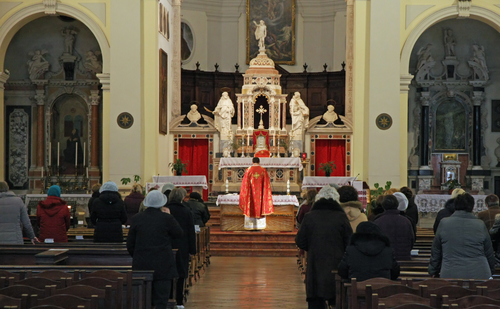
I was raised Catholic. I say that often. Not that it is a bad thing. It’s just my experience. During my time in the Catholic church, through my childhood and early adulthood, I had no connection with God. I can’t lay the blame for that at the feet of the Catholic Church. That was just where I was.

When I became a Believer, when I accepted Christ as my personal Lord and Savior, my life changed. I also began to see the Catholic Church in a different light. I was never into the ritual and observance, which is a major component of the Catholic Church. Not that other denominations and religions don’t have central religious rituals. All religions have ritual observances and traditions.

Those ritual observances and traditions are not, in themselves, bad, but they can create a facade that hides emptiness, darkness and sin. They can create an appearance of piety with no spiritual reality behind them. They can be more superstitious than spiritual, like stroking a rabbits foot for good fortune. In these and other ways, ritual observances can become a substitute for relationship with God.

Continue reading “Ritual, Spirit and Truth”