The Need for the Church to Address Racial Injustice

Everyone agrees there is a racial disparity problem. Only people on the fringes deny the problem.


I believe the Bible teaches that Christians who seek to follow Jesus as he followed the Father should be as earnest in doing justice as they are in preaching the Gospel. The Gospel and justice go hand in hand. The evangelical church, however, has fallen short on the justice side of the equation.

I believe the evangelical church has left a void in the area of justice that has allowed new, competing philosophies to take over the cultural space. Critical race theory has become the loudest voice in that arena.

Many Christians who are justice-minded have gravitated toward critical race theory to give a voice to the injustice they see because the church is not speaking to it. Without realizing that critical race theory may be another gospel that runs antithetical to the true Gospel, they may be embracing ways of thinking that could be harmful.

Critical race theory defines the problem and the solution in terms that do not align with the Gospel and to biblical truth. That is not to say there is no redeeming value to critical race theory, that it is inherently evil, or that people who espouse CRT are wicked or evil.

CRT is a man-made construct, and it’s not the Gospel. Inevitably it’s a solution that doesn’t get to the heart of the problem and doesn’t bring about true justice.

The Gospel offers true justice.

The Gospel says that all humans are made in the image of a holy God. All human beings, therefore, have intrinsic value that cannot be denied. We honor God and do right be each other by recognizing that in our thoughts and actions.

Love God and love your neighbor is the simple formula for recognizing the reality of human value in our thoughts and actions. This simple phrase is the summation of the Law of God boiled down to its essence. If we actually did that, there would be no injustice.

The problem with men is sin (missing the mark), transgression (breaking trust with God and people) and iniquity (brokenness). We often don’t do the right things we know we ought to do. W often want to go our own ways and to please ourselves rather than love God and love our neighbors.

The Gospel teaches that we have all fallen short (missed the mark). We have all broken trust with God and people. We are broken in our own ways, and we need help we cannot provide for ourselves.

Jesus offers the solution to the sin problem by taking on the sin of all people (of all races) on himself and setting us free (ultimately) from the consequences of sin. Jesus does that so we can have relationship with God who, then, begins to work within us to will and to act according to His good purpose.

That reality is borne out in the process of personal sanctification (vertically) and in just relationships with our fellow man (horizontally).

We do not achieve salvation by anything that we do. It’s a free gift available to all of us by grace. We simply need to embrace it. Salvation takes away the shame and the ultimate consequence of sin, which is death (physically and spiritually).

Salvation also frees us up to live as God intended by the help of the Holy Spirit who takes up residence within people who yield to Him. We demonstrate that by our love for God and our love for people. We no longer live for ourselves; we now live for God and others if we have truly been born again and received God’s gift of salvation and His Spirit.

Racism is the sin of partiality. (James 2) In Christ, there is no Jew nor Gentile; no male nor female; and no black, nor white or brown. We are all one in Christ, and the ultimate goal of the Gospel is to unite all humanity in Christ with God the Father. The picture of that ultimate goal was given to the Apostle John in a vision:

“After this I looked, and behold, a great multitude that no one could number, from every nation, from all tribes and peoples and languages, standing before the throne and before the Lamb….” (Rev. 7:9)

Most people can see there is a racial disparity problem in the United States. We might not agree on all the causes or what to do about it. Only people on the fringes deny the problem of racial injustice.

The evangelical church, unfortunately, has had a very spotty track record on the issue of racism. A large segment of the evangelical church supported slavery in our more distant past. It was also a segment of the evangelical church who championed abolition and freedom.

Many Christians with a heart for justice are (rightfully) responding to the voices speaking to the issue of racial disparity, but many of those voices are using CRT as their guide. We have, to some extent, failed to develop a robust, biblical response to racial injustice, so people even in the church use the language that is available.

Continue reading “The Need for the Church to Address Racial Injustice”

Evangelicalism and Injustice Part II

We must recognize injustice and speak to it if we are going to represent God, the Father, accurately to the world. 


In Evangelicalism and Injustice Part I, I discussed how the evangelical world has been a champion of preaching the Gospel, but we have not been champions of doing justice. In fact, we have shied away from it.

Less Gospel-orientated people, religious and otherwise, have rushed in to fill the void we have left, including people with philosophies and worldviews that are hostile and antithetical to the Gospel. I will address those things in a follow up post.

Meanwhile, the burden that weighs on my heart in these days is that our God is a God of righteousness and justice at the very foundation of His throne. (Psalm 89:14) This should be our foundation too as children of God our Father.

Jesus carried that great pillar of God’s character forward in the parable of the sheep and the goats, instructing his followers that those who will be blessed by God and receive their inheritance at the throne of God (calling Psalm 89 to mind) are the people who feed the hungry, give drink to the thirsty, invite the stranger in, clothe those in need, heal the sick and visit prisoners.

Jesus announced his ministry by reading from the Isaiah scroll. He said that God anointed him to preach the gospel to the poor, to proclaim release to the captives, and recovery of sight to the blind, and to set free those who are oppressed. (Luke 4:18-19, quoting from Isaiah 61:1)

The good news (the Gospel), in this way, is holistic. Jesus demonstrated that holistic approach of preaching good news and doing justice in his ministry. If we are to be his followers, we should do what Jesus did as he did what he saw the Father doing. (John 5:19)

When Jesus quoted from Isaiah, the prophet, he was calling to mind the great theme of all the prophets, which is the call of God to His people to do justice. Zechariah, for instance, says,

“This is what the Lord Almighty said: ‘Administer true justice; show mercy and compassion to one another.'” (Zech 7:9)

And he adds what true justice looks like:

“‘Do not oppress the widow or the fatherless, the foreigner or the poor. Do not plot evil against each other.'” (Zech 7:10)

James picks up the same theme in the New Testament.

“Religion that God our Father accepts as pure and faultless is this: to look after orphans and widows in their distress and to keep oneself from being polluted by the world.” (James 1:27)

James emphasizes the need for doing, not simply giving mental ascent to what Jesus says. The example he provides falls into the Old Testament definition of “doing justice”:

“Suppose a brother or a sister is without clothes and daily food. If one of you says to them, ‘Go in peace; keep warm and well fed,’ but does nothing about their physical needs, what good is it? In the same way, faith by itself, if it is not accompanied by action, is dead.” (James 2:15-17)

Evangelicalism has been very good at preaching and proclaiming.  Many evangelical organizations exist, like Administer Justice (which I mentioned in the first blog article), that both proclaim the good news and do justice (meet the needs of the poor, the oppressed, the prisoners, widows, orphans and strangers), but evangelicalism, as a whole, falls a bit short on the justice side of the equation. Let’s be honest.

Continue reading “Evangelicalism and Injustice Part II”

From Where I Sit “Riots are the Language of the Unheard”

Voting is the lowest form of democracy; and not just prayer alone, we need action ….


These are not my words. I am only amplifying them here: ~

A reflection from Richard Townsell, Executive Director of the Lawndale Christian Development Corporation.

Dr. Martin Luther King, Jr. has been quoted a lot this week. One quote that has gotten a lot of traction is from an interview with CBS News’ Mike Wallace in 1966 where he said:

“I think that we’ve got to see that a riot is the language of the unheard. And, what is it that America has failed to hear? It has failed to hear that the economic plight of the Negro poor has worsened over the last few years.”

This is as true today as it was then. The young adults in my house and the young staff on our team are very angry and some have joined peaceful protests over the death of brother George Floyd. His death represents the latest in a long line of public lynchings at the hands of primarily white law enforcement officials. We wait in anticipation for what happens in this case because we have seen slaps on the wrist before after the heat dies down. As of my writing, the other officers have not been charged. The young people make me wonder if I am too old because I don’t want to join protests or marches. They probably think that us baby boomer types just don’t get it. Are we too comfortable, too scared or too accommodating with this system that we can’t bring ourselves to hit the streets? Or is it something else?

I lived through the riots of 1968 when Dr. Martin Luther King, Jr. was assassinated. I was not quite four years old but I remember my mother and older brother talking about it in hushed tones. How afraid they were as they heard ambulances and fire trucks all night. The anger was palpable in North Lawndale. Last night was like that. Stores along Roosevelt Road, Ogden and Pulaski and others were looted and burned. Madison and Pulaski stores were also looted.

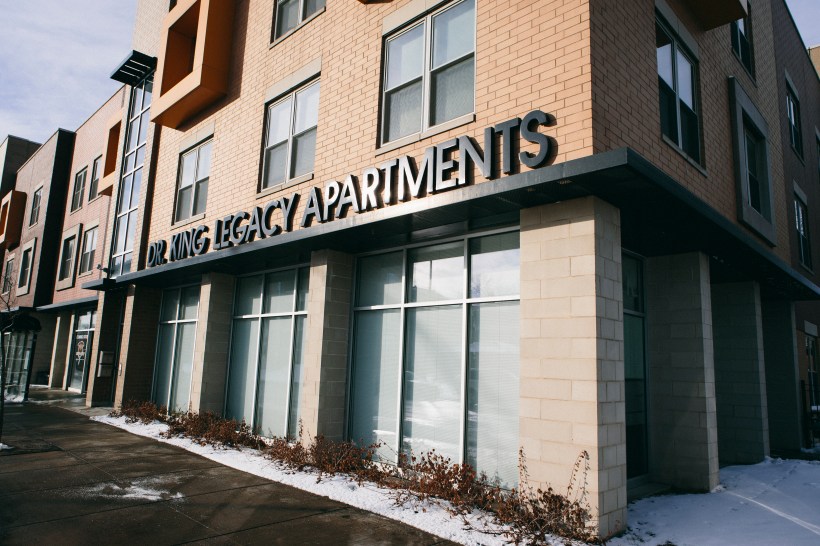
It has been over 50 years since that happened and the community has yet to recover. There have been some heroic efforts in our community and communities like it around the country to rebuild in the aftermath of Dr. King’s death. In 2011, LCDC and our partners the Westside Federation and Safeway Construction built the $17MM, 45-unit apartment building called the MLK Legacy Apartments, primarily because of Dr. King’s presence in North Lawndale in 1966. He came to protest slum housing.

After he was murdered, the building that he and his family lived in for those months in 1966 was torn down. There would be no memory that he ever lived here. Back in the 1990’s, our church wanted to build a park in his memory. I thought that we should build a building that he would have been proud to live in instead on the site. Despite this and other noble efforts, the amount of resources allocated to rebuild North Lawndale has not come close to matching the devastation since 1968. I won’t quote any statistics because they are so readily available (and because our community has been studied to death by academics the world over), but suffice to say that if COVID 19 has wrought devastation to America in every socioeconomic statistic available then imagine Black folks have experienced 70 years of COVID in North Lawndale from health disparities, unemployment, blatantly racist housing discrimination and redlining, mass incarceration, vacant lots, poorly funded and maintained schools and the list of problems goes on and on. Problems, not issues. I’ll get back to that later.

That being said, I am firmly against rioting and looting. The primary reason is that for the past 52 years since the riots of 1968, not much of scale has been accomplished. Additionally, a lot of the folks instigating and provoking the theft and vandalism are white paid provocateurs, anarchists and professional looters who are opportunistically taking advantage of black grief and rage to cause mayhem at our expense. Why are they driving from the suburbs to tear up our neighborhoods? Fortunately, young black activists with camera phones are catching them in the act and stopping them from gentrifying and hijacking our legitimate and peaceful protests.

So, what do we do? I will tell you what is not the answer from my experience in community development and organizing over the past almost two decades of work and then what we can do. Continue reading “From Where I Sit “Riots are the Language of the Unheard””