Paul Put the Pieces of a Puzzle together for Dionysius at the Areopagus

Some people want to fit the pieces to the puzzle together.

Perhaps, my favorite speech (sermon) in the Bible is Paul’s address to an elite group of people in Athens. The people in Athens were fond of spending their time “in nothing except telling or hearing something new”. (Acts 17:21) When some Epicurean and Stoic philosophers heard Paul in the marketplace, they brought him to the Areopagus.

Do you know people like that? They like to talk philosophy, but they don’t do it out of a love for the truth. They just like the intellectual challenge or the exercise of the imagination. Those conversations are ultimately unfulfilling unless truth is the object.

When Paul came to Athens, he was struck by all the idols he saw. (Acts 16:17) Athens was filled philosophies and gods of unending variety. In this way, Athens was like the modern Internet: a person might not ever exhaust all the possibilities. A person could spend a lifetime trying without ever synthesizing all the information and fitting the pieces to the puzzle of life together.

Paul cut the chase. Referencing an inscription: “To the unknown god”, Paul opened his speech with the statement, “What therefore you worship as unknown, this I proclaim to you.” (Acts 17:23)

I love that! Paul started where they were. He started with something familiar to them, and he used it as a segue into an introduction of “[t]he God who made the world and everything in it”. There were temples everywhere in Athens, but Paul was not shy in saying that the “Lord of heaven and earth does not live in temples made by men”. (Acts 17:24)

Paul wasn’t interested in small talk, or ideas for nothing but the novelty of them.

I also love that Paul quoted Greek philosophers and poets to them. He quoted Epimenides of Crete for the proposition that “In him [the God who made the heaven and earth] we live and move and have our being”; and he quoted Aratus for that proposition that we are His offspring. (Acts 17:28)

Paul was educated, and he could speak the language of educated people. He could take poetry and use it in a sermon on God. He didn’t play their games, though. He didn’t speak just to hear himself talk. He didn’t pander to their penchant for novel ideas.

He called them to account: “The times of ignorance God overlooked, but now he commands all people everywhere to repent, because he has fixed a day on which he will judge the world in righteousness by a man whom he has appointed; and of this he has given assurance to all by raising him from the dead.” (Acts 17:30)

Paul preached the Gospel, the good news that Jesus died for our sins, redeeming us from destruction and giving us the hope of everlasting life, but Paul lost most of his audience at that point. They weren’t interested in “dogma”. They took offense at the exclusivity of Paul’s message. They liked ideas, but they weren’t interested in truth. Sound familiar?

Truth, of course, is exclusive. That’s the nature of truth. People like the Athenians, and people who embrace post-modern thought today, don’t want to want to hear ideas that are exclusive. They want variety. They want to keep their options open, ironically even to the exclusion of truth.

A few people, though, were moved by Paul’s sermon. They wanted to hear more. Among them was Dionysius, the Areopagite. For Dionysius, Paul provided him the missing piece to the puzzle of his life.

Continue reading “Paul Put the Pieces of a Puzzle together for Dionysius at the Areopagus”

How the Moorings of the Gospel Were Secured

God’s promise to Abraham was given 430 years before Moses

I have taken some time to reflect on the unity for which Jesus prayed in relation to the story of Peter & Cornelius and the tension that continued in the early church over extending the Gospel to Gentiles (non-Jews). The tension that persisted at the heart of the early Church threatened to unmoor the Gospel from its footing.

In previous articles, I reflected on the deeply ingrained nature of the belief that the Jews were God’s people. They were entrusted with the Law of Moses, and they had protected the Law God gave them for well over a 1000 years, painstakingly preserving it, passing it down from generation to generation.

They were instructed by God Himself to drive out all the inhabitants in the land God promised them, to avoid intermarrying and being corrupted by the influence of “Gentiles” to worship their gods. Thus, Hebrew descendants of Abraham avoided association with others – Gentiles – like the plague.

So intent on sticking to the script were Jews in the First Century that they didn’t recognize God when He shed his deity and came to them in the form of a man, as Jesus from Nazareth. Thus, He came to His own people, and they didn’t recognize Him!

When the Word through whom the universe was created, the Word who “was with God” and “was God”, became flesh (John 1:1-3, 14), “his own people did not receive him.” (John 1:12) “He was in the world, and the world was made through him, yet the world did not know him.” (John 1:11) On the other hand:

“But to all who did receive him, who believed in his name, he gave the right to become children of God, who were born, not of blood nor of the will of the flesh nor of the will of man, but of God.”

John 1:12-13

“His own” were the Jews. The “all who did receive him, who believed in his name”, were Gentiles (and Jews) who believed in what Jesus said and trusted in him. They became children of God, not because they were born into it, nor because they or anyone else desired it, but because God Himself desired them to be His children. (John 1:13)

But these things were far from clear to the early Church. Even Peter, who lived with Jesus and knew him intimately, had difficulty with the idea that the Gospel should be extended to Gentiles.

In the previous articles linked above, I summarized how God gave Peter a vision that occurred three times in a row for emphasis, including by an audible voice and the voice of the Holy Spirit, directing him to go with men who appeared just then at the door to summon him. Peter’s experience was orchestrated with an angel that visited Cornelius, a Roman Centurion, who was directed to send those men to “a man named Simon who is called Peter”. (Acts 10:5)

Peter yielded to God’s obvious orchestration of these events, and he went with the man who summoned him. When he found himself at a Roman Centurion’s home, Peter recognized God was at work. Then God poured out His Holy Spirit on the Centurion and his household to emphasize to Peter his intention to extend the Gospel to the Gentiles.

But the tradition of shunning the Gentiles would not die easy. Despite the obviously divine orchestration of events to drive home God’s intentions to Peter, Paul had to confront Peter publicly in Antioch over the issue when Jews from Jerusalem came to visit because Peter had disassociated himself from the Antiochian Gentiles. (See Galatians 2-3)

Paul encountered the same issue in Galatia where people were insisting that the Jews continue to follow the Mosaic law. In his letter to the Galatians, Paul described his confrontation with Peter. More importantly, Paul explained why the Mosaic Law no longer applied to the people of God – who now included not just the Jews, but everyone!

Continue reading “How the Moorings of the Gospel Were Secured”

Tension Leads to Accord: Peter, James & Paul

The big issue that threatened to divide the early Church

Paul wrote to the Galatians to address a grievous error in their thinking. They were holding on to a belief that followers of Christ, even Gentiles, must continue to follow Jewish law. Though Jesus prayed for unity among his followers (John 17:20-23), it was a rocky start for his fledgling following. They didn’t last 10 years without division!

To emphasize the gravity of the situation, Paul recalled to the Galatians a time when he opposed Cephas (Peter the Apostle, himself) “to his face” over the Jew and Gentile. (Gal. 2:11)

Consider this: Peter lived with Jesus for 3 years. He was one of the closest people to Jesus during his life. He was there when Jesus died, and he was one of the first people to see Jesus when he returned, risen from the dead.

Paul was never around back then. He despised Jesus and his followers! He held the cloaks of the people who stoned Stephen to death, and he was hellbent on quashing the “rebellion” of the Jesus followers to the traditions of Judaism…

Then, Jesus dramatically revealed himself to Paul. Paul changed completely and became the boldest of proclaimers of the Gospel. Still, what gall to confront Peter of all people! Right?

First for a little back story. In my last post, I described Peter’s vision of animals on a great sheet and the encounter with the Roman Centurion that convinced him Gentiles can be saved from their sins, the same as Jews. It was no small revelation. It took quite the orchestration of visions, angels, voices and a powerful outpouring of the Holy Spirit to convince Peter to accept the fact that God wanted to share the Gospel with Gentiles.

Peter experienced his own change, though not as dramatic. He went from being concerned that he should be not associating with Gentiles to baptizing the Centurion and his entire household and welcoming them into the family of believers!

I also wrote about this story in relation to the theme of the unity of believers: Reflection on the Unity for which Jesus Prayed: Peter & Cornelius. The great shift from the following law to faith, was a change to beat all changes.

It took a nothing short of a divine appointment of Peter, the Apostle on which Jesus said he would establish the Church, orchestrated by God with all the bells and whistles to provide clear direction. We might think that this encounter settled the score for Peter, once for all, right?

Not so.

Continue reading “Tension Leads to Accord: Peter, James & Paul”

Tracing the Origin of Natural Law & Equal Rights in Western Thought

The law of loving your neighbor as yourself written on the tablet of the heart by God

In Chapter 9 of Tom Holland’s book, Dominion: the Making of the Western Mind, he traces the idea of natural law back to 1150 AD when a lawyer named Gratian compiled the first canon of law in the west. His work (the Decretum Gratiani, as it came to be called) was derived from Scripture and the writings of the early church fathers. It was an attempt at harmonize those two sources into a comprehensive whole.

The original notion of natural law came from the Stoics: “The Stoics believed that the fundamental moral principles that underlie all the legal systems of different nations were reducible to the dictates of natural law.” Gratian syncretized the Stoic notion of natural law (the law of nature) by attributing it to divine origins. This law, which God desires to write on men’s hearts, can be summarized as the law of loving your neighbor as yourself.

Holland observed that for a millennia Christianity existed without “what Muslim lawyers had long taken for granted – a comprehensive body of written rulings supposedly deriving from God Himself”. Holland is struck by the contrast of the Christian notion that God “wrote His rulings on the human heart”.

Holland first picks up that theme in his book with Saint Augustine of Hippo in Chapter 5. Hollands description of Augustine’s words – that “God writes His laws on the heart,” and, therefore, “Love, and do what you like” – is a theme Holland traces as he finds it in the history of western thought.

Thus, Holland observes that Gratian opened his Decretum Gratiani with the statement that all law can be summed up in a single command: love your neighbor as yourself. Gratian called this idea “natural law”, summarized by the statement, “all souls are equal in the sight of God”. Gratian further identified this principal as the foundation stone of true justice.

Holland mistakenly attributes these ideas to Paul (“Paul’s authority on this score was definitive…. [e]choing the Stoics”). but the important point is that Gratian’s syncretism of the law was a decisive departure from earlier ages:

“Much flowed from this compilation that earlier ages would have struggled to comprehend. Age old presumptions were being decisively overturned – that custom was the ultimate authority, that the great were owed a different justice from the humble, that inequality was something natural and to be taken for granted.”

This is the central theme of Holland’s book – “How the Christian Revolution Remade the World” (its alternate title). His book is an attempt to trace back the roots of modern notions, such as the idea that people have “equal rights” stemming from natural law (“inalienable rights”) that fundamentally inform modern, western thought.  

Holland notes that these ideas do not flow out of Greek or Roman philosophy or law. They were are much foreign to the world of classic Greco-Roman thought. They are definitively Christian – Judeo-Christian – in their origins.

Holland, of course, is an atheist. He comes to these conclusions through his study of western civilization. He is an “outsider” to Christianity, which perspective makes his observations so interesting – the that he picks up on the novelty of these ideas as being a distinctively Christian departure from classical Greco-Roman thought.

He also wrote Dominion coming off the heels of writing a similar work on the history of Islam. The contrast was striking for him. Whereas Islamic scholars attempted to proscribe laws for every detail of human life, including things like how to brush your teeth and dog ownership, Christians distilled law down to a single phrase – love your neighbor as yourself – and rested in the confidence that God writes His laws on people’s hearts (“not in ink” as Augustine said). The influence of Holland’s awareness of that contrast is striking.

It shouldn’t be surprising, coming from his perspective, that Holland doesn’t get things exactly right. When Augustine focused on love, he wasn’t championing anything new, and Paul was not the source of the notion that the law can be summed up in the phrase, love your neighbor as yourself or the belief that God writes His laws on human hearts. While he might attribute these things to Paul and Augustine, the history is much older and deeper than that.

Continue reading “Tracing the Origin of Natural Law & Equal Rights in Western Thought”

Heavenly Citizens In These Modern Times

What deserves our ultimate allegiance?

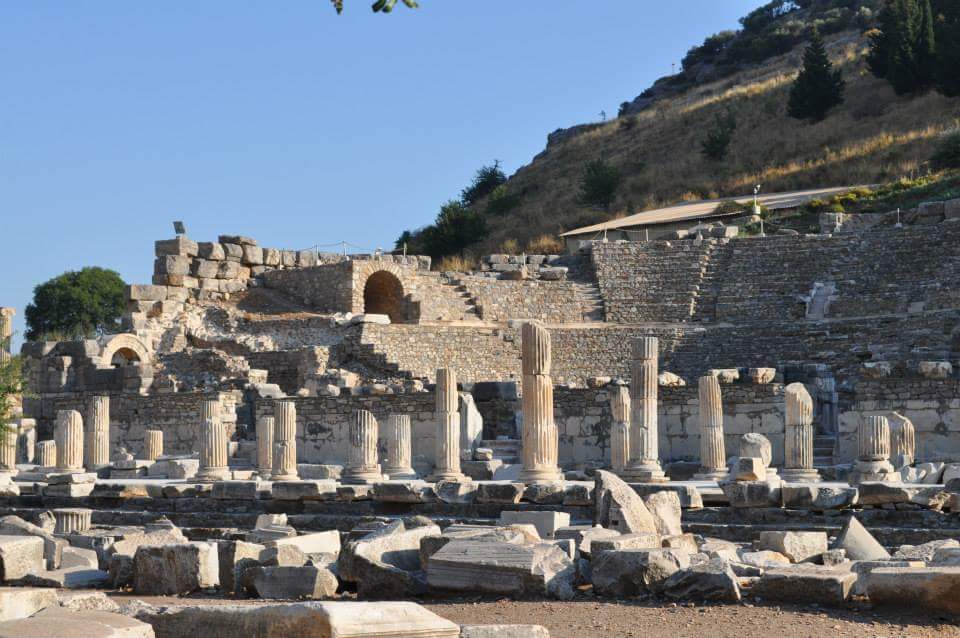
City Hall at Ephesus by Brooke Miller

Peter and Paul, the pillars of the Church, were clear that the only citizenship that counts is our citizenship in heaven. (Phil. 3:20) W are only “sojourners and exiles” in this world. (1 Peter 2:11)

Paul submitted to earthly authorities as though they had been established by God. (Rom. 13:1) He submitted to lashing by Jewish authorities five times! He appealed to his Roman citizenship, but, he clearly saw himself not as a citizen of this world. He was a citizen of the kingdom of heaven that is to come.

He used his Roman citizenship to gain an audience for the gospel among the Romans, to be an ambassador for Christ as he spoke to people in the public squares. He used his credentials as a Hebrew scholar to gain an audience for the Gospel in the synagogues.

Paul submitted to the processes and protocols of Roman and Jewish authorities. He recognized their earthly authority over him. He appealed to that same authority, not for his own advantage, but for the purpose of advancing the kingdom of God.

When we get involved in politics in the 21st century, do we submit to the authorities established by God as Paul did? Paul boasted of his lashings. Paul used his Roman citizenship, not to get out of prison, but to get to Rome to support the followers of Christ there.

Do we count ourselves, first, as citizens of heaven? Paul longed to be with Christ. He used his time on this earth to advance the kingdom of God while he longed for the day when he would put off his perishable body and put on immortality.

Do we use our earthly citizenship not for our own advantage, but to advance the Kingdom of God? When we fight for tougher laws and tighter borders and the right to walk around without masks, are we fighting for the kingdom of God?

Paul said what needed to be said for the sake of the Gospel, but he accepted the earthly consequences of his focus on heavenly things. Paul lived in an earthly world that was hostile to him and everything that he stood for. He submitted to the world’s authority, but he did it in obedience to the authority of God for the advancement of the Gospel, the good news of the coming of the kingdom of God.

Sometimes, I wonder whether we resist authorities that to advance our earthly objectives and appeal to political power and influence to secure our earthly advantage. I wonder how often we have it all wrong.

What are our priorities? To whom do we owe our ultimate allegiance? What are our ultimate goals? Are we seeking to advance the kingdom of God at all costs, including the cost to ourselves and our own position in the world?

Paul used his station in life as a Jewish scholar and a Roman citizen not for his own benefit, but for the benefit of the kingdom of God, to gain audience in front of people, and to spread the gospel. How do we use our station in life, our political power and religious knowledge? To whose benefit are our actions accumulating?

Are we fighting to protect and preserve our own families, communities and country in this world only to lose sight of our citizenship in heaven? Are we striving to save our lives only to lose our souls?

These are questions, not accusations. God knows the heart. I pose these questions in my own heart as write them.