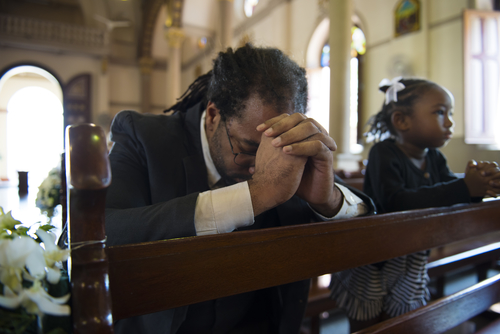
Where Is God in the Messiness of the Church?

I have never participated in a perfect church and have never met a perfect person, yet I believe in a God who is perfect and who is perfecting us, His people.


Toward understanding and healing the wounds of the church, I write this blog piece. The context is the very public struggles of two mega-churches in the Chicago are where I live. Last year, Bill Hybels resigned as the head of Willow Creek Church, after allegations of misconduct came to light. Just today I read about James MacDonald deciding to step down from leadership of the Harvest Bible Church in the wake of a lawsuit and allegations of poor leadership.

The two situations are different, though they both involve allegations against longtime leaders of two of the largest and most prominent churches in the Chicago area. Bill Hybels is accused of inappropriate relationships with women in the church. MacDonald is accused of mismanagement of money, heavy-handed leadership and related allegations. Both situations expose the nature of the human side of the church and the prevalence of sin in the church, even at the leadership level. (The Catholic Church is not alone in this respect.)

In the 1980’s, I became involved in a church that I thought, at the time, was the “perfect” church. It was a vibrant engaging church community. Worship was spirit-led and dynamic. The leadership was charismatic and inspiring. The church community was tight-knit and familial. This church had planted many other churches that were also thriving and growing. I spent 6 years there and knew the church intimately.

It wasn’t as perfect as I first thought, of course. People are people, even people who go to church. Within a year of my leaving to pursue what I believed God was directing me to do next, the church was splintering, disintegrating and falling apart. My pastor, the man who married my wife and I, divorced his wife within a few years of our leaving. Neither he nor his wife are involved in a church today (as far as I know).

We were devastated. This was over 25 years ago, and it still puzzles me. The coming apart at the seams of this church that I viewed as a model of what churches should be impacted me more than I would care to admit.

I realize now that I had invested more of my spiritual capital in the church and its leaders than I should have.

A friend of mine, a fellow church-goer, has been struggling with issues in his church – the leadership in particular. I have listened to him, recognizing the disappointment and disillusionment in his voice. Though I don’t know the details of the issues he has had with the leadership, I do know that he feels cut adrift; he is hurt; his faith is shaken. He has stopped going to church. He isn’t sure he can trust Christians anymore, and he is struggling to make sense of his experience. I can relate.

We left the last church we attended because of leadership, trust and personality differences that affected the people to whom we were closest in that church. Our friends were financially and personally hurt by leadership in the church. We felt we needed to stand with our friends and support them as they drifted away from the church, unable to remain in a church led by people who could not be trusted with their spiritual well being.

These are just the experiences I have had, but I don’t think I am alone in having difficult and painful experiences in churches and with the leadership of churches. Church is a messy business.

Many people turn away from the church and even from Christianity because of similar experiences. How many times have you heard someone say they don’t go to church because Christians are hypocrites? And the fact is that Christians are hypocrites!

But that shouldn’t be the end of the story.

Continue reading “Where Is God in the Messiness of the Church?”

Truth in Love

Truth in love pulls people up on to safe ground, but truth without love pushes people off the ledge.


“Love does no wrong to a neighbor; therefore love is the fulfilling of the law.” Romans 13:10 ESV

This little tidbit from Paul’s letter to the Romans packs so much into it. God gave Moses 10 commandments, and law followed after law until there were over 600 different laws for the people to follow. Jesus summarized everything in two statements: love God and love your neighbor.

Paul echoes those words of Jesus in Romans when he says” love is the fulfilling of the law” and equating love with doing no wrong to a neighbor. (Mark 12:30-31)

As I read Romans 13:10 this morning, I think about our Christian tendency to preach to the world about sin, a world that does not know God and has not accepted Him. I have heard Christians use the excuse that they are standing up for truth because Jesus says, “Whoever denies me before men, I will deny before My Father in heaven.” (Matthew 10:33) Paul told the Ephesians to “speak the truth in love.” (Eph. 4:15) Only Paul was writing to the believers in Ephesus, and he was talking about quipping the believers in the church in ministry and building up the body of Christ.

This is significant because, when we think of truth, judgment is not standing far off. Paul is talking to the church in his letters and instructing believers. Paul says, “What business of mine is it to judge those outside the church? Are you not to judge those inside? God will judge those outside.” (1 Corinthians 5:12-13) (The context is a man in the church who was acting immorally.)

The audience of Paul’s statement about speaking the truth in love seems significant this morning as I am thinking about all the times I have seen Christians blast their neighbors with “truth” on social media with not a lot of love. Social media isn’t like a sniper rifle; it’s like a shotgun. Anyone in front of the blast feels the sting – believers and non-believers alike.

Of course, what of the unbelievers who potentially face judgment for denying God? Do we have a heart for them? Do we care enough to get to know them and establish a relationship with them? When we speak the truth to them, are we speaking in love?

It seems to me that we often emphasize truth over love, and the result is that we tend to speak only the truth. We might as well not say anything at all. I’m afraid we often do more damage than good when we do that.

Continue reading “Truth in Love”

Love: Who is Your Enemy?

Creative Commons

Asking who is your enemy may seem like a strange way to begin a blog article about loving your neighbor, but bear with me. My question is inspired by a different, but related, question. My question is inspired by the question asked by an expert in the law many years ago: “Who is my neighbor?”

This question followed a theological dialogue between the expert in the law and Jesus in which the expert in the law sought to test Jesus. (See Luke 10:25-29) As Jesus often did, though, the test put to Jesus turned into a challenge to the so-called expert.

The expert in the law asked Jesus the loaded question, “What must I do to inherit eternal life?” Jesus answered with his own question, “What is written in the law?… How do you read it?” Not to be shown up, the expert in the law answered:

“‘Love the Lord your God with all your heart and with all your soul and with all your strength and with all your mind’; and, ‘Love your neighbor as yourself.’” (quoting Deuteronomy 6:4 and Leviticus 19:18)

The expert in the law was probably looking for some debate, but Jesus wasn’t interested in debate. Instead, he simply concluded, “You have answered correctly…. Do this and you will live.”

The expert in the law had the tables turned on him. He wanted to test Jesus, but Jesus put the test to him, and now he was in defensive mode. He might said, “Wait a minute!” And then the question followed that leads me to my question, “Who is my neighbor?” If we have to love our neighbors, and if loving our neighbors is the measure for inheriting eternal life, we better know who are neighbors are!

But there is a back story here that leads from the one question to the other question. Apparently, the First Century Palestine Jews had interpreted Leviticus 19:18 to mean, “Love your neighbor; hate your enemy.”

How do we know that? It isn’t found anywhere in Scripture, but Jesus quoted the statement in the Sermon on the Mount when He said, “You have heard that it was said, ‘Love your neighbor and hate your enemy….’” Ah, and now you know where I am going, because Jesus followed with this:

“But I tell you, love your enemies and pray for those who persecute you, that you may be children of your Father in heaven. He causes his sun to rise on the evil and the good, and sends rain on the righteous and the unrighteous. If you love those who love you, what reward will you get? Are not even the tax collectors doing that? And if you greet only your own people, what are you doing more than others? Do not even pagans do that? Be perfect, therefore, as your heavenly Father is perfect.” (Matthew 5:43-48)

Lest there be any doubt who my neighbor, Jesus stretched it so far that love must reach all the way from my friends to my enemies and everyone in between!

And that leads me to the question, “Whos is my enemy that I must love?”

Continue reading “Love: Who is Your Enemy?”

Self-Sufficiency Sufficient to Love God

It’s axiomatic that, if God exists, we are not God, and this isn’t our universe.


“They [Adam and Eve] wanted, as we say, to ‘call their souls their own.’ But that means to live a lie, for our souls are not, in fact, our own. They wanted some corner in the universe of which they could say to God, ‘This is our business, not yours.’ But there is no such corner. They wanted to be nouns, but they were, and eternally must be, mere adjectives.”

The quotation is by CS Lewis in the Problem of Pain. As he notes, tt’s axiomatic that, if God exists, we are not God, and this isn’t our universe.

By “God” (capital G), what is meant is a “maximal being” – that is a Being having maximal qualities. Thus, we say of God that He would have to be all-knowing, all-powerful, all-good, all-just, all-merciful, etc. All characteristics of which God is the standard find their greatest expression in God.

We are not talking about flying spaghetti monsters or Zeus-like personalities when we refer to God, capital G.

If such a God exists, and I believe this is more or less self-evident, than anything we call our own, including our own self-sufficiency, is mere illusion.

I find it interesting that many naturalists, like the late, great Stephen Hawking, agree that self-sufficiency is nothing but an illusion. We are all merely dancing to the tune of our DNA, says Richard Dawkins. Ravi Zacharias describes a lecture given by Stephen Hawking many years ago in which he eloquently laid out the evidence that we are determined (by natural influences) in everything we do. Hawking ended with the “uplifting” thought that, even though we have no control over anything that we think or do, we still feel as if we do – to which Ravi Zacharias says the audience audibly groaned.

For the naturalist, the conclusion, some say (like Hawking and Dawkins), is inescapable. We aren’t the captains of our own souls as we suppose, and our end is “predetermined” by naturalistic causes as our beginning and everything in between. Such a fatalistic view might be sufficient to undo us completely, but for our ability to imagine otherwise – even if it isn’t true – according to these naturalists. Some very small consolation!

For the Christian, however, we find our consolation in the very God whose existence belies our illusion of self-sufficiency and self-control. We find that this God made us in His image, which suggests we are made with some capacity for free will and self determination – even if it subsists within the sphere of God’s ultimate providence.

We find that God is loving and desires us to reflect Him and His love without coercion from Him. Even if our ability to govern ourselves is ultimately illusory, the fact that we believe we have this ability, is all that matters because believing it to be so, believing that we can choose other than we can, even if we can’t truly exercise this choice freely as God does, means that we can, nevertheless, reflect God’s love back to Him without coercion.

Love, after all, is not coerced. Love is the complete absence of coercion.

Though we may not be self-sufficient or self-controlling as we suppose, we can still reflect God’s love back to Him by virtue of the appearance (the illusion if you will) that we are or can be self-sufficient and self-controlling. Feeling as if we can deny God and go our own way, we freely exercise our will to submit to Him and to choose His way, and this act of love is genuine to the extent that we genuinely believe it and mean it.

Selfishness to Salvation

Depositphotos Image ID: 69572625 Copyright: Christin_Lola

Today someone spoke about going “from selfishness to salvation”. I have never heard anyone put it that way before, but it’s as accurate a statement as any I have heard.

Jesus said, “Whoever loves his life loses it, and whoever hates his life in this world will keep it for eternal life.” (John 12:25) Loving and holding tightly to my own life, shutting God out, refusing to concede control to my Creator, desiring to go my own way is the life of a person without God. Marked by a desire to control my own destiny, to be captain of my own soul, so that I can say, at the end of the day, “I did it my way”, is a life lived without God.

The terrifying reality is that God will let us go our own way. He didn’t prevent Adam and Eve from eating the forbidden fruit. They were tempted by the desire to “be like God”[a], to define good and evil for themselves, to make their own choices and, ultimately, to usurp God’s place of prominence in their lives.

The fruit they ate was “good”; it was delightful and even desirable.[b] The fruit, itself, wasn’t necessarily bad (the knowledge of good and evil). The decision to go their own ways, to assert their own wills over the will of God, was their downfall.

Without that fateful choice we might live  idyllic lives. We might forever be “perfect” little angels, but God obviously had something else in mind.  God must have known the choice we would make. Right?

That choice doomed us to the imperfection of our humanness, but it also opened the door to something else completely. It opened up the opportunity for us to enter into a relationship with God we could never have known in that “perfect”, idyllic, innocent (and naive) state.

Continue reading “Selfishness to Salvation”