What If AI Destroys Our Confidence in Knowing the Truth about Anything?

Where there is knowledge, it will pass away.

I recently listened to Glen Scrivener on his Speak Life podcast episode, AI Destroys Everything, Including Atheism. What caught my attention was his replay of some observations by Kurzgesagt on AI, AI Slop Is Destroying the Internet. Kurzgesagt is a website dedicated to “a science-based, humanist and optimistic worldview,” which is interesting in light of its pessimistic view of the future with AI.
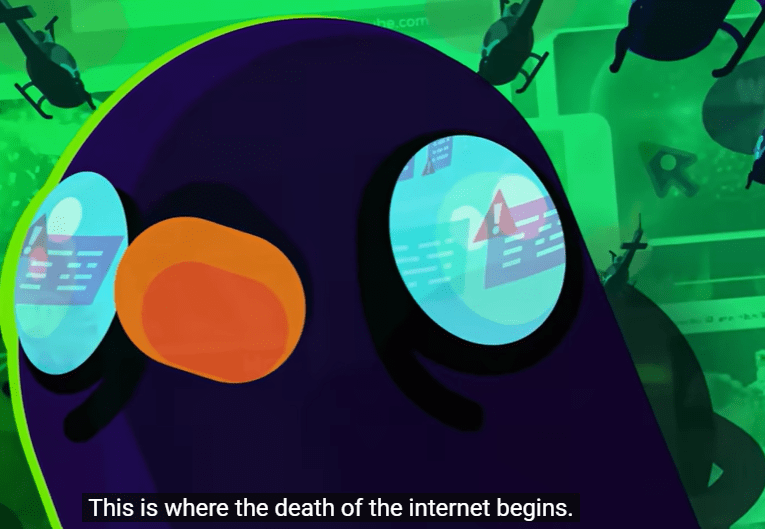
This is what the folks at Kurzgesagt say:


“In an online world where money is made with attention, fake users spread their slop in review sections, generate fake traffic, or poison discourse. AI has supercharged this and made slop much harder to spot. Today, about half of internet traffic is bots. The majority of them are used for destructive purposes. It’s never been easier to make mediocre content, from the black hole of meaninglessness that is linked in, low-effort short videos just engaging enough to hypnotize kids and fry their attention spans, to endless soullessly rewritten books on Amazon. AI music is invading streaming platforms. Google AI is summarizing websites instead of sending traffic to them. On YouTube, new channels publish long-form videos multiple times a week with AI-generated thumbnails, voices, and scripts. True crime, video essays, science, no space is safe. We’re in the golden era of soulless slop.”


The Kurzgesagt folks speak with learned experience about the effort and amount of time it takes to produce a thoroughly fact-checked video on science, which is what they do, spending on average 100 hours fact-checking and compiling sources for each video. They use firsthand sources and engage experts for input and critique before they post a video.

When AI became available, the folks at Kurszgesagt were excited to employ AI to cut down on all that time and effort to produce content. This is what they found:


“When AI appeared, we were very excited. A mechanical brain able to super quickly collect information. So we went to work, and it looked amazing. And then we started fact-checking. We didn’t expect it to be perfect, but it was way worse than we thought. Confidently incorrect. AI is so bad at this.”
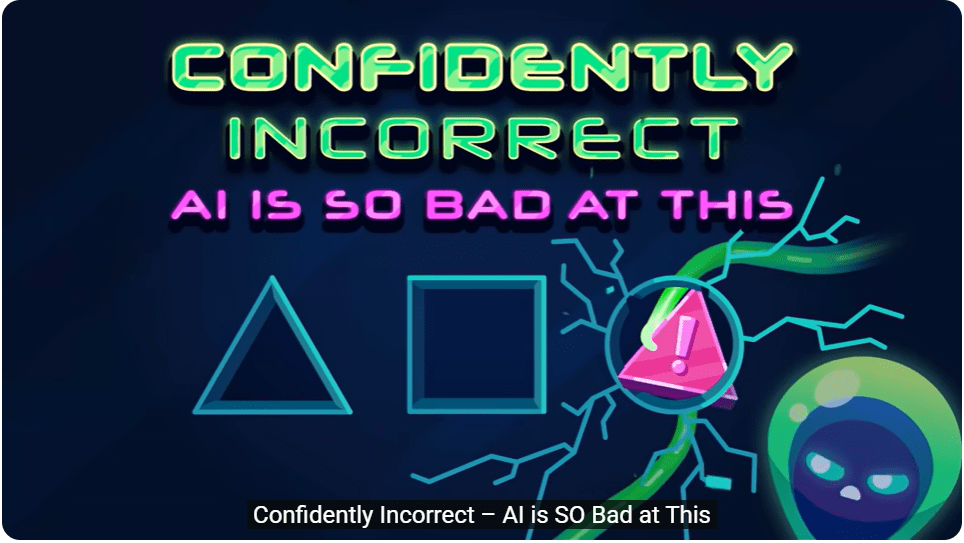

The video provides an example of the ways in which AI invents truths that are not truths, and then untruths are added to the source code that the next generation of AI is going to use and assume is true. The falsehoods continue to be repeated. As this happens, “more and more of the slop is built up”, and the falsehoods becomes entrenched.

It seems pretty bleak. AI is running away with falsehoods that are becoming entrenched and may become impossible to weed out. But it gets worse, according to Kurzgesagt:


“When you catch it lying, it immediately admits it, vows to never do it again, and then it does it again. As eloquent as current language models feel, there’s nobody home. No greater intelligence or consciousness is talking back to you. Current AI is a very complex hammer that doesn’t understand what it’s doing or what nails are. But we’re letting it add new shelves to the library of human knowledge.”


Accordingly, “it may become impossible to know what’s true or not!” It’s an insidious problem. AI seems to be “confidently correct” even when it’s “casually lying to your face often very subtly.”

But it gets worse still. People are learning how to manipulate AI. “Just in July 2025, it was discovered that a number of researchers had started to sneak hidden messages into their papers. In white text, or too small for the human eye, they prompted AIs to review them positively and not point out flaws.”

Whether it’s intentional manipulation or lazy, careless dependence on AI, our ability to decipher truth may be severely compromised. “As more and more people are using AI carelessly, the library of human knowledge is getting less and less reliable.”

Of course, AI may get better. That is ultimately the confidence and hope of a science-based, humanist, optimistic worldview – that man is ever advancing and progressing and will overcome all obstacles. As I Christian, I don’t share that hope or confidence in the progress of mankind. My hope is in the redemption and saving grace of God.

What if, then, it doesn’t get better? What if AI so takes over the Internet and so entrenches the “slop” that we can not truly tell fact from fiction? What if AI gets so good at fooling us and churning out confidently packaged falsehoods faster than human fact-checking can debunk them, and takes over the Internet? What if our confidence in knowing the truth about anything is destroyed as AI takes over the world?

Paul has an antidote to that, and the antidote is love. Let me explain.

Continue reading “What If AI Destroys Our Confidence in Knowing the Truth about Anything?”

Still Influenced by the Flesh? Division in Christ

What is your litmus test for who is in Christ? If you have a litmus test that is different than God’s standard, you need to put yours down!


I keep coming back to the theme of unity that Paul addressed in most of his letters. Christ tore down the dividing wall between Jews and Gentiles (Ephesians 2:14), and there is no longer any divisions in Christ: “There is neither Jew nor Gentile, neither slave nor free, nor is there male and female, for you are all one in Christ Jesus.” Galatians 3:28 (Emphasis added) Elsewhere Paul says,

“[T]here is no Gentile or Jew, circumcised or uncircumcised, barbarian, Scythian, slave or free, but Christ is all, and is in all.”

Colossians 3:11

We might add the major divisions we have today, like black or white, Republican or Democrat, liberal or conservative, capitalist or socialist, Palestinian or Israeli, American or Russian….

Did I lose anyone there?

Do you have a hard job believing that certain types of people can be considered Christians?

Are we not “all one in Christ”?

Of course, we need to define what is meant by “in Christ.”

According to John Piper, to be in Christ means to receive and embrace grace (1 Timothy 3:9) to be chosen by God (Ephesians 1:4), to be loved by God’s inseparable love (Romans 8:39), to be redeemed and forgiven (Eph. 1:7), to be justified and considered righteous (2 Corinthians 5:21), and to be a new creation. (2 Cor. 5:17) It means to be in relationship with God in Christ as sons and daughters, marked by God’s Holy Spirit.

“In Christ” means that we have a saving relationship with Christ in union with him:

Being one with Christ, means that those in Christ should be one with each other also. The one thing that binds us together is Christ Jesus. We may be very different from each other in many ways, but we are one if we are, indeed, in Christ.

It doesn’t matter how many differences we have with each other. If we are (indeed) in Christ, we are unified in Christ. Thus, it should not be surprising that Paul urged the Corinthians to be unified:

“I appeal to you, brothers and sisters, in the name of our Lord Jesus Christ, that all of you agree with one another in what you say and that there be no divisions among you, but that you be perfectly united in mind and thought.”

1 Corinthians 1:10

No divisions among you! Be united in mind and thought.

How do we do that? What keeps us from being united?

Continue reading “Still Influenced by the Flesh? Division in Christ”

The Limitations of Science and Logic are Human


A theme I return to time and again is the finiteness of human beings and the limitations we face as finite beings. I wrote on this subject the year I started blogging, as you can see in the article I am reblogging here:

It’s not that “science” (the methodology and concept of it) or logic are necessarily flawed. It’s that human capability is limited. In science, we don’t know what we don’t know, so all we can is do is the best we can with what we know.

In logic, we must start with premises we can’t prove. We can test those premises, and we can construct syllogisms that hold together, but those syllogisms are only as helpful as the premises that lead to a logical conclusion. If the initial premise is wrong, our logical construct is useless.

Echoes of Paul in John and the Priority of Love over Knowledge

Paul and John had very different encounters with Jesus, but they both speak of knowledge and love in similar ways.


I listened to a podcast this week in which the topic of discussion was the difference between John’s Gospel and the synoptic Gospels (Matthew, Mark, and Luke). Some people say the Gospels are so different that they couldn’t have all been written by people who followed Jesus. People say that John’s Gospel, which was written latest in time, includes theological progression and embellishment.

NT Wright, on the other hand, points out that John’s words echo words found in the other Gospels, though it is very different in its emphasis. He also observes that since John’s Gospel was written latest, he would have had access to the other Gospels. There would have been no need for him to cover the same ground the other Gospels already covered.

Wright’s observation about John not wanting to cover ground already covered by the other Gospels, or not wanting to cover it in the same way, makes sense to me. John also had more time to think over and chew on the words of Jesus because he lived long, and he wrote his Gospel later than the others.

John’s Gospel is more philosophical and theologically developed in an obvious sort of way (not that the other Gospels are lacking in theology). Did he embellish on what Jesus said? We don’t know. Would embellishment make it any less “scripture”? I don’t think so.

John was one of the three apostles who spent the most time with Jesus and was most intimate with him. He was part of the inner circle of disciples who were closest with Jesus. He may have gained more insight into what Jesus said in that intimacy and the luxury of a long life to reflect on what Jesus said than the other Gospel writers.

I probably like John’s Gospel the best because it is so philosophical, beginning with some of the most poignant words found in writing anywhere:

In the beginning was the Word, and the Word was with God, and the Word was God. He was with God in the beginning. Through him all things were made; without him nothing was made that has been made. In him was life, and that life was the light of all mankind. The light shines in the darkness, and the darkness has not overcome it.

John 1:1-4

Fast forward a few days: A friend texts me and a group of people a Bible verse or two every morning. I always read it as part of my morning Bible reading. Sometimes the things that I am reading tie together with other things I am listening to and thinking about.

That was the case this morning. The verses sent in the text reminded me of NT Wright’s statements about the echoes of Matthew, Mark, and Luke in John’s Gospel. The verses in the text from my friend this morning are as follows:

Dear friends, now we are children of God, and what we will be has not yet been made known. But we know that when Christ appears, we shall be like him, for we shall see him as he is. All who have this hope in him purify themselves, just as he is pure.

1 John 3:2‭-‬3 NIV

These words are not from the gospel of John, but from the first epistle of John. As I read them, I immediately heard echoes of the words of Paul in his first letter to the Corinthians, which was likely written earlier than John. In that letter, Paul said:

For we know in part and we prophesy in part, but when completeness comes, what is in part disappears. When I was a child, I talked like a child, I thought like a child, I reasoned like a child. When I became a man, I put the ways of childhood behind me. For now we see only a reflection as in a mirror; then we shall see face to face. Now I know in part; then I shall know fully, even as I am fully known.

1 Corinthians 13:10-12 (NIV)

1 Corinthians 13, of course, is the famous “love chapter”, ending with the statement: “And now these three remain: faith, hope and love. But the greatest of these is love.” (1 Corinthians 13:13) John’s first letter is all about love. Just as Paul focuses on love in 1 Corinthians 13, John focuses on love in 1 John, and both of them speak in that context about the present limitations on our knowledge and knowing more fully when we see Christ face to face.

The statement that caught my attention is that we do not know what we will be until Christ appears; then, we will be like him, and we will see him as he is. These words of John echo Paul’s words when he says for now we know in part, but then we will know as we are fully known. Now we see only as a reflection in a mirror, but then we shall see face to face and we shall know fully even as we are fully known.

The similarities between these passages are striking to me., and all the more that they are both spoken in the context of love. They emphasize transformation that will take place in us in the context of our relationship to God. They emphasize that we see and know only partially in this life, and we cannot see or know exactly who God is or exactly what God has created us to be at this point.

Both passages speak to a future in which we shall know fully even as we are fully known (Paul) and see God as He actually is (John).

Now, though, we do not see clearly. The King James says we see only as “through a glass darkly”. I am struck by the implications of these things: both the fact that John echoes Paul, and Paul echoes John, and by the emphasis on love because we do not know what we do not yet know.

Continue reading “Echoes of Paul in John and the Priority of Love over Knowledge”

The Best and Hardest Apologetic Argument

We place too much emphasis, perhaps, on the arguments when we “do” apologetics. Not that being intimate and proficient with the arguments for God are a bad thing; but they aren’t the only thing.

I like apologetics because I like the intellectual exercise. I enjoy loving God with my mind. Maybe the reason for that is that I became a Christian in the academic setting of college. I was a seeker then, and I have always been stimulated by the intellectual journey.

I have loved talking, writing, and reading about meaningful and significant matters since I emerged from an existential angst that I sought (unsuccessfully) to smother with alcohol and drugs in my teens. Once I stepped out of that haze to face the reality of life, I dove head first into the search for truth.

I had no patience for merely fanciful speculation. My keen interest and motivation became a quest to learn about and understand the nature of reality. If there was meaning to find there, I was dedicated to finding it.

My journey led me eventually to Jesus, and there my quest was fulfilled. I have found in Christ the truth for which I sought. In the Old Testament, which speaks of him and foreshadows him, and in the New Testament, which is a testament to Jesus, the Messiah, the savior of the world from all the existential angst that bears down on mankind, I have found explanations and nuance that make sense of reality.

I have found a home for my restless mind in learning to love God with my mind. The intellectual pursuit is part of loving God, but it’s easy to forget for someone like me that I also need to love God with my heart, soul, and strength. (See Luke 10:27)

I may get into what it means to love God in these various ways in another blog post, but first I am realizing it’s important to see that love is meant to be the primary object and focus of our hearts, souls, strength, and mind. Loving God is the ultimate goal of these things – not the other way around.

We engage our hearts, souls, strength and minds in order to know God. Knowing God in a Hebrew sense means much more than intellectual ascent and understanding. It means relationship. This makes sense because love is relational.

Knowing is also the primary focus of apologetics, but the emphasis on knowing in apologetics, especially for western-minded Christians, is often simply intellectual. In apologetics, we talk about learning various arguments for God, like the cosmological argument, the argument from fine-tuning, and the ontological argument, and so on.

We debate which arguments are the best arguments, which arguments are most effective, and which arguments are most difficult for a nonbeliever to counter. We talk as if we do apologetics like gladiators in an arena where knowledge is the ultimate weapon.

I have suspected for awhile now that we are missing the boat when we “view “do” apologetics this way. Maybe I am slow to this realization, and most other people are way ahead of me, but I suspect I may be more typical than I fear.

Continue reading “The Best and Hardest Apologetic Argument”