
The Need for Unity of Purpose in the Church: Focus on Jesus

When Paul heard of the divisions in the Corinthian church, he came to them with the centrality of the Gospel – Jesus and him crucified.


I have been meaning to write on unity in the Church for some time, but the subject has seemed too large for me to tackle. I am not a theologian. I took all the classes to be a religion major in college, but I didn’t hand in my thesis paper (on inerrancy), so I settled on being an English Literature major only.

Over the last 15 years, approximately, I been serious in reading Scripture and thinking (and writing) through the many difficult issues that face modern Christians. I have always been about “mere Christianity” since my earliest days as a Christ follower over 40 years ago, and I am convinced more than ever of the importance of being unified around basic or essential Christian principles.

My church is going through 1 Corinthians for the next several months or more, and the first chapter of the letter focuses on unity. I began writing about the need to be intentional – to agree – to end divisions and be unified in mind and purpose in Fighting for Unity in the Body of Christ.

I learned that the Greek word translated “mind” (or mindset”), nous, means more than just our thinking. It encompasses our attitude and disposition also. As we follow Jesus as he followed the Father, we should have same attitude/mindset that Jesus had.

Jesus is our pattern, and he calls us all to live as he lived, conforming to the same pattern he described when he said, “A new command I give you: Love one another. As I have loved you, so you must love one another. By this everyone will know that you are my disciples, if you love one another.” John 13:34-35

Paul reminds us that Jesus left aside his privilege and humbled himself to become one of us. (Philippians 2) Paul adds that our knowledge and ability to fathom all mysteries are nothing if we don’t have love. (1 Corinthians 13:1-2) Therefore, our mindset – our attitude and disposition (love) toward one another – is vitally important in what it means to be unified in mind and purpose.

Unity does not just mean intellectual assent on matters of doctrine. Paul says that we only “know in part”. (1 Corinthians 13:12) We need to bear that mind, therefore, as we try to be obedient to the commandment to end divisions and be unified in mind and purpose.

This all begs the question, though: what mind and what purpose is Paul talking about? What is it that we must be intentional to agree about?

In the first article, I found some clues in the Greek meanings of the words translated “mind and purpose”, but they only scratch the surface. Thayer’s Greek-English Lexicon of the New Testament, the Bauer, Danker, Arndt, and Gingrich Lexicon, and the Theological Dictionary of the New Testament all agree that νοῦς (nous) (translated mind) refers not only to the intellect, understanding, or reasoning faculty; it it also encompasses the mindset or disposition of a person.

Doctrine is implied in the concept of being of one mind, but doctrine is not all that this word implies. In fact, the summary of the Law Jesus provided for us (love God and love neighbor) seems to emphasize attitude and action over intellectual, theological constructs.

That doesn’t mean that Jesus was not doing theology when he summarized the Law. In fact, I think it is safe to say that we do theology far less perfectly than Jesus did!

We tend to complicate theology, but Jesus simplified it. In simplifying it, though, Jesus was not discounting or minimizing the rationality and intellectual rigor of it. Rather, Jesus was prioritizing the intellectual aspect of knowledge below below love. As Paul says: even if we can fathom all mysteries and have all knowledge, we have nothing without love. Love, therefore, is the priority over knowledge and understanding.

As we have already seen, the mindset we adopt must also incorporate our disposition and attitude toward God and each other. Any doctrine divorced from these things is empty. It is like a clanging gong without a symphony.

I think it is safe to say that doctrine, by itself, is devoid of life. Knowledge and understanding are nothing without love. It seems to me that love, even without knowledge or understanding, is better than knowledge and understanding without love.

Some might say though, that love cannot be divorced from truth. Jesus said that he is the way, truth and the life, so truth is obviously important.

But, not all truth is of the same value. It is true that today is sunny and warm in the Chicago area, but that truth is not nearly as important as the truth that Jesus is God incarnate who died on the cross for our sin and rose from the dead to redeem us from sin and death.

Having the same mind and purpose implies that we agree to the certain key value and truth propositions. It cannot mean that all of us view all value and truth propositions the same way. As finite beings who know only in part, that would be impossible! So what does Paul mean?

Continue reading “The Need for Unity of Purpose in the Church: Focus on Jesus”
Is Offense a Measure of whether the Gospel is Authentically Preached?

Jesus said, “My sheep hear my voice, and I know them, and they follow me.” (John 10:27)

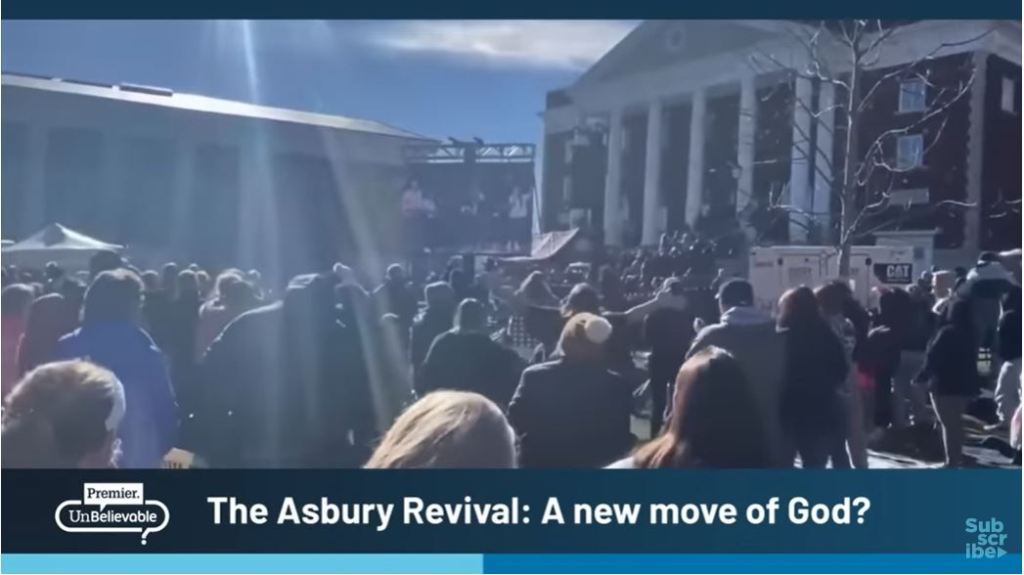
On a recent Unbelievable Podcast, Justin Brierley posed the question: is the gospel really being preached if no one is being offended?

That question might seem odd out of context, so I should quickly add that the question was posed in the context of the “Asbury Revival”. Many Christians are advocating caution. They are expressing concern about calling the happening at Asbury University in Wilmore, KY a “revival”. Some are questioning whether God was involved at all.

The claims people are making include, among other things, that there is no preaching going on, that the Gospel is not being preached, and that no one is being offended by the message. The latter statement prompted the question.

Is that the measure of whether the gospel is being preached? That some people are offended? Do we really think that it isn’t really the Gospel unless some people are offended?

Because some people were offended that no one seemed offended, does that count as people being offended?

As food for thought, it seems that everyone was offended during the Super Bowl by the two commercials paid for by a Christian group (with a lot of money) conveying the message that “God gets us”. It seems that everyone was offended by those ads, both the secular world and the Christian world. Does the offense mean that the Gospel was preached?

Perhaps, but only if the right people are offended? What if Christians are offended? What if progressive Christians are offended? What do we mean by “progressive”?

Again, is that really the measure of whether the Gospel was preached? Is that really the right question? Isn’t the Gospel the Gospel? Isn’t the Gospel the Gospel, whether some people are offended or not?

What is the Gospel?

We all know that “gospel” means good news, right? But, what is it? What is the good news?

Paul defines the Gospel to the Corinthians when he says, “I want to remind you of the Gospel I preached to you….” (1 Cor. 15:2) He adds, “ By this gospel you are saved, if you hold firmly to the word I preached to you. Otherwise, you have believed in vain.” (1 Cor. 15:3) Then, he says that the gospel message, which is “of first importance”, is as follows:

“… that Christ died for our sins according to the Scriptures, that he was buried, that he was raised on the third day according to the Scriptures, and that he appeared to Cephas [Peter], and then to the Twelve.”

1 Corinthians 15:3-5

When disagreements arose among the Corinthians, and some were lining up behind Paul, and others were lining up behind Apollos, Paul was perplexed by their disunity. He implored them “that all of you agree with one another in what you say and that there be no divisions among you, but that you be perfectly united in mind and thought.” (1 Cor. 1:10)

Paul was perplexed that some were touting him above Apollos, and the other way around. “Is Christ divided”, he asked rhetorically. (1 Cor. 1:13) The obvious answer is no! And the obvious implication is that we should not be divided either.

The problem with the Corinthians was that they were quarreling with each other over their allegiances to Paul and to Apollos. They were disagreeing and quarreling over peripheral things. Thus, Paul says he only came “to preach the gospel—not with wisdom and eloquence, lest the cross of Christ be emptied of its power.” (1 Cor. 1:17)

Emptied of its power? What did Paul mean? Paul said,

“When I came to you, I did not come with eloquence or human wisdom as I proclaimed to you the testimony about God. For I resolved to know nothing while I was with you except Jesus Christ and him crucified. I came to you in weakness with great fear and trembling. My message and my preaching were not with wise and persuasive words, but with a demonstration of the Spirit’s power, so that your faith might not rest on human wisdom, but on God’s power.”

Paul didn’t emphasize his preaching. He didn’t come with “wise and persuasive words”. He emphasized the “demonstration of the Spirit’s power”. The demonstration of the Spirit’s power is usually what we associate with a revival or an awakening. It isn’t the preaching; there is always preaching, but we don’t always get a demonstration of the Holy Spirit.

Continue reading “Is Offense a Measure of whether the Gospel is Authentically Preached?”

What Laws Must a Christian Follow?

The tension between the Law and the Gospel and how they relate to each other is the key to understanding Christianity.


The themes of law and grace are central to Christianity. Sorting them out gets to the very heart of the gospel message. Yet, many people inside and outside of the Christian community are unclear on what laws Christians must follow, what laws are no longer applicable, and why.

Someone recently posted the following question to a group to which I belong on social media:


I get the message of we are not under the law but under grace. But if we live through Christ we will follow the law. How do we know what law to follow? Does this go as far back as to not mix fabrics? 

Obviously everyone says we’re no longer under the law, but ”faith without works is dead” so I am confused. 

How do we know which laws to follow?


Human tendency is to want a list of rules to follow so we can check them off. The rich young ruler demonstrates that human tendency when he came to Jesus one day and asked, “Teacher, what good thing must I do to get eternal life?” (Matt. 19:16)

We also have a tendency to want to quantify rules, and to simplify them to make them easier to follow. Perhaps, that is what motivated someone to ask Jesus, “Teacher, which is the greatest commandment in the Law?” (Matt. 22:36)

Or we go the other direction: we add rules on top of rules on top of rules to make sure that we don’t miss anything. The Pharisees demonstrated this approach in how they handled the commandment to observe the Sabbath. The created a list of “work” that was forbidden including, among other things: sowing, plowing, reaping, binding sheaves, threshing, winnowing, selecting, grinding, sifting, kneading, and baking bread; twelve similar activities related to the preparation of clothing, from shearing sheep to sewing; and seven activities related to preparing the carcass of a deer for food or leather. (See What are some Sabbath Observance rules that the Pharisees made?)

Moses started with ten commandments. By the time the books of Moses were completed, there were 613 commandments! (Though not everyone agrees on exactly what they are.)

The Torah (the Five Books of Moses – Genesis, Exodus, Leviticus, Numbers & Deuteronomy) focused on laws. That focus carries through the entire Old Testament. Though the laws are often more prominent in the breach, than in the observance thereof!

The same focus continued into the New Testament. We see it in the question asked by the rich young ruler and the Pharisees’ questions to Jesus. We see it in the tension that threatened to divide the early church between Paul and Peter over whether believing Jews must follow the Law and what laws believing Gentiles must follow.

This is the tension between the Law and the Gospel. If we understand only one thing about the Gospel message, the relationship of the Law to the Gospel might be the most important thing! I have written about it often, including How the Moorings of the Gospel Were Secured.

For the sake of brevity, I won’t to summarize everything here. You can click in the links in the last two paragraphs to get an overview from the articles linked there. Understanding what Jesus meant when he said he didn’t come to abolish the law, but to fulfill it, is key.

If you are not a Christian, or you are a Christian, but you are not sure you understand these things, please do not just gloss over them. The tension between the Law and the Gospel and how they relate to each other is the key to Christianity.

It was the focus of almost all of Paul’s writings. It is the major theme in Romans, Galatians, Ephesians, Hebrews and other epistles besides. Take some time now to wrestle with it. Don’t stop until it makes sense to you!

Hopefully, the rest of my thoughts in this piece will help.

Continue reading “What Laws Must a Christian Follow?”

What Does the Church Have to Do with Judging Outsiders? Politics, the Gospel and Whose Side Is God On?

Paul said, “What business is it of mine to judge those outside the church?”

Paul said, “What business is it of mine to judge those outside the church?” (1 Cor. 5:12) This is where my mind went when I watched An (Un)Civil War: The Evangelical Divide posted online recently by CBS News. In the next moment, I was asking question Joshua asked the commander of the army of the Lord: “Are you for us or for our enemies?” (Joshua 5:13)

If you know the Lord’s answer to Joshua’s question, think about it for a moment. The subject here is the modern form of evangelicalism that is highlighted in the CBS piece linked above: hyper patriotic, nationalistic and political. I will come back to the Lord’s response to Joshua before I conclude. (You can read the passage now if you are too curious to wait.)

I hardly watch the news anymore, and CBS is certainly not my “go to” news source. I don’t have one. The portions of the CBS piece that are ringing in my head are the clips of the evangelical leaders preaching and explaining themselves in their own words.

I do understand that these clips are selected and don’t represent all that these leaders stand for or all that they might say. What they reveal, though, is enough to move me to write.

The clips show various preachers unapologetically “speaking the truth” from the pulpit, which the commentator calls “sermonizing a brand of social conservatism defined by conspiracy and apocalyptic rhetoric”. The words of the commentator are not what catch my attention, but they should be noted for the way they are perceived.

The piece focuses on what is described as a “power struggle” in evangelical circles. That is how the world sees the difference in opinions by evangelicals: a power struggle inside Christianity “at war within itself”.

One firebrand pastor (Greg Locke) touts the amount of support for his position, seeming to affirm the perception that it’s all about power and influence. In the world of politics, the number of evangelical constituents (over 1 in 4 Americans) is a matter of power and influence to political pundits. Locke’s comment and the concern expressed in the media piece align on that basis.

(I question whether 1 in 4 Americans are really evangelicals in the way I and most people of genuine faith define evangelicals. The statistic is a political one, not a religious one, but that is a topic for another day.)

One pastor is heard saying, “But we shouldn’t talk politics in religion. Says who? Satan?! That’s the only way they control us!”, he says. “To get us to be silent.”  

Indeed, power, influence, and control are at the center of this phenomenon. At the same time, Locke claims that the Bible is the issue, “Here is what the Bible says. Boom! We’re going to go with it!”

Locke views himself as fighting for the Bible, fighting for ‘God and country”, trying to wrestle the United States out of the grip of the left and Satan. But, is that really what is going on? What about the Bible?

Are they actually preaching what the Bible says?

There is so much to be said here, but I want to focus on just three things: 1) what the Bible says; 2) what the message of the Gospel is; and 3) whose side God is on in this struggle.

Continue reading “What Does the Church Have to Do with Judging Outsiders? Politics, the Gospel and Whose Side Is God On?”

An Exercise in Looking at ‘White Privilege’ through Marxist and Gospel Filters

The inspiration for this article comes from an attempt by a black person to explain to a white friend what she means by white privilege. Much of the evangelical world resists the term, fearing its Marxist roots will poison the vine if we let it grow.

Before I get to the article explaining white privilege from anecdotal examples, I did a little research and found an article written by a Marxist critiquing of the concept, “white privilege”. Critique as I use it here means a critical (as in negative) view. (I found the article when searching for the origin of the term, thinking I would find its Marxist roots.)

I found the idea of white privilege can be traced back to a pamphlet, White Blindspot, generated by Noel Ignatin and Ted Allen in 1967 in which they presented arguments for “white-skinned privilege theory”. They argued that the white working class conspired with their exploiters against the non-white working class to achieve certain privileges that the non-white working class were denied. They called on the white working class to repudiate those privileges and stand with their non-white comrades.[i]

The 2020 article from which I take this narrative is critical of the “privilege theory” that developed. It identified the “privileges” that had been gained by largely white working class people included better access to medical care, better educational opportunities, and so on. The article took umbrage with the call for those workers to forgo those hard fought “privileges” to stand with their comrades of color against the capitalist elite.

“The problem with this conception is that these measures, rather than representing undeserved ‘privileges’, were in fact reforms won by the working class through bitter struggle. These class gains represented the return of a small part of the great wealth held by capitalists that workers had produced. Privilege theory – on the basis of unequal access to these gains under racist American capitalism – converted hard-won class victories, reforms and rights into “undeserved” workers’ ‘privileges’.”

The article says that “privilege theory” is “totally flawed” because it pits the white working class against the black working class. The article blames “privilege theory” on “divisive propaganda of the capitalist class” – a kind of divide and conquer strategy that served the interests of the capitalist class by creating tension in the working class on the basis of race. (Perhaps, the fact that “liberal elites” in cloistered universities developed “privilege theory” was another strike against “privilege theory” to a true Marxist.)

This article is not even a year old. Interesting, is it not? Just as the church is leery of white privilege, so are actual Marxists!

To a certain extent, this article exposes the weakness of Marxist theory which thrives on conflict. When conflict is part of the creed, it undermines itself; conflict conflicts with itself. Perpetual conflict begets perpetual conflict. “Privilege theory” is just one example of how Marxism pits factions against each other, even among factions with common interests.

On the other hand, I can argue that the idea of white privilege is actually more gospel than Marxist. I don’t necessarily believe that, but stay with me for a second. Paul urged the Philippians to have the same attitude as Christ Jesus, saying:

Though he was God,
    he did not think of equality with God
    as something to cling to.
Instead, he gave up his divine privileges….

Philippians 2:6-7 (NLT)

Most translations say that God “emptied Himself”. The Greek word, kenoó, literally means “to empty” and is translated empty, deprive of content or make unreal.[ii] The HELPS word study adds, to be “perceived as valueless”.

The idea that God “gave up His divine privileges” captures the essence of the meaning of the Greek word in a very modern way. I think about this often when I consider the concept of white privilege.

This is the example of Jesus – that he had the attitude of emptying himself and giving up his privilege. Jesus calls us to be like him, to deny ourselves, take up our crosses and follow him. Thus, if we have any privilege (white or otherwise), our attitude should be the same as Jesus. We should be willing to give up our privileges, literally or figuratively, and empty ourselves (consider those things valueless) for the sake of the gospel and others.

In the next chapter of Philippians, Paul says,

“I count everything as loss because of the surpassing worth of knowing Christ Jesus my Lord. For his sake I have suffered the loss of all things and count them as rubbish, in order that I may gain Christ ….” 

Philippians 3:8

Thus, the idea of recognizing the privileges we have, whether they are on account of being white, or American or whatever, actually has some biblical roots. Our willingness to recognize that privilege and to be willing to empty ourselves of it for others is consistent with Christian values and faith


The idea of recognizing privilege and being willing to empty ourselves of it may be more biblical than Marxist! (I am not completely jesting to suggest it.)

But this really isn’t the ultimate point I want to make today. I am not here to argue for the concept of white privilege in our interpretation or application of the gospel. I agree that foreign concepts, such as the notion of white privilege, should not be brought into the gospel message. The gospel message has integrity in itself and stands alone in its ability to transform lives and bear the fruit God intended of it.

I do want to argue, though, that Christians should not reflexively recoil from and demonize the notion of white privilege. It’s the language of the modern world, so demonizing it creates a divide between us and those God desires to save.

Rather, I think we can use the term to the advantage of the Gospel. If Paul used quotations from pagan poets and philosophers to bridge the gap to his Greco-Roman audience at Mars Hill (Acts 17), we can do the same with the notion of white privilege (and other words that are used in modern parlance).

Continue reading “An Exercise in Looking at ‘White Privilege’ through Marxist and Gospel Filters”