Redeeming Diversity, Equality, and Inclusion

DEI has become a weaponized, pejorative term.


Diversity, Equality, and Inclusion (otherwise known as DEI) has become a pejorative label for the “evils” of progressives that is a target of the Trump administration in their take down of government as it existed when Donald Trump took office. I don’t want to talk about politics. I want to address something to the Church in America. Something I think we need to think about prayerfully in these times.

I have been through a DEI session as a mandatory component of my professional continuing education. My experience is limited, so I discount it, but it will serve my purpose of introducing the subject I want to address.

Honestly, I would characterize the DEI session I went through as cringy. It was uber sincere, preachy, and not a little condescending. I also didn’t think it was very effective for these and other reasons. Well-intentioned, maybe. I will give it the benefit of the doubt, but I am afraid it rubbed me the wrong way – privileged white man that I am.

I can see how people outside the church might feel about the uber sincerity, preachiness, and condescension of Christians. It can be … well, cringy. I find it ironic that the progressive world (it seems to me) has overtaken the Church in self-righteous condescension, preachiness, and overall cringe in its own beliefs that it appears to be trying to cram down the throats of people it views as less than.

But, I digress. I want to take a step back and re-examine the ideas of diversity, equality, and inclusion. I am not going to do a deep dive, but I want to recapture these words that have been hijacked by political operatives and used alternatively as political bludgeons and pejoratives.

Diversity was created by God when he confused the languages of the people. God confused their languages because the people had unified together with one common language to make a name for themselves and to resist God’s instruction to be fruitful and multiply over the earth. God “confused the language of the whole world” to scatter people around the world as He originally intended. (Genesis 11:1-9)

From this, we see that God is in control, and He has a plan. Well, He is still in control, and He still has a plan. People are either working with Him, or they are working at cross purposes to His plan.

As Christians, we don’t ever want to be working at cross purposes to God! Diversity was God’s idea going all the way back to Genesis, and He shows where He is going with it in Revelation. This is the vision He gave John to share with the world to let us know His end game:


“After this I looked, and there before me was a great multitude that no one could count, from every nation, tribe, people and language, standing before the throne and before the Lamb. They were wearing white robes and were holding palm branches in their hands.  And they cried out in a loud voice:

“Salvation belongs to our God,
who sits on the throne,
and to the Lamb."

Revelation 7:9

God’s plan is to bring all the nations, tribes, and languages back together in all their diversity! Every different nation, and every different tribe, in all their different languages – diversity. But, they will be unified in their worship of the Lamb who sits on the throne. (Notice, it isn’t the Lion of Judah who appears on the throne, but the Lamb of God.)

God celebrates the diversity He created by gathering all the nations, tribes, and tongues together from around the world where they were scattered. Diversity is not pejorative. It is something God created in His wisdom that we can celebrate as we worship Him in one voice and many tongues.

If we pray authentically as Jesus taught us, we pray, “Our Father, who is in Heaven, hallowed be your name. Your kingdom come and your will be done on earth as it is in Heaven!” If we are praying for God’s kingdom on earth – now – as it is in heaven, we cannot really mean that if we do not embrace the diversity that God created on earth.

Continue reading “Redeeming Diversity, Equality, and Inclusion”

Thoughts on the Great Commission: Our Finite Tendency to Miss What God is Doing in Our Time

What are we missing? What dogmatic understanding have we clung to that is correct in some aspect, but not completely accurate?

Go into all the world and tell the gospel to all creation

‭As I read through the New Testament this year as part of my daily reading plan, I have finished the Gospels, and I am well into the Book of Acts. As I read through the Gospels, I was mindful of the context in location, time period, and the history of the area and the people of Israel, surrounding nations, and the Greco-Roman world leading up to the time that Jesus walked the earth. I have also been mindful of the sweep of this history as it has played out since that time to the present day.

As a believer in the story of God revealing himself to human beings in this history that we continue to live into, I am also mindful that this time was pivotal. God becoming incarnate (taking on human form and fully living into His own creation), is the centerpiece of our story. It ties the story together from the beginning to the end that will play out into the future fulfillment of God’s ultimate plans.

Abraham and his descendants have been the focus of this story from the time that he heard God encouraging him to leave his family and homeland and strike out to a land God would show him, full of the promise descendants as numerous as the sands of the shores of the sea and the stars in the sky. But the story has taken an unexpected turn – unexpected, at least, for those descendants who have been living into this story for millennia by the time of Christ.

But it shouldn’t have been unexpected. That original promise to Abraham included blessing for all the nations of the earth. This was God’s plan from the beginning – from the creation of Adam and Eve and the command to “be fruitful and multiply.”

The covenant God made with Moses with those descendants of Abraham, however, took on a life of its own – at least as far as they perceived it. They were (more or less) faithful to that covenant. At least, they clung to that story despite their failings to be faithful and despite their myopic view of what God was doing.

It was myopic because they lost sight of God’s intention to bless the nations of the earth through them. This blessing was embedded into the original promise to Abraham, and it was always intended to be part of the story. Yet, they had lost that thread.

Thus, when God entered into the story to move it along and begin to work out the thread of His ultimate plan, they didn’t recognize Him. The people God chose through whom He would work out this plan unwittingly resisted it.

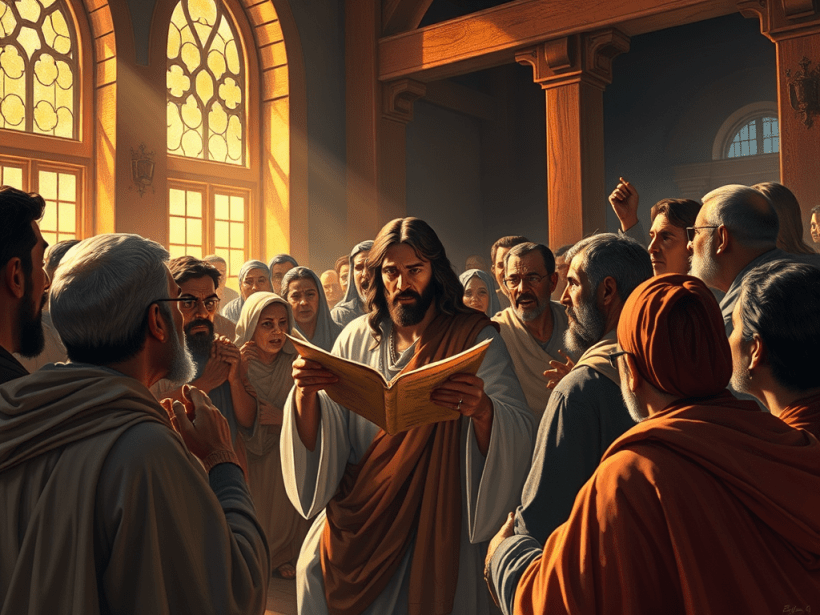
Yet, God in His sovereignty was not surprised by this. He used their resistance to move the story forward. Jesus knew this when he read from the Isaiah scroll in his hometown synagogue:

“The Spirit of the Lord is on me,
    because he has anointed me
    to proclaim good news to the poor.
He has sent me to proclaim freedom for the prisoners
    and recovery of sight for the blind,
to set the oppressed free,
to proclaim the year of the Lord’s favor.”

Luke 4:18-19

When Jesus told them, “Today this scripture is fulfilled in your hearing”, they were not ready to receive it, though the fulfillment of it was long-awaited by them. Jesus knew their rejection of him would be the catalyst God would use to unfold the rest of the story:

“Jesus said to them, ‘Surely you will quote this proverb to me: ‘Physician, heal yourself!’ And you will tell me, ‘Do here in your hometown what we have heard that you did in Capernaum.’”

Luke 4:23

Jesus, the fullness of God in human form (Col. 2:9), knew he would die at the insistence of his own people, but this was meant to be.

“And being found in appearance as a man,
    he humbled himself
    by becoming obedient to death—
        even death on a cross!”

Pjilippians 2:8

God worked through this people He chose to prepare for the time He would enter the story, and their rejection of Him would be the turning point.

Continue reading “Thoughts on the Great Commission: Our Finite Tendency to Miss What God is Doing in Our Time”

What Are We Missing in the Story of the Garden of Eden?

Why did God place the tree of the knowledge of good and evil in the garden and forbid Adam to eat it?


Once again, I am reading the epic of Eden by Sandra Richter. She takes the orthodox, traditional position that Eden was perfect, man fell, bringing God’s creation down with him, and God is redeeming man with creation so that man will live forever in perfection, again, after redemption is complete. I am indebted to her and other scholars, and I greatly appreciated her book.

I wrote recently, on the question, Was the Garden of Eden Really Perfect? With due respect to Sandra Richter, I am leaning in the direction of no, the Garden of Eden wasn’t perfect. I explain my thinking in the article linked in this paragraph, and today I want to explore something that may be missing from the traditional narrative (at least as I understand it).

Today, I am posing some questions that occur to me as I continue to read through Sandra Richter’s fine book. Why did God place the tree of the knowledge of good and evil in the garden? Did God know men would eat from it? What is the point of the fall and the long road back to redemption?

I don’t claim to have all the answers, or at least not all the right answers. We may not know, and may never know, the answers in their nuanced details. I think that is ok, though we should strive to know as best as we can.

Maybe some things are not meant for us to know; or at least we are not meant to know that we know. We have a strong tendency to become proud and self-righteous and to start relying on our own understanding, rather than remaining humble before God and our fellow man.

Yet, I think God wants us to seek to understand. “It is the glory of God to conceal things, but the glory of kings is to search things out.” (Proverbs 25:2) Thus, my article today is an attempt at better understanding God’s redemption story and searching out these things.

Surely, God had purpose in placing that tree in the garden, right? God is sovereign and all-knowing, right? Thus, I think the questions I pose today are good for us to consider.

Continue reading “What Are We Missing in the Story of the Garden of Eden?”

Why Did God Subject the World to Futility?

Photo by Ken Gortowski

I want to focus on the following statements Paul made in his letter to the Romans:

“[T]he mind set on the flesh is hostile toward God; for it does not subject[i] itself to the law of God, for it is not even able to do so…. 

Romans 8:7

“[C]reation was subjected[ii] to futility[iii], not willingly, but because of Him who subjected it, in hope that the creation itself also will be set free ….”

Romans 8: 20-21

Life and death, the universe and all the “stuff” that is, ever was and ever will be are “in God’s hands”. That is another way of saying that God created everything. God is timeless and immaterial and has created all that is material out of nothing, including us.

But the material world, the world as we know it, is passing away (1 John 2:17), even from the moment it was created! That’s what science (the second law of thermodynamics) tells us also. The world has been has been “winding down” since the “Big Bang”.

Paul’s statement about the “futility” to which the world has been subjected suggests that futility is part of God’s ultimate plan, because it was done “in hope”.

If that doesn’t add up for you, I don’t think you are alone. I have been puzzling on it for awhile. What possibly could be the plan?

The trite response that “God’s ways are not our ways” falls short. We want to know, though perhaps it’s true that we may never completely understand. Still, I have some ideas that are informed by Scripture that I will try to lay out in this article.

Continue reading “Why Did God Subject the World to Futility?”

How Does the Tower of Babel Fit into God’s Plan for People to Love Him and Love Our Neighbors?

Our frustration, toil and separation from other people are not contrary to the purposes of God, but part of the plan.

The story of the Tower of Babel is included in Scripture for a reason, right? So, Why is it there? How does the tower of Babel fit into God’s redemptive plans and purposes?

These are questions we should think to ask. In fact, Scripture is designed, according to Hebrew thinking, to invite us to ask questions.

Western thinking might assume that we just take things on faith and don’t ask questions. Or the opposite: take it at face value and dismiss it when we find problems (“contradictions”) in the text. The biblical texts, however, are inherently Hebrew (“eastern”) in their assumptions, and we lose something if we do not understand that.

God wants us to seek Him, and that includes asking questions of Scripture, wrestling with it, and finding answers to our questions. We don’t exhibit a lack of faith when we find “problems” in Scripture and ask questions. Our faith propels us forward to wrestle with the text and seek answers through study, prayer, and the guidance of the Holy Spirit.

We can hold to a high view of Scripture and admit there are “problems” in the text. Those problems can lead us to some real gems in the answers they reveal.

God desires us to seek him and find him, as Paul says to the philosophers in Athens. (Acts17:27) Jesus, of course, promised that those who ask, seek, and knock will be answered, will find, and the door will be open to them. (Matthew 7:7) Faith is evident when we use the problems we see as the springboard to seek answers.

I recently wrote an article on the Tower of Babel story exploring some of the questions it invites us to ask, and trying on answers that are suggested by a more eastern (Hebrew) mindset than most westerners might be adopt.

One question we might ask is: why is the story there to begin with?

We might assume the story is simply an explanation for how people became scattered all over the world in different language groups. If that is all we get out of the story, though, we miss the most important meaning. If we stop there, and assume there is no more to the story, we may be missing the most important part of the story!

A Hebrew (or eastern) mind always asks, “Why?”

I resonate with this basic practice incorporated into the BEMA Podcast because of a Jewish professor I had in college. He explained one day the difference between the western and eastern approaches to Scripture. He illustrated it with the following example.

If the universe consisted of a chair in a room, people with western minds and eastern minds would approach the room differently. The westerner would measure the height, width, depth and mass of the chair. He would weigh it and measure the distance of the chair from the walls and the ceiling. The easterner (the Hebrew) would start by asking, “Why is the chair here?”

In my previous article, I discussed how the story is a chiasm (a type of poetry). A chiasm puts emphasis on the middle verse. In this story, the emphasis falls on the people’s desire to “make a name for ourselves” because “otherwise we will be scattered over the face of the earth”. (Gen. 11:4)

Why were they concerned about being scattered? Why does God care? What is God doing in confusing their languages and scattering them?

For starters, God does not break into the story, yet, when they are making bricks. We might assume, therefore, that God isn’t threatened or concerned about their development of new technology. He doesn’t break into the story until they say they are going to build a tower to make a name for themselves.

We also need to be mindful, always, of context. The context here is that people are moving away from God, away from his plans. (Moving east.) God wanted them to multiply and fill the earth, but they wanted to put down roots in the plains of Shinar (Babylon), lest they be scattered, and build a tower to exalt themselves.

God’s plan was to have them “multiply and fill the earth”. This was the instruction from God to Adam and Eve. The people who built the Tower of Babel didn’t want to do that. They didn’t want to be “scattered”. They resisted, and they put down roots when they should have been filling the earth.

Building a tower to make a name for themselves, in this context, means wanting to pursue their own plans to achieve their own ends. The concern about being scattered suggests they knew they were doing their own thing contrary to God’s plans for them. They might have feared being scattered because it would disrupt their plans to exalt themselves.

Maybe they thought God couldn’t scatter them if they built a fortified tower. Maybe they were trying to make God deal with them on their own terms, in a location they established, by a structure by which they thought they could ascend to God and control where God met with them.

Of course, God did exactly what they feared, and scattered them a against their wishes by confusing their languages.

But why? Was God threatened by them?

Um…., no. God is sovereign. He created the heavens and earth, and He created these people. They were no threat to Him. So why did God scatter them?

I believe the answer lies partly in the fact that they were pursuing their own plans in exultation of themselves. God had other plans, and God frustrated their plans that were not in keeping with His plans.

That might all seem arbitrary unless we keep asking questions and seeking answers. Why were the peoples’ plans something God couldn’t abide? How did the peoples’ plans interfere with God’s plans?

What were God’s plans?

Continue reading “How Does the Tower of Babel Fit into God’s Plan for People to Love Him and Love Our Neighbors?”