Is the American Church a House Divided Against Itself?

Whether God for us or against us is the wrong question.


I have yet to find my equilibrium after the Charlie Kirk killing. I didn’t know Charlie Kirk. I didn’t follow him. I heard him speak one time at an event in which Ravi Zacharias was the keynote speaker, but I never watched, or listened, or read anything from Charlie Kirk online. I didn’t agree with his Republican apologetic, though I couldn’t have identified anything Charlie Kirk specifically said before his death.

Since his death, I have heard and read testimony of his love for Jesus. His wife, Erika, publicly forgave his killer in an ultimate act of sacrificial obedience to Jesus.

Charlie Kirk’s legacy will always be that of a follower of Jesus and a staunch Republican, friend and defender of Donald Trump, who maintained political views opposed to mine.

I am a born again Christian. I believe in the death of Jesus Christ for the forgiveness of my sins and his resurrection from the dead. I believe the Bible is the word of God and His revelation to mankind. I read the Bible daily. I believe there is only one path to God, and that is through Jesus Christ. I go to church every Sunday, and I am involved in Wednesday evening and Saturday morning Bible studies.

I have been a Christian for 45 years. The fundamentals of my faith have not changed in that time, but I have gone down some side roads from which I had to retreat back to a more orthodox faith. I was tempted by the prosperity gospel, and I once embraced an Americanized Christianity verging on idolatry.

Jesus is the same yesterday, today, and forever. God has not changed during my life (or at any time since the foundation of the earth), but I have changed often, as I have had to adjust my thinking, confess my sin, and allow my mind to be transformed by God’s Word and the influence of the Holy Spirit in my life.

I am a work in progress, of course. I have yet to arrive at any final destination, but I look forward with yearning for the day when I see Him face to face, and I will know as I am fully known!

I used to believe that all true Christians should (and therefore must) believe all of the same things about everything. That makes sense in a rationalistic way because we all have the same Holy Spirit, and we all read the same Bible, so we all should believe exactly the same things about everything. Right?

Continue reading “Is the American Church a House Divided Against Itself?”
What Is the Place of Christians in the World?

“By faith [Abraham] made his home in the promised land like a stranger in a foreign country; he lived in tents, as did Isaac and Jacob, who were heirs with him of the same promise.”

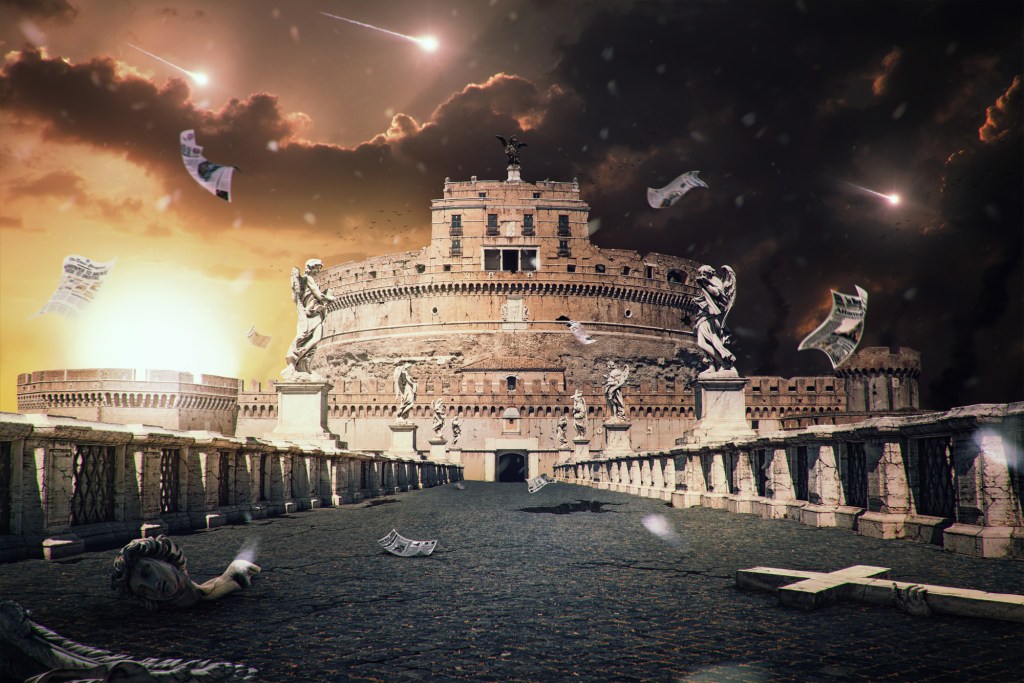
Apocaliptical scene to the Rome cityscape matte painting

I go back from time to time to the early “church fathers” for perspective. Most recently, I have focused on what we call The Epistle of Mathetes to Diognetus (the “Letter”). Even when translated from the Greek language in which it was written, the words and thoughts ring foreign to our American ears.

As I read this early Letter, I am impressed that Christians in the 21st Century have much to learn from 2nd Century Christians. They lived into the message of Jesus in ways that we seem to have long since forgotten

We don’t know who the author was. The Greek word, “mathetes“, merely means “student”. The person or ruling family to which the letter was written is also uncertain. We only know it was written in the early to mid 2nd Century.

The Church had grown slowly but steadily into the 2nd Century. Persecution ebbed and flowed around those early Christians, but they were more generally ignored and almost universally despised. In many ways, Christians were a complete oddity. They didn’t fit into the pagan (Greco/Roman) culture or the Jewish culture.

Christianity was centered in Jerusalem until the Roman war against the Jews and the destruction of the Temple in 70 AD. Christians scattered at that point, though Jerusalem remained one of many hubs of Christian life. The 2nd Century was a time of decentralization and spreading out throughout the Roman Empire and beyond – into areas of Africa and Asia, some of which were controlled by the Roman Empire, and some not.

According to the Letter, Christians were not physically, culturally, or linguistically distinguishable from the people in the many places in which they lived. They were distinguishable in other ways:

“But, inhabiting Greek as well as barbarian cities, according as the lot of each of them has determined, and following the customs of the natives in respect to clothing, food, and the rest of their ordinary conduct, they display to us their wonderful and confessedly striking method of life. They dwell in their own countries, but simply as sojourners. As citizens, they share in all things with others, and yet endure all things as if foreigners. Every foreign land is to them as their native country, and every land of their birth as a land of strangers.”

The Epistle of Mathetes to Diognetus
chapter 5

The most distinguishing feature of those Christians, according to the author of the Letter, was their “striking method of life”: they lived as strangers in their own countries. Though they were citizens in those countries, they “endure all things as if foreigners”.

We might be tempted to think that the “uprootedness” of early Christians was merely a product of rejection and persecution by non-Christians, but the Apostle Peter suggests otherwise: Christians are a “royal priesthood” and a “holy nation” who live as “foreigners and exiles” in this world. (1 Peter 2:9,11) This echoes the writer of Hebrews, who described all great people of faith as “foreigners and strangers on earth”. (Hebrews 11:13)

These passages in the New Testament epistles highlight a fundamental trait of Christians in the world at that time. But not just at that time; Jesus spoke to all his followers (including us) when he said, “[Y]ou are not of the world” (John 15:19), and, “My kingdom is not of this world.” (John 18:36)

How strange are these words and concepts to modern Americans! From the earliest days of our youth, we are taught about our freedoms and rights as American citizens. In contrast, 1st and 2nd Century Christians enjoyed some rights as citizens of the various countries in which they lived (maybe not as robust as the rights we enjoy), but they lived as if they had none. And, this was their “distinguishing “striking” feature as a people! It is what made them stand out.

They marry, as do all [others]; they beget children; but they do not destroy their offspring. They have a common table, but not a common bed. They are in the flesh, but they do not live after the flesh. 2 Corinthians 10:3 They pass their days on earth, but they are citizens of heaven.

the Epistle of Mathetes to Diognetus
chapter 5

Second Century Christians lived as if they were really not of this world. And, this “feature “striking method” of living was noticeable. They adapted and fit into their surroundings and culture wherever they lived, except for this one thing: they lived like they were not citizens of the countries in which they lived – even if they were actually citizens.

They were outsiders wherever they lived because they lived like citizens of heaven. They fit in wherever they went, but they stood out by their allegiance to loving God and loving others. How strange and foreign that may seem to us!

Continue reading “What Is the Place of Christians in the World?”

Focus on Love to Remain on the Narrow Path

The narrow road is where the innocent and the wise travel in the maturity of love.


When the church reaches “unity in the faith and in the knowledge of the Son of God and become mature, attaining to the whole measure of the fullness of Christ…. [t[hen we will no longer be infants, tossed back and forth by the waves, and blown here and there….” Ephesians 4:13-14

This a verse that ended a sermon in a series on the love chapter – 1 Corinthians 13, given by Jeff Frazier at Chapelstreet Church, The Greatest of These, May 24, 2020.

The sermon began with the observation that 1 Corinthians 13 is not really the “ode to love” that we often think it is. The First Century Corinthians probably didn’t embroider 1 Corinthians 13 and hang it on their walls. Paul was chiding them for all the things they were not doing and doing wrong.

The Corinthians were a worldly, wealthy, educated and diverse people. If Corinth had magazines, they would have been candidate for the list of 10 best towns in which to live in the First Century Roman Empire. They were sophisticated in all the ways of the world.

But they fell short when it came to love.

Love, of course, is the greatest attribute of a Christian. That’s the point of 1 Corinthians 13. (1 Cor. 13:13) Though the Corinthians were rich in many things like eloquent speaking, even prophecies and faith, Paul says even those things mean nothing without love. (1 Cor. 13:1-2) A person could even give all his wealth away and offer his body to hardship, but without love, nothing is gained, says Paul. (1 Cor. 13:3)

The Corinthians thought they were pretty hot stuff. They had much in this world and much in the way of talents and resources, and because of that they were boastful and proud.

The beautiful list of what is love is a list of what the Corinthians lacked.

We could read it this way: the Corinthians are not patient or kind. They are envious, boastful and proud. They dishonor others and are self-seeking, easily angered and keep records of all the wrongs done to them. They delight in evil and do not rejoice in truth. They aren’t protective, trusting or hopeful, and they don’t persevere. (1 Corinthians 13:4-7)

The Corinthians were full of jealousy and pride about their own spirituality, and they didn’t appreciate each other. (1 Cor. 12:16 -22) They were puffed up with their own knowledge. (1 Cor. 8:1) They were given to argument, strife and disunity over which leaders to follow. (1 Cor. 1:10-12) At the same time, they tolerated sexual sin, greed, idolatry cheating, slander and drunkenness in their members. (1 Cor. 5:1-5, 9-11)

The Corinthian church was rich in the way of worldly wealth and talents. They were even full of the gifts of the Holy Spirit, but they were poor in the fruit of the Holy Spirit (love, joy, peace, forbearance, kindness, goodness, faithfulness, gentleness and self-control (Gal. 5:22-23)).

Paul goes on to say that love is the greatest fruit of the Holy Spirit. Love is the ultimate goal of the Christian, because God is love (1 John 1:9), and He desires us to be transformed into His image. (Rom 8:29) We don’t need wealth, resources, talents, knowledge or even the gifts of the Holy Spirit if we have love.

Love, including all the fruits of the Holy Spirit, is the sign of mature Christianity.

Jeff Frazier said that Paul could have written the love chapter to much of the American church, and I think he is right.

Continue reading “Focus on Love to Remain on the Narrow Path”

Are Christians Hypocrites?

Calling Christians hypocrites is like shooting fish in a barrel. It’s that easy. You literally can’t miss.


The charge that Christians are hypocrites is a common one. Many people cite the hypocrisy of Christians as a reason they don’t go to church or consider themselves Christian. According to Webster, a hypocrite is “a person who puts on a false appearance of virtue or religion” or “a person who acts in contradiction to his or her stated beliefs or feelings”. As a Christian, I take this charge seriously, and so I feel compelled to address it.

In this world of fake news, we seem to be on hyper alert to what is fake. If Christians claim to be virtuous or religious, but they act like everyone else, most people would consider them “fake”. If Christians have ascribed to certain standards of morality and conduct, but don’t live up to those standards themselves, most people would call them hypocrites.

As I survey the Christians that I know and have known in my life, I find myself having to concede that Christians are guilty as charged. In fact, I need look no further than myself to come to that conclusion. I fail in my life on a regular basis to live up to the standards I believe in, though I recoil at the thought of putting up a false front about it.

Still, the answer is clear and obvious: Christians are hypocrites.

We are religious. It isn’t a pretense, for most of us. We try to be virtuous. That usually isn’t a pretense either, but we fail to live up to the standards we hold out. There can be no doubt of that.

Calling Christians hypocrites is like shooting fish in a barrel. It’s that easy. You literally can’t miss.

But, that isn’t the end of the story. Not by a long shot. It’s only the beginning.

Continue reading “Are Christians Hypocrites?”